
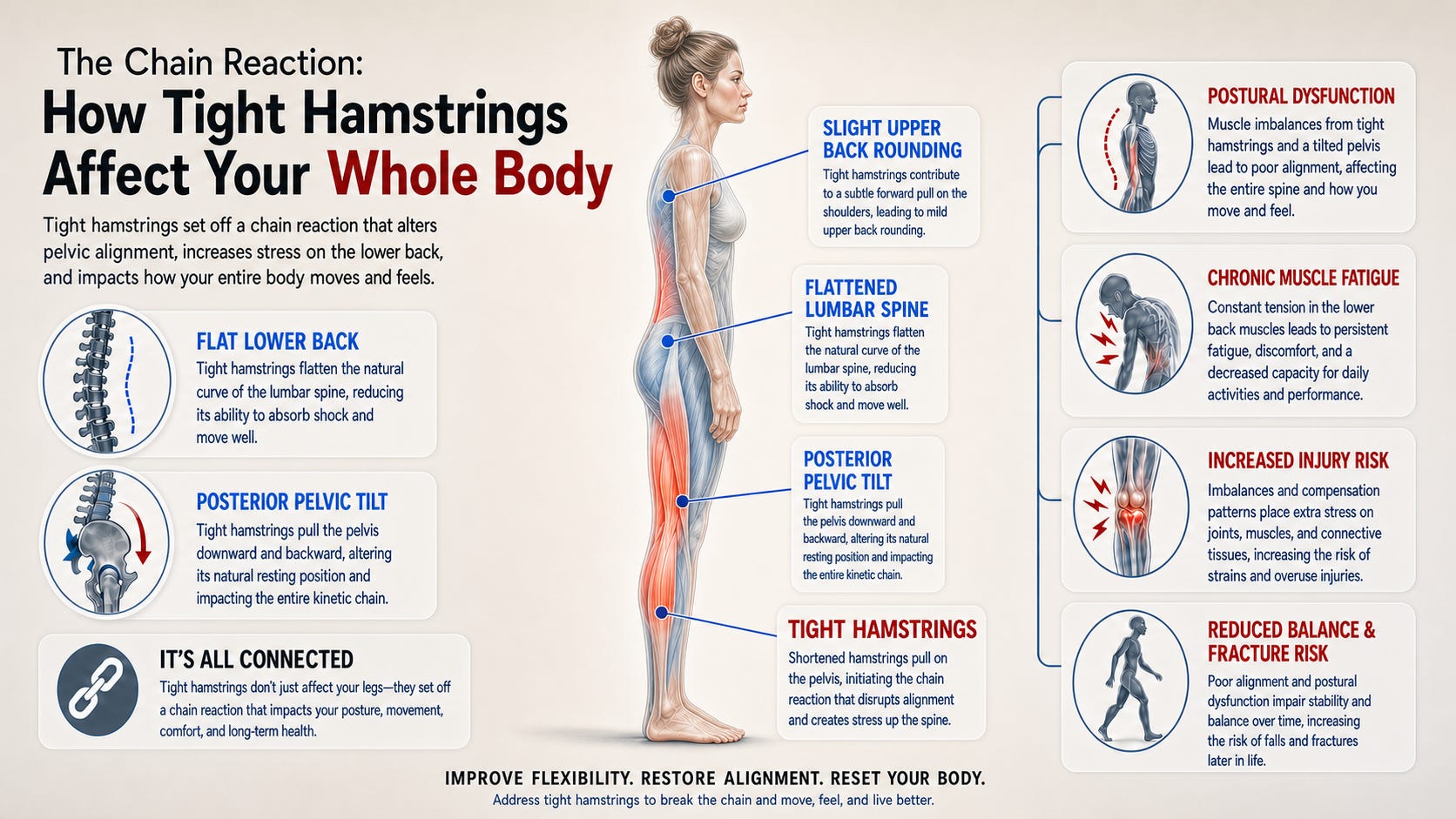
If you’ve ever struggled to touch your toes, you’re not alone. Hamstring tightness is incredibly common, affecting both athletes and people who sit for long hours with reduced physical activity.
You may simply consider tight hammies an inconvenience that holds you back from reaching our toes when you bend forward.
But in effect, tight hamstrings do a lot more than limit a forward fold — they create a long list of potential biomechanical issues that can quietly reshape your posture, contribute to chronic back pain, and even play a role in your long-term fracture risk.
The good news: this is one of the more approachable pieces of fracture prevention puzzle. Once you understand the chain reaction, you have a clear, gentle place to start.
Tight hamstrings often begin early in life, and the reasons behind it are more varied than most of us realize.
For boys especially, adolescent growth spurts are a common starting point: during rapid growth, the long bones of the thigh and lower leg lengthen faster than the surrounding muscles and tendons can keep pace, stretching the hamstrings tighter and increasing their resting tension.
For adults, simple daily inactivity plays a major role — extended sitting and a sedentary lifestyle both shorten and weaken the very muscles that support the low back and pelvis, including the hamstrings.
Then there’s the natural process of aging itself — resting muscle stiffness measurably increases with age, independent of activity level, as connective tissue within the muscle changes over time.
To understand why this single tight muscle group can ripple outward into posture, back pain, and even bone-health risk, it helps to understand the concept at the root of all of it: the kinetic chain.
First described by orthopedic surgeon Arthur Steindler, the kinetic chain is a biomechanical concept that charts how movement or restriction in one joint cascades into the joints around it.
Hamstrings are part of what is referred to as the lower kinetic chain, which consists of the muscles in the lower part of your body.
It includes the muscles that run from the toes and feet through the ankles, knees, hips, and pelvis, with each segment designed to move in coordination with the others.
Crucially, because the hamstrings cross both the hip and knee joints, they function as a critical link in this chain, connecting the pelvis directly to the lower leg.
The hamstrings attach to the sitz bones of the pelvis, so when they get tight, the effect does not stay isolated to the back of the thigh. Tight hamstrings tends to pull the pelvis into a posterior tilt, which in turn affects the normal curvature of the lumbar spine.
The result? A flat lower back with limited lumbar mobility.
This is precisely the model researchers use to explain why hamstring tightness so often shows up as low back pain.
Dysfunction in one segment, such as the hamstrings, leads to compensatory changes elsewhere, including anterior pelvic tilt, excessive lumbar strain, and disrupted lumbar-pelvic rhythm.
The kinetic chain concept reframes the whole topic in an empowering way: a tight hamstring is not a problem to fix in isolation, but a signal about how your entire lower body is working, or struggling to work, together.
It also explains why gentle, consistent movement that respects the whole chain, rather than aggressive isolated stretching, tends to produce more lasting results.
This postural cascade is a well-documented, and often overlooked, contributor to chronic low back pain.
A review of prospective cohort studies covering more than 5,400 participants found that restricted hamstring range of motion was significantly associated with the future development of low back pain, alongside limited lumbar lordosis and reduced lateral spinal flexibility. Separate clinical research has identified a direct correlation between the degree of hamstring tightness and the severity of existing low back pain.
The mechanism has been studied closely: tight hamstrings, particularly when paired with weaker core muscles, restrict the pelvis’s ability to move freely, altering the coordinated motion between the lumbar spine and pelvis known as lumbar-pelvic rhythm.
This can compromise the spine’s normal curve and increase strain on the lumbar discs and joints with every bend, sit, and step.
Encouragingly, this is not cast in stone. Regular hamstring stretching has been shown to measurably increase pelvic tilt and improve mobility during walking, standing, and forward-bending tasks, supporting its use as part of a broader approach to easing low back strain.
This matters for more than day-to-day comfort. Persistent low back pain in older adults is associated with a meaningfully higher likelihood of falling — a major risk factor for fractures as we get older. One large study found older adults with persistent low back pain were roughly 34 to 77 percent more likely to experience a fall than those without back pain.
A separate large cohort study of older women found that even mild back pain was linked to increased fall risk, with the risk climbing further for frequent or activity-limiting pain.
Since falls are the leading trigger for fractures in people with fragile bones, a body that’s guarding against back pain, and therefore less confident and less mobile, is also a body facing higher everyday fall exposure.
When tight hamstrings pull the pelvis into a backward tilt, it doesn’t necessarily just affect the low back. It frequently sets off a cascade of compensations traveling up the spine.
As the lower back flattens with the loss of the normal curve in the lumbar spine, the upper back and head compensate by rounding and jutting forward in sort of a banana-shaped posture.
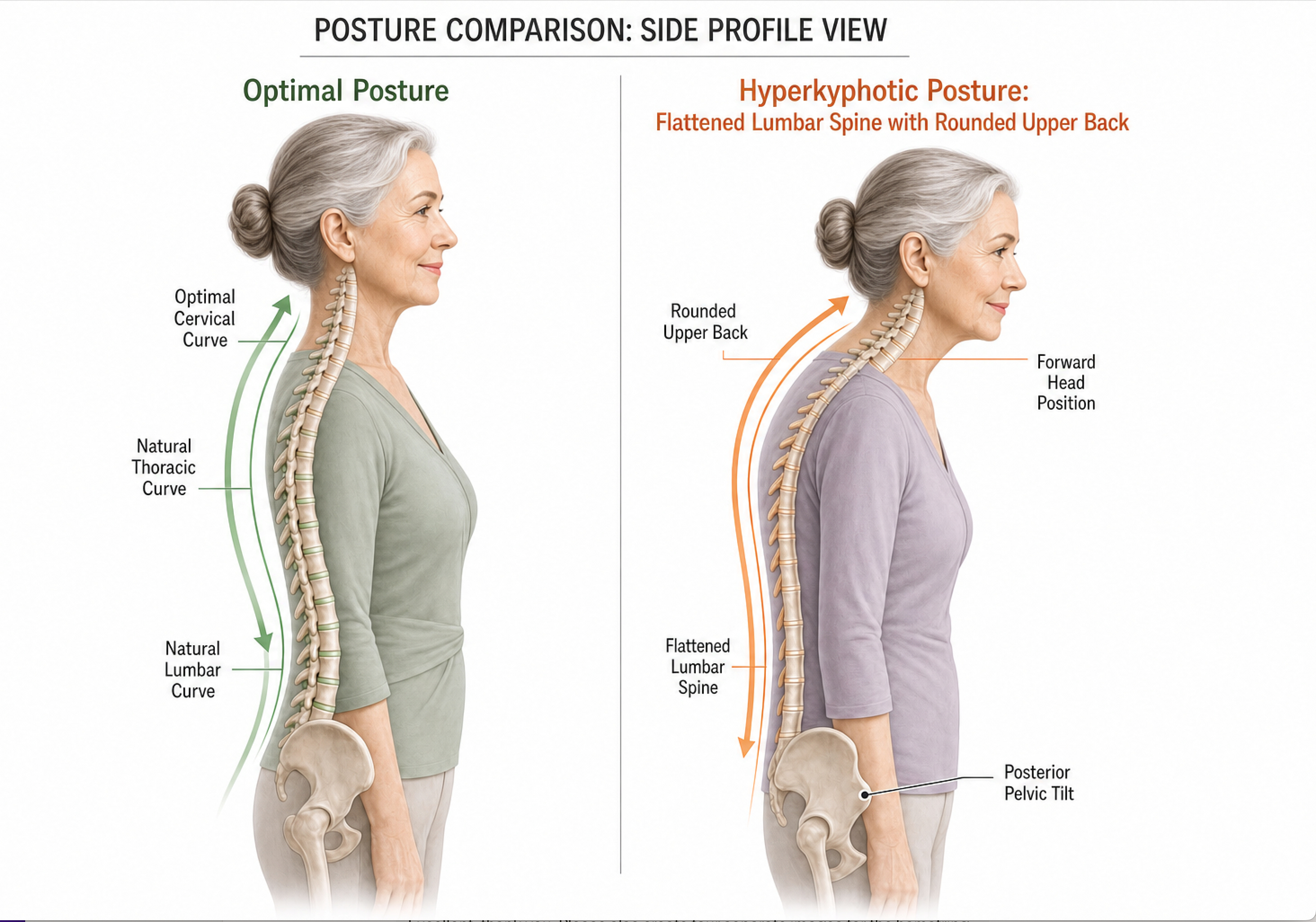
This postural cascade from tight hamstrings often shows up over time as hyperkyphosis — an excessive rounding of the upper back beyond the spine’s normal, healthy curve. This is where the bone-health/fracture risk connection becomes most direct.
Research has found that older women with hyperkyphosis face a 70 percent increased risk of future fracture, independent of age or prior fracture history.
Separate biomechanical research suggests that greater thoracic kyphosis may increase the mechanical load placed on the vertebral bodies during ordinary daily activities, which can raise the risk of new vertebral fractures. Hyperkyphosis has also been linked to an elevated risk of fractures beyond the spine itself, independent of traditional fracture risk factors.
The balance piece matters too. A systematic review of 19 studies found that hyperkyphosis significantly impairs both static and dynamic balance in older adults, with fall rates among those with hyperkyphosis ranging from 24 to 64 percent across studies.
Other prospective research found that older adults with increased thoracic kyphosis were more than twice as likely to experience a future fall within the following year. Put simply: rounded posture doesn’t just look different — it changes how the body balances and how forces move through the spine, both of which matter directly for fracture prevention.
None of this means tight hamstrings alone cause hyperkyphosis or fractures — posture and bone health are influenced by many overlapping factors.
But hamstring flexibility is one of the few pieces in this chain that’s genuinely within your control, which is exactly why it deserves more attention than it usually gets.
Curious where you stand? Beyond the paywall we take a look at a simple, at-home way to check your own hamstring flexibility as well as a soothing, gentle yoga practice for tight hamstrings.
Thanks for reading Age Strong for Life! This post is public so feel free to share it.
Comments
Nothing yet. Say the first thing.
Sign in to join the conversation.