
Yesterday, we named the enemy: internalized ageism. We looked at the way negative cultural messages about aging get inside our heads and quietly begin shaping what we believe is possible. Today, we take the next step. We begin reclaiming our value.
One of the most damaging effects of internalized ageism is that it causes experienced adults to question whether they still matter. People who have spent decades working, raising families, solving problems, surviving hardship, building communities, and carrying responsibility begin to wonder whether their most useful years are behind them. That is not only painful. It is profoundly wrong.
Thanks for reading! Subscribe for free to receive new posts and support my work.
The problem is that our culture often measures value by speed, productivity, novelty, and visibility. Younger people are celebrated for their energy, potential, and ability to adapt. Those qualities matter, but they are not the only qualities that matter. Energy is not the same as wisdom. Information is not the same as understanding. Speed is not the same as direction. Enthusiasm is not the same as discernment. A younger person may move faster, but an experienced person often knows where to go, what to avoid, and which problems are not worth solving in the first place.
I learned this growing up on a farm. As a teenager, I would work beside farmers in their seventies. I was young, strong, and determined to prove myself. I moved fast, worked hard, and sweated through my shirt. Then I would look over at one of those older farmers. He did not seem to be moving very quickly, but somehow he was getting three times as much done as I was.
At the time, it made no sense to me. Years later, I understood. He had performed the task so many times that he no longer wasted movement. Every step had a purpose. Every action was productive. He had learned what mattered and what did not. That is what experience does. It teaches us where to place our energy. It teaches us how to recognize patterns, anticipate problems, read people, and make decisions with a perspective that only comes from having lived through the consequences of earlier choices.
That farmer may not have moved as quickly as I did, but he knew how to work. That is the value of age.
In Age Out Loud, I describe wisdom and perspective as two of the great blessings of a long life. We have seen children grow, relationships change, businesses rise and fall, plans succeed, dreams fail, and unexpected doors open. We have watched circumstances that once felt catastrophic eventually become turning points. Life has taught us that panic is rarely productive and that difficulty does not always mean defeat.
That knowledge cannot be downloaded or purchased. It has to be lived. Yet many people undervalue it because it feels ordinary to them. The things you know may not feel remarkable because you learned them slowly, one experience at a time. You may assume everyone understands what you understand. They do not.
You may know how to remain calm in a crisis because you have survived one before. You may know how to repair a relationship because you once nearly lost one. You may know how to stretch a dollar, lead a team, raise a child, care for a parent, rebuild after failure, recognize a dishonest person, finish what you started, or keep faith when circumstances tell you to quit. Those lessons have value. The fact that they come naturally to you does not make them ordinary. It means they have become part of who you are.
This is where many people in the second half of life get stuck. They compare themselves to who they used to be. They measure today’s energy against yesterday’s energy. They focus on what takes longer, what feels harder, or what they cannot do in exactly the same way anymore. But that is the wrong measurement.
The better question is not, “Can I still do everything I did at 35?” The better question is, “What can I do now that I could not have done at 35 because I did not yet possess the experience, patience, perspective, and wisdom I have today?”
That question changes the entire conversation. At 35, you may have had more energy, but perhaps you lacked the confidence to trust yourself. At 45, you may have had ambition, but perhaps you still believed every opportunity had to be chased. At 55, you may have understood success, but not yet understood what success cost. Now, you may finally know what matters.
You may have enough perspective to stop proving yourself and start serving others. You may have enough clarity to recognize that your life is not about impressing people. It is about impacting them. That is the transformation Age Out Loud is calling people into. We are not trying to turn older adults into younger versions of themselves. We are helping them recognize the strength of who they have become.
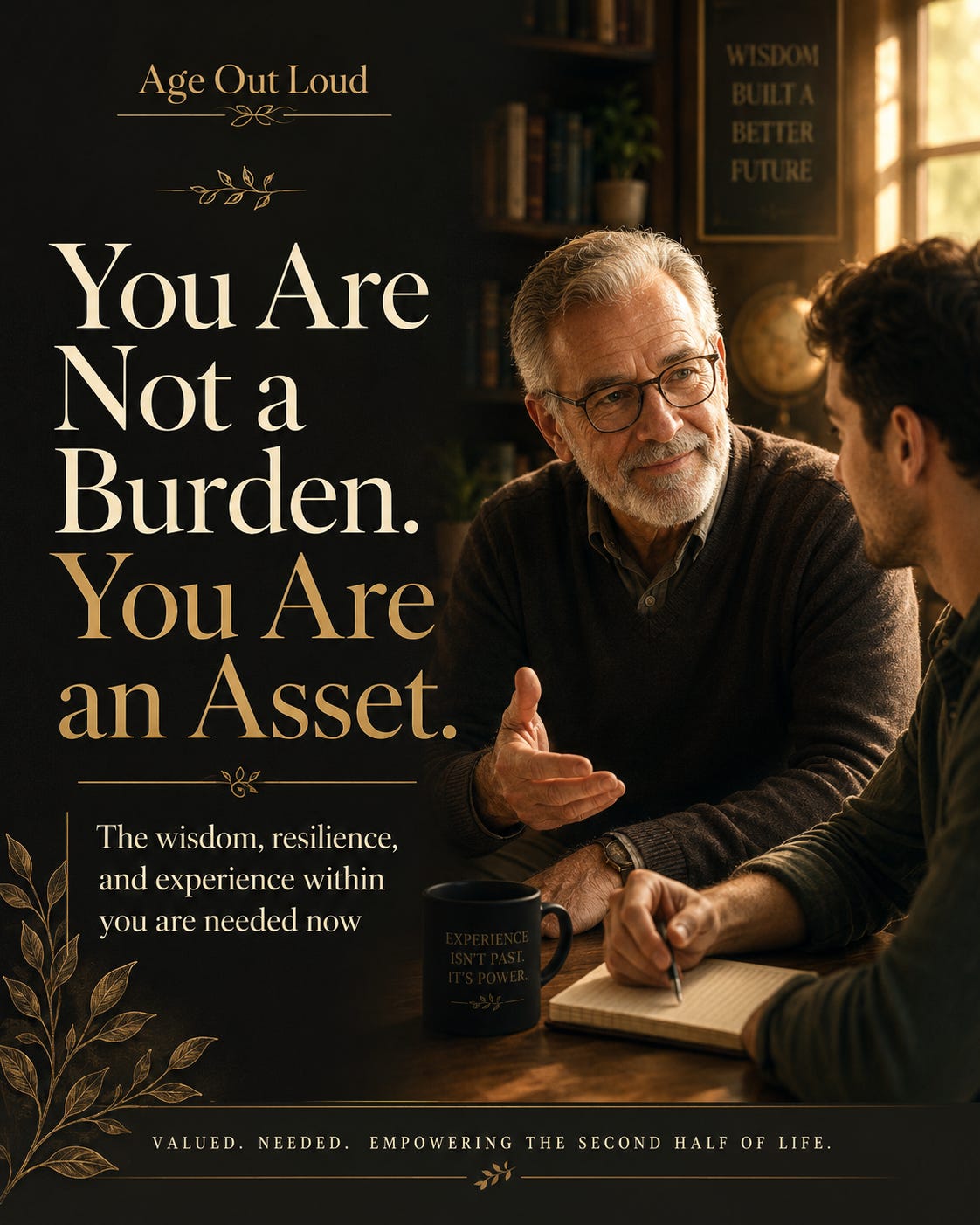
Older adults are not burdens to be managed. They are assets to be activated.
When a person begins believing they are a burden, they withdraw. They stop offering advice because they do not want to interfere. They stop asking to participate because they assume no one wants them there. They stop sharing their stories because they think nobody is interested. Over time, they become less visible, not because they have less to offer, but because they have stopped offering it.
That is one of the great tragedies of our culture. When experienced adults retreat, society loses more than labor. We lose judgment, history, craftsmanship, patience, stability, mentorship, perspective, and memory.
In construction, I see this clearly. Many of the most skilled craftsmen are in their sixties. They know how to solve problems that are not written in any manual. They can walk into a room, look at a wall, and understand what is happening behind it. They know which shortcuts will fail, which materials will last, and how to adapt when the plan on paper collides with reality. That knowledge took decades to build. If it is not passed on, it disappears.
The same is true in families, businesses, churches, communities, and every other part of society. When older adults are pushed aside or convince themselves they no longer matter, younger generations are forced to learn everything the hard way. That is unnecessary. Wisdom is meant to move. Experience is meant to be shared. Resilience is meant to become a bridge for someone who has not yet crossed the river you survived.
Your life has given you something to contribute. You may not have a public platform. You may never write a book, teach a class, lead an organization, or speak on a stage. That does not diminish your value because contribution is not measured only by size.
Sometimes contribution looks like mentoring one younger person. Sometimes it looks like calling someone who is lonely. Sometimes it looks like teaching a grandchild how to build, cook, pray, garden, listen, work, or keep their word. Sometimes it looks like serving in a community organization, helping a neighbor, passing down a family story, or simply being the calm presence in a room full of chaos.
You do not need to change the whole world. You need to recognize the part of the world you are uniquely equipped to change.
I believe each of us has an assignment. No one else has your exact combination of experiences, relationships, gifts, mistakes, scars, knowledge, and perspective. There are people you can reach because of what you have lived through. There are conversations you can have because you understand the pain behind the words. There are doors that may open for you because someone trusts the steadiness they see in your life.
You are not waiting to become valuable. You already are. The work now is to identify that value and put it back into motion.
So, here are the questions I want you to consider today: What do people consistently come to you for? What have you learned that could shorten someone else’s journey? What challenge have you survived that now gives you the ability to walk beside someone facing it for the first time?
Do not answer modestly. Answer honestly.
Your experience is not an ending. It is a foundation. Your scars are not proof that life defeated you. They are evidence that you endured. Your age is not a liability. It is an accumulation of lessons, perspective, resilience, and wisdom.
Tomorrow, we will look at the next part of the journey: renewing the vitality and sense of purpose required to put that value into motion. Your value was never the problem. The problem was that you stopped seeing it.
You are still needed. You are still capable of contribution. You are still becoming. And God is not done with you.
Thanks for reading! Subscribe for free to receive new posts and support my work.
Comments
Nothing yet. Say the first thing.
Sign in to join the conversation.