
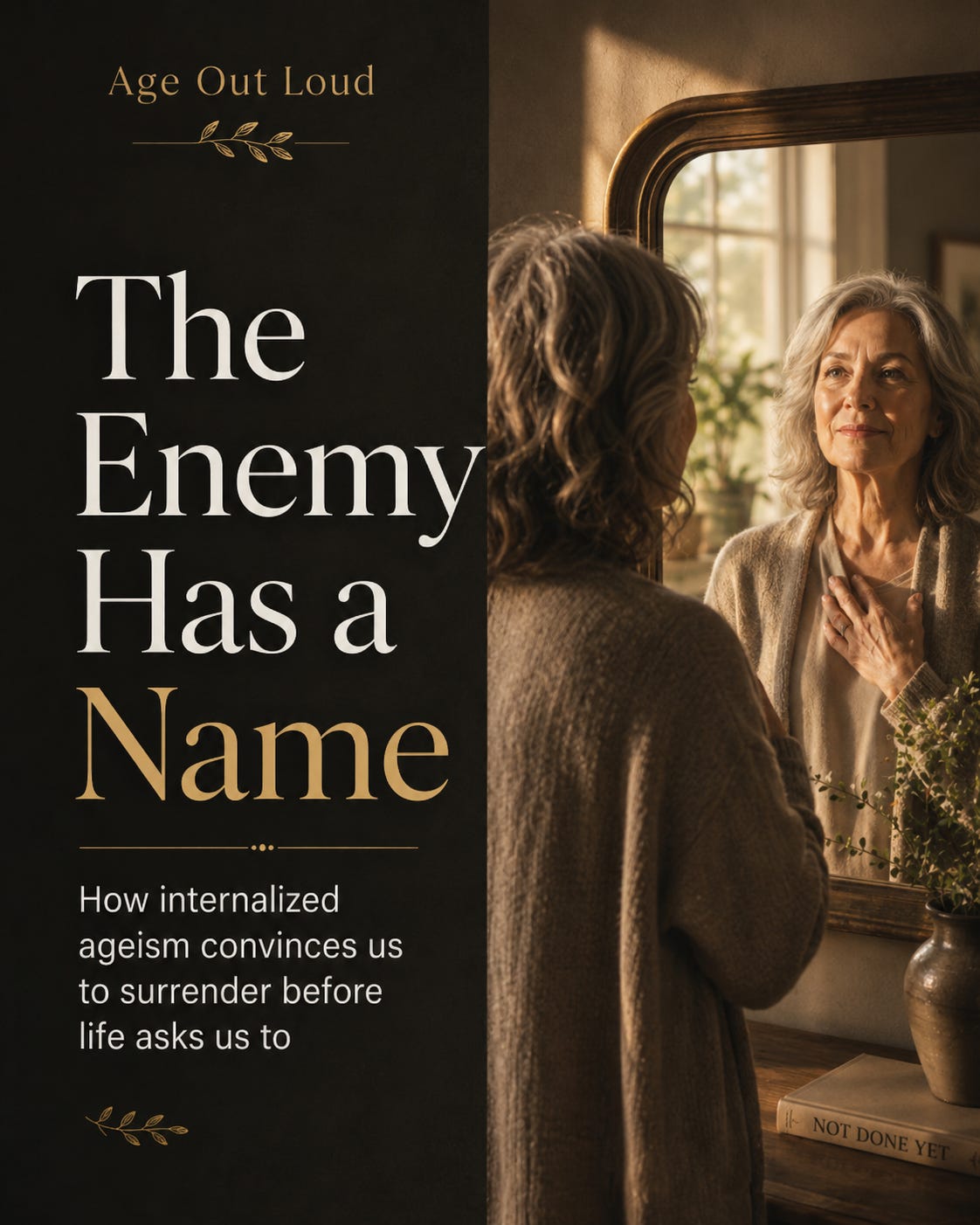
Yesterday, I wrote about the quiet moment when we stop expecting more from life. We rarely make a conscious decision that our best days are behind us. It happens gradually. Possibility gets replaced by practicality. Dreams get pushed aside. We become a little more cautious, a little less curious, and eventually we may find ourselves living more from our memories than from our expectations.
But what causes that resignation? Why do intelligent, accomplished, experienced people begin lowering their expectations for what is still possible?
I believe one of the biggest reasons has a name: internalized ageism.
Ageism is fairly easy to recognize when someone else is doing it. We see it in jokes about older people being out of touch, assumptions that someone cannot learn technology because of their age, or the idea that people eventually reach a point where they should politely step aside and let younger people take over. Our culture constantly reinforces the idea that youth equals possibility while age equals decline.
But the most damaging form of ageism is not what someone else thinks about us. It is what we eventually start believing about ourselves.
That is internalized ageism.
After hearing the cultural message long enough, we begin repeating it in our own heads. “I’m probably too old to start something new.” “People my age don’t do things like that.” “I need to be realistic.” “Nobody really needs what I know anymore.” “My opportunity has passed.”
The dangerous thing about these statements is that they sound reasonable. They rarely sound like surrender. They sound like wisdom. But there is a huge difference between wisdom and resignation.
In Age Out Loud, I describe a cultural script built around several deeply rooted assumptions: aging equals decline, youth equals value, and old means invisible, outdated, or burdensome. We hear these messages so consistently that we can begin accepting them without ever stopping to ask whether they are actually true.
Once we accept those beliefs, they begin shaping our behavior. If I believe I am too old to learn something new, eventually I stop trying to learn. If I expect physical decline to be inevitable, I have less reason to strengthen my body. If I assume nobody needs my experience, I stop sharing it. If I believe adventure belongs to younger people, I stop looking for adventure. And if I become convinced that my best days are behind me, I slowly begin organizing my life around protecting what remains instead of pursuing what could still become.
That is how a belief can become a self-fulfilling prophecy. Not because the original assumption was necessarily true, but because we started living as though it were.
This is why I talk so much about expectation. Expectation may be one of the most powerful forces shaping how we experience the second half of life. We rarely work consistently toward an outcome we fundamentally believe is impossible. Desire says, “I would love to do that.” Expectation says, “I believe that is possible for me.” When desire and expectation disagree, expectation usually wins.
None of this means denying reality. Aging is real. Bodies change. Circumstances change. Health challenges happen. People we love die. Sometimes life changes in ways we never would have chosen. Age Out Loud is not about pretending those realities do not exist. It is about refusing to turn reality into resignation.
There is an enormous difference between acknowledging a limitation and allowing that limitation to define your identity.
Maybe you cannot do something exactly the way you did it at 35. So what? Perhaps you need a different strategy at 65, 75, or 85. Maybe you need more preparation. Maybe you need help. Maybe you have to modify the goal. But different does not mean finished.
I began understanding this years ago through my remodeling business. I would sit across from people who clearly needed modifications that could make their homes safer, easier, and more comfortable, yet I repeatedly heard the same response: “I’m not ready for that yet.”
That fascinated me. What exactly were they not ready for?
Eventually I realized that most of them were not really resisting the grab bar, curbless shower, wider doorway, or zero-step entrance. They were resisting what those things represented in their minds. Getting old. Needing help. Becoming less capable. Becoming the person they had spent years hoping they would never become.
The physical modification was not the real obstacle. The meaning they had attached to aging was the obstacle. That realization became one of the foundations of Age Out Loud.
Internalized ageism can become an invisible prison. You cannot see the bars, but you can recognize them every time you talk yourself out of something primarily because of your age. The tragedy is that the door may already be unlocked. We simply stopped trying the handle.
I have encountered too many people who shattered those assumptions for me to accept them as truth. People start businesses, write books, learn languages, paint, travel, hike mountains, serve communities, form new relationships, discover new callings, and completely reimagine their lives in their 60s, 70s, 80s, 90s, and beyond.
They did not stop aging. They stopped allowing their age to decide what was possible.
That distinction changes everything.
What if your age were not evidence against your future? What if it were evidence for it? Think about everything you have accumulated through the years: successes, mistakes, heartbreaks, relationships, disappointments, recoveries, hard-earned lessons, skills, discernment, faith, resilience, and perspective. What if all of that has been preparing you rather than diminishing you?
What if you are not becoming less valuable? What if you are becoming more equipped?
That is the shift we are making with Age Out Loud. We are moving from resignation to expectation. From fading to becoming. From assuming our usefulness is diminishing to recognizing that decades of living have given us resources we simply did not possess when we were younger.
Older adults are not burdens to be managed. They are assets to be activated. That conviction is at the heart of everything I am building through Age Out Loud.
So I want you to think about one question today: What is one thing you have stopped considering because you believe you are too old?
Maybe it is travel. Maybe it is getting stronger. Maybe it is starting a business, changing careers, learning Spanish, writing something, pursuing a relationship, serving in a completely new way, or finally attempting something that has been whispering to you for years.
Whatever came to mind, don’t dismiss it. Write it down. Then ask yourself an even more important question: Is my age actually preventing this, or have I accepted a story that says it should?
That question may reveal more than you expect.
Tomorrow, we are going to take the next step. Once we recognize the story that has been holding us back, we can begin reclaiming what it has stolen from us. And one of the first things we need to reclaim is our understanding of our own value.
You are not invisible. You are not past your usefulness. You are not finished contributing.
You are still becoming.
And the future still has a claim on you.
No posts
Comments
Nothing yet. Say the first thing.
Sign in to join the conversation.