
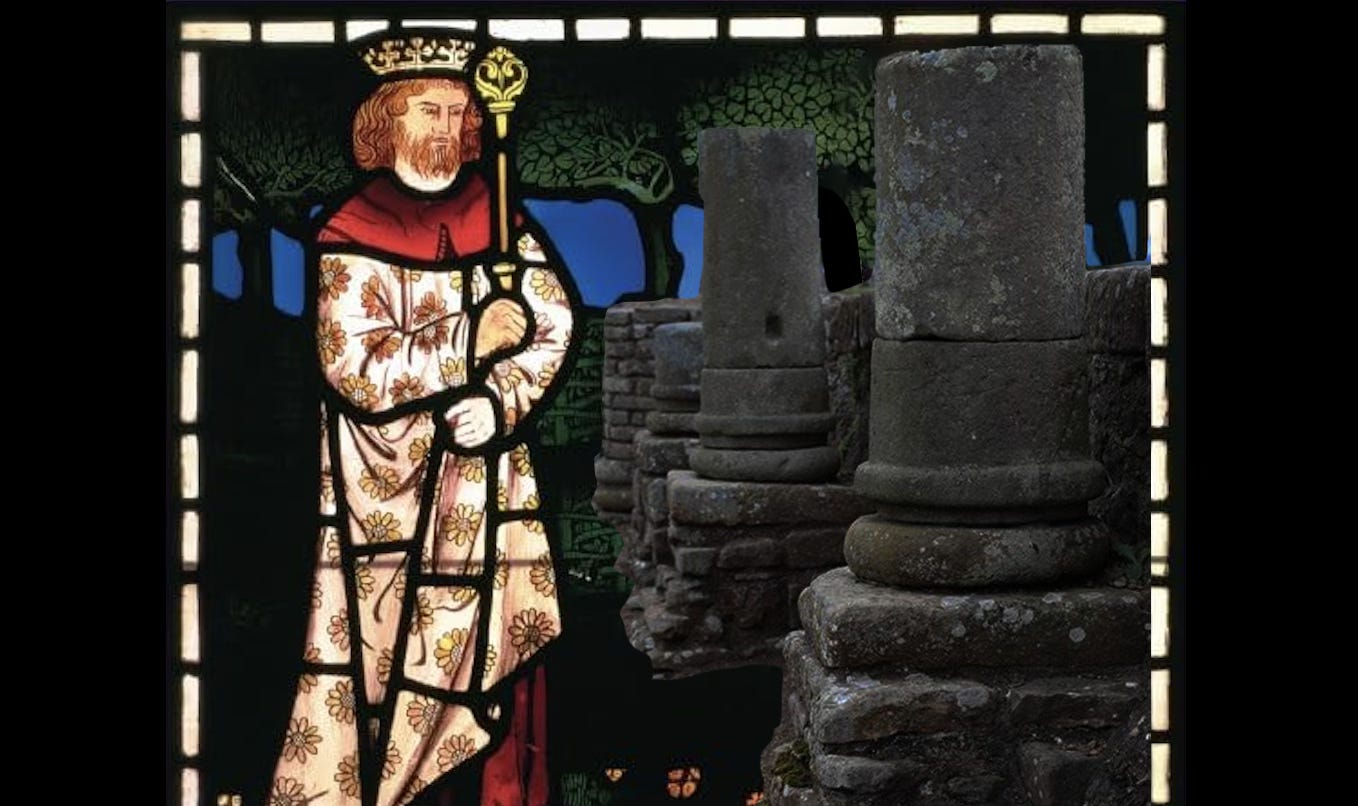
King Arthur has traditionally been thought to be a southwestern British figure, a successful early medieval king associated especially with Wales and the West Country of England. In the Arthurian romances, he held court at Caerleon in Wales or the fabled castle of Camelot. The earliest historical mentions of King Arthur are mostly preserved in Welsh sources and it is not only Welsh nationalists who assume that Arthur must have been a Welshman – or at least someone from near the Welsh borders
But the earliest historical records appear to make Arthur a northern British leader, fighting battles near Hadrian’s Wall and as far north as Scotland. Arthur appears in these sources as if he were a hero of what medieval Welsh accounts call the “Old North” (or Hen Ogledd), a name used for northern Britain in the years before the rise of the Anglo-Saxon kingdom of Northumbria.
So which of the two King Arthurs was real? Was Arthur an originally northern British figure who was later turned into a Welshman? Or is there a better explanation? He was later hailed as a paragon of medieval kingship and treated as if he was really an early king of England. So could Arthur have originally not been truly Welsh, but only subject to a later “Welshification”? Did King Arthur undergo a transformation in early Welsh tradition similar to that which later made him an exemplar of English royal virtue?
Debate over where Arthur came from – which part of Britain “owns” King Arthur – has been raging for centuries. He seems to be linked in the earliest sources with places in both the north and south of Britain. So where did he originally come from?
Arthur is recorded in the Welsh annals dying in the year 537 at Camlann, a place usually associated now with the Roman Fort of Camboglanna, at Castlesteads, Cumbria, on Hadrian’s Wall. Similarly, Arthur is held in the Historia Brittonum to have fought battles against the Saxons at locations such as a river known as the Glein and the Forest of Celidon. The River Glein has usually been identified with the River Glen in Northumberland and the Forest of Celidon seems to have been located in the Southern Uplands of Scotland. King Arthur may have originally had something to do with the region about what is now the border between Scotland and England.
The names of the battles in the Historia Brittonum have seen several attempts to link King Arthur with Scotland. The twelve battles of Arthur are set out in the Historia Brittonum as if the most important early battle he fought against the Saxons occurred at a site called Fort Guinnion and this place-name has been linked recently with that of Carwinning hillfort in Ayrshire. But like nearby Kilwinning, Carwinning hillfort was named after a British bishop called St Winning who seems to be called Vinniau in earlier sources, not someone called Guinnion. And Ayrshire is too far away from where the Anglo-Saxons are recorded in the early sixth century for Carwinning to have been the location of one of the twelve battles of Arthur.
Similarly, the Historia Brittonum records that Arthur fought four battles on the River Dubglas, and the river on which they were fought has been associated with the Douglas Water in Lanarkshire as if the battles were fought in the region of the later Kingdom of Strathclyde. But the list of Arthur’s battles records that the River Dubglas was in a region called Linnuis, not Strathclyde, and the Anglo-Saxons are not known to have settled anywhere in Scotland early enough for King Arthur to have fought battles against them in Strathclyde.
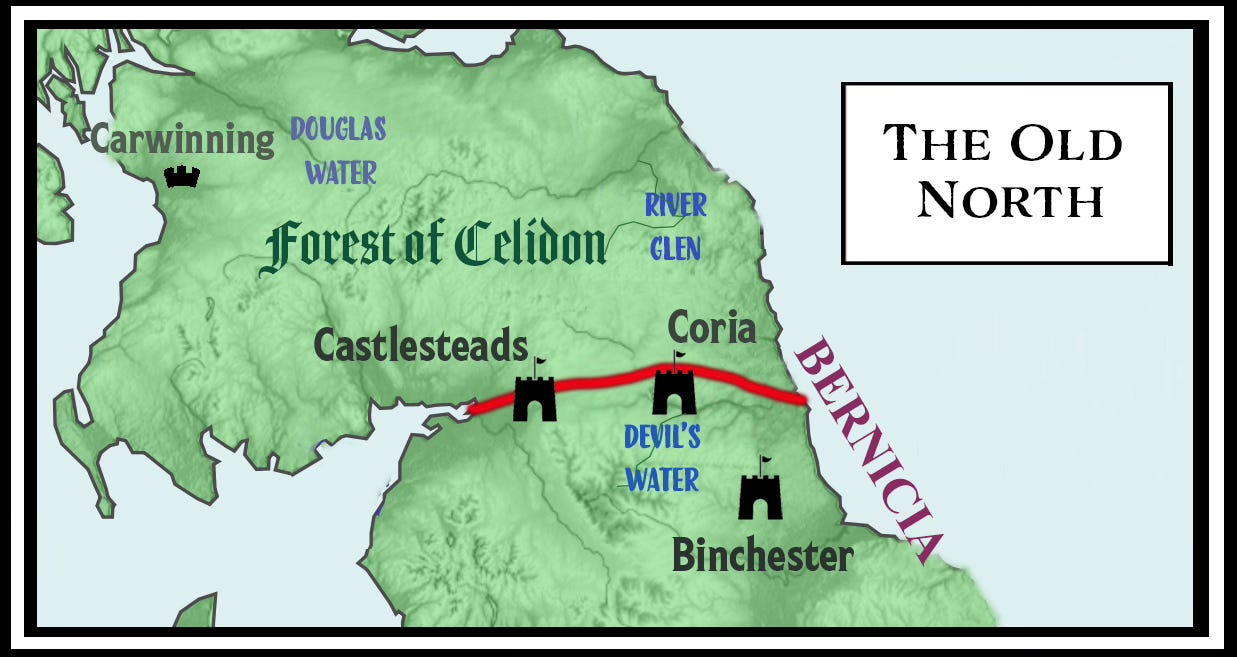
Yet is northern England really any better a location for Arthur’s battles? No one has ever been able to find a suitable location for Fort Guinnion anywhere near Wales or the West Country of England. Instead, Fort Guinnion has long been connected with Binchester Roman Fort in County Durham whose name is recorded in inscriptions as Vinovia and Vinoe. Earlier Vin- regularly becomes Guin- in Welsh and Vin- evidently developed to become Bin- in the English place-name Binchester. The element -chester commonly appears in English place-names and it clearly derives from a loan of castrum, the Latin word for a fort. The ending -ion is also common enough in Welsh place-names where it is the equivalent of the English adjectival suffix -ian. Fort Guinnion seems very likely to have been the old Roman fort that Binchester was named after.
But who would King Arthur have been fighting? Most historians accept that the Anglo-Saxon kingdom that preceded Northumbria was founded in 547 when the monk Bede records that its first king Ida came to power. Ida was the king of Bernicia, the northern part of what was later renamed Northumbria, but 547 seems too late for Ida to have fought battles against King Arthur. Arthur is recorded to have died in 537 in the Welsh annals and the Historia Brittonum clearly places Arthur in the period immediately before the reign of Ida. Accordingly, some historians have claimed that there were no Anglo-Saxons north of the River Tees before 547 for King Arthur to fight against.
There is, however, evidence that Anglo-Saxon settlement in the region about the eastern end of Hadrian’s Wall predated Ida’s founding of the Kingdom of Bernicia. The early British cleric Gildas records that the Anglo-Saxons were invited to Britain to help protect its inhabitants from raids by the Picts and Scots, and a likely location where soldiers hired for the job would have been stationed is on Hadrian’s Wall.
The Historia Brittonum records that Hengist sent his son Octa and nephew Ebissa north to the country about Hadrian’s Wall to defend against the Picts, hyperbolically claiming they were so successful they even raided Orkney. But is there any evidence that Anglo-Saxon soldiers were first sent north to guard Hadrian’s Wall as early as the fifth century?
In 1908, archaeologists excavating the ruins of the Roman town at Corbridge discovered two brooches. They have since been stolen, but it is clear that they were of a cruciform type that is typically associated with Anglo-Saxons. Corbridge is the site of the ancient Roman town of Coria and the archaeologists dated the brooches to the late fifth century.
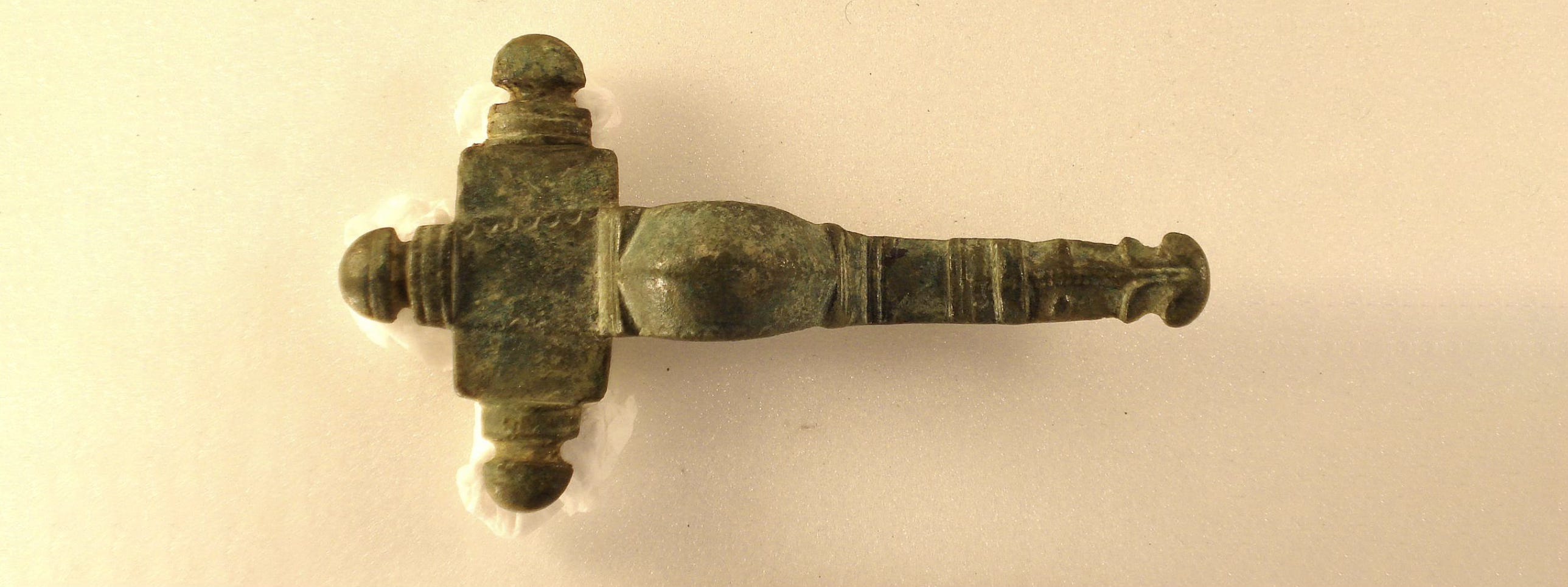
The ruins of the Roman town of Coria can be visited today, just outside Corbridge. Coria was one of the most northerly towns in Roman Britain, and lying just to the south of Hadrian’s Wall it must have been a key supply centre for the soldiers who guarded the fortifications. The town is mentioned in letters that have survived from Vindolanda, dating from the second century, and the discovery of two typically Anglo-Saxon brooches at Coria suggests that there is some truth to the account preserved in the Historia Brittonum.
The illustration of the brooches from Coria that has survived indicates that they are early examples of a type of cruciform brooch dated most recently to c. 475-550. Cruciform brooches are only found in Britain otherwise in areas of Anglo-Saxon settlement, and the pair found at Coria seem to be clear evidence that there was an Anglo-Saxon presence in Northumberland before the formal founding of the Kingdom of Bernicia.
Perhaps more striking than the early date of the brooches is the proximity of Coria to the likely sites of several of Arthur’s battles. The River Dubglas seems likely to have been the Devil’s Water, a river that flows into the River Tyne a few hundred yards from Corbridge. The Devil’s Water is first recorded as the Diveles and its name is generally acknowledged to reflect an earlier Dubglas. There is also a settlement called Linnels on the Devil’s Water whose name seems to be related to Linnuis, the name of the region where the Dubglas lay according to the Historia Brittonum. It is no wonder that so many historians have concluded that Arthur’s battles mainly occurred in the north of England, and that his later connection with Wales is not historically reliable.
Later Welsh sources agree that Arthur had some sort of connection with northern Britain. In the eleventh-century poem Pa Gur yv y Porthaur? (Who is the Gatekeeper?) Arthur recounts that he and his companions had travelled north to Edinburgh to fight cinbin or ‘dogheads’ and that they had fought against Garwlwyd, a figure otherwise known as Gwrgi Garwlwyd ‘Mandog Roughgrey’.
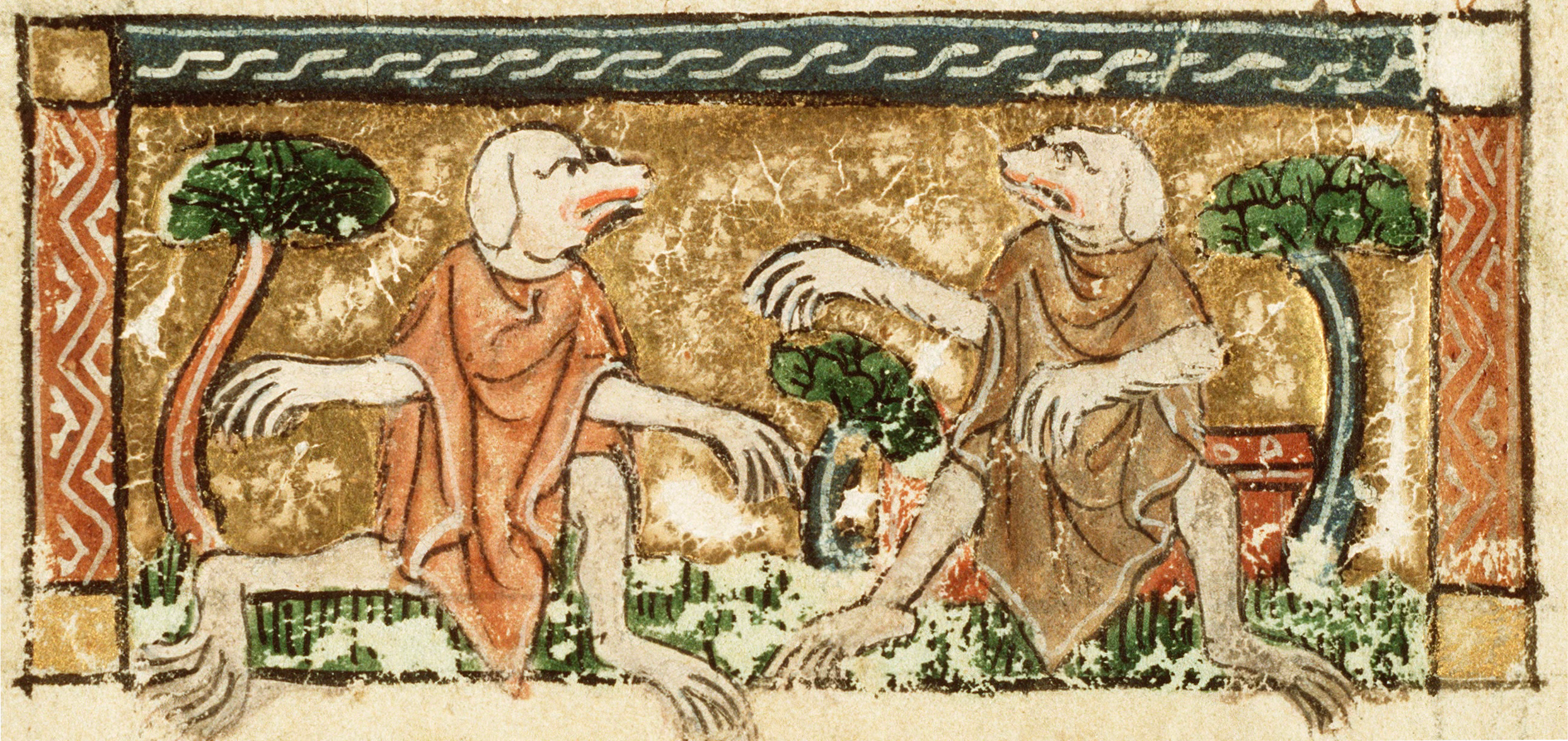
Gwrgi Garwlwyd was an infamous villain who medieval Welsh tradition held “used to slay one of the Britons every day, and two every Saturday so as not to slay one on the Sunday”. The death of Gwrgi Garwlwyd was accorded one of the “three fortunate slayings” in the medieval Welsh Triads, short, threefold summaries of traditional British lore. Two Welsh Triads record that Gwrgi Garwlwyd was slain by Diffeidell son of Dissynyndawd, one of three chieftains of Bernicia and Deira. Gwrgi Garwlwyd seems to have been thought of as an enemy of the Britons who lived in the “Old North”.
Arthur was held to have undertaken adventures in the “Old North” in medieval Welsh tradition and many of the battles he is recorded having fought in the earliest sources seem to have occurred in northern Britain. But does that necessarily make Arthur a northern Briton who was later “Welshified”? Or did he just journey there, as later Welsh tradition maintained?
Arthur is also recorded to have led the Britons to victory at the Battle of Mount Badon. Mentioned both by Gildas and in the Welsh annals, the Battle of Mount Badon is usually assumed to have occurred somewhere in the south of Britain. It is the site of King Arthur’s most famous victory and it has long been thought to have been won against the West Saxons. But where Mount Badon was located is not entirely clear. Archaeological evidence indicates that the early kingdom of the West Saxons was located in the Upper Thames Valley, and Badbury Hill in Oxfordshire seems a likely-enough location for the battle.
So it could be that King Arthur had a connection with Wales or the West Country of England. But just a connection does not seem to be enough for many historians. Attempts to prove that Arthur was not a northern Briton continue to appear, as if the evidence recorded in the earliest sources is somehow not reliable. It could be that King Arthur fought battles in both the north and south of Britain – he could even just have headed north when he was a young man to make his name fighting the English before later returning south. But despite all the denials, the suspicion will continue to persist that Arthur was essentially a northern British figure who was only later “Welshified”. The weight of historical evidence has long been thought to point to Arthur being a northern Briton who was only adopted secondarily by the Welsh as the great British king who defeated the Saxons at the Battle of Mount Badon.
Comments
Nothing yet. Say the first thing.
Sign in to join the conversation.