
It is widely understood that England takes its name from the Angles, one of the three peoples that migrated to Britain after the end of Roman rule. The early English historian Bede called his most famous work a history of the ‘English people’ (gentis Anglorum), and despite the later rise of West Saxon kings to political pre-eminence, the description ‘English’ stuck. The Angles were known in Old English as the Engle and the country became known, accordingly, as England.
The part of Britain especially associated with the Angles is still known as East Anglia. But there has never been a “West Anglia” – the specification “East” arose originally to distinguish the people known as the East Angles from a group called the Middle Angles who were later absorbed into the Kingdom of Mercia. The name of Mercia derives from a meaning ‘borderland’ or ‘march’, and its inhabitants were called Mercians (Mierce) rather than “West Angles”.
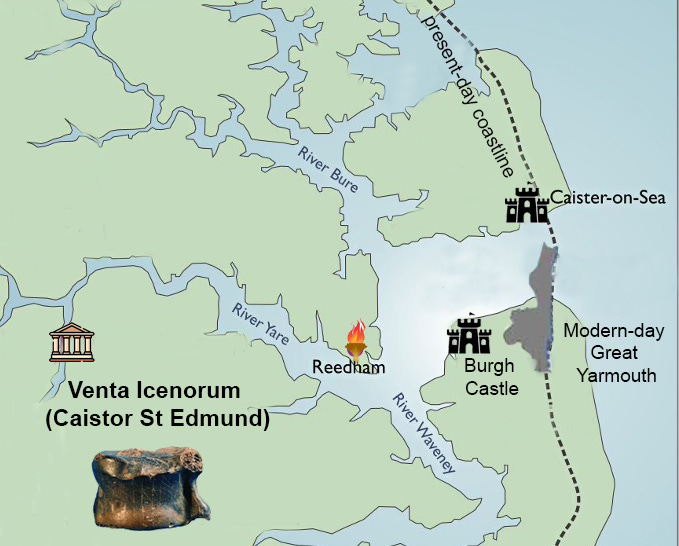
Yet it is clear that the East Angles came first. In the 1930s, excavation of an early cemetery at Caistor St Edmund, near Norwich, even saw the discovery of a particularly early runic inscription. The Caistor St Edmund inscription has been dated most recently by archaeologists to c. 425-450 and it appears to be an indication that East Anglia was one of the earliest regions in Britain that were settled by Anglo-Saxon migrants.
Caistor St Edmund is the site of the ruins of Venta Icenorum, the former capital of a British people called the Iceni. The Iceni are famous because of their revolt against the Romans in the first century that was led by their queen Boudicca. Or at least that is how her name is recorded in the earliest accounts – many popular books refer to her, ahistorically, as Boudica, a spelling that is not attested in any ancient source.
The reason why the Angles settled in Caistor St Edmund also seems reasonably clear. During the fifth century, Venta Icenorum could be accessed from the sea. The River Yare formerly flowed into a large estuary where the northern parts of Great Yarmouth are now located that was later filled up with silt and drained for farming. Roman forts guarded both sides of the ancient estuary, at Caister-on-Sea and Burgh Castle, with a lighthouse at Reedham guiding ancient mariners to Venta Icenorum.
The Caistor St Edmund inscription is preserved on a deer ankle bone and it merely records that the find is raïhan ‘from a deer’. The rune-inscribed bone was discovered along with a set of black and white gaming pieces that seem to have been used to play a variant of what Roman sources call the ludus latrunculorum or ‘soldier game’, or tafl as it was known later in Old English.
But the finds from the cemetery at Caistor St Edmund do not indicate what the people who were buried there called themselves or why they or their ancestors migrated to Britain. Sets of similar gaming pieces have been discovered in northern Germany, however, in Angeln, the region where Bede records that the Angles originally came from. Yet Bede calls the homeland of the Angles Angulus – unlike New England in the United States, East Anglia does not seem to have been considered a “New” Angulus, 340 miles away. The masculine noun Angulus has a different gender than the feminine Anglia and the vowels of Angulus are slightly different than those of Anglia.
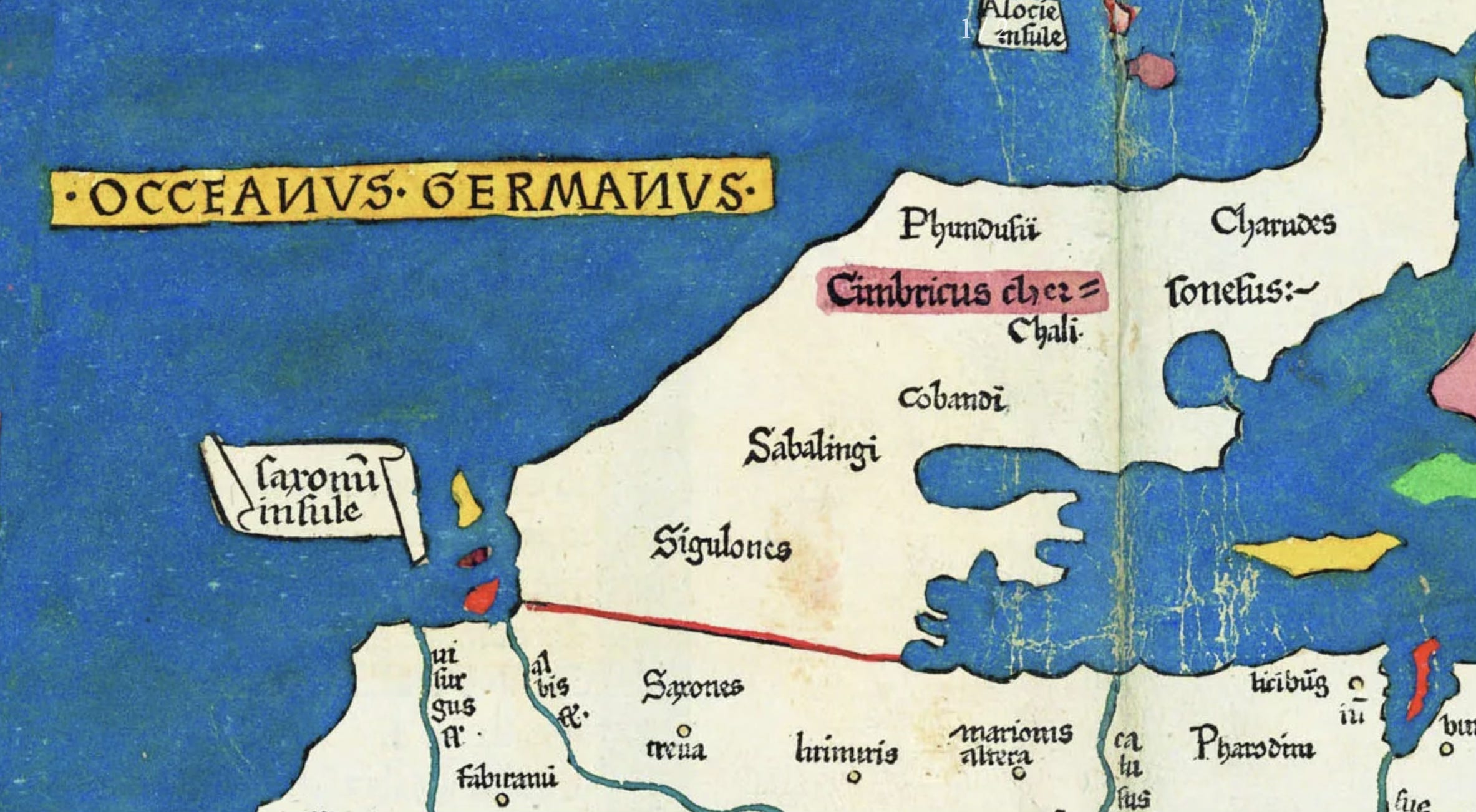
There is also a further difficulty with associating the Angles with Angeln in northern Germany. The Angles are mentioned in the first century by the Roman historian Tacitus living on the Jutland peninsula. Writing in the second century, however, the Greek geographer Ptolemy does not record a tribe called the Angles in the same location. Instead, he mentions peoples called the Sigulones and the Sabalingi where Tacitus placed the Angles, and Ptolemy mentions a people called the Angeilon in what is now central Germany. It is as if the Angles had moved out of Angeln by the second century and headed further south. Ptolemy calls this people the Sueboi Angeilon as if they had joined up with the Suebians, the most powerful tribe in Germany at the time.
So had the Angles really left Angeln by that date? Historians have not known what to do about Ptolemy’s Sueboi Angeilon, but the term Angeilon is clearly connected with Angulus and Anglii, and comparable variation is recorded in Greek and Roman mentions of the name of the Vandals. Some ancient sources refer to the Vandals as Vandali, others call them Vandili, and more rarely still they are called Vanduli, as if the vowel before the l was unclear. Yet the variation of Vandali, Vandili and Vanduli is the same as that found in the English verbs sing, sang, sung and it has long been recognised to reflect what German linguists call Ablaut or what in English is often called vowel gradation or apophony.
Apophony is well known to English speakers because it still affects verbs such as freeze, froze and drink, drank as well as sing, sang, sung – it indicates a change in tense, from present to past (and in sang, sung, from the simple past to the past participle). Yet variation such as that seen in the name of the Vandals appears to have also influenced the place-name Angulus and Ptolemy’s form Angeilon (where the spelling ei seems to stand for i) even though Old English does not display active apophony in its nouns. Apophony in nouns seems largely to have died out from English before the time of the oldest Anglo-Saxon manuscripts.
Yet it is well known why apophony occurred in early Germanic nouns because similar variation is recorded in the nouns of some other early Indo-European languages. The variation originally arose because of how some nouns were inflected – it occurred when they were used as objects or possessives rather than subjects, in what is known as their case forms (nominative, accusative, dative and genitive).
It is difficult to reconstruct now what the difference between Vandali, Vandili and Vanduli signified originally, but it is likely that the variation originally distinguished subject from object and possessive forms of the name of the tribe. The variation seems to have not been understood by Roman and Greek authors, however, who adopted different spellings of the vowel before l in the name of the Vandals in what appears now to be a willy-nilly manner.
The variation in the name of the Angles and Angulus, however, is slightly different. The name of the people is spelled with no vowel before the l in Anglii, with ei before the l in Angeilon and with a u in Angulus. But Anglii and Angeilon appear to be secondary forms derived from the place-name Angulus. Angeilon seems to be a variant of Angulus with the vowel u changed to i (written by Ptolemy as ei) and the vowel before the l appears to be dropped altogether in Anglii as if the recorded names of the people were derived from different inflected forms of Angulus.
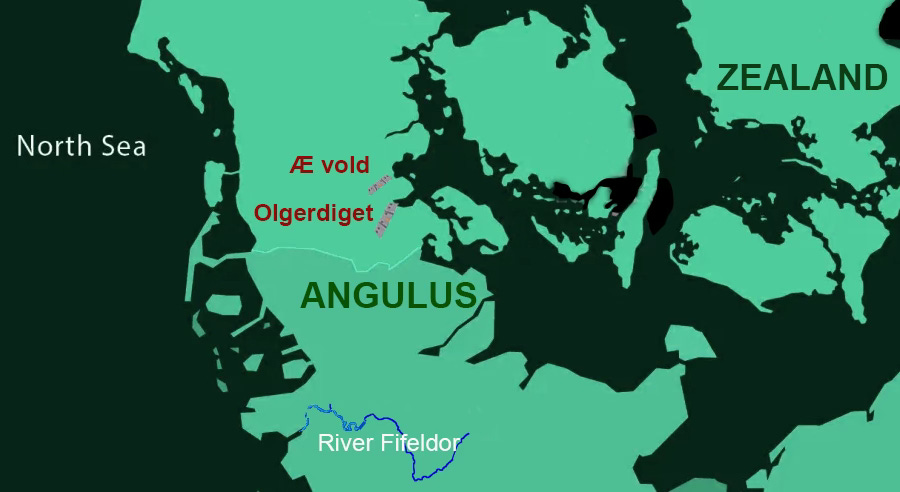
How Angulus received its name is not as clear, although quite a lot is now known about the old homeland of the Angles. A tradition has survived in the Old English poem Widsith that records that Angulus was ruled by a king called Offa and that he fixed its southern boundary at Fifeldor, presumably the River Eider. The northernmost boundary of Angulus seems to be indicated by the survival of two ancient fortified dykes in what is now southern Denmark (known as Æ vold and Olgerdiget), and archaeologists have long recognised that there are pottery styles that are restricted only to Angeln. A particular kind of housing construction is also typical of the region and runic inscriptions are attested, dating from the third to the fifth centuries, that preserve evidence of the language spoken in Angulus before the migration to Britain.
But how did Angulus receive its name? The most obvious explanation is that Angulus was related in some way to the Old English term angol ‘fishhook’ which is also sometimes written angul or ongul in early manuscripts. The Old English term is related, etymologically, to Old English anga ‘a sting’ and the name of the angon, a type of javelin employed by the early Anglo-Saxons that had a barbed head.
The most likely reason why Angulus received its name is that Angeln is a peninsula. The description Angulus is related both to the Ancient Greek adjective ankulos ‘crooked, curved’ and the Modern English verb angle ‘to fish with a hook and line’, but the association with fishing hooks seems to be relatively late. Part of the old homeland of the Angles juts out into the Bay of Kiel and it appears to have been thought to be akin in shape to a spike or a barb originally.
The distinction recorded in the spelling Angeilon also seems to explain why Ptolemy placed the Angles in Central Germany. The names Sigulones and Sabalingi appear to mean the ‘victors’ and the ‘followers of Saba’ respectively and they are not attested otherwise. But it is as if the Angles had spilt up into rival groups by the second century, with the group that Ptolemy calls the Sueboi Angeilon perhaps representing a third faction.
The Suebian Angles appear to have been a group of Angles who had left Angulus and gone to join up with the Suebians. They appear likely to have been exiles from Angulus, ejected by the Sabalingi or the Sigulones (or both). The description Angeilon employed by Ptolemy suggests that they took their name directly from Angulus while the place-name was still subject to apophony. The description Angeilon appears to have been a way of indicating ‘from Angulus’ that was formed in a different manner from the term Anglii and the later description Engle used for the Angles in Old English.
The name of the Angles seems to have derived from a physical description of the Angeln peninsula. Yet by the time that the Angles arrived in Britain, the apophony that allowed the inhabitants of Angulus to be called both Anglii and Angeilon had died out in English. The people called the Angeilon by Ptolemy were known by a different form of the place-name Angulus as if they did not consider themselves to fully be Anglii anymore, but instead to be people from Angulus who had joined up with the Suebians. Yet in Britain, a new variant of the place-name Angulus arose, employing different vowels and a different gender. As apophony was no longer active in early English nouns, a quite different description Anglia emerged in Britain to describe the new territory of the Angles. Both Angulus and Angle remained associated with each other, but the loss of apophony from Old English nouns meant that a new form of the old place-name arose in Britain, one derived directly from the name of the Angles, not the place they originally came from.

Comments
Nothing yet. Say the first thing.
Sign in to join the conversation.