
Yes, it’s a cliché - but like many others, we like to publicly set out our vision for Ageism Is Never In Style at the start of each year. Think of it as our overarching guide: the principles and messages we’ll really hone in on and amplify, building on what we’ve done before to further the conversation and the movement as a whole.
Last year, our focus was intergenerational connection. In 2024, it was all about educating around age through mixed forms and mediums. We’re still committed to both. But standing still? That’s never been our style. This year, as we mark our 10th anniversary, we’re evolving further.
How we set our ‘Vision’
The process usually starts in Q3/Q4 of the previous year. Ideas are born from foresight, passion, frustration, and motivation. As a small team, we’re deeply rooted in the global age movement: listening, learning, conversing, keeping a dialogue going.
We’re often ahead of the curve - and proud of it - but timing matters. A message won’t land if it’s too early. We have to reconcile the ideal with the real.
We reflect on successes and failures. Where have we been? Where are we? Where are we going? As a business and culture consultancy - and with a global community of 300k+ - we pull together our live intelligence and take the temperature of the wider space.
So for our overarching year vision, we aim for a balance: what resonates today, and what pushes the conversation. Progressive yet realistic.
Usually, we pick one vision. This year, we’ve gone for two. They’re connected and together set the tone for 2026.
So without further ado…
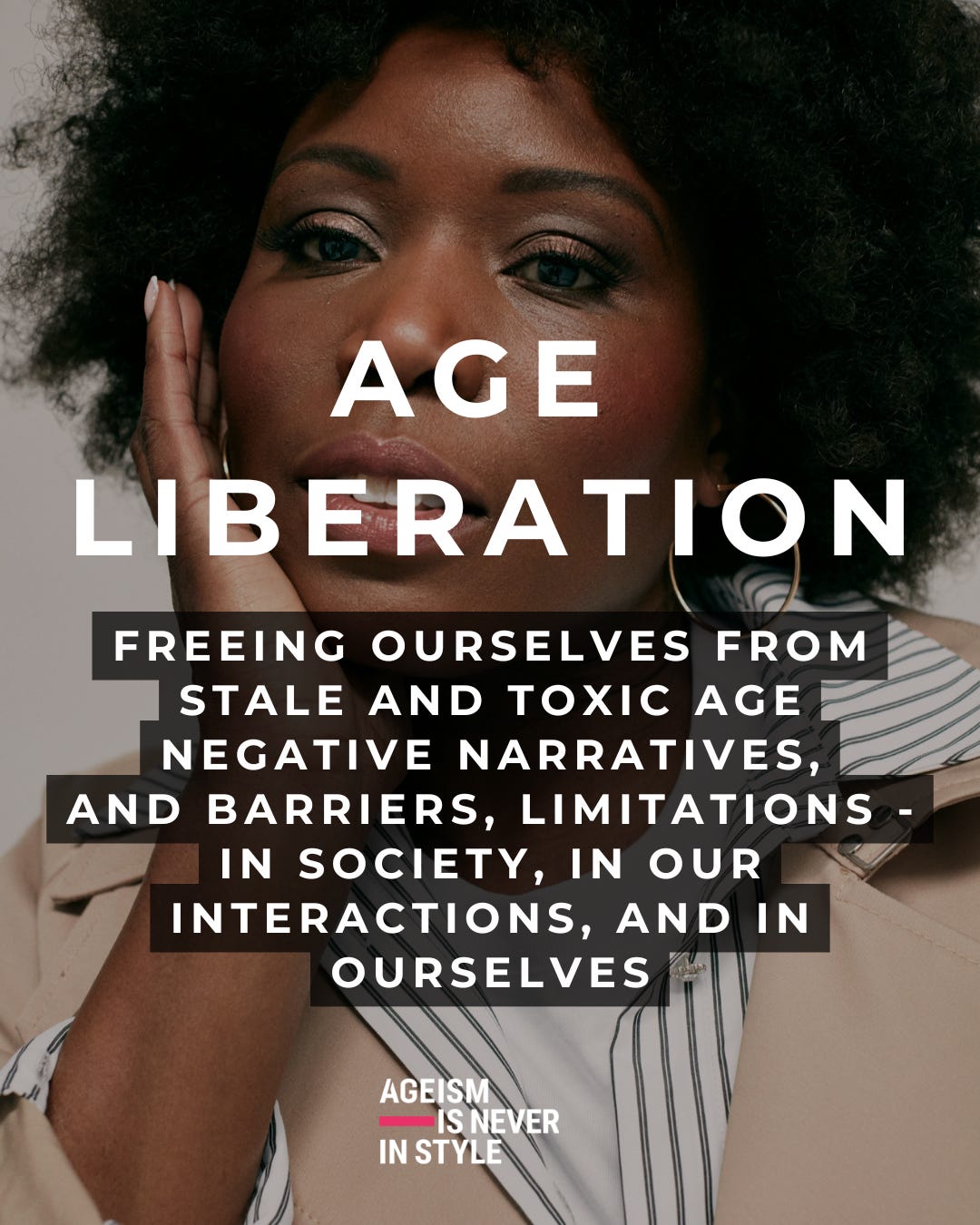
At its core, age liberation is about breaking free from outdated, negative ideas about age - those that hold us back, distort how we see ourselves, or limit what society expects of us or offers us. The phrase itself was coined by the brilliant DrBecca Levy , Yale professor and author of the Breaking The Age Code, and furthered by Natasha Ginnivan who discussed it in last year in The Guardian.
It’s about freeing ourselves from stale and toxic narratives, from societal expectations, from barriers in our interactions and within ourselves. It’s about challenging the systems, structures, and beliefs that perpetuate ageism.
How do we do this? By reclaiming and reframing ageing: how we talk about it, relate to it, think about it, present it, and behave around it.
And much of this comes from confidence and courage. That’s why we’ll be sharing more and more real, relatable and genuine stories of confidence from our community, such as Karen’s; to kick off the year, we partnered with her and SunLife UK to show confidence isn’t something you have or don’t have. It’s something you can grow:
Is this the same as pro-age or age positivity? Not quite. Those remain critical antidotes to age negativity and ageism, but now that talking about ageing, age inclusion and anti-ageism is (thankfully) no longer radical and has become more mainstream, we now need to bring more nuance and balance.
As this movement has gained momentum (which we love), we’re also seeing side effects: toxic positivity, and going to extremes overemphasising age as a superpower. Yes this is normal and to be expected, but it’s time for equilibrium. We need to normalising and neutralise ageing.
Age, in isolation, shouldn’t be perceived as a superpower. Nor should it be perceived as kryptonite. There are some unavoidable realities and inevitabilities of ageing and getting older - the good and the less good. There are others that are completely avoidable. Sometimes it really should matter, sometimes it really shouldn’t. It’s about knowing if, when, where, and how it’s relevant - and even having the confidence to let it be irrelevant when it really doesn’t matter.
To us, that’s true age liberation: the freedom to move through life without being weighed down by stoic age-based and driven expectations, assumptions, pressure, attitudes, limitations (at both extremes). Having balance. Realising light and shade exist at every stage of life. No stage is “right” or “wrong,” and no way of ageing is the only way.
As the age-inclusive, anti-ageism movement grows, so does a certain hypocrisy: gatekeeping. Some advocates, in their passion, try to keep the conversation for “certain ages” or generations.
You do not have to be a certain age to talk about ageing, age inclusion and/or ageism. And it does not only apply to people at a certain age.
One problem is the way society talks colloquially about ageing - as if it magically begins at 40, 50, 60… or older. When, in reality, it starts the moment we step foot on this earth. We are all ageing. It’s a universal experience we all share.
This is then compounded by the common misconception that ageism is prejudice or discrimination towards someone who’s older.
Ageism is simply prejudice or discrimination on the grounds of age. That’s it. Full stop.
We do indeed live in a youth centric society, so its understandable that a lot of people first approach and engage with age inclusivity through that lens.
To give you one example: last year Centre for Ageing Better found that 45% of people aged 51–70 and 46% of those aged 71+ have felt badly treated because of their age in the past year.
And on a personal level, it’s true that I first became interested in in this space, seeing myself as an ‘ally’ after witnessing how my mum and her peers were increasingly feeling alienated and irrelevant in society, because they were getting older.
But the same aforementioned study by centre for ageing better the group most likely to say they’ve been badly treated because of their age is 18–29-year-olds (75%).
And, on a personal note, the most ageism i’ve experienced is in the age sector itself. (irony much).
So it’s time to stop looking at ageing through a one dimensional lens. We’re making it clear: age inclusion affects and involves all of us. Age inclusion isn’t just about older people or your “future self”. It’s about everyone. Right now. Today. You have a personal stake in this, whatever your age and stage you’re at in 2026.
Still too often, people (often younger) are pushed out of the conversation, alienated, or told “this isn’t for you” and “you don’t belong”. This undermines the movement’s purpose and reinforces ‘othering’. And this results in deprioritising it as a strategic , business, social, and cultural priority.
As a result, last at the American Society on Aging Summit, I went so far as to query whether we should stop using the term “allyship” in the age inclusive context all together. Why? Because “allyship” by its definition about supporting something you’re not personally a part of.
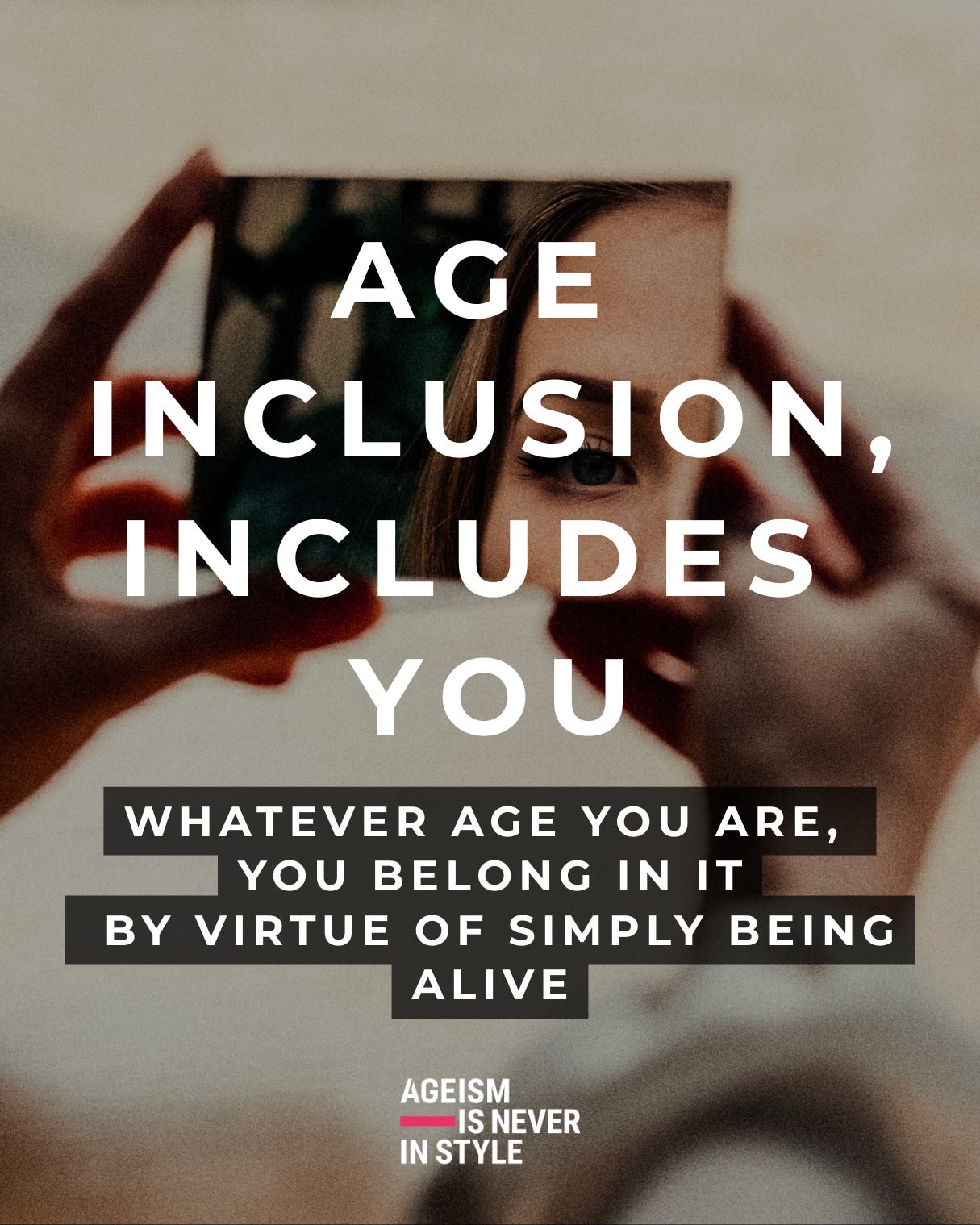
Age inclusion isn’t like that - you are part of it, by virtue of simply being alive. So we have to make this very clear. Because whether we like it or not, one of the more and most effective ways to in bring people of any age – and organisations - into this space is by indicating they have a direct stake in this matter.
To be clear: that doesn’t mean we ignore intersectionality, life stage differences, and minority or marginalised groups - they exist in the age space. And different backgrounds, ages, life stages and identities can bring different and unique challenges and experiences. We absolutely must support them and be allies of them, and provide safe spaces and conversations.
But when we look at the bigger picture of the age inclusive movement and our mission to transform hearts and minds around ageing as a whole, we must discourage siloed thinking and gatekeeping. We must actively and intentionally ensure this is a space where every voice & perspective is heard and valued – at every age.
A couple of years ago we asked our community when they started engaging with ageing. Most said in their 40s or 50s. But when asked if they wished they’d started earlier, 92% said yes. Earlier engagement makes a difference - to the movement, and personally.
So let’s not perpetuate this. Let’s actively and intentionally welcome all ages into the conversation. Show them they matter. This includes and makes a different to them too.
One testimonial from last year stuck with me:
“Jacynth’s presentation struck a chord with me - I’d been experiencing incidents of what I now recognise as ageism, but felt that as a young woman in my 20s, I wasn’t the ‘right’ age to be involved. Jacynth’s talk changed that for me, and I went on to join the Steering Committee of the FCA’s Age Inclusivity network, where I’ve been able to contribute to championing awareness and change for all ages.”
This is exactly what we want to keep pushing and encouraging at Ageism Is Never In Style.
So 2026 is about making it loud and clear: progressing age inclusion includes and involves you - whatever your age or stage of life today.
Comments
Nothing yet. Say the first thing.
Sign in to join the conversation.