
Like every great lie, the narrative that claims we are living through an intergenerational war contains elements of truth that should be acknowledged. Inequality between generations in terms of income and, above all, wealth does exist, producing a static snapshot in which certain age groups possess more resources than others. However, it is entirely unjustified to infer from that snapshot a causal relationship according to which the relative poverty of the young is due to the greater relative wealth of the old. This illegitimate argumentative leap allows the idea to spread that the focus should be placed on the “unjust generosity” of the sources of income of older generations—such as pensions.
Most conventional analyses that fall into this error lack both an international and a historical perspective, which severely limits their ability to understand the phenomenon they claim to explain. This mistake leads them to a conservative position that is perfectly functional for dismantling social gains, paradoxically worsening the very problem they purport to solve.
Ecosocialist Notebook - Alberto Garzón is a reader-supported publication. To receive new posts and support my work, consider becoming a free or paid subscriber.
History matters
For around 300,000 years, human beings have lived in communities organised collectively through historically specific institutions. It is common sense that our range of possibilities differs depending on whether we are members of a hunter-gatherer society, a medieval agrarian society, or a modern capitalist society. But even within capitalism, conditions have not been the same at all times: we would not live in the same way in nineteenth-century industrial England, in post-war twentieth-century United States, or in contemporary Spain. Understanding the type of institutions in place is central to understanding the “world” into which each generation and each individual is inserted.
These institutions change over time, and sociology has devoted considerable attention to explaining the reasons for these transformations. One of the most powerful explanations is the political struggle between social groups, which is obvious in the sphere of labour. In early British industrial capitalism, what we would now call labour law did not exist, so working conditions were marked by severe exploitation and defined more by the biological limits of human bodies than by legislation. But political struggles in society and in Parliament gradually imposed limits on that exploitation, leading to regulations and laws that protected workers from the most brutal abuses. Political struggle built a historically specific institutional framework, but at an extremely high cost, since repression was always violent and relentless: those first regulations were gains achieved after thousands of deaths caused by industrial accidents and trade union repression.
This political struggle did not stop with those early victories. Over the following decades, new gains expanded the scope of protection for the working class, until by the late nineteenth century they had crystallised in many Western countries into what became known as the Social State or Welfare State, that is, a set of institutions designed to restrain the abuses carried out by the stronger party—capital—against the weaker party—labour. Historical specificity lies in the fact that no two welfare states are identical, either across space—each country has its own version—or across time—their content is constantly disputed and redefined. For that reason, it is correct to say that the social gains embodied in institutions are always contingent and never definitive: they are never guaranteed forever.
Theorists have sought to provide a coherent periodisation to situate these changes in recent history, the most fruitful and well-known being the distinction between the wild capitalism of the nineteenth century, the Keynesian-Fordist period that unfolded after the Second World War, and the neoliberal period which, from the 1980s onwards, began dismantling social gains. Even the simplest reading of this classification makes it possible to understand that institutions—particularly those relating to labour rights—change over time and affect generations unequally.
It is logical to conclude that an individual who grew up in a Fordist society, with its large factories, high union density, and protection from a strong welfare state, does not enjoy the same rights as someone who grew up decades later in a post-Fordist or neoliberal society, where work is typically precarious and flexible and highly exposed to the whims of employers. Undoubtedly, both individuals will think about society differently. However, this type of approach is entirely absent among analysts of the “intergenerational war”. For them, it is as if individuals were always inserted into the same place, devoid of history and social change.
The case of Spain
Spain is a country that had to build its welfare state against the grain of the rest of Europe, since just when the restoration of democracy was driving its construction domestically, its dismantling was beginning elsewhere in Europe. Moreover, the economic foundations were not the most suitable for sustaining a welfare state. Spain transitioned towards modern industrialisation in the late 1950s, but by the 1970s deindustrialisation had already begun. During the 1980s this process accelerated, alongside a process of de-agrarianisation and the growth of the service sector (particularly tourism and real estate services).
The main effect of these changes was the decline in industrial employment, which fell from representing 23% in 1980 to below 10% today. This transformation meant the progressive disappearance of the blue-collar industrial worker, typically employed in medium- and large-sized firms with strong union presence, and their replacement by less-skilled workers in sectors with low union density. A process of flexibilisation and individualisation of labour relations thus unfolded, leaving workers in a more vulnerable position vis-à-vis employers.
This had not only political consequences—organised workers tended to form the social base of left-wing parties—but also economic ones. The share of wages in national income has declined systematically, closely tracking the fall in the weight of industrial employment, as shown in the following chart. This means that, of the total monetary value of production, a progressively smaller share has gone to wages and a larger share to corporate profits.
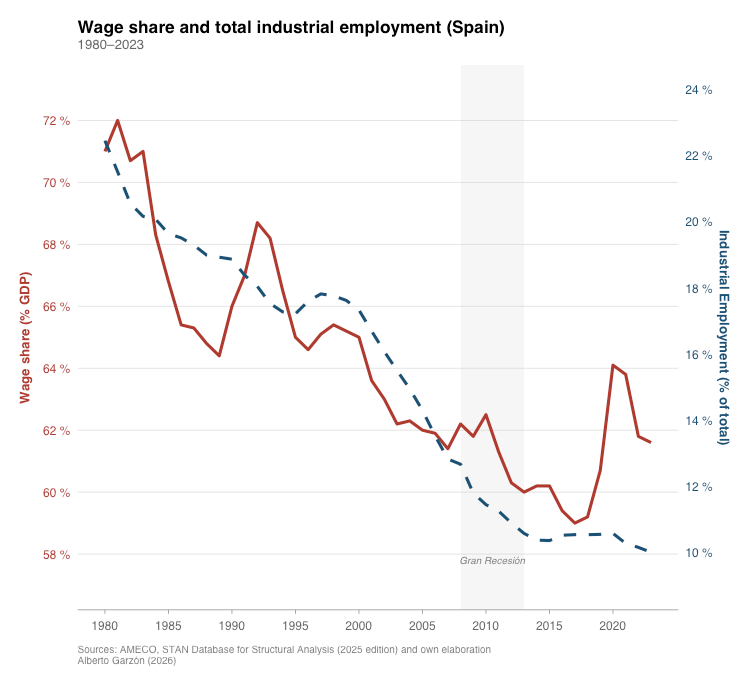
These data suggest that deindustrialisation has been the key structural factor behind the collapse in the wage share in Spain. Industry generates jobs with higher productivity, greater bargaining power (due to factory concentration and sectoral unions), and greater capacity for workers to capture income. Thus, the tertiarisation of the Spanish economy—especially towards low value-added services such as tourism and construction—has weakened labour’s structural position vis-à-vis capital.
However, monocausal interpretations should be avoided. After all, deindustrialisation has not operated in a vacuum. The process has been accompanied by increasing financialisation of the Spanish economy and by persistent inflation in real estate asset prices. As I have highlighted on other occasions, housing has become a central mechanism of wealth accumulation for cohorts who accessed homeownership in decades of relatively low prices and expansive credit. This dynamic has amplified wealth divergence between generations, but not because the old “extract” resources from the young, but because the growth model has shifted income generation away from productive labour and towards asset price appreciation. It is a structural transformation of the accumulation regime, not a conflict between age groups.
Among these institutional changes, labour market reforms deserve particular mention. Especially important were those of 1984 and 1997, as well as those of 2010 and 2012. All of them aimed to weaken the bargaining power of the working class, resulting in more precarious working conditions and relatively lower wages. The neoliberal labour model was justified in terms of a supposedly greater capacity of labour to adapt to a deindustrialised productive structure increasingly dependent on precarious sectors. This gave rise to what is technically called a segmented labour market, in which individuals from earlier generations tended to enjoy labour rights that were no longer available to newer generations.
This pattern is not unique to Spain. All Western economies have followed a similar path as a result of neoliberal globalisation, but those that have experienced more intense processes of tertiarisation and union weakening—such as the United States or the United Kingdom—show more pronounced declines in the wage share. By contrast, countries that have preserved a stronger industrial base and more robust institutional architecture—such as Germany or some Nordic countries—have recorded more balanced distributive dynamics. This suggests that the problem lies not in the age of citizens but in the productive and institutional structure shaping their life trajectories. The fact that in all countries income differences are more pronounced between young and older workers than between workers and pensioners underscores this point—an aspect deliberately ignored by critics of the “boomers”.
A decade ago, the proposal of conventional economists was the “single contract”, a subterfuge intended to homogenise labour conditions downward by removing protections previously gained by older groups. Today’s discourse on the “intergenerational war” echoes those proposals, albeit in a more naïve form: it argues that the weight of the gains achieved by previous generations constrains the possibility of new gains for subsequent generations, usually focusing on pensions.
Conclusion
The recurrent emphasis on pensions as an alleged obstacle to the progress of younger generations also reflects a macroeconomic misunderstanding. The pension system is not an autonomous mechanism that competes with young people’s wages, but an institution structurally dependent on the wage bill and the level of employment. When labour’s share of income declines and the productive structure shifts towards low value-added sectors, the financial base of the welfare state deteriorates simultaneously. The problem, therefore, is not the “generosity” of pensions, but the weakening of the productive and distributive capacity of the economy as a whole. The problem is not the boomers, but that the world into which they were inserted has been replaced by another with a fraction of its rights and labour opportunities.
In reality, the argument must be turned on its head: it has been the historical inability to defend past social gains against the brutal advance of neoliberalism that has left younger generations in an extreme state of vulnerability. Therefore, it is institutions and political struggle—class struggle, more specifically—that fundamentally explain intergenerational differences in income and wealth. A corollary of this argument is that the solution lies in more social gains, not fewer—as conservative analysts claim—and in a profound restructuring of the economy based on reindustrialisation, ending dependence on low value-added sectors, and reducing the excessive power of private employers.
Ultimately, what we are witnessing is not a confrontation between young and old, but a deeper conflict between labour income and capital income within an accumulation regime that has systematically weakened the structural position of the former. Intergenerational differences are the demographic expression of this institutional transformation. Attempting to resolve them by eroding existing social gains amounts to deepening the very logic that generated the problem—an outcome highly satisfactory for capital. The solution does not lie in redistributing scarcity between cohorts, but in rebuilding social power, reorienting the productive model, and expanding the institutions that protect labour.
Ecosocialist Notebook - Alberto Garzón is a reader-supported publication. To receive new posts and support my work, consider becoming a free or paid subscriber.
Comments
Nothing yet. Say the first thing.
Sign in to join the conversation.