
Every year, the European Union imports an area of cropland equivalent to the size of Spain. These are invisible hectares embedded in the soy, cocoa, coffee, and sunflower oil we consume. They are the “phantom acres” that Georg Borgström described more than half a century ago, by which he meant the land located abroad that a country needs to cover a level of consumption its own territory could not sustain.
Decades later, in the year 2000, historian Kenneth Pomeranz revived that notion in his influential book The Great Divergence to answer the old question of why certain regions of Europe industrialised before other, equally advanced regions, such as China’s Yangtze Delta. His answer combined coal, which allowed England to stop depending on wood just as the deforestation crisis was becoming acute, with colonial networks—those “phantom acres” that freed the European economy from the constraints imposed by land.
The fact is that land is a finite good that does not allow for simultaneous uses: a single hectare cannot at once be forest for timber, cereal for people, fodder for livestock, and fibre for clothing. A choice has to be made. And since Europe did not have enough land for everything, the New World colonies provided it. In that era of industrial capitalism’s expansion, this international asymmetry between the European centre and the global periphery rested on extra-economic mechanisms such as the violence that empires exercised over their colonies. Today, however, the forms have changed, but the underlying phenomenon remains in force, insofar as the richest countries benefit from an international division of labour that sustains consumption in rich countries by exploiting the labour force and natural resources of poor countries. A paradigmatic example is the agri-food model in the European Union.
According to the FAO, Europe is a net exporter of agricultural and livestock products in monetary terms. That means we export more euros in food than we import, which invites the conclusion that “we have food to spare”—something very different from what happens in Asia, where there is a net deficit of 300 billion dollars. But that accounting in euros conceals more than it reveals. As soon as we swap money for a physical metric—the hectares of land behind each product—the picture changes radically.
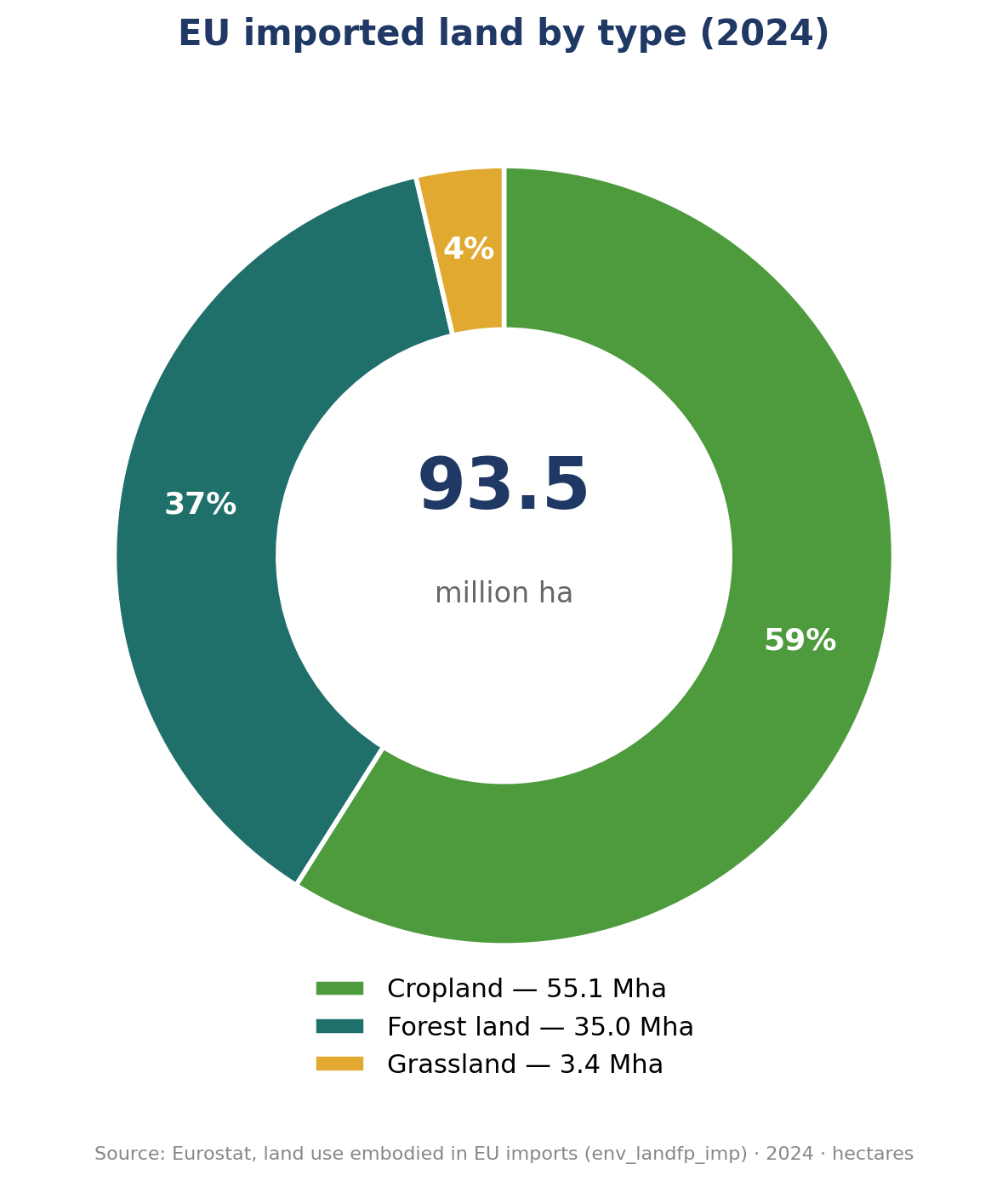
In recent decades, the notion of “phantom acres” has spurred the development of methodologies to put physical figures on trade flows: the aim is to calculate how much land—measured in hectares—is needed to produce each good that crosses a border. This is known as the land embodied (or “embedded”) in products, that is, the soil footprint that travels, invisibly, inside each sack of soy or each coffee bean. One of these methodologies is that of the European Commission and Eurostat, on which the charts in this analysis are based. For example, in 2024, the European Union imported 55 million hectares of crop products, an area slightly larger than Spain (around 50 million hectares). We Europeans also import 35 million hectares of forest land and just over 3 million hectares of pasture land.
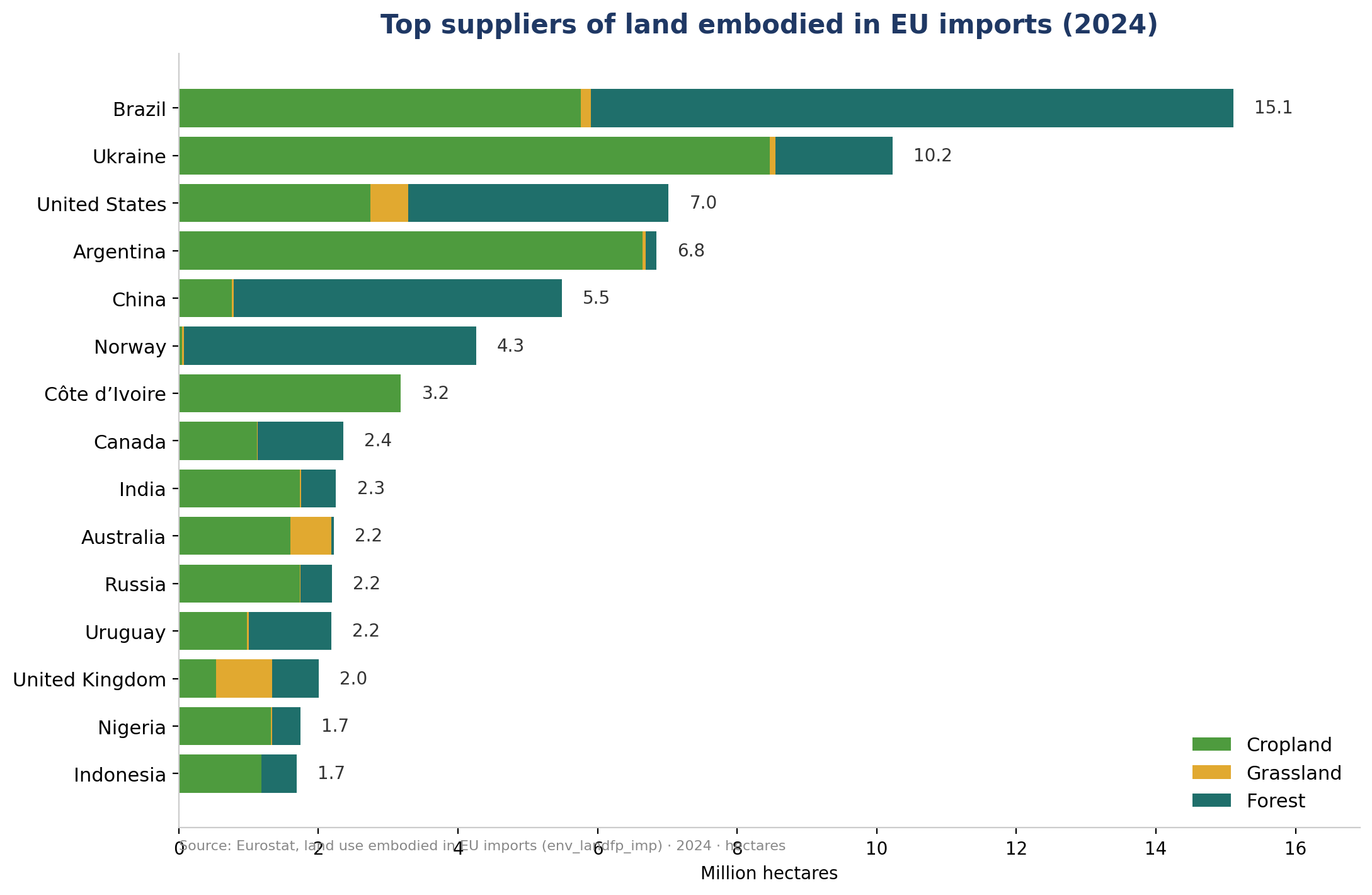
If we look at where those hectares of land come from (again: embodied in products), the main supplier countries are Brazil, Ukraine, the United States, and Argentina. As the following chart shows, we import 15 million hectares of land from Brazil, while from Ukraine we import more than 10 million. As might be expected, these are large countries and, in general, with an overrepresentation of so-called ‘developing countries’ or the Global South (especially in cropland).
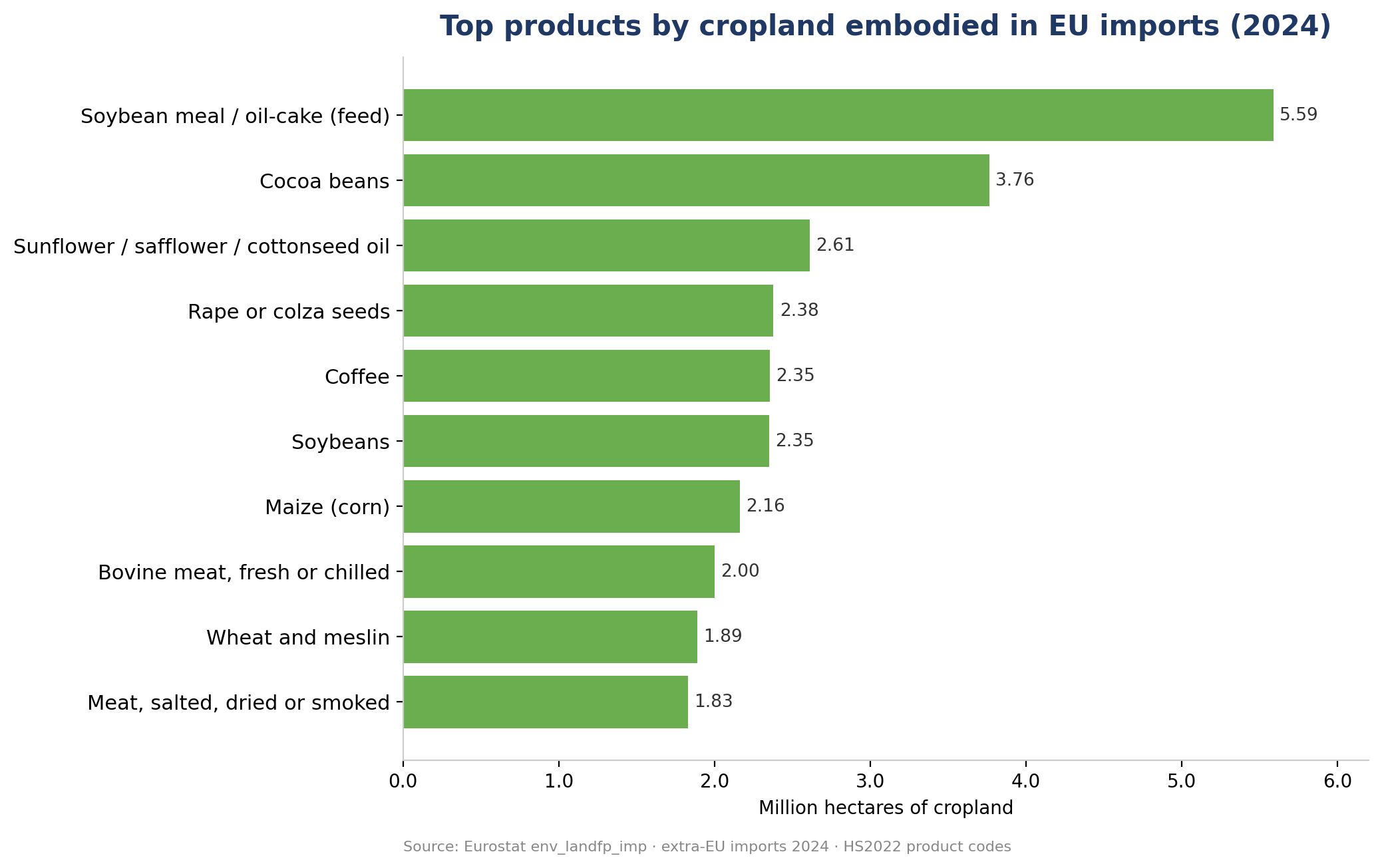
But what are we really importing? As the following chart shows, the leading product by far is soy feed, followed by cocoa beans, sunflower oil, rapeseed, and coffee. The key role is played by soy feed, especially from Brazil and Argentina, which is imported into Europe for animal feed and whose production is closely linked to Amazon deforestation. This already gives us signs of the ecological unsustainability of the European agri-food model and its relationship with the world-economy.
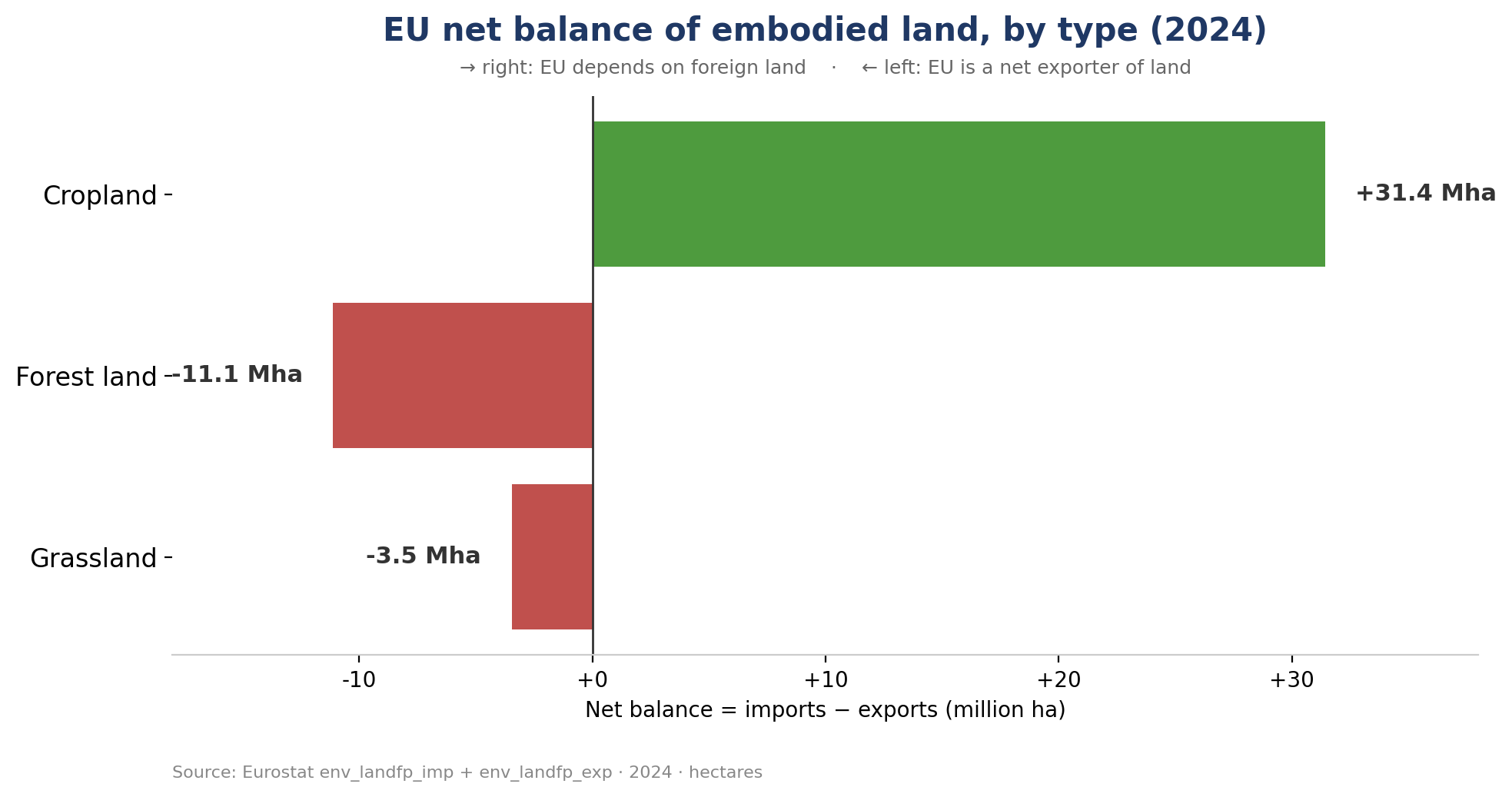
But this works in both directions: just as we import land embodied in soy or coffee, we export it embodied in what we sell abroad. The final tally—imports minus exports—shown in the following chart, leaves Europe as a net importer of cropland and a net exporter of forest and pasture. Here lies the key to the accounting mirage, since Europe imports cheap land—a hectare of soy for feed is worth little—and exports more expensive products, such as dairy, wine, and meat. That is why the accounts in euros show a surplus while the accounts in hectares show a deficit.
These data describe a European agri-food model—an aggregate with differences between countries—that is highly dependent on imported cropland, with soy and other crops destined for animal feed. In this sense, the European economy consumes hectares of foreign land to produce food for livestock on intensive farms. These data are consistent with the system of the notorious mega-farms, especially those for pigs and chickens, because in such large factories, the animals can barely move, and feed must be imported. That food is what we consume domestically, often in the form of cheap meat (re-exports of animals to third countries are already discounted from the data).
On the other hand, European countries export animal products from extensive livestock farming, that is, animals that feed on the pastures of their surroundings (sheep, cows, goats…) and that consume land in Europe. In this way, at the same time that Europe imports cropland, it also exports pasture land—and likewise with timber, of which it sells more abroad than it buys.
In short, when a European eats pork, drinks coffee, or buys chocolate, they consume not only a product. They also consume an invisible portion of land located thousands of kilometres away. Monetary statistics record the price of that transaction, but they do not record the material geography that sustains our way of life. These biophysical methodologies have their limitations, but there is no doubt that monetary metrics conceal physical relationships that reveal profound asymmetries. It is what ecological economics—from Joan Martínez-Alier to Alf Hornborg—has called ecological unequal exchange: a trade that, under the appearance of an exchange between equals, systematically transfers land, energy, and materials from poor countries to rich ones. A hierarchy of the world-economy that is, at once, ecologically and socially unsustainable.
No posts
Comments
Nothing yet. Say the first thing.
Sign in to join the conversation.