
In 1971, the ecologist Howard T. Odum wrote in Environment, Power and Society that “industrial man no longer eats potatoes made from solar energy” but rather “now eats potatoes partly made of oil.” This striking remark responded to the widespread belief that the Green Revolution—a term for agricultural innovations that began in the 1940s—had provided humanity with a definitive solution to feeding growing populations without fear of famine. For Odum, the high productivity of land was in fact underpinned by intensive fossil-fuel use, both in the mechanisation of agriculture and in the production of fertilisers and agrochemicals. In other words, our food system had become deeply dependent on fossil fuels.
This is something we rarely think about, because we tend to assume that our dependence on fossil fuels is limited to transport infrastructure and electricity generation. That is why, when part of the inflow of fossil fuels is disrupted—as is happening now with the war in Iran—we immediately become concerned: we know that gasoline prices will rise and that life will become more expensive. Unfortunately, our food system is also profoundly dependent on fossil fuels, which means that price pressures eventually show up in the food we buy and eat.
According to estimates by the Global Alliance for the Future of Food, food systems account for up to 15% of total fossil-fuel consumption. Of that share, 42% corresponds to food processing and packaging, 38% to retail distribution and household consumption, and the remaining 20% to agriculture and agrochemical inputs—the point Odum was highlighting. In other words, we eat food grown with oil and natural gas, and this fossil-fuel support is responsible for both climate change and the possibility of very large human populations.
We must remember that there are currently around eight billion people in the world, a number that would be nearly impossible to feed without mineral fertilisers. In the United States, for example, between 40% and 60% of agricultural yields are estimated to depend on such fertilisers. According to the physicist Vaclav Smil, without them the global population would need to be about 40% smaller. This chemical “miracle” is produced by the petrochemical industry, and fertilizers fall into three main categories: nitrogen fertilizers—such as urea—phosphate fertilizers, and potash fertilizers. The largest group is nitrogen fertilisers, produced by a process that captures nitrogen from the air and converts it into a liquid solution, which is spread on fields to increase soil fertility.
The problem is that producing these fertilisers requires large amounts of natural gas, both as a feedstock—about 60% of the input—and as an energy source, because the process requires extremely high temperatures and pressure. In fact, the nitrogen fertiliser industry alone accounts for around 2% of global greenhouse-gas emissions. For this reason, our current method of producing food poses a very serious challenge that is often overlooked—although during my years at Spain’s Ministry of Consumer Affairs it was a priority issue, as the controversies over steak consumption and industrial livestock farms made clear.
Given these relationships, we need to look at the entire production chain. Fossil fuels and fertilisers become production costs for farmers. While the key variable in food prices is usually the climate, any disruption in fossil-fuel or fertiliser prices will exert pressure across the entire chain: beginning with farmers, moving through distribution, and ending with retail markets, ultimately pushing up the final price of food. This transmission of costs is exactly what happened between 2021 and 2022 after the Russian invasion of Ukraine, and it is also what is beginning to occur again as a consequence of the war in Iran.
One indirect channel through which fertiliser prices rise is the cost of raw materials—especially natural gas. The fertiliser industry is highly concentrated because plants tend to locate where raw materials are cheapest. Phosphate fertilisers depend on phosphate mining, whose largest reserves are in Morocco and the occupied Sahara, which explains why Morocco is the leading exporter. Potash reserves are concentrated mainly in Canada, Belarus, and Russia, and the war in Ukraine dealt a severe blow to this market. Nitrogen fertilisers depend particularly on natural gas supplies and are therefore often produced where gas is cheap, such as in Russia and the countries of the Middle East. For this reason, geopolitics immediately affects the supply and trade of all mineral fertilisers.
During the era of free trade, it was assumed that any country needing a specific product—if it did not possess it domestically—could obtain it through global markets. By contrast, in today’s emerging neomercantilist era, and amid a geopolitical rivalry for hegemony between the United States and China, economic powers increasingly use trade as a strategic weapon. Protectionist policies and sanctions imposed by countries such as the United States, the European Union, and China follow this logic. After the invasion of Ukraine, for example, the European Union sanctioned Russia and Belarus, tightening the supply of potash fertilisers and driving up prices—by 2020, the EU imported 64% of these fertilisers from those two countries. Meanwhile, in a world of increasingly scarce resources, states are also seeking greater self-sufficiency in sectors considered strategic or critical. China, for instance, restricted fertiliser exports in 2021, which also pushed up global market prices.
All of this was already happening before the recent attack by the United States and Israel on Iran—and precisely for that reason the current impact may be even greater. As noted, the Middle East, and particularly the Persian Gulf, exports large quantities of both natural gas and manufactured fertilisers. The closure of the Strait of Hormuz prevents these supplies from reaching their destination markets. Through this narrow passage—known in English as a “chokepoint”—flows roughly one fifth of the world’s oil, but also up to one third of globally traded fertilisers.
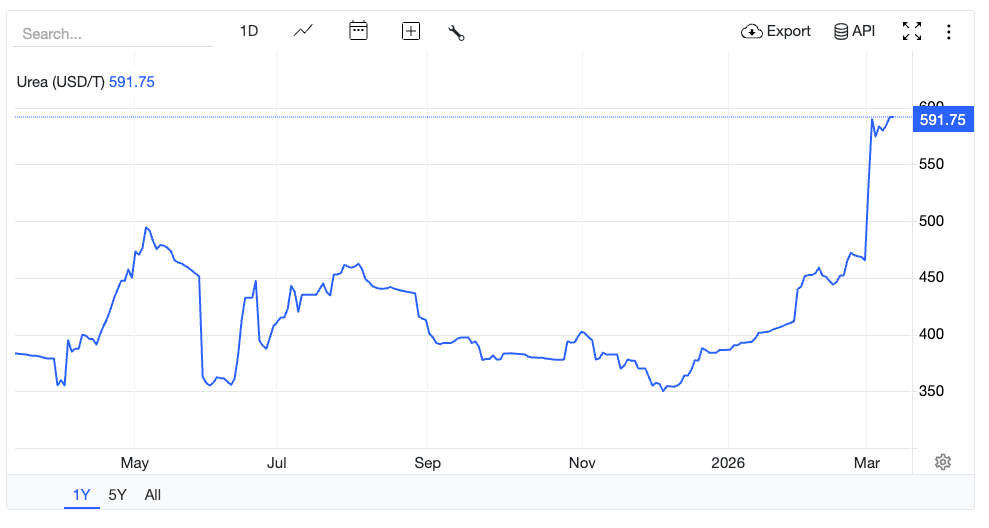
After just a few days of conflict, prices of mineral fertilisers and natural gas have already surged. Urea ended the week close to $600 per tonne—after finishing the year slightly above $360. Although this is still far from the $1,000 per tonne reached in the spring of 2022, the rapid increase suggests that if the conflict continues for a few more days, those levels could easily be surpassed. Natural gas prices are also rising quickly, although supply sources are more diversified—Russia and, especially, the United States export large volumes—so we remain far below the levels seen a few years ago. Nevertheless, at the regional level, it is clear that fertiliser production will be affected by higher gas prices—and in Iran’s case, directly by the bombing of fertiliser plants.
In short, Hormuz is a critical node in the global agro-industrial metabolism. If the conflict drags on and the Strait remains closed for weeks, the rise in fertiliser prices will eventually feed through into staple food prices around the world, including in Spain. The effect will not be immediate—the transmission takes months to move through the production and distribution chain—but it will be inevitable. And when it arrives, it will remind us once again that food security depends critically on a fossil-fuel energy infrastructure that is increasingly exposed to geopolitical instability.
There are alternatives to reduce this vulnerability: from transitioning toward agroecological practices to developing fertilisers produced with renewable energy—the so-called green ammonia, which today accounts for barely 0.3% of global production—and even policies aimed at reducing and restructuring food demand similar to those already being proposed for energy consumption. But all of these require time, investment, and political will—three things that tend to be in short supply when missiles are already flying.
PS: If you are interested in this topic, I highly recommend reading Raj Patel, a specialist in food systems.
No posts
Comments
Nothing yet. Say the first thing.
Sign in to join the conversation.