
Salutations, Solarpunks!
Please enjoy our anthem for today’s post:
I’ve been reflecting on all the things I do with my limited spare time and what brings me joy. It used to include video games, binging streaming shows, and scrolling random content on my phone. But that dopamine rush just doesn’t hit the same way anymore. I can’t fully describe what’s shifting inside me, but I’ve found myself much more compelled to spend time in nature.
And the top outdoor activity that lights me up these days?
Composting.
Yes, really. The act of turning food scraps, yard trimmings, leaves, and old paper into nutrient rich, living soil. I know how it sounds. How fun can it really be tending to a decomposing pile of banana peels? But hear me out, because I’ve come to believe this humble practice is one of the most direct, tangible, radical things any of us can do for the planet. And yes, it is SO satisfying!
Thanks to for capturing this lovely composting moment.
The Dirty Secret of Our Garbage
Have you ever wondered where your food scraps go after you toss them in the garbage?
Most of us never think about either, and that’s by design. Our waste systems are engineered to make things disappear. Out of sight, out of mind. However, in nature, there is no “away”. Everything goes somewhere. And where our food scraps currently go is quietly wrecking mother earth.
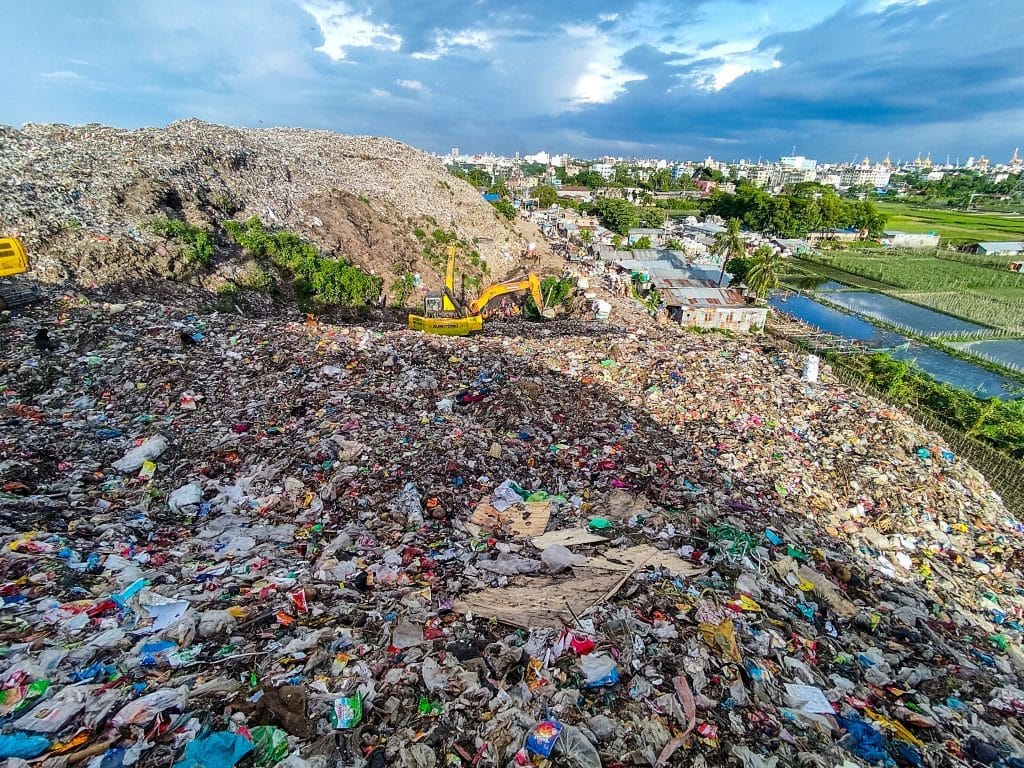
Let’s follow that apple core you threw out this morning
It gets bagged, trucked, and buried in a landfill. Entombed in plastic, squeezed under layers of trash, cut off from oxygen. Here’s where it gets ugly: without air, organic matter can’t decompose properly. Instead of gently breaking down into soil, it rots anaerobically and releases methane, a greenhouse gas roughly 80x more potent than CO2.
The numbers are staggering:
Food scraps and yard waste make up more than 28% of what Americans throw away1
Landfills are the third-largest source of human-caused methane emissions in the United States2
An estimated 58% of fugitive methane emissions from landfills come from landfilled food waste alone3
And an estimated 90%+ of compostable materials worldwide still head to landfill4
Read that last one again. We are taking the very material that could regenerate our planet’s soil... and converting it into climate poison. It’s a broken loop.
Why is composting is great for the planet?
I recently watched this documentary and was deeply inspired:
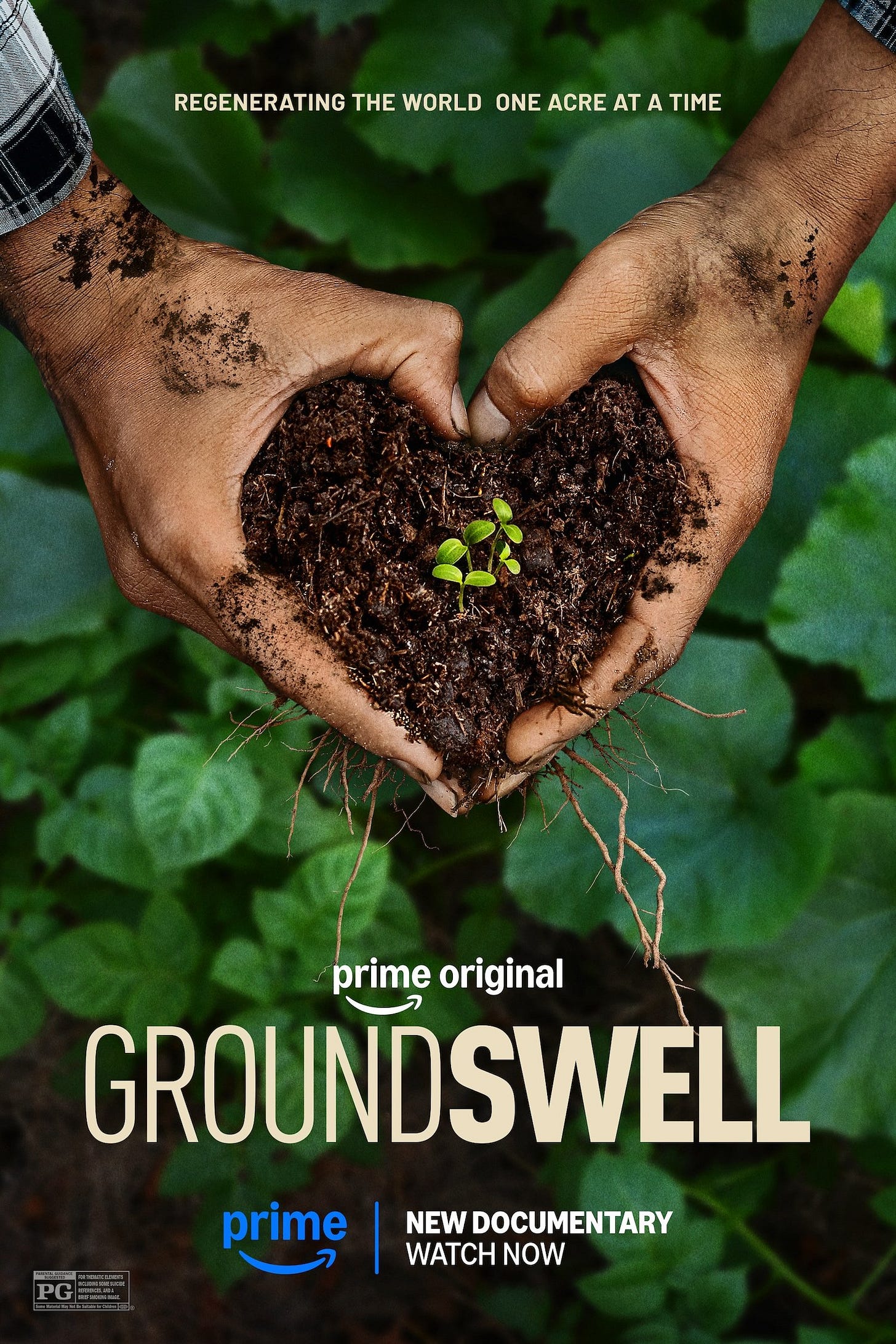
Goundswell’s core thesis is that regenerative agricultural practices, when practiced locally on a global scale, has the power to restore biodiversity and reverse climate change.
If we want to heal mother earth, the process begins with healthy soil. Soil is the underlying foundation upon which terrestrial life springs forth, sustains, and regenerates. It’s the universal dinner table where bacteria, fungi, insects, plants, and animals (including us humans) get to eat.
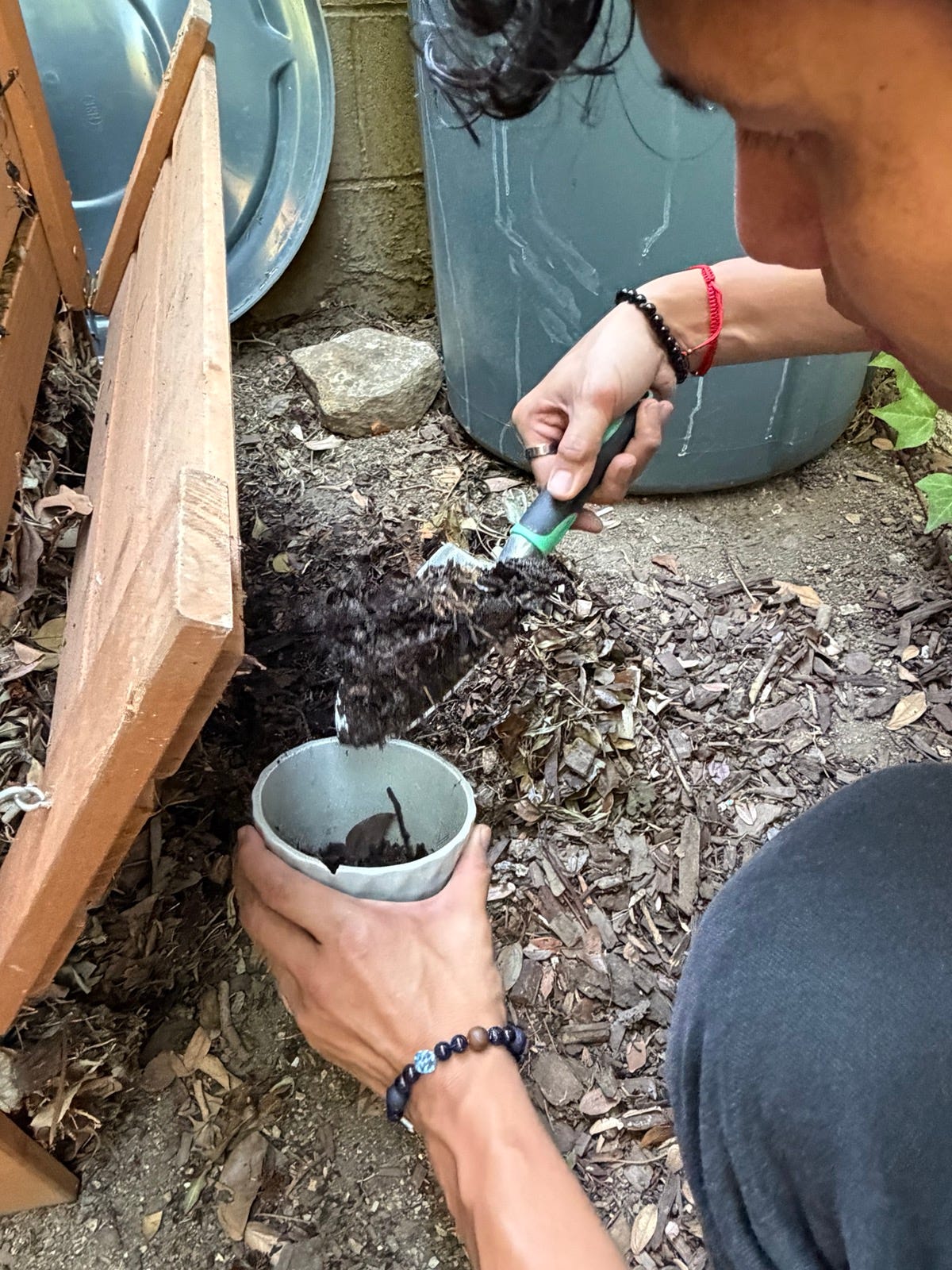
Composting goes beyond reducing harm, it reverses the destructive loop
🌍 Carbon goes into the ground, not the sky. When compost is applied to land, carbon gets stored in the soil instead of released into the atmosphere. Healthy soil is one of the largest carbon sinks on Earth.
💧 Soil learns to hold water again. Compost-enriched soil absorbs and retains dramatically more moisture, reducing erosion and flooding during heavy rain, and keeping land alive during drought.5
🌱 Nutrients return to the food system. Compost slowly releases nutrients back into the earth, reducing the need for synthetic fertilizers, cutting runoff, and protecting water quality.
🐛 Life comes back. One handful of healthy compost contains more microorganisms than there are humans on Earth.
This matters more than ever because we are losing our living soil at an alarming rate. Roughly 35% of soils across the US Corn Belt have already eroded through their fertile topsoil layer6. We are quite literally running out of the stuff that grows our food.
Why is composting great for you?
It feels amazing
When you compost, you stop being a spectator to nature’s lifecycle and become a participant in it: garbage → fertile soil → plants → food → you → garbage → fertile soil... It’s the unending circle of mother nature, and you’re in it now. You made that soil. That soil grows that tomato. That tomato becomes you.
There’s something deeply grounding about it: a humbling, daily antidote to the abstraction of modern life. Your hands in the earth. Real things, decomposing and becoming. It comes with the realization that we’re all connected, all part of one colossal, beautifully interwoven system. Perhaps that’s the subtle feeling that keeps pulling me away from screens and into the garden.
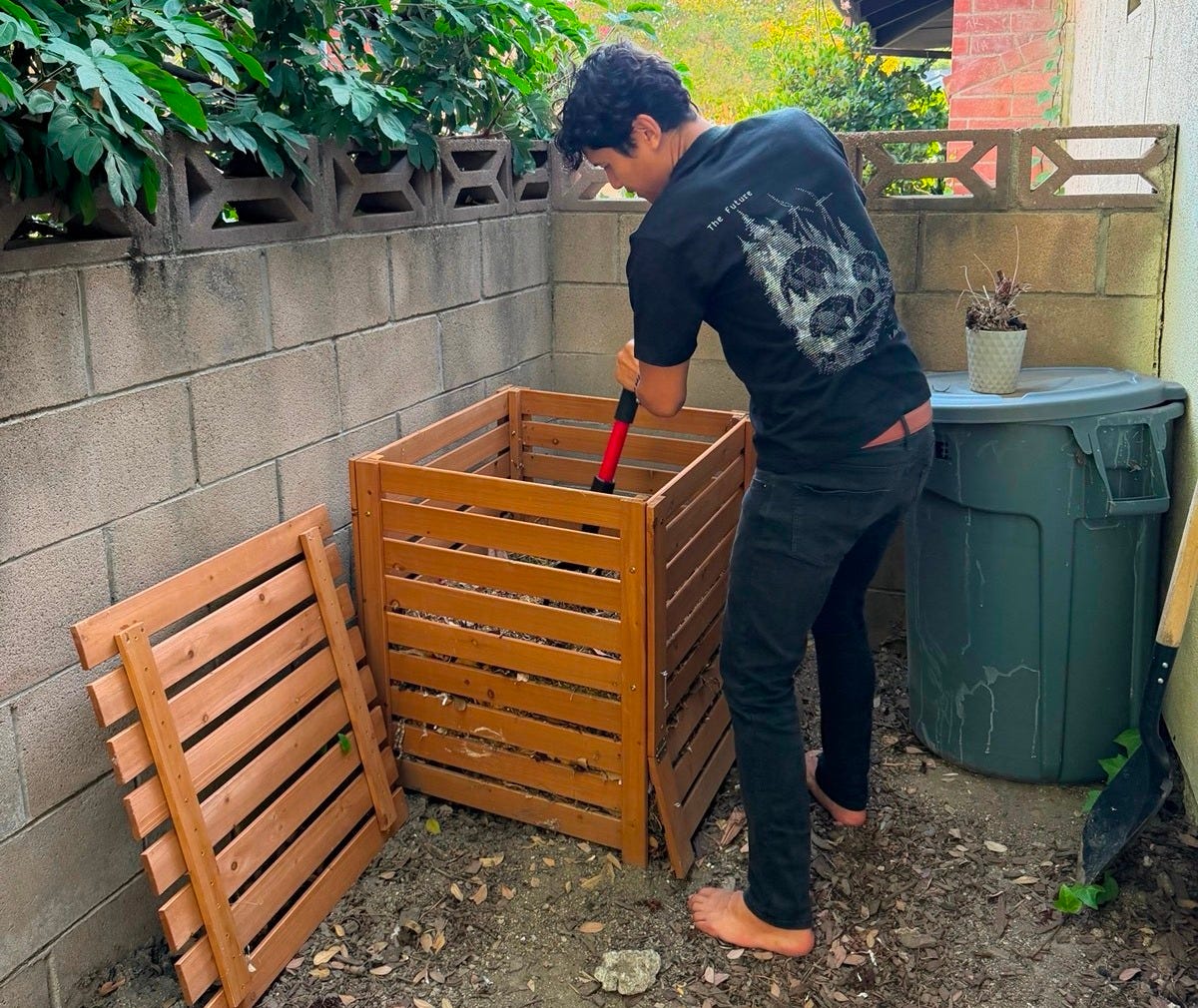
You’re witnessing the miracle of life
But it goes beyond just a feeling. You get to witness a miracle in action. When you make your own compost, you are actually breeding trillions upon trillions of microbes. These tiny lifeforms eat up the organic matter you piled up for them and then become meals for all sorts of insects such as beetles, centipedes, and earthworms. Then these guys become food for birds and mammals.
Now, I’m able to look outside my window and observe a vibrant ecosystem of plants, insects, and lizards… eating and dancing to a symphony of birds. Who knew it could be so easy to experience such glory right in our backyards?
Here’s a hummingbird neighbor that loves our composting pile.
A pleasant outdoor activity for the family
Composting has also become a wonderful way for my family to bond. Here’s a few photos of my daughters helping me construct our bin. Together, we get to work in the yard, learn about nature, grow new plants, and cultivate relationships with them. It’s a precious experience and I hope that it will positively influence their connection to the natural world as they grow up.
The magic of nutrient-rich soil
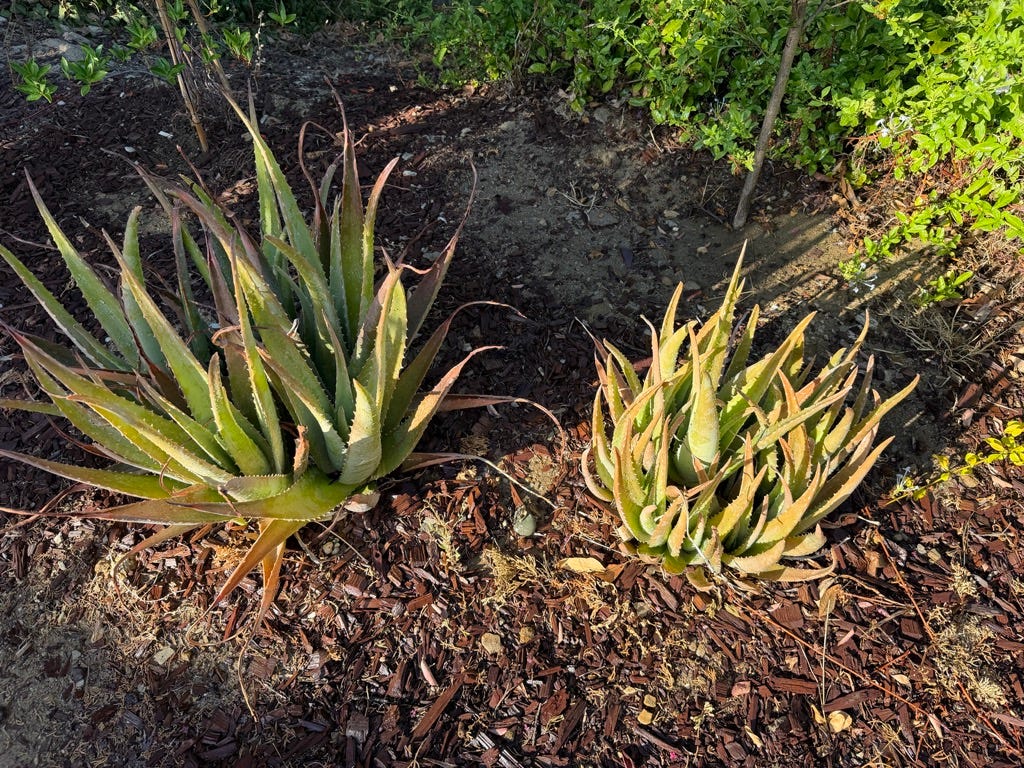
Here’s a photo of my two aloe plants, Algebra and Allen. I planted Algebra with just one helping of composted soil, and left Allen with his original potted soil. I watered them the same and kept them together for over a year. Their difference in size and thickness absolutely shocked me!
Getting started is easy
There are many different composting techniques, but it all begins with four main ingredients:
Greens (nitrogen): food scraps, coffee grounds, grass clippings
Browns (carbon): dry leaves, straw, woody material, shredded paper & cardboard
Air: turning the pile keeps it aerobic, the difference between sweet, earthy-smelling compost from stinky anaerobic rot
Moisture: water the pile enough, but not too much (~40-60% moisture)
Equipment:
A small corner of the yard for your pile
A pail for the kitchen to collect scraps
A pitchfork
(optional) A bin - here’s the one I bought or you can DIY
When you’re beginning, just keep it simple and enjoy the process. Aim for roughly 2–3 parts browns to 1 part greens, water it occasionally, and nature handles the rest. In a few months: black gold.
For more in-depth guides, check out some of these articles:
You Don’t Have to Do It Alone
This is where I get to shout out one of my favorite projects in the Solarpunk ecosystem: MakeSoil, a decentralized network of local composters.
’s story is peak Solarpunk: back in 2009, he was living in a suburban apartment block in Raleigh, North Carolina, watching all his neighbors send their food scraps to landfill. So he banged together some discarded wooden pallets into a compost bin and started knocking on doors, inviting neighbors to bring him their scraps7.
That one pallet bin became a platform, and that platform became a global movement, now active in over 70 countries.
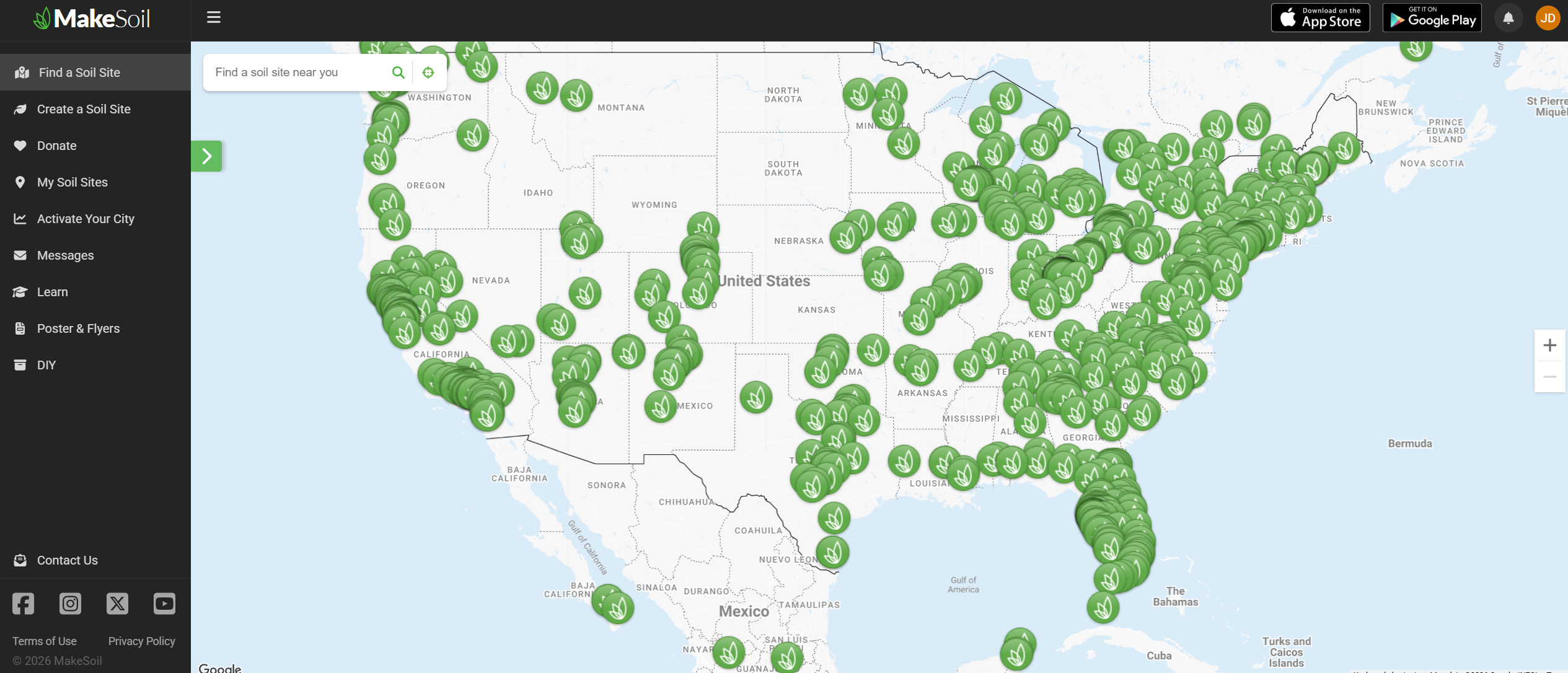
Here’s how it works:
A Soil Maker hosts a compost setup, a “soil site”, and posts it on the MakeSoil map.
Soil Supporters nearby join the site and bring their food scraps.
Week after week, everyone watches their “waste” disappear and new, living soil build up in its place.
This model is a decentralized alternative to curbside compost pickup with some nice perks:
You meet your neighbors.
You stimulate your local food system.
You see the transformation happen, turning an eco-chore into a community ritual.
You create a new potential income stream.
That’s the MakeSoil vision in full: a global movement to capture carbon, restore nutrients to the local food system, improve community resilience, re-align economic incentives, and unify people in caring for the Earth. It’s everything we believe at Agartha, growing out of a pile of banana peels.
Composting at scale is already happening
It’s also worth celebrating the story of the ‘green bins’: cities and states have already been implementing larger composting programs to divert organic waste from landfills and reduce methane emissions.
In the USA, nine states, including California, Vermont, Massachusetts, and Washington8, have enacted laws requiring organic waste diversion. Meanwhile, major cities like San Francisco, Seattle, Portland, and New York City operate mandatory curbside collection systems.
European Union nations are significantly ahead in adoption, with Austria, the Netherlands, France, Spain, and Germany9 composting approximately 18–34% of municipal waste, driven by directives to reduce landfill use. Additionally, cities in Latin America and the Caribbean, such as Bogotá, Medellín, and Mexico City, are experiencing a resurgence in composting markets, with some diverting up to 15% of their waste through centralized or decentralized facilities.10
Putting that into perspective
To get a sense of the impact coming from just one city: San Francisco diverts approximately 550 to 650 tons of organic waste from landfills every day through its citywide composting program. This daily collection results in the annual diversion of roughly 255,500 tons (or approximately 2.5 million tons cumulatively since the program’s inception) of compostable material, including food scraps and yard trimmings.
San Francisco has composted roughly seven Empire State Buildings’ worth of material.
Every single day, the city keeps the equivalent of a fully loaded Boeing 747 (about 400 tons) plus change out of the landfill, and instead turns it back into soil.
Composting that material instead avoids somewhere in the neighborhood of 130,000–200,000 tons of CO₂-equivalent per year, roughly like taking 30,000–40,000 cars off the road permanently.
Check out what city composting solutions look like:
Let’s go Make Soil!
Composting reframes “waste” as a relationship: the scraps that fed you go back to feed the soil that grows the next meal. It may not be a single silver bullet to solve the metacrisis, but every pile is a small rebellion against a system that treats the living world as disposable. It’s regeneration you can hold in your hands. It is the simplest, most Solarpunk, value-additive action you can take right now. And perhaps it’s the beginning of a journey towards greater solutions and cooperation around planetary regeneration.
Imagine a world where all our neighbors are healing the soil, cleaning the air, growing food, and sharing meals in loving community. A world where our garbage alchemizes into life. A world where we feel deeply connected with the wisdom and power of mother nature. A world where we humans have the power to come together and rebalance an entire global ecosystem. That’s the Solarpunk world I choose to live in.
It doesn’t require much to get started. Keep it simple and don’t worry about perfection: just doing it and understanding the process is the real value. It reminds me of the old adage “If you want to change the world, change yourself.” What happens when just one person decides to take action? Who does that inspire? How many more will join? How far does that spread? We can do this! One backyard at a time…
So what’s stopping you from starting your pile? Have a composting setup you’re proud of? Drop a photo or story in the comments, or come share it in our Telegram. We’d love to feature some community setups in a future post! 🪱
Until then, sending you love (and healthy microbes)... 💕
✨ Thanks for reading! Agartha is a Solarpunk Builder Network on a mission to accelerate Planetary Regeneration. 💕 Join us as we chronicle our journey through residencies, co-living places, pop-up cities, regenerative villages, and Solarpunk lifestyles. ☀️
https://www.epa.gov/sustainable-management-food/composting
https://www.epa.gov/land-research/quantifying-methane-emissions-landfilled-food-waste
https://www.epa.gov/land-research/quantifying-methane-emissions-landfilled-food-waste
https://www.makesoil.org/learn
https://www.epa.gov/system/files/documents/2025-01/environmental-value-of-applying-compost.pdf
https://pmc.ncbi.nlm.nih.gov/articles/PMC10625358/
https://www.oneearth.org/climate-hero-josh-whiton/
https://climatechangeresources.org/learn-more/communities/communities_waste/composting/
https://e360.yale.edu/features/recyclings_final_frontier_the_composting_of_food_waste
https://drawdown.org/explorer/increase-centralized-composting
Comments
Nothing yet. Say the first thing.
Sign in to join the conversation.