
Executive view
NRF is approaching its centenary with a business that looks very different from the radiator repair factory founded in Amsterdam in 1927. Cooling remains the foundation, but the company now sells sensors, electronics, emissions-management products, EV components and turbochargers through a logistics network built for European scale. The strategy is not diversification for its own sake. It is an attempt to sell more relevant categories through the same distributors, catalogues, warehouses and technical relationships.
Automotive Aftermarket CEE Newsletter is a reader-supported publication. To receive new posts and support my work, consider becoming a free or paid subscriber.
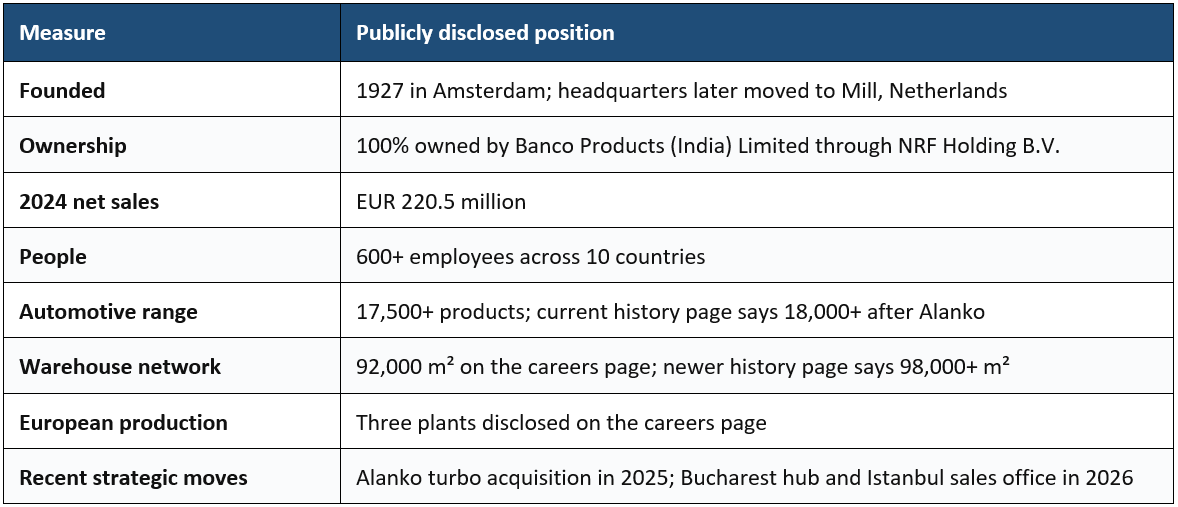
The company reported EUR 220.5 million in net sales for 2024, employs more than 600 people across ten countries and lists more than 17,500 automotive products on its careers page. Its newer corporate history uses a figure above 18,000 after the Alanko turbo acquisition. The difference is best read as a timing and scope issue, not as a contradiction that changes the strategic picture.
BOTTOM LINE: NRF is not trying to become another universal wholesaler. It is building a specialist product platform with enough range, stock and technical depth to become more important to the wholesalers it already serves.
Company at a glance
1. What NRF is - and what it is not
NRF sits in an interesting position in the European independent aftermarket. It is a manufacturer and product specialist, but it also behaves like a logistics-intensive platform. It does not need to own the workshop relationship in every country. It needs to make its range easy for national and regional distributors to catalogue, stock, explain and deliver.
That distinction matters. A wholesaler wins by breadth, route density, credit and the next delivery run. NRF wins by giving that wholesaler credible coverage in technical categories where failure is expensive and identification matters. The radiator remains a useful anchor because it carries nearly a century of brand permission. The growth question is whether that permission transfers to electronics, emissions, EV parts and turbochargers.
The company has already moved beyond the narrow definition of cooling. Its current automotive menu spans engine cooling, air conditioning, sensors and electronics, air and emissions management, turbochargers and e-mobility. The operating logic is simple: keep the specialist reputation, broaden the basket and use one supply chain to monetize more of the same customer base.
2. Scale with an important caveat
NRF’s EUR 220.5 million of 2024 net sales makes it a meaningful European supplier, but it should not be compared lazily with a universal parts distributor. The revenue mix includes automotive aftermarket and thermal-engineering activities, while the company itself separates trade from made-to-order cooling solutions for rail, marine and industrial customers.
The published operating numbers also move between company pages. One page lists 17,500+ automotive products and 92,000 m² of warehouses; the newer history page says more than 18,000 products and 98,000+ m². These are normal consequences of a fast-changing network and different publication dates, but they are a reminder to avoid false precision. The useful conclusion is that NRF has crossed from specialist catalogue to broad category platform.
The more demanding consequence is inventory. A catalogue above 17,500 references does not create value by itself. It creates working-capital needs, slow-moving stock, returns exposure and a permanent obligation to improve data quality. The commercial benefit appears only when the right reference is available close enough to the customer and identified correctly the first time.
“The aftermarket is all about volume and efficiency... The days of surplus margins paying for shipping goods back and forth through Europe are long gone.”
” Scaling up is key in the automotive industry. We have doubled our sales in 5 years and expect organic growth to continue. Reporting and financing requirements have grown with us.”
Frank Toebes, Managing Director of NRF.
3. Europe is the engine room
NRF’s expansion is still overwhelmingly European. This is where the warehouses, product teams, laboratories and distributor relationships sit. The company can export globally, but Europe remains the operating base that makes those exports possible.
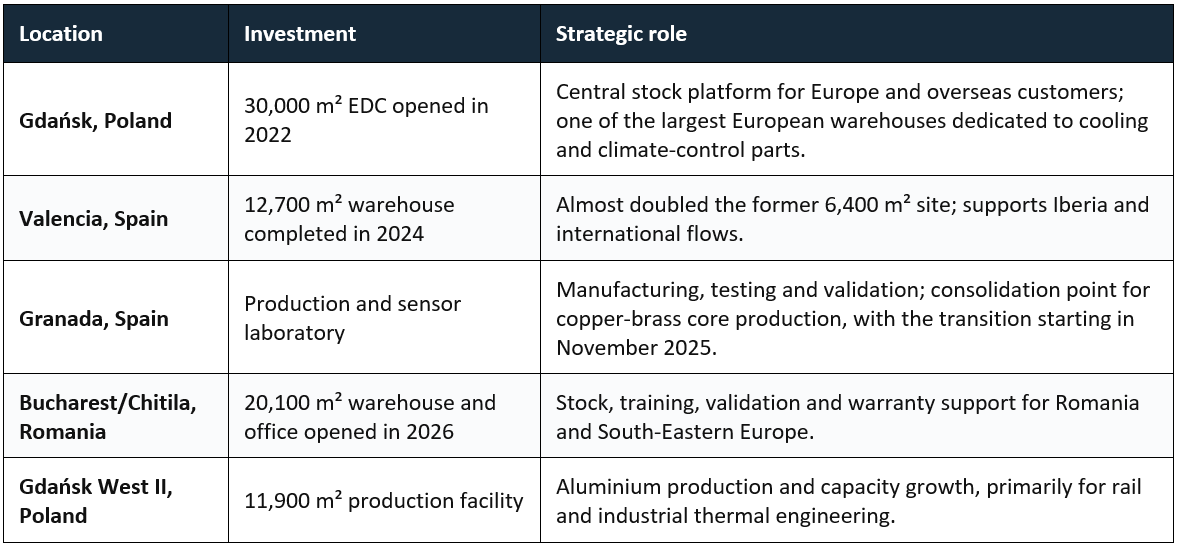
The pattern is disciplined rather than spectacular. NRF is adding capacity where it can combine customer proximity with regional scale. At the same time, it is consolidating specialist production: the transfer of copper-brass core manufacturing from Mill to Granada began in November 2025, a reminder that expansion also means choosing what not to duplicate.
4. Romania is more than a local warehouse
The Bucharest investment is the clearest signal in NRF’s current geography. MLP Group announced a long-term lease for 20,100 m² at MLP Bucharest West in Chitila: 18,600 m² of warehouse space and 1,500 m² of offices. The landlord planned handover for November 2025; NRF’s current history records the site as opened in 2026. NRF is the tenant and operator, not the property owner.
The location matters because it shortens the physical and commercial distance to South-Eastern Europe. Chitila sits beside Bucharest’s ring-road infrastructure, with access toward the A1 corridor and the wider Romanian motorway network. It can serve Romania directly while supporting the Balkans and nearby non-EU markets without moving the core inventory platform outside the European Union.
The facility is also planned for technical training, validation and warranty applications. That is strategically more interesting than square metres. A warehouse creates availability; a technical centre creates trust, data and fewer repeated failures. In the aftermarket, the second capability often protects the margin created by the first.
ROMANIA SIGNAL: NRF is treating South-Eastern Europe as a service region that deserves local stock and technical capability, not as an export territory managed permanently from Western Europe.
5. The portfolio move: cooling plus
Cooling remains the credibility engine. NRF lists 3,300 radiator references covering more than 15,200 OE references and 93% of the European car parc. That is the kind of coverage that earns catalogue visibility and gives distributors confidence that a supplier can solve most mainstream applications.
The growth strategy is to carry that credibility into adjacent categories. Sensors and electronics are supported by the Granada laboratory established in 2023. Air and emissions products broaden the combustion-engine basket. Turbochargers add a technically demanding and faster-growing category. EV parts extend the relevance of thermal-management know-how into the next vehicle parc.
The Alanko transaction is the sharpest example. NRF took over the turbocharger business in May 2025 and moved marketing, logistics and customer service into its own network. Alanko contributed established German credibility, new and remanufactured products and category expertise; NRF contributed funding, distributor access and European availability. This is a better fit than launching a generic turbo line from zero.
“With this acquisition, we bring the Alanko technical knowhow and credibility in-house. Furthermore, we are excited to add one of the fastest growing aftermarket product ranges to our portfolio.”
Frank Toebes, Managing Director of NRF.
The opportunity is revenue per customer. The risk is brand dilution. A customer who trusts NRF for radiators does not automatically trust it for every sensor or turbocharger. The company must earn each transfer through coverage, catalogue accuracy, technical support and warranty behaviour.
6. E-mobility: a natural extension, not a slogan
Thermal management does not disappear in an electric vehicle. It becomes more distributed and, in several systems, more critical. Batteries, inverters, electric motors, cabin conditioning and charging systems all create cooling and control requirements. That gives NRF a credible bridge from its historical competence into electrification.
NRF’s Innovation Range includes more than 250 components for Tesla models and more than 160 parts for BYD vehicles. The company describes itself as one of the first aftermarket suppliers to bring a dedicated BYD range to market. It also operates an e-mobility office at the Automotive Campus in Helmond for development, vehicle testing and technical support.
The BYD move deserves attention. European suppliers often build EV programmes around the installed base of premium Western brands. NRF is also preparing for Chinese parc growth. That may prove especially relevant in price-sensitive European and emerging markets, where affordable electrified vehicles can scale faster than premium battery-electric cars.
“Digital future is today.” Frank Toebes, Managing Director of NRF.
The timing risk is obvious: EV parc development is uneven, reference demand is fragmented and early catalogues can be expensive to support. The strategic answer is not to choose between combustion and electric. It is to manage both curves without allowing tomorrow’s range to starve today’s service level.
7. Emerging markets: corridor before empire
NRF’s emerging-market story should be stated carefully. The company exports to more than 100 countries and recruits beyond Europe, but its largest physical investments remain European. There is no publicly disclosed automotive distribution complex in Africa or Latin America comparable with Gdańsk, Valencia or Bucharest.
The visible model is a corridor strategy. Inventory stays in large European hubs; local commercial capability moves closer to the next ring of markets. Bucharest supports South-Eastern Europe. The Istanbul sales office, established in 2026, creates local presence in Turkey. Banco provides an Indian manufacturing and sourcing base. Product development for BYD and other Asian vehicles gives the range relevance beyond the traditional Western European parc.
This is a lower-risk expansion model than building standalone infrastructure in every market. It also has limits. Export reach is not the same as local market power. Without disclosed revenue, market share or country-level investment outside Europe, the correct description is selective commercial expansion supported by a European logistics platform.
8. Ownership: independent identity, not independent capital
NRF became part of Banco Products (India) Limited in 2010. Banco states that it acquired 100% of Nederlandse Radiateuren Fabriek B.V.; its audited FY2024-25 annual report identifies NRF Holding B.V. as a wholly owned subsidiary. The national NRF companies sit below that holding structure as indirect, or step-down, subsidiaries. [9][10]
Banco is not a financial institution. It is an Indian automotive-component manufacturer founded in 1961, focused on engine-cooling and sealing products. That ownership gives NRF access to manufacturing capability, sourcing relationships and capital while leaving the Dutch company with its own brand, management identity and European commercial architecture.
NRF sometimes describes itself as an independent part of Banco. The word independent should be read operationally, not legally. The company has its own market identity; it does not have separate outside shareholders.
OWNERSHIP IN ONE SENTENCE: NRF is a Dutch-headquartered aftermarket and thermal-management group operating as a wholly owned subsidiary of publicly listed Indian component manufacturer Banco Products (India) Limited.
9. What can go wrong
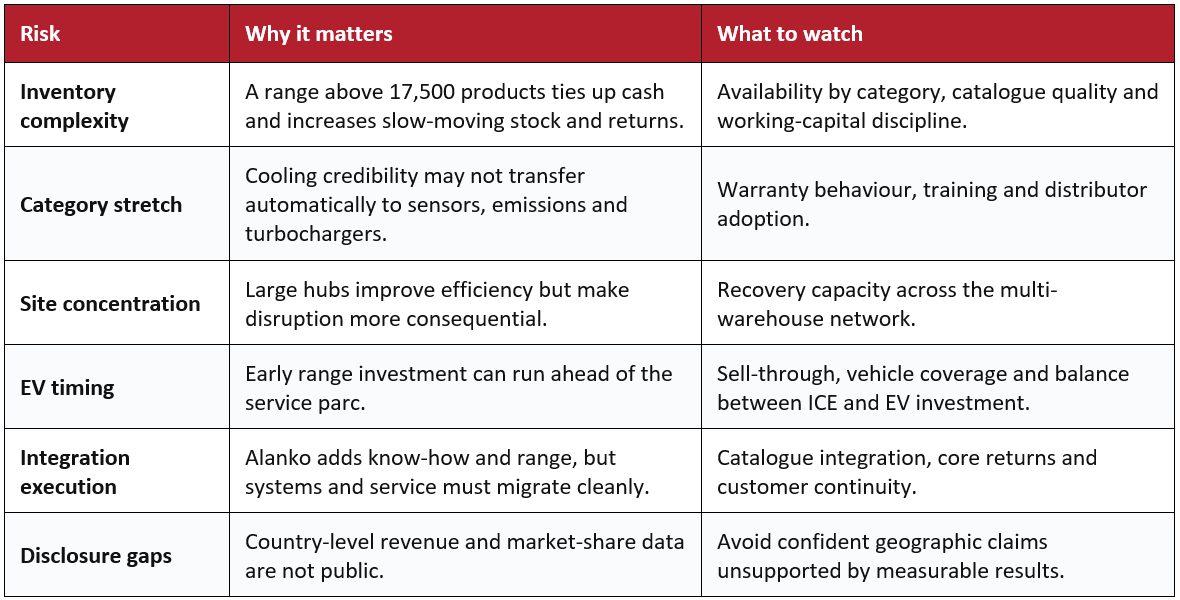
The 2025 fire at NRF France’s Valenciennes operation is the practical reminder. Banco disclosed an estimated preliminary insurance claim of EUR 5.97 million in its February 2026 results note. The event does not invalidate the hub model, but it shows why network redundancy, insurance and recovery procedures belong in the commercial conversation.
10. Outlook
NRF enters its centenary year with a stronger platform than the word radiator suggests. It has meaningful European scale, broad car-parc coverage, a dense logistics network and a portfolio that now addresses both combustion and electric vehicles. Romania and Turkey extend the commercial perimeter; Alanko expands the basket; Banco connects the European business to an Indian industrial base.
The next test is not whether NRF can announce more references or more square metres. It is whether the enlarged platform converts into higher distributor relevance without losing service quality or working-capital control. The company must prove that its newer categories can rotate through the network with the same credibility as cooling.
If it succeeds, NRF will occupy a valuable middle ground: too technically focused to be a generic parts brand, but broad and available enough to be a strategic supplier across multiple aftermarket categories. That position is difficult to build and even more difficult to copy.
Titi’s take
NRF’s real transformation is not from radiators to parts. It is from category specialist to aftermarket platform. The warehouses make the range visible, the laboratories make it credible and Banco makes it financeable. Romania is the most revealing move: 20,100 square metres are not needed to make a press release; they are needed when a company wants South-Eastern Europe to become part of its normal service territory. The opportunity is clear - sell more technical categories through relationships already earned. The discipline is equally clear - do not let 18,000 references become 18,000 reasons for working capital and service quality to drift.
My conclusion: NRF should keep expanding beyond cooling, but it should behave like a specialist every time it enters a new category. Breadth opens the door; technical credibility keeps the account.
Methodology and sources
This report started from the user-supplied NRF research document. Public information was reviewed through 7 August 2026. Company figures are presented as disclosed and are not adjusted to create artificial comparability. Where NRF pages carry different product or warehouse totals, the report states the difference and treats it as a timing-and-scope issue.
Interpretive statements - including the description of Romania as a regional bridge and NRF as a specialist platform - are the author’s analysis, not quotations from the companies.
[3] NRF - Radiators product page
[4] NRF - New 12,700 m² warehouse in Valencia
[5] MLP Group - NRF at MLP Bucharest West
[6] NRF - 11,900 m² production facility in Poland
[7] NRF - Alanko turbocharger acquisition and transition
[8] NRF E-Mobility - Innovation Range
[9] Banco Products - FY2024-25 annual report
[10] Banco Products - About us and 2010 acquisition
[11] NRF - News archive and Valenciennes fire notice
[12] NRF - Copper-brass production consolidation notice
[13] NSE filing - Banco results note on NRF France fire
Automotive Aftermarket CEE Newsletter is a reader-supported publication. To receive new posts and support my work, consider becoming a free or paid subscriber.
Comments
Nothing yet. Say the first thing.
Sign in to join the conversation.