
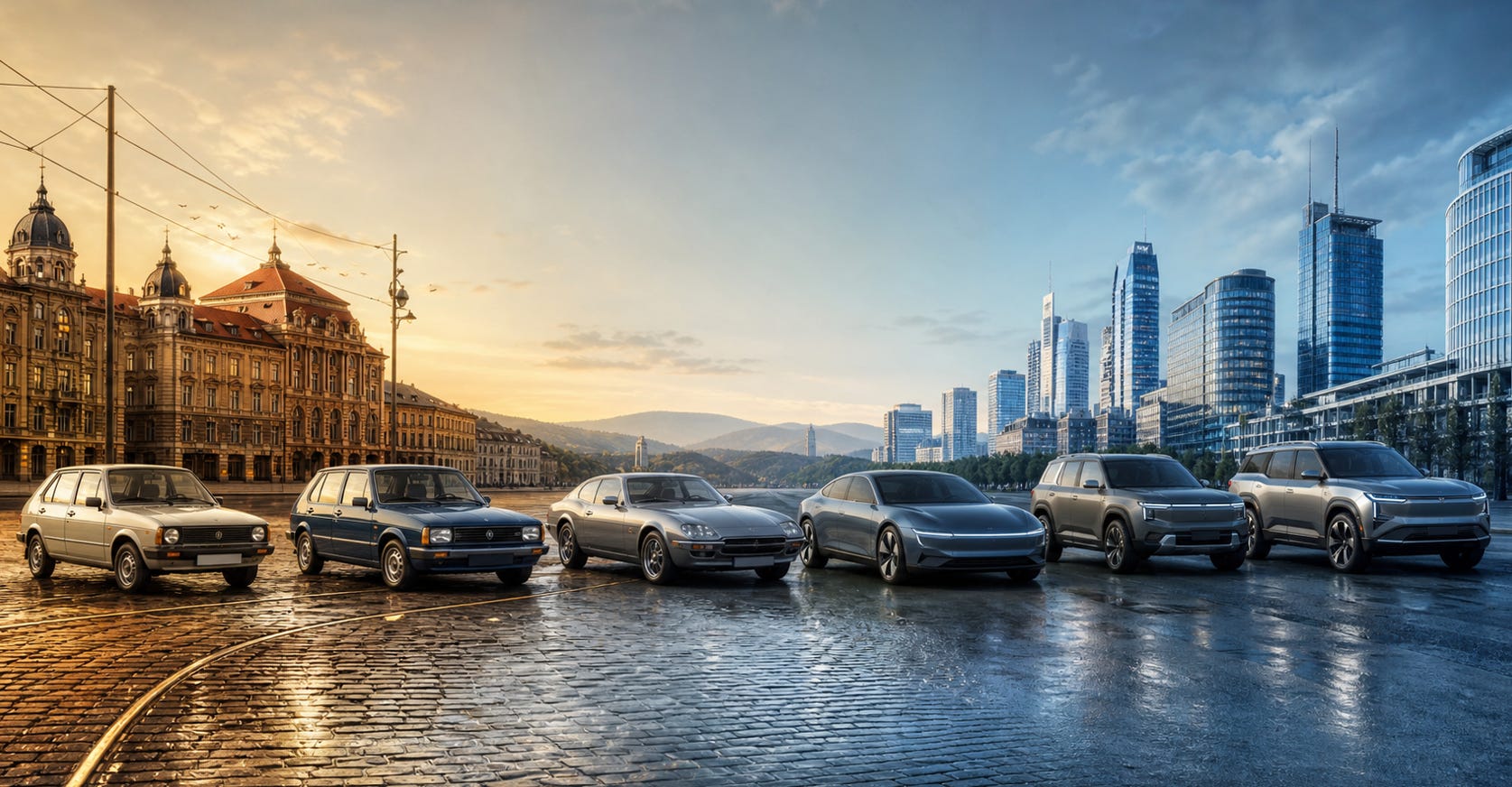
The automotive industry has discovered that its past can be one of its most valuable resources. Instead of relying exclusively on unfamiliar new names, an increasing number of manufacturers are bringing back models that disappeared years or even decades ago.
The phenomenon is not entirely new. Volkswagen, for example, revived the Scirocco name in 2008 after a 16 year absence. Its third generation remained in production until 2017, when the Scirocco story came to an end once again. It is a useful historical example of the trend, rather than one of the current revival projects.
https://www.volkswagen-newsroom.com/en/scirocco-3-20082017-19654
Today, cars such as the Renault 5, Ford Bronco, Toyota Supra, Honda Prelude and Mitsubishi Pajero show that automotive nostalgia has evolved into a sophisticated business strategy. Reviving a famous model can boost sales, attract attention to an otherwise conventional product range, reduce the risks associated with an unknown name and even make new technologies, particularly electrification, more appealing.
Mitsubishi Pajero: the return of a brand defining vehicle
One of the most significant current revivals is the Mitsubishi Pajero. Mitsubishi Motors has confirmed that an all-new off-road SUV bearing the Pajero name will make its world premiere in autumn 2026. The model was withdrawn from international markets in 2021, meaning that its return comes after an absence of approximately five years.
The stakes are high. Pajero is not simply a familiar name: it is one of the vehicles that built Mitsubishi’s global reputation. Introduced in 1982, the model recorded cumulative sales of more than 3.25 million vehicles across over 170 countries and regions.
Its motorsport record is equally important. Pajero achieved 12 victories in the Dakar Rally, including seven consecutive wins. That heritage gives the forthcoming model an authenticity that would be extremely difficult to create around an entirely new name.
https://www.mitsubishi-motors.com/en/newsroom/newsrelease/2026/20260529_2.html
The new Pajero could become a halo vehicle for Mitsubishi. Its purpose will not necessarily be limited to generating its own sales. It can also restore visibility to the brand and transfer some of its reputation to the rest of Mitsubishi’s range.
Fiat 500 and MINI: turning nostalgia into a business
Fiat 500 and MINI are among the most successful examples of modern automotive revival.
Fiat relaunched the 500 in 2007, exactly 50 years after the original model appeared. The company did not attempt to reproduce the 1957 car mechanically. Instead, it retained its emotional qualities: compact proportions, rounded styling, a cheerful personality and extensive opportunities for personalisation.
The result became one of Fiat’s greatest commercial successes of the 21st century. Approximately two million examples of the modern 500 were built during its first ten years. The model also demonstrated that a small, historically affordable car could be repositioned as a fashionable lifestyle product.
https://www.media.stellantis.com/em-en/heritage-hub-italy/press/heritage-hub-hosts-the-exhibition-the-italy-we-love-welcome-to-the-home-of-the-fiat-500
BMW followed a comparable formula with MINI. Production of the classic Mini ended in 2000, and the modern interpretation reached the market in 2001. Its recognisable design, lively handling and possibilities for customisation were preserved, but the new car was placed in the premium segment.
The Oxford plant built its first million modern MINIs in only six years. More importantly, the revival transformed a single historic small car into an international premium brand with several model lines.
https://www.press.bmwgroup.com/global/article/detail/T0012284EN/1959-%E2%80%93-2009-sixty-years-of-mini
These two cases proved that a popular car from the past could become an aspirational product. Customers were no longer buying transportation alone; they were also purchasing design, identity and a place within a familiar story.
Ford Bronco: rebuilding an off-road identity
Ford brought the Bronco back in 2020 after an absence of almost 25 years. The new vehicle does not copy its predecessor, but its proportions, design details and off-road abilities establish a clear connection with the original.
The Bronco name immediately gave Ford a credible rival to the Jeep Wrangler. It also became the foundation of a broader off-road family, supported by accessories, special editions, driving experiences and a distinctive brand identity.
This illustrates an important advantage of reviving a successful model: the manufacturer does not have to explain what the vehicle is supposed to represent. The public already associates the Bronco name with freedom, durability and adventure.
https://media.ford.com/content/fordmedia/fna/ca/en/news/2020/07/06/bronco-returns.html
Toyota Supra: a legend strengthened by popular culture
Toyota revived the Supra in 2019 following a 17-year production hiatus. The value of its name came not only from previous generations, but also from motorsport, video games and its prominent role in the Fast & Furious film franchise.
The fifth-generation Supra became the first global model of Toyota’s Gazoo Racing sports car range. Its development also illustrates how manufacturers can make specialist models financially viable by sharing engineering and production resources. The GR Supra was developed in cooperation with BMW and built alongside the BMW Z4 in Austria.
Some enthusiasts criticised the extent of that collaboration, but the Supra retained essential characteristics associated with its predecessors: a front-mounted engine, rear-wheel drive and, in its flagship version, a turbocharged inline-six engine.
The revival therefore achieved more than the return of a famous badge. It gave Toyota a recognisable performance flagship around which it could develop the identity of Gazoo Racing.
https://global.toyota/en/newsroom/toyota/26144480.html
Alpine A110: reviving an entire brand
Renault did not merely revive a model when it introduced the new Alpine A110 in 2017. It brought an almost dormant marque back to life.
The modern A110 inherited the philosophy of the original Berlinette: compact dimensions, low weight, a mid-mounted engine and an emphasis on agility rather than extreme power. Its design unmistakably recalls the historic car, while its structure and technology are entirely modern.
The A110 subsequently became the starting point for Alpine’s transformation into a broader performance brand. This makes it one of the clearest examples of a heritage model being used to rebuild an entire business rather than simply fill a gap in a manufacturer’s range.
https://media.alpinecars.com/?lang=eng&p=79696
Renault 5 and Renault 4: wrapping electrification in familiar memories
The newest stage of the revival trend involves using historic names for electric vehicles. Manufacturers have recognised that unfamiliar technology can become easier to accept when it is presented through a familiar design and identity.
The Renault 5 E-Tech Electric reinterprets the popular small car first introduced in 1972. Its lights, bright colours and numerous exterior details reference the original, but its electric platform, powertrain and digital technology belong entirely to the modern era.
For Renault, the car represents both the return of a much-loved model and a central part of its transition towards electric mobility. The company deliberately adopted a “retrofuturistic” approach, transforming recognisable elements of the old Renault 5 rather than simply copying them.
https://media.renault.com/renault-5-e-tech-electric-the-electric-renaulutionary-pop-icon?lang=eng
The same strategy was applied to the Renault 4 E-Tech Electric, commercially launched in 2025. The original Renault 4 was a simple, practical and versatile family car. Its modern successor interprets those qualities through an electric crossover—the body style currently favoured by a large proportion of European buyers.
Renault is therefore reviving more than the appearance of its old cars. It is transferring the affection accumulated by historic names to a new generation of electric products.
Honda Prelude: an old name for the hybrid era
The Honda Prelude returned in September 2025 after approximately a quarter of a century. The sixth-generation car is no longer a conventional sports coupé in the traditional sense. Instead, it is a hybrid performance model intended to connect Honda’s engineering heritage with its electrified future.
The essential promise associated with the Prelude, driving enjoyment, is retained, but it is delivered through a different type of powertrain. Honda describes the new model as a bridge towards a new generation of electrified sports vehicles.
The Prelude demonstrates how a historic name can legitimise a change in direction. Honda is not attempting to reproduce one particular generation of the original car. It is using the model’s reputation for innovation and accessible performance to introduce a new interpretation of the sports coupé.
https://global.honda/en/discover/feature/02/
Why the revival strategy works
Bringing back a successful name offers several advantages:
- The model already possesses public recognition.
- Former owners and enthusiasts can become ambassadors for the new vehicle.
- A familiar name attracts immediate media and social-media attention.
- Historic design elements help the vehicle stand out in an increasingly uniform market.
- Emotional value can support higher prices and more profitable special editions.
- New technologies can be introduced in a more familiar and approachable form.
- A famous model can improve the image of the manufacturer’s entire range.
This approach also reduces one of the largest challenges facing a new vehicle: creating an identity. A manufacturer launching an unfamiliar name must invest heavily in explaining its character and position. A revived model arrives with decades of accumulated meaning.
Nostalgia is not a guarantee of success
A famous badge cannot compensate indefinitely for a weak product or a shrinking market segment.
Volkswagen’s New Beetle generated enormous attention when it appeared in 1998, but demand eventually declined as buyers moved towards SUVs and crossovers. Production of the final Beetle generation ended in 2019. Volkswagen noted that approximately 600,000 examples had been sold since 2011, while acknowledging that cult status does not automatically translate into sustained sales.
https://www.volkswagen-newsroom.com/en/stories/bye-bye-beetle-4446
Authenticity is another potential problem. A revived model must preserve something meaningful: its proportions, purpose, driving experience, accessibility or social role. If a manufacturer simply applies a celebrated badge to an unrelated vehicle, customers may see the project as a superficial marketing exercise.
Expectations can also become a burden. Enthusiasts often remember the original through a filter of nostalgia and may reject changes required by modern safety standards, emissions regulations or customer demands. The manufacturer must therefore satisfy existing fans without creating a car that appeals only to them.
The past does not replace innovation—it makes innovation easier to sell
The return of historic models does not necessarily mean that the automotive industry has run out of ideas. It is better understood as a response to the rising cost and risk of developing new vehicles.
Platforms, powertrains and electronic systems are increasingly shared between multiple models and brands. As the underlying technology becomes more similar, design, storytelling and identity become more important sources of differentiation.
Fiat 500 and MINI show that a well-executed revival can support a brand for decades. Ford Bronco, Toyota Supra and Alpine A110 use history to restore credibility in specialist market segments. Renault 5, Renault 4 and Honda Prelude turn collective memory into a bridge towards electrification. Mitsubishi now hopes that Pajero will restore some of the visibility and prestige that the brand enjoyed during the model’s most successful years.
Manufacturers are not reviving old cars solely for the people who once owned them. They are also targeting younger buyers who know the stories, even if they never experienced the originals.
In an industry permanently focused on the future, the shortest route to the customer may sometimes pass through the past.
Comments
Nothing yet. Say the first thing.
Sign in to join the conversation.