
Story Summary: Tucker makes a mistake at work, gets a promotion, and realizes his life is meaningless. (Scroll Down To Read)
Take the poll for this week’s story, “The Rapture Module”:
(It’s completely anonymous…and fun! Last week’s poll results at end of post)
“Resident Philosopher” Nalini’s take:
Nalini Jacob-Roussety ties simple questions to deeper philosophical frameworks! Listen to her discuss the poll question above. Comment in the discussion area at the end.
💡 Paid subscribers help us publish stories like this every week and access our full archives.
📖 Weekly Short Story
📖 Email cut short? Read This Story on Substack

The Rapture Module by Joshua Hathaway
Tucker had to do a double take: The spreadsheet returned the correct result.
He could have sworn he had made a mistake—his finger slipped—but the cell displayed the number he thought he wouldn’t see. It occurred to him that this was the first time he had noticed such an event, and now that it happened, he could only squint at the monitor as the screen ebbed, wavy lines flowing from top to bottom. He tapped the keyboard and input the formula again, as a test. Same result. He tried one more time. Again, the number appeared. At least I’m not seeing things, he thought.
He looked through his cubicle window to see his coworker, Derrick, whose eyes stayed trained on his own computer.
“Derrick,” Tucker said.
Derrick did not look up.
“Derrick!”
His coworker stopped typing and shot him a toothy smile. It put Tucker off a little.
“Hi, Tucker,” Derrick said in an overly cheery tone. “How may I help you?”
“I messed up a formula and got the right number. Is that normal?”
“Messed up?!” Derrick asked. Tucker recoiled at the excitement. “In Metadyne, you can’t mess up! Don’t doubt yourself, Tuck. I’m sure you typed it in right.” He went back to his work.
Tucker looked back at his screen until it fell asleep and went black. Something about Derrick’s tone perturbed him. He didn’t feel encouraged. He might have heard a sneer, and he didn’t like it.
Screw you, then.
Suddenly, he grew warm in the usually cool and comfortable office.
He reawakened the monitor and stared at the cell until his head ached. He knew he shouldn’t spend so much time thinking about it, but he massaged his temples and thought about it anyway. Maybe he did type it correctly. Maybe his finger went exactly where it was supposed to. He wanted to believe it, but he wasn’t sure that he could. As he looked at the wavy black text, he began to distrust himself more than the formula.
Footsteps clacked against the vinyl floor behind Tucker. He let them come close.
“Is there a problem, Mr. Quinn?” a happy, baritone voice asked.
Tucker swiveled in his chair and put on the cheeriest face he could muster. When he saw Mr. Brown’s pearly teeth, he knew he couldn’t compete and dropped the act. He thought about the spreadsheet phenomenon but figured another conversation would be as fruitless as the last.
“N-No, sir,” he stammered. “I thought there was, but there isn’t—”
“Splendid!” Mr. Brown exclaimed as he clapped his hands.
“I guess,” Tucker muttered. He looked down at his shirt and saw the sweat stains forming in his armpits. Instant embarrassment. He would have given anything for his suit jacket. Of all the days I leave the damn thing at home. He crossed his arms.
Judging by his supervisor’s wide grin, Mr. Brown couldn’t have cared less.
“Even if there was a problem,” Mr. Brown continued, “my good news would surely outshine it.”
“What good news?” Tucker asked.
“You, son”—Mr. Brown paused for dramatic effect—“are being promoted to financial analyst next week!”
Everyone rose from their desks and clapped in unison, their smiling faces looking directly at Tucker. Almost as though they were looking inside him.
Pinpricks of heat spread throughout his body as he tried to shrink into his chair. If the chair had swallowed him whole, it would’ve been a blessing. Everything was so sudden: the correct answer he may or may not have found, Derrick’s reassurance (mocking as it sounded), a pop promotion (if there was such a thing), and all eyes on him. He hated unexpected attention.
“I don’t mean to be rude, Mr. Brown,” Tucker said once the applause subsided, “but I’m getting promoted next week?”
Mr. Brown winced, as though taking offense. “Absolutely! Aren’t you excited?” he asked.
“Sure. But it feels like it’s being thrown on my lap. I’ve only been here a month, and to be honest, I like where I am. I think ‘staff accountant’ is a fine title for now. Maybe someday.”
“Why can’t ‘someday’ be next week?”
“I’m not saying I don’t want to get there one day. Right now, though, it would be a little much. Can I at least have some time to think about it?”
“Afraid not. You’ll report to your new position on Monday.”
Tucker’s lack of choice did nothing to placate him. True, he wanted to be successful, but he wanted to create his own path to that success. If that meant staying as a staff accountant, what was wrong with that?
Mr. Brown’s perpetual grin bothered him. Doesn’t he know how to not smile? Tucker struggled to remember the last time he saw anyone without a happy face. He shifted in his chair. There was something behind the faces he couldn’t quite see.
He adjusted his glasses. “I assume the promotion means more money, right?”
“You got it!”
“I can finally be who I’ve wanted to be, right?”
“I can finally be who I’ve wanted to be, right?”
“You’re two for two!”
Tucker developed a sudden dislike for how Mr. Brown talked. His heart pounded. Not with anger, but frustration.
Which is why he was surprised when he reached for Mr. Brown’s hand and said, “Thank you, sir. I appreciate the opportunity.”
Mr. Brown’s face beamed. He said, “Awesome! Be proud of yourself, Tuck!” He looked out toward the other cubicles. “Let’s hear it for our new financial analyst!”
More applause.
Mr. Brown glanced at his watch. “Well, looks like it’s time to clock out. Have a nice weekend, Tucker. And be proud of yourself!”
The office had emptied out well before Tucker finished packing his briefcase. He tried not to think about the day, but he found it difficult to concentrate on anything else. It was disorienting: a kind of confusing he hadn’t experienced before. The litany of emotions intruding on the dull grind of work and living made him uncomfortable.
He latched his trunk and made his way to the door before turning back to look at the clock on the wall. 5:00p.m. The day ended at 4:30, but he knew he had only been back from lunch for a half hour when he talked to Derrick. That was at 1:30; it could not have been any later.
Tucker shook his head, noting the coincidence: quitting time, right as his symptoms started. He walked to the elevator bay and struggled to remember if that was one of the benefits of this Rapture.
* * *
As Tucker pushed through the revolving door and started his walk home, he wondered if he could have reacted better. Any sane person would have joyously accepted the promotion. More money, more authority. Things he wanted.
But his chest felt empty, like a vacuum had sucked out all manner of positive feeling.
He wasn’t given time to decide. Not even a weekend. More than that, Mr. Brown’s insistence was intimidating, almost a form of coercion. Then he remembered: The company rarely asked his opinion on anything in his time there.
Tucker realized he was holding his breath and exhaled. Thank God the day was done. Of his recent memories of working at the firm, that was his least favorite.
As he waited at a crosswalk, he thought about his favorites. It was weird to think of promotions in such a way, but he considered them his favorite thing about the business world. It wasn’t so much for the benefits as much as the bragging rights. Hi, I’m Tucker Quinn, and I’ve been promoted. He had wanted to say that for a while. Now he could.
That was the thing about Metadyne: It built itself around your fancies. It granted you every wonderful thing you could imagine.
He’d heard of many Raptures: People being skinnier—he found that feature particularly attractive—or more muscular. Having more money. Running your own city. You could run a country if you wanted to. Your choices of identity were endless. The world bent according to your desires.
Your very own paradise. That’s what Tucker heard. He briefly wondered if he could request a refund before the blue stick figure illuminated across the street.
The city was sentient, but not alive. The swarm of people flowing past him on either side moved, looked, and smiled like Derrick and Mr. Brown. Yet, their eyes indicated a lesser state of being. “You know someone’s a person by the light in their eyes,” someone said to him once. “No light in their eyes? They’re just a meaty shell.”
There was an abundance of meaty shells, it seemed.
Colorful video screens flashed overhead, catching his eye. Most of the commercials were generic: a soda commercial here, an ad for running shoes there. Not really his first choices, either. Tucker was usually too preoccupied to notice such things. But that day, he saw something that made him stand in astonishment.
Every other ad was for Metadyne, Inc. Testimonials from employees and customers flashed across the screens along with a short segment about the Rapture Modules.
Initially, he paid the ads no mind. The Metadyne logo was everywhere: on coffee cups, on designer suits. He’d even seen it on a condom box.
But as he walked, an awkward sensation slithered up his spine. The logo was on every product he could think of. The more he thought about it, the more the tingling persisted. The logo showed up everywhere, especially when he least expected it. Or the opposite: when he saw it too often, the Module hid it. Metadyne reacted to him, making its presence known (or inconspicuous) in a calculated manner.
It was not enough that Metadyne was everywhere.
You had to know it was everywhere. It had to burrow into the depths of your mind until you barely thought about it. You had to believe in it as much as you believed the Sun would rise and set.
And when you forgot, it showed up again.
The hair on Tucker’s neck stood on end.
* * *
Up ahead, a coffee shop offered Tucker a solace from the thought. He waded through the crowds at a heightened pace before pushing the wooden door and stepping up to the counter. The barista, a tan girl wearing a plain black visor around her dark hair, wore a face that looked like everybody else’s.
“May I help you, sir?” she asked. She was cordial, at least.
Tucker perused the menus—one for coffee, one for tea—and answered, “Yeah, can I get a large chai latte iced, please?”
“I’m sorry, sir,” the barista said, her smile nearly blinding. It was a wonder her lips didn’t reach her ears. “We only have mocha Frappuccino at this location.”
He opened his mouth to speak, but his vocal cords froze for a moment.
Did she just say what I think she said?
He cleared his throat and tried again. “Maybe you didn’t hear me. I’d like a large chai latte with ice.”
“Perhaps you didn’t hear me, sir. I only have ingredients to make a mocha Frappuccino. It’s your favorite drink, yes?”
Tucker didn’t want to admit that it was.
Something about the girl seemed strange, something he should have seen as soon as they interacted. She sounded like Derrick and Mr. Brown. She had a cheerful voice, but there was another element to it that lay just below the surface. He thought it could be annoyance, but that didn’t fit. This girl was happy as could be. Instead, her demeanor was… artificial. Which made no sense.
He was promised (and paid for) a realistic world.
But he couldn’t think about that. He still wanted a drink, and he slowly clenched his left hand until it trembled.
“Look. I see a menu”—he pointed to the one for the teas—”and I see ‘chai latte’ on it. Stop screwing around and give me an iced chai latte.”
“Unfortunately, no matter how many times you ask for something else, all I can offer is mocha Frappuccino.”
Tucker tried to quell his frustration, and he found his response surprisingly tame. “All I’m asking for is a chai… fucking… latte. If it’s on the menu, why can’t I have it?”
The barista leaned in close, and Tucker took a step back. Her smile unwavering, she said, “Because mocha Frappuccino are your favorite. Would you like one?”
He would have liked to flip one of the tables. He considered walking out, but took a few breaths and replied, “Yeah. One large mocha Frappuccino.”
At least they had something to offer.
“Perfect!” the barista replied.
He made it to the door and took one sip before throwing his coffee in the garbage. He pulled the door open and stepped onto the sidewalk.
Through the window, Tucker saw the barista. Her smile remained.
* * *
Tantalizing smells of boiling pasta and freshly steamed vegetables wafted from the kitchen, but Tucker made straight for the living room. He wanted to invest whatever energy he had left into mindlessness. He sat in his recliner, kicked off his shoes, and crossed his legs. He grabbed the remote and pressed the “On” button. The television fizzled as a nature documentary popped onto the screen.
Supper wouldn’t be ready for a while, so Tucker leaned back in his chair. A monkey screamed and chattered. He hadn’t seen a real monkey for a long time—not since he went to the zoo (outside the Module) the month before. Except for television, there was no way to see them in Metadyne. When he thought about it, he wasn’t sure he’d seen any animals.
Not even a pigeon. He hated pigeons before, but lying in his recliner, he would have given anything to look through his roof and see one of those winged rats flying above the city.
Metadyne, used to it as he was, made him forget what “normal” was.
Metadyne, used to it as he was, made him forget what “normal” was.
He tried to make himself comfortable, but the events of the day gnawed at his mind. A dull pain clasped itself around his forehead. He massaged his temples, but it did little to help. That spreadsheet shouldn’t have fixed itself. It went against his kinder nature, but he would have preferred for the problem to remain. That’s what he was paid to do: fix problems. If he were a financial analyst, his job would be to find problems and solve them. He was one for easy work, but he never thought about how he would feel if everything were handed to him.
The idea caused a numbness in his chest. He put a hand over his heart to make sure it was still beating. It was.
Bare feet thumped in his direction.
“Time for supper, hon,” Delilah said sweetly.
Tucker wanted to keep trying to sleep. “Yes, dear. Be there in a bit.”
* * *
He picked at his broccoli and twirled his spaghetti with his fork. No matter how much he commanded it, his hand would not shove the fork into the food and lift it to his mouth.
“Something wrong, Tuck?”
Tucker looked up. Another smile, somehow the most repellant one of all.
“No, I’m good.”
“You don’t seem good. Is the food okay?”
“Yep. It’s wonderful.”
“I haven’t seen you take one bite. I can make you something else if you—”
“No. This—this is good.” He rose from the table, went to the little window above the sink, and breathed in when the cool evening air met his face. But he felt uncomfortably warm, and a sharp needle of guilt poked at his heart. He never was good at deception. A lie either showed itself on the outside or prodded him on the inside. He reached into the cabinet beside him and pulled out a bottle of bourbon and a double-shot glass.
“Delilah?” he asked, staring out toward the part of the amber horizon visible behind the cityscape.
“Yes, dear?” she responded.
“Do you ever feel… fake? Like, when it comes down to it, nothing you do matters?” He poured some bourbon and took a big sip.
“No, I’ve never felt that way. Why?”
Drop it, Tucker’s brain told him. You don’t need to talk about it. Just drop it.
He turned his head to the refrigerator beside him. “Something happened at work. I got promoted.”
Delilah rose from her chair. “A promotion? That’s wonderful!”
He turned to her. “That’s the thing. Promotions are good, aren’t they?” His voice turned grim. “So why doesn’t it feel good?”
She went to him and made a puppy-eyed face. “Aw, babe. You should be proud of yourself. No need to get so—”
“Mr. Brown told me the same thing!” he interjected. He noticed, for the first time in a month, how dead Delilah’s eyes looked. “I should be proud, and I’m not! It’s like I’m not allowed to be. I wanted it, yeah, but I wanted it to mean something, too. But it doesn’t mean anything. Nothing here”—he raised his hands in a grand gesture—“means anything.”
Tucker looked at Delilah and thought of his Frappuccino as a drop of sweat dribbled down his neck. His grip tightened around the glass. “And the coffee? I don’t think it’s good: Metadyne tells me it’s good. It tells me I can’t get enough of it, that I need to have it all the time! You know, I couldn’t even get a chai latte today. It was on the menu, and I couldn’t get one.” He sipped and finished the bourbon.
Delilah looked puzzled. “So, you’re being like this because you got promoted and couldn’t get tea? Don’t you think you’re overreacting?”
“That’s not the point, Delilah! I don’t care about the promotion or the tea. I care that I had no choice in them. I either got something I didn’t want or couldn’t get something I did want. And that pisses me off!”
“I guess you are overreacting.”
At that, something switched inside Tucker. The frustration he’d felt morphed into anger. He set the glass down, thinking he would break it if he gripped any harder.
“Don’t you care? Don’t you care about my feelings, Delilah? Is it so hard to see where I’m coming from?”
Delilah put her arms around Tucker’s waist. They felt cold. “Tuck, I just want you to calm down.”
“Get off me.”
Delilah’s eyebrows rose, and she hesitated. “What… did you say?”
“I said: ‘Get off!’” Tucker flung Delilah’s arms away. “Nobody cares,” he said, his voice growing louder. “My boss doesn’t care, the barista doesn’t care, and my own fucking wife doesn’t care!”
He grabbed the glass and threw it with a cry. It hit the wall, shattering upon impact. Tucker walked to the table and slumped into his chair. His catharsis provided no relief.
“What am I doing here? Really, what am I doing here? Is this what I wanted? I don’t know. I don’t know anything any—”
A thought crossed his mind. A sudden dread rose within him.
“I don’t know anything. That’s what they want me to think. I can’t be sure of anything. I can’t be happy… without Metadyne.”
He buried his face in his hands. He couldn’t do the job he wanted to do; he couldn’t drink what he wanted to drink; he couldn’t live how he wanted to live. Nothing in this world—his house, his body, his identity—would ever be his. It all belonged to Metadyne.
No wonder their logo was on everything.
Delilah came toward him. “Of course, you can be happy. Don’t I make you happy?”
Tucker looked up. “I know what I’m supposed to say: ‘Yes, dear. You make me happy. You’re the wife I’ve always wanted.’” He hesitated and tsked. “But it’s hard to be anything when you’re not real, isn’t it?”
Delilah’s mouth drooped slightly. Tucker thought he was seeing things and blinked. Yes, her smile flattened, and her face seemed dimmer.
They cleared the table and washed the dishes in silence. The rest of the evening went on in relative peace. As Tucker lay in bed, he thought about Delilah’s neutral face. He offended her, and she was a product of Metadyne.
In effect, he offended Metadyne.
For the first time in as long as he could remember, he smiled. It wasn’t legitimate—it wouldn’t be, so long as he remained in the system—but it was different from everyone else’s. His disillusionment faded.
Still, he had to obey the system. He still had to go to work on Monday, and he would buy a coffee beforehand. And at the end of the day, he had to come home to a wife of a computer system’s making.
It was the life—the Rapture—he wanted.
Complete perfection.
He closed his eyes, and a tear trickled down his face.
It would be a while before someone unplugged him.
Discussion Questions:
Why do you think Tucker was upset that his mistake was automatically fixed? Don’t people want to be the best version of themselves?
Do you agree with Tucker; do promotions and accolades only have value if you feel you earned them? If that is the case, then why do people cheat at sports or other games? Why do students ask teachers to raise their grades?
What would your perfect Rapture experience look like, and why?
Is the basic desire of humanity to be happy, or is it something else? If is it something else, what is it?
If Tucker lives in Rapture, why doesn’t he simply go on an anarchy spree, doing a million horrible things? Do you think people in a world of their own creation would naturally steer towards being horrible?
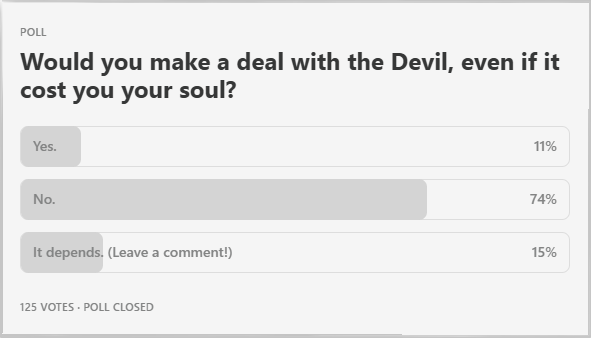
Last Week’s Poll Results:
AWARDS:
Rated “Most Popular Fiction Magazine 2024” by Chill Subs
Rated “Top 10 LitMag of 2023, 2024” by Chill Subs
Rated #1 “The Very Best Literary Magazine” by Ranker
Rated “Top 50 Fiction” on Substack
NEWS:
🤟If you are new to our Substack, take a look at the Welcome Message from our Editor and Founder, Kolby Granville.
🖥️ Want a book club with a focus? We have started a Luma Page for our virtual/zoom and in-person short story discussion groups. Join today!
🆘 Volunteer as an acquisition reader and help us decide which story submissions get published. No experience required, just a keen eye for stories that make you think. If you’re interested, just shoot Kolby an email and he’ll get you set up.
👩🏫 Educators, find out how to get a free copy of a themed edition.
Thanks for reading, sharing, and re-stacking this post!
Maddie
ADVERTISE WITH US
Interested in advertising in this email? Learn more.
Comments
Nothing yet. Say the first thing.
Sign in to join the conversation.