
If you would like to submit to After Dinner Conversation Magazine, here’s how.
Read Val Stuart’s short story, "What Do Friends Say?”:
Click the image to get your copy!
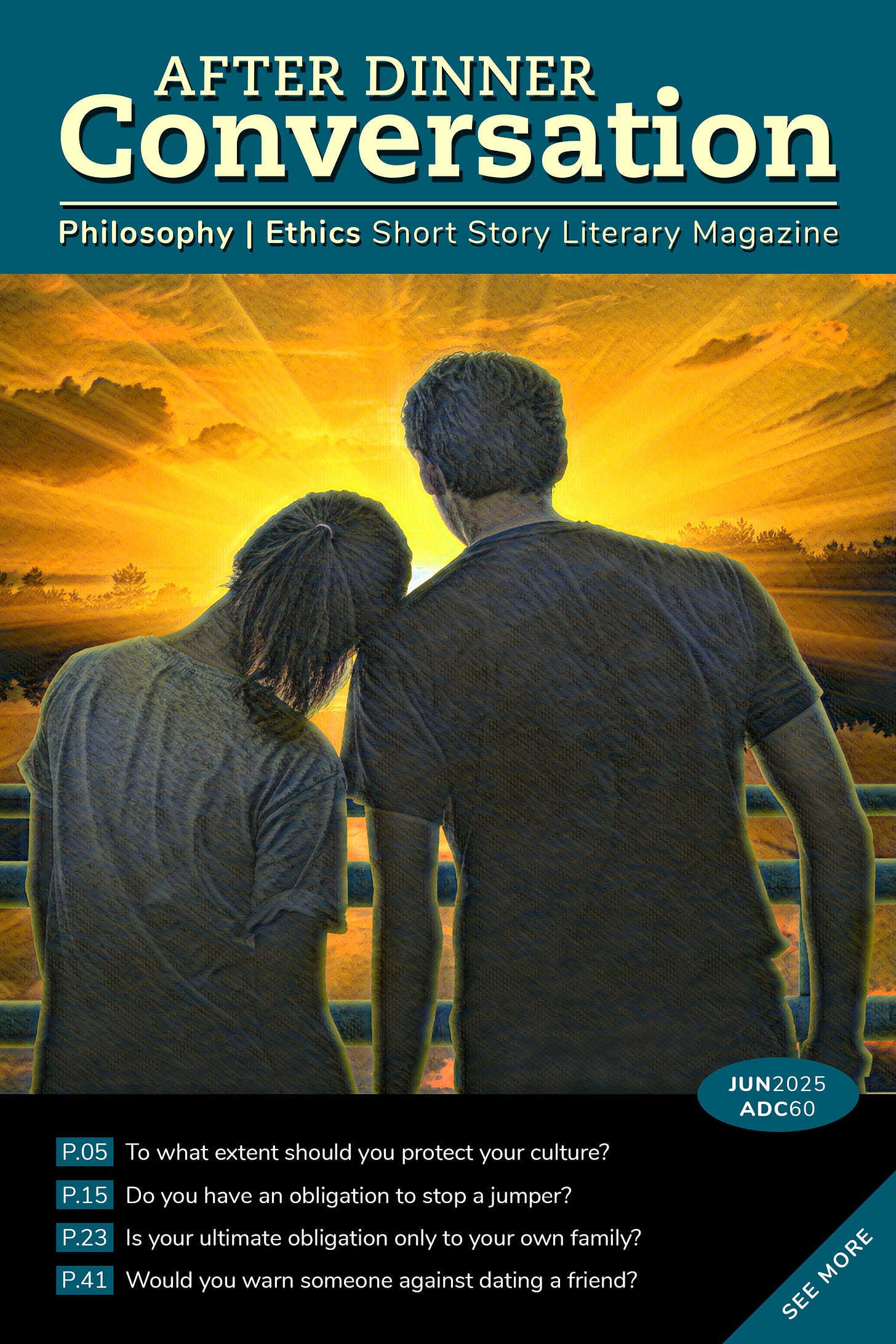
After Dinner Conversation - Philosophy | Ethics Short Story is a reader-supported publication. To receive new posts and support my work, consider becoming a free or paid subscriber.
Q&A
Are there any ideas or topics that you wish you had the courage to write about?
Yes, sinister human behavior. It’s delicate to emphasize a character’s nastiness, for the sake of the story, without writing something gratuitously offensive.
A colleague suggested I write non-fiction essays about my poignant family experiences. I feel shy about that prospect. Everyone must set limits. Creativity is like a plant—when you put a boundary in one direction, it grows taller in another.
How do you come up with ideas for your short stories?
1) Character. The first question I ask is “Who?” Then next is “Who else?” I started writing fiction only recently, because I envisioned a character so unique and powerful that I felt compelled to write her. I believe people remember characters long after they forget what happened.
2) Imagined connections. Pretend one person made an object. A dissimilar person, thousands of miles away, anonymously purchased it. Why? How did the object’s journey unfold? What if those two strangers later met? The object could be a one-of-a-kind wooden sculpture or a fast-fashion sweater, but either way, a compelling story awaits.
3) Curiosity. In a foreign city, I’ve ridden the train to the last stop just to see what’s out there. Memories naturally percolate into scenes in subtle ways.
4) Good questions—your first one, for example. Perhaps my next submission to After Dinner Conversation will explore what a person might do after overhearing an offensive comment at a social gathering. If they object, what could be the outcome, and for whom? Do the consequences depend on the setting?
Is there any standard publishing or writing advice that you disagree with? Or any standard advice that you feel is too often neglected?
I hope this may be useful to newer writers like myself, and take this with a large cube of salt, but I disagree with “Write every day.” Even if your lifestyle affords that privilege, I believe it’s unhealthy to prod yourself towards a certain word count and then feel rotten if you fall short. Write when you feel inspired to; write what inspires you. Eventually, every writer quits writing—whether they want to or not—so enjoy the labor. A quality finished work is paramount: however you get there, however long it takes. In the interim, don’t ignore your loved ones.
Neglected advice is “Read your work aloud.” Listeners must understand which character has spoken. Every sentence should flow. For more good writing advice, follow esteemed editors like Benjamin Dreyer for free tips. (This is not a paid endorsement of Benjamin.) Less than a year after I began writing fiction, I feel grateful that two of my short stories were purchased for publication. That doesn’t mean I’m great; I just sought sound advice. Plus, I do many revisions of my drafts.
What is the greatest compliment you have received as a writer? The most stinging criticism?
I’m active on Critique Circle and keep a list of notable feedback. A beta reader said the final chapter of one of my forthcoming novels was so good it made them sob. Wow! I felt honored—especially because I’d also shed tears writing that chapter. This marked my first writer-reader connection of that nature. My harshest criticism lives on that same list: “Why would someone with a clear grasp of grammar choose to write like trite stage directions?” My prose style was deliberately succinct. I’d left much to the imagination—on purpose. Did I push style too far? For one reader, definitely. For most readers? Maybe. But I’m amazed by the variety of styles in literature.
Val Stuart has been published by After Dinner Conversation (June 2025, “What Do Friends Say?”) and Novellum magazines. Two of Val’s novel-length manuscript drafts are in the revision process: 1) a divorced, middle-aged dragon writes her spicy, forked-tongue-in-cheek memoir, and 2) a young woman escapes her father’s doomsday cult only to fall into a life of crime, then escape again. If you’re a literary agent (or know one) and those ideas pique your interest, kindly contact https://substack.com/@valstuart. While legendary authors post photos of their blistered feet on Twitter, neophyte Val Stuart is attempting literary mystique: no photo, no location. In the meantime his new website is valstuart.com
Share After Dinner Conversation - Philosophy | Ethics Short Story
Comments
Nothing yet. Say the first thing.
Sign in to join the conversation.