
If you would like to submit your story to After Dinner Conversation, here’s how.
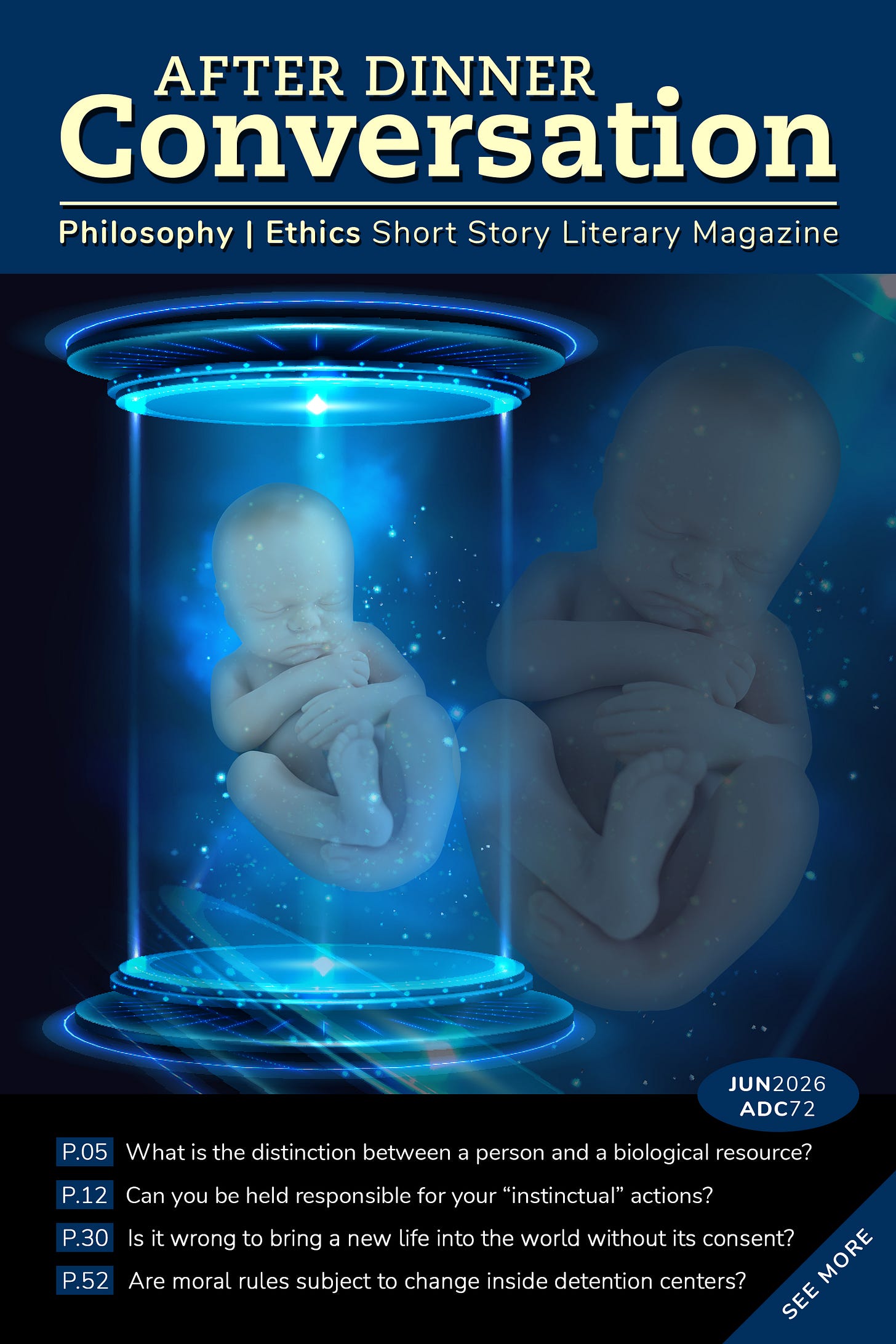
Read the newest edition of After Dinner Conversation!
Click the image to get your copy!
After Dinner Conversation - Philosophy | Ethics Short Story is a reader-supported publication. To receive new posts and support my work, consider becoming a free or paid subscriber.
Q&A
Which philosophy or philosopher most aligns with your own beliefs?
The philosophy I try to live by is: “I know that I know nothing” (usually linked to Socrates), which really keeps me grounded and constantly wanting to learn new things. I’ve also long been fascinated by dreams, and while writing Intrinsic, I spent time studying Carl Jung’s concept of Individuation—from the shadow to the archetypes, and moving toward a more whole Self.
Is there any standard publishing or writing advice that you disagree with? Or any standard advice that you feel is too often neglected?
I think the whole debate between traditional vs self-publishing can be exhausting. Each side has its pros and cons—so actually, you can do both! Andy Weir is a living, breathing example of a successful hybrid author.
As far as neglected advice goes, movement while you’re not writing is just as important as sitting at your desk when it’s time to write. I say this because a lot of the times I’m stuck on something—a plot or a concept, whatever—doing something else genuinely helps. Walking, cleaning, taking a bath, brushing my teeth—those simple activities can give you the perspective and distraction you need to dislodge yourself from the stubborn section that you’re working on.
Is your process for writing philosophical fiction different from the way you approach other works?
I realize that most of my fiction has philosophical undertones. Even in short stories, I rarely write in a straightforward way. I tend to rely on subtext, and I think it has something to do with the themes that I usually gravitate towards: dreams, memory, consciousness, and identity.
What is the greatest compliment you have received as a writer? The most stinging criticism?
Probably one my favorite ones would be Anne being an “excellent unreliable narrator.”
The most stinging criticism would be clumsy formatting of dream sequences and long run-on sentences.
Which authors or books would you recommend to those who want to challenge their own thinking?
There are so many authors whose books shook and shaped me as a fiction writer (1984, Lord of the Flies, Fahrenheit 451, etc.). Yet I will say, as a general recommendation, to once in a while read books outside of the genres that you prefer. Or maybe check out books written by authors not from your country or continent. Read nonfiction, poetry, and magazine articles. If there’s one thing great about the time we’re living in now, it’s that we have access to so much material. Challenging your own thinking should start becoming a habit.
Recommended Substacks:
Literature: Naomi Kanakia’s Woman of Letters

Fiction: Ricardo José Romeu’s Analog Stories, particularly his novella “In the Wake of Dreams”
Vince Wetzel’s Space Between:
Movies: Robert Walrod’s Earthly Delights: walrod.substack.com
Music: Niko Batallones’ Nicksy Once Monthly, particularly “Plaka Notes”: nicksyoncemonthly.substack.com
Book Reviews: Timothy Atkinson’s The Substack Review: stackreview.substack.com
Author Bio:
France Pinzon is a writer and editor whose lifestyle journalism has appeared in major Philippine publications. Her fiction explores consciousness, identity, and the moments that define selfhood. Intrinsic marks her debut as a published novelist.

Comments
Nothing yet. Say the first thing.
Sign in to join the conversation.