
The farewell tour sells tickets. The jersey retirement sells merchandise. The press conference gets a standing ovation from a room full of people who will not think about you again until your name comes up in a trivia question.
None of that is legacy.
History is lazy. The market is merciless. The algorithm has the attention span of a golden retriever at a tennis ball factory. The people who understand this are not the ones with the longest careers. They are the ones who started building infrastructure before the lights went down.
Most don’t. Most wait for the tribute and mistake it for arrival.
The sports and entertainment industries love passive legends.
A franchise can sell your vintage jersey without consulting you. The league turns you into a static data point. You become a highlight package they pull out for halftime tributes and anniversary broadcasts. You are useful. You are not present. There is a meaningful distinction between those two things and it shows up clearly in your bank account about eighteen months after the last contract ends.
The average professional sports career lasts three to five years. The window between when a principal is celebrated and when they are replaced by the next version of themselves is measured in months, not years. The endorsement market knows this. Brands are not waiting for you to figure out your second act. They are already auditioning your replacement. They are polite about it. The meetings stay warm. The contracts just stop coming.
When I sit down with retiring athletes and executives, they almost always have the same profile. An extraordinary history of physical output. Rings. IPOs. A jersey in the rafters. And absolutely zero legacy infrastructure. No vehicle to translate past success into future institutional leverage. They are standing on top of a mountain of achievements with no blueprint for what compounds next.
If your influence stops the moment you stop performing, you did not build a legacy. You just had a really good run.
I recently spoke with a former NBA point guard. Long career. Highly respected in the league. He walked away from the game in his early thirties with millions still on the table because he had other options. Not many people in a similar position would have made that call. Conviction at that level, when the money is still real and the offers are still coming, is not common.
He asked me why I was interested in telling his story.
I told him the truth. Retelling the LeBron James story might get more initial eyeballs, but there has been enough documented about LeBron at this point that unless he wants to reveal something the world is truly unaware of, where is the value for the principal outside of incremental revenue? Incremental documentation of a fully documented life is not storytelling. It is inventory management.
I told him I want to produce stories the general public does not yet know but should. That his life, like so many others, deserves a permanent record. The only difference between his film and someone else’s is scale. Some are thirty minutes. Some are two hours. Determining the right duration is Afterburn’s job. Getting his one hundred percent authentic lived experience into every scene is the only standard we work to.
He was quiet for a moment. Then he said every conversation he had ever had about reliving his evolution started with what the production company needed. What the platform wanted. What the audience would respond to.
Nobody had ever started with what he deserved to have preserved.
That is the gap Afterburn was built to close.
The global athlete endorsement market was valued at $62.4 billion in 2025 and is projected to reach $118.7 billion by 2034. The athletes capturing the largest share of that market are not the ones with the most recent performance numbers. They are the ones whose worldview transcends the sport.
Cristiano Ronaldo and Lionel Messi remain commercially dominant years into the later stages of their careers, especially in the case of Ronaldo, who has professionally relocated to Saudi Arabia, which is not typically considered a career apex, but because they built identities that operate beyond the scoreboard. That is not an accident. That is architecture.
A study by ESP Properties found that brands gain approximately $3.4 million in media exposure for every $1 million spent on athlete partnerships. The deals generating the deepest and most durable returns are not built on last season’s stats. They are built on a documented point of view that survives a roster change, a market shift, and a slow news cycle.
A memory requires someone else to remember you. A system forces the market to deal with you. The difference between those two sentences is the difference between a name on a wall and an institution that compounds.
The principals who build lasting post-career value share one structural characteristic. They treated the transition as a construction project, not a press cycle.
They built a documented record of their worldview before the career ended, not after. They established a private archive of their story that no algorithm can fragment, no production company can sanitize, and no platform can repossess when the terms of service change. They created a governing strategy for how that record gets deployed, to whom, in what context, and under whose control.
Most importantly, they built it while they still had leverage. Before the contract ended. Before the market moved on. Before the halftime tribute became the most recent thing anyone associated with their name.
Antoine Bethea played 14 years in the NFL, won Super Bowl 50, and moved through roster changes, coaching transitions, and contract cycles across multiple franchises without losing institutional value at any point. That kind of durability is not accidental. It is the product of a professional identity that was documented, verified, and deployable independently of any single team’s platform.
The machine will always try to reduce your life’s work to a moment. A highlight. A statistic. A halftime tribute on a night you are not there to see. The sports industry has normalized this. The entertainment industry has normalized this. The business world does it to founders the day after the acquisition closes. Thanks, now hand in your key fob.
Afterburn was built to interrupt that pattern.
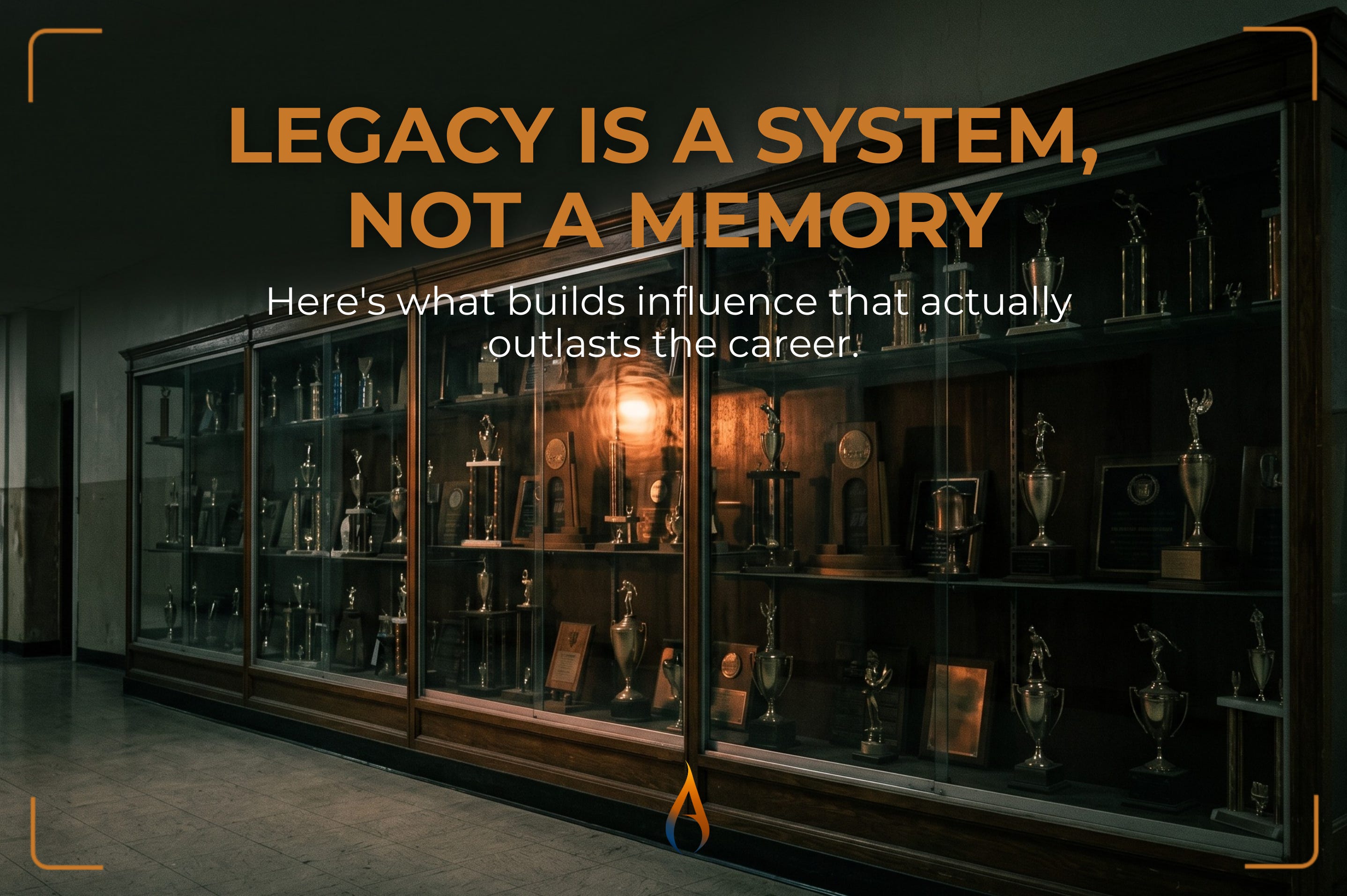
The farewell tour is a moment. Moments expire. What endures is not the achievement. It is the governing idea behind the achievement, captured, verified, and deployed through a structure that operates independently of your physical presence.
Moments are what the market gives you when you perform well. Systems are what you build when you understand that performance has an expiration date and influence does not have to.
The man who retired in his prime with millions still on the table needed one thing. Not a better pitch deck. Not a warmer introduction. A system that had been doing the work while he was still playing, so that the moment he decided to step away, the architecture of what came next was already in place.
Build the system before you need it. The market will not wait for you to finish the farewell tour.
If you are approaching a transition and the infrastructure is not yet in place, that is worth addressing before the market addresses it for you. Connect with Afterburn here.
No posts
Comments
Nothing yet. Say the first thing.
Sign in to join the conversation.