
Headline: The Audience Is Ready: Bring Afrobeats Orchestra Home
Life as a Nigerian music fan in Nigeria is a wild ride. The advantages far outweigh the drawbacks. Every Friday brings a flood of new tracks as favourite artists inundate streaming platforms. Star musicians are generous, often dispensing cash and gifts on impulse. On Lagos Island, you might share a joint with your idol at a random party while soaking up the latest celebrity drama, relationships and podcast gossip.
But there is a flip side. The highs of proximity can reach stratospheric levels of enjoyment and connection, yet the downsides cut deep. They restrict access to a fuller music culture. The music business rarely invests its full resources in Nigeria, especially for experiences that are routine in other markets. Commercial realities explain why. The country is gripped by severe inflation, eroding the purchasing power of young people — the core consumers of pop music. Standard live-performance venues are scarce. A touring circuit is virtually nonexistent, and novel ways to experience music remain absent.
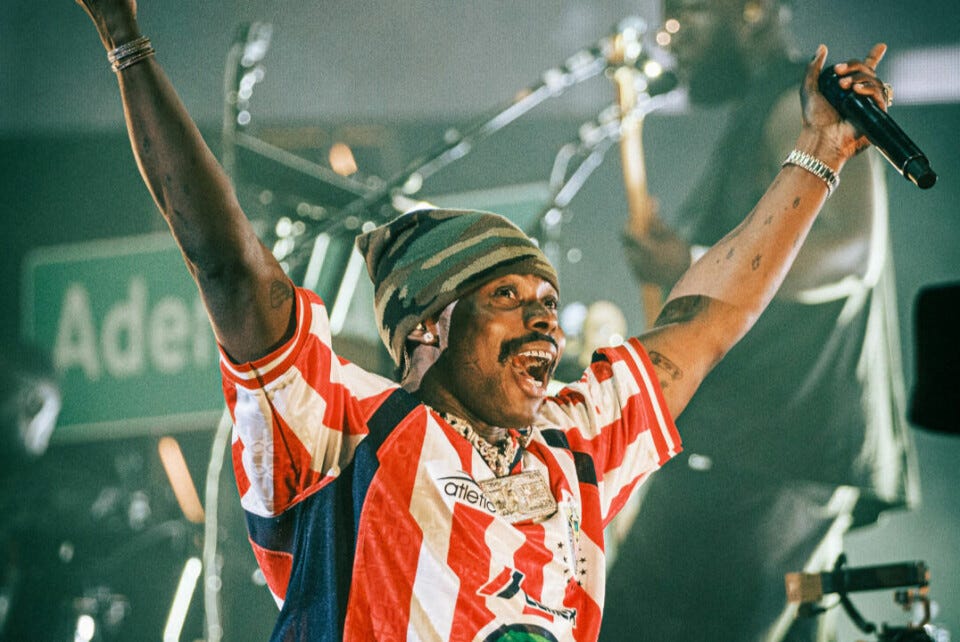
On Nov. 8, the Afrobeats star Asake will take the stage at Red Bull Symphonic in Brooklyn’s Kings Theatre. He will perform his greatest hits with a world-class orchestra conducted by Glenn Alexander II. This one-night-only event marks the first time an African artist has headlined the series in the United States. It celebrates a sound Asake helped carry to the world.
Asake is bringing his homegrown melodies and Afro-fusion to New York, reworking hit records into orchestral form for his debut in this hybrid format. All tickets sold out quickly — a clear sign of demand. Red Bull Symphonic redefines musical boundaries by fusing high-energy contemporary sounds with orchestral grandeur. The result is a cultural collision that amplifies artists’ visions on an epic scale. For Asake, the event acknowledges his role in exporting Afrobeats globally and signals the series’ commitment to elevating diverse voices. Innovation flourishes when genres refuse to stay in their lanes.
Red Bull Symphonic excels at spotlighting boundary-pushers. In 2023, the producer Metro Boomin electrified Los Angeles by reworking trap anthems with a full orchestra under Maestro Anthony Parnther; bass-heavy bangers became cinematic swells that left audiences spellbound. Last year, the Amapiano maestro Kabza De Small heated up Johannesburg’s Lyric Theatre, fusing soulful house grooves with Ofentse Pitse’s symphonic vision and a 33-piece ensemble to create a rhythmic symphony pulsing with South African pride. These triumphs underscore the series’ global reach and set the stage for Asake’s Afrobeats odyssey in Brooklyn.
So why is this not happening in Lagos, Asake’s hometown? The answer lies in the details.
Afrobeats’ global expansion over the past decade has showered Lagos with blessings. A generation of Nigerian pop artists cracked the international market, powered by major-label contracts and TikTok’s democratizing force. Stars like Rema, Wizkid, Davido, Burna Boy, Tems and others found new audiences and cultures, expanding Lagos’s creative blast radius. One welcome consequence is exactly what Red Bull now offers: an African star reimagining local art for a global audience on a global stage.
Yet Nigerians are watching from afar as Brooklyn hosts this milestone. The longing for a homegrown version is real. New York deserves Asake for his cross-cultural brilliance, but Lagos deserves him more — in this format, on this scale, at this moment. A Red Bull Symphonic in Lagos is a cultural necessity. The city birthed the sound, nurtured the artist and fueled the global wave. It has earned the right to host its own symphonic revolution. Anything less leaves the story half-told.
Begin with the audience. Lagos does not merely support its artists; it anoints them. When Asake released “Lungu Boy” in August 2024, the city claimed it. From Surulere to Lekki, from beer parlors to boardrooms, every corner echoed “Active,” “Fuji Vibe” and the inescapable “MMS.” TikTok challenges erupted within hours. Street vendors sold bootleg merchandise by noon. DJs folded tracks into club sets by nightfall. In Lagos, communal ownership runs deeper than passive consumption. Nigerian fans need no permission to celebrate their own. Burna Boy’s 2021 Grammy win sparked a citywide party without official events. Rema’s “Calm Down” remix hitting a billion streams lit up the internet like New Year’s Eve.
This same audience sold out Asake’s 2023 O2 Arena headline show in London, driven by Nigerian money, passports and cultural pride. They crossed oceans because Lagos could not host it. That energy remains homegrown. Fans here crave more than another concert at Eko Hotel or a pop-up party in a dingy warehouse. Lagos music culture seeks elevation and innovation. It yearns for a night like this, where the music it gave the world returns transformed — as a coronation.
Infrastructure is finally catching up. The National Theatre reopened after renovation backed by federal and private investment. This 3,000-seat mainland marvel boasts upgraded acoustics, lighting and staging that rival midtier venues in Europe or North America. The forthcoming Eko Arena will offer 12,000-capacity multipurpose space on Victoria Island, built to international standards with private capital. Terra Kulture Arena, Alliance Française and the reimagined Balmoral Convention Center at Federal Palace add further options. Lagos is building for the future — a future that includes symphonic Afrobeats, jazz-fusion concerts and electronic orchestras. Red Bull Symphonic fits perfectly. Venues exist. Talent abounds. Conductors can be flown in or sourced locally; Nigeria has classical musicians trained at the MUSON Centre or the University of Lagos. Orchestras can be assembled. Audiences will show up.
Red Bull knows the playbook. It staged the event in Johannesburg with Kabza De Small, in Cape Town with Black Coffee years earlier, and in Vienna, Dubai and Los Angeles. Cultural resonance demands the authentic city, not the safest one. Johannesburg hosted Kabza as his home; the Lyric Theatre delivered a homecoming. The audience moved. The orchestra grooved. A rooted base creates that alchemy.
Lagos calls for the same. Picture Asake on the National Theatre stage in Iganmu. Lights dim. A 50-piece orchestra of Nigerian and international players strikes the opening chord of “Sungba.” Talking drums answer. Violins swell. The 3,000-strong crowd erupts. They sing every word. Phones wave like lighters. A classical hall becomes an Afrobeats cathedral. This can be Lagos today.
The local live-music scene has looped too long: album launches, “detty December” concerts, one-off festival slots. They deliver fun, loud chaos in the best way. Yet they remain predictable. Fans arrive, artists hit their marks, and everyone leaves sweaty and satisfied. That is the baseline. Red Bull Symphonic breaks through. Afrobeats is evolving from party soundtrack to multidimensional art. A genre forged in Lagos backyards can command concert halls. At home, it is no different. Afrobeats dominates globally — on Grammy stages, NBA halftime shows, fashion runways and Hollywood soundtracks. Lagos built it, yet the city remains a bystander to its own evolution. Nigerian fans pay premium prices to fly to London, Paris or New York for elevated formats, spending thousands on flights, hotels and tickets to watch abroad what belongs at home. That path is unsustainable, unfair and unnecessary.
Red Bull has already started it by pioneering another live experience elevation of Afrobeats. In Lagos, live formats innovations like this can ignite a movement. It would prove African innovation can find legitimacy at home. A street-born genre can command local concert halls without losing its soul. Nigerian fans can gain lifelong memories as participants, not just spectators, in foreign cities.
The audience is ready. The venues are ready. The artist is ready. The sound is ready. Bring it home.
No posts
Comments
Nothing yet. Say the first thing.
Sign in to join the conversation.