
ALGIERS — The Turkish Airlines relay from Lagos through Istanbul dumped me in Algiers on Friday, Sept. 5, the Algerian summer’s last ragged breath clinging to the air. Outside Houari Boumediene Airport, Arabic flowed like river talk, French clipped sharp, diesel growled low—a Mediterranean fog blurring the Casbah’s white cliffs into half-remembered lore. The city thrummed, avenues jammed with delegates in linen cuts and kaftan sweeps, all funneling to the Palais des Expositions des Pins Maritimes. This was IATF 2025, the fourth Intra-African Trade Fair—a seven-day sprawl of grit where Africa’s trade maps crossed its cultural blade. From Sept. 4 to 10, themed “Boosting Intra-African Trade for a Sustainable Future: Innovation, Value Addition, and Green Industrialisation,” it aimed to patch the continent’s cracked lines. For me, a Nigerian music journalist who has chronicled Afrobeats’ global ascent from smoky Lagos clubs to Coachella stages, the real draw lay in CANEX, the Creative Africa Nexus, where sounds, stories and styles would be forged into something sharper and more bankable.
Jet lag clung to me as I dropped my bags at the hotel near the expo grounds, but the evening’s mega concert refused to wait. CANEX’s flagship showcase at the Algiers Opera House had dominated my Lagos group chats for weeks: Wizkid headlining a pan-African bill to cap the fair’s creative thrust. I grabbed a quick taco from a street vendor and pushed through the dusk crowds, my sparse French coming to my rescue with the taxi drivers. The Opera House, perched on a hill in the Ouled Fayet suburb, already heaved with 100s of attendees. On my way to the venue, flags from 81 countries snapped in the breeze, Nigerian green-white-green brushing Algerian crescents and South African rainbows.
The night ignited with amapiano heat from South Africa’s Musa Keys, the producer whose “Tanzania” had soundtracked a continent’s summer. Flanked by collaborator DBN Gogo, he transformed the stone venue into a pulsing dance floor. Basslines thudded through the humid air, his set a clinic in Gqom grooves laced with house flourishes. The crowd, a blend of diplomats, designers and deal-makers, shed decorum fast. A Zimbabwean student swayed beside a Kenyan filmmaker, phones aloft. Musa Keys owned the stage solo at first, his energy contagious, before handing off to openers: Grenadian singer Jeverson Ramirez, whose reggae-soul tracks carried a Caribbean lilt; Kenyan DJ Coco Em, layering deep house synths over tribal percussion to nod at East Africa’s electronic edge; and local Algerian raï acts, their accordion riffs channeling Cheb Khaled’s golden era.
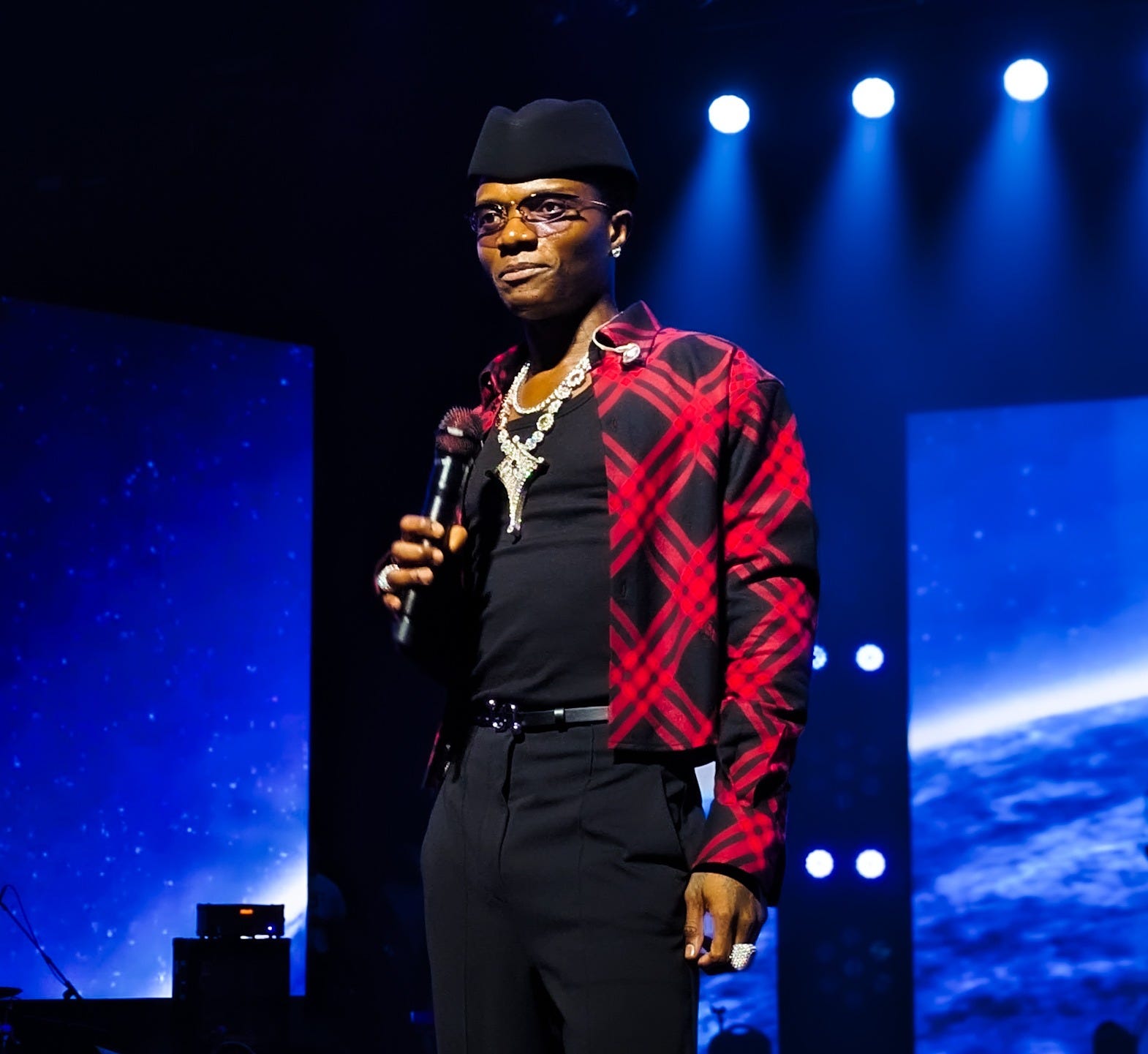
Then Wizkid arrived. He stepped out alone in a minimalist black tank top, his signature outfit, backed only by his personal DJ, DJ Tunez. No guest features, no orchestral swell as I’d half-anticipated from his global tours. This was Wizkid stripped to essence, raw and regal, leaning into his catalog with storyteller poise. He opened with “Ojuelegba,” the Lagos anthem that launched his ascent a decade ago, his voice slicing clean over stripped guitars. The crowd exploded, a sea of waving arms and choruses in Pidgin and French. “Kilo da le!” he called, and the reply rolled back like thunder.
He paced through hits deliberately: the sultry sway of “Come Closer,” the triumphant horns of “Fever,” the introspective haze of “Essence” solo, rendered with a haunting falsetto that hushed the amphitheater. The sound stayed pristine throughout, every note landing sharp in the salt-kissed air. Wizkid powered through, ad-libbing laughs and crowd call-outs. “I have day one Wizkid fans here o?” he grinned, sweat gleaming under the spots. The irony struck mid-set: the artist whose O2 sell-outs I had dissected in London now anchored a continental spectacle for a crowd spanning Sahel to Cape. No diaspora polish, just home-soil fire. The night crystallized CANEX’s ethos: repatriating talent, turning export dreams into local thunder.
Exhausted but buzzing, I crashed at the hotel, beats echoing in my skull. The concert had set the tone, but to grasp IATF’s sweep, I needed the origin. Flash back to Thursday, Sept. 4, the official opening at the Abdellatif Rahal International Conference Centre in upscale Club des Pins. I’d missed the pomp, but footage and delegate whispers painted it vivid: a marble-and-chandelier grand hall, air-conditioned against the swelter, packed with 1,500 dignitaries from 140 countries. Heads of state in national attire filled front rows, Olusegun Obasanjo, former Nigerian president and IATF advisory chair, beside Mauritanian and Tunisian counterparts.
Algerian President Abdelmadjid Tebboune took the podium at midday, commanding in a dark suit, flanked by Afreximbank brass. Silence fell as he invoked the fair’s slogan, “Gateway to New Opportunities,” framing IATF amid a “sensitive global context where events accelerate at an unprecedented pace.” Algeria stood proud as host, he declared, vowing active contributions to Africa’s developmental challenges. A video montage followed: independent Algeria’s pan-African legacy, from anti-colonial solidarity to Sahel mediation, underscoring its continental anchor role. Tebboune emphasized youth’s pivotal place, noting Africa’s young population as both greatest asset and urgent imperative. “We must empower them to drive integration,” he said, his gravelly baritone echoing off walls.
The ceremony flowed into “Algeria Day,” showcasing investment reforms and megaprojects: Sahara solar farms, coastal desalination plants, Oran electronic hubs. Obasanjo praised the host, calling IATF a “vital step in continental integration.” Deals teased early: a €245 million sports media rights facility with New World Television, spanning 24 nations. Speeches rolled and hands clasped in the foyer. The message landed clear: this was a blueprint for economic sovereignty.
Saturday, Sept. 6—Day 3 of IATF—and the CANEX Summit unfolded in a floodlit auditorium, where leaders delivered a clear verdict: Africa’s creative economy stands at the center, not the margins. It fuels strategy and capital, shaping the continent’s path forward. With proper backing, they argued, imagination sparks jobs, fosters inclusion, and drives industrial momentum across borders. Namibia’s vice president, H.E. Lucia Witbooi, captured the spirit: “Creativity is a currency. Culture is capital. Africa’s youth are the entrepreneurs of a new age.” She urged governments and businesses to weave artistic pursuits into their core strategies for growth.
Afreximbank’s EVP Kanayo Awani carried the momentum, recalling CANEX’s 2020 origins as a bridge from innate talent to thriving enterprise—armed with funding, training, and policy tools. “When we invest in our creators, we invest in Africa’s prosperity,” she said, citing last year’s surge in intra-African trade to $220.3 billion. H.E. Wamkele Mene, AfCFTA’s secretary-general, linked it to deeper unity: The sector, valued at over $50 billion, could thrive in a 1.4 billion-person market with stronger IP protections, digital marketplaces, and expanded access for artists. “Through the AfCFTA we can protect intellectual property, expand digital trade, and open new markets for our artists.” The session closed on a surge of resolve, as designers, musicians, filmmakers, and digital pioneers committed to forging an economy rooted in identity, pride, and global edge.
The CANEX Creative Return by JVL followed, opened by Ben Bruce—a Nigerian entrepreneur, media powerhouse, and former senator—who framed the creative sector as the engine of industry, employment, and worldwide influence. The panel had actress and activist Yara Shahidi; Algerian singer and ambassador Lila Borsali; Basketball Africa League president Amadou Gallo Fall; Afreximbank’s Temwa Gondwe on creatives and diaspora; writer and social entrepreneur Lavaille Lavette; Nollywood’s Funke Jenifa Akindele; and actor Winston Duke. They delved into the power of cross-border, cross-industry partnerships—tools to shatter barriers, reframe narratives, and convert inspiration into lasting value.
Shahidi evoked the core call: “Unless we begin to see ourselves as a collective and build relationships amongst ourselves, we will never realise the true power of Global Africa.” Akindele outlined the essentials for endurance: “You have to respect culture, be transparent, and carry your partners along. Only then can a collaboration truly succeed.” Duke lifted it to purpose: “At the end of the day, it is not about money or fame. It is about changing reality, so our children see themselves as whole, and our spaces reflect the beauty that is already there.” The takeaway rang true: Culture operates as capital, amplified through deliberate, equitable, and resilient alliances. Grounded in mutual respect, balanced investment, and robust infrastructure, these bonds empower Africa and its diaspora to seize fresh opportunities and assert global presence.
For me, the music sessions hit hardest, CANEX’s vital rhythm. “Decolonising Algorithms: Compensation and Fair Value for African Artists” confronted the digital divide head-on, probing how to ensure fair returns in an algorithm-fueled landscape. Eddie Hatitye of the Music In Africa Foundation moderated, joined by Dr. Adesegun Adeosun Jr. (King Smade, Afro Nation co-founder and Smade Group CEO), Idir Smaili (Algeria’s copyright digital deputy), and Boubacar Djiba (Vasy founder and CEO).
Adeosun championed unity: “We need to collaborate across industries, partner with each other and align around culture if we are to build lasting value for African creativity.” Isolation dooms the effort, he warned; music, film, fashion, and platforms must interconnect to retain creators’ worth on home soil. Smaili drilled to the root: “Art is not free. Every creation represents work, and that work must be compensated.” African ingenuity draws endless acclaim yet meager reward — reframe it as economic labor, and just systems emerge. Djiba scaled the vision: “Culture is the new crude oil. If we invest in it with the same seriousness as natural resources, it will power industries and livelihoods across the continent.” As hydrocarbons defined past eras, creatives can define this one, provided they receive commensurate funding, frameworks, and focus. The session crystallized the challenge: Value creativity on par with any sector, and artists not only captivate the globe but cultivate enduring prosperity within.
A fireside chat brought Khaby Lame, the platform’s most-followed creator, into conversation with Konnie Touré. He traced his path from a pandemic-era factory layoff in Italy to idle TikTok sketches that erupted into billions of views and over 160 million followers. His signature silent clips? “They work because everyone can understand: humour is universal when told through mimic and expression. I always liked making people laugh,” he reflected. “I was shocked but happy to see all of the sudden followers when I started blowing up. I appreciate every single one of them.” The exchange revealed digital realms’ transformative force for African talents, unlocking unexpected paths to international acclaim.
Sunday, Sept. 7—the CANEX Music Masterclass “Rewriting the Rules: Securing Fair Pay and Content Ownership for African Artists” dissected the era’s thorniest hurdles: retaining authorship and securing equitable pay amid digital flux. Hatitye moderated anew, with Mehdi Delmi from Algeria’s copyright office and Tobie van Zyl, Makerverse founder. Delmi laid the groundwork: Losses stem from unregistered claims, erroneous metadata, or under-equipped collectives unable to enforce collections. Counter it with enhanced literacy, streamlined tools, and unified continental standards—making royalties verifiable, prompt, and dependable.
Van Zyl illuminated innovations via his Metaverse startup: Fan-direct sales, transparent licensing, and blockchain contracts bypass legacy hurdles, anchoring revenues locally while immersing Africa’s young creators in the global arena. The dialogue demystified the path: Seamless registries are a neccessity, accurate tagging of songs, empowered collectives, and airtight licensing; AfCFTA-linked networks to span frontiers.
As Day 4 waned that evening, the hall hushed, then surged as the Mansa Orchestra transported us through Africa’s chronicle—from the anguished strains of women consigned to desert crossings and oceanic voids, to the radiant fanfare of Mansa Musa’s gilded entourage. Drums resounded, voices ascended, strings intertwined, forging epochs of anguish into resolve, resolve into victory. Sorrow yielded to dignity; desolation, to aspiration. Africa’s chronicle endures not as ordeal alone, but as testament to tenacity, ingenuity, and inexhaustible reinvention.
Midweek blurred: jet lag and handshakes. Undercard gems persisted. A film panel hashed Nollywood-Egypt co-pros. A literature class dissected Chimamanda Ngozi Adichie’s trade tales. I dodged the automotive electric minibus pitches for a Senegalese-Algerian thiéboudienne-couscous fusion tasting, Gondwe’s blend in edible form.
Sept. 10 broke with the IATF closing at the Pavilion Saoura, AfCFTA banners draping the cavern. 112,000 souls had streamed through: 60,650 live, the balance virtual, from 132 countries. 2,148 exhibitors, 958 buyers.
The curtain fell on the fourth Intra-African Trade Fair in Algiers, capping a transformative week from September 4 to 10 that drew tens of thousands of visitors, exhibitors, and visionaries from Africa’s farthest reaches and the world beyond, all united in harnessing the African Continental Free Trade Area’s boundless potential to forge enduring partnerships and chart the continent’s bold tomorrow. H.E. Larbi Latrèche, Commissioner General of IATF 2025, reflected on Algeria’s timeless solidarity with Africa—from championing liberation battles to defending sovereignty and self-determination—now revitalized under H.E. President Abdelmadjid Tebboune’s steadfast guidance, which propelled this edition to unprecedented heights in scope, drive, and resonance. He extended profound thanks to H.E. President Olusegun Obasanjo for his sage counsel that steered the fair to triumph, alongside the unwavering alliance of the African Union, AfCFTA Secretariat, and Afreximbank. In the shadows of the spotlight, ministries, agencies, security forces, and myriad unsung architects collaborated seamlessly toward a singular vision: not just execution, but ignition.
Awards punctuated: prizes for CANEX Shorts for filmmakers, Book Factory Prize to a Zambian migration anthology. Confetti rained as Obasanjo named Lagos 2027 host. Diplomats and sneaker-clad creatives flooded the reception, champagne toasting AfCFTA horizons.
Algiers’ dusk enveloped me, minaret calls adrift. The whirlwind recapped: $640 million creative inks, music to fashion. Intangibles endured: networks beyond news cycles. For the Nigerian fans I rep, this whispered futures. Afrobeats home-manufactured, royalties fueling Lagos dens, tours threading Dakar-Dar es Salaam. Flight-bound, Mediterranean shrinking, Gondwe lingered. We’re exporting cultural capital. In Algiers, it brimmed infinite, graspable at last.
No posts
Comments
Nothing yet. Say the first thing.
Sign in to join the conversation.