
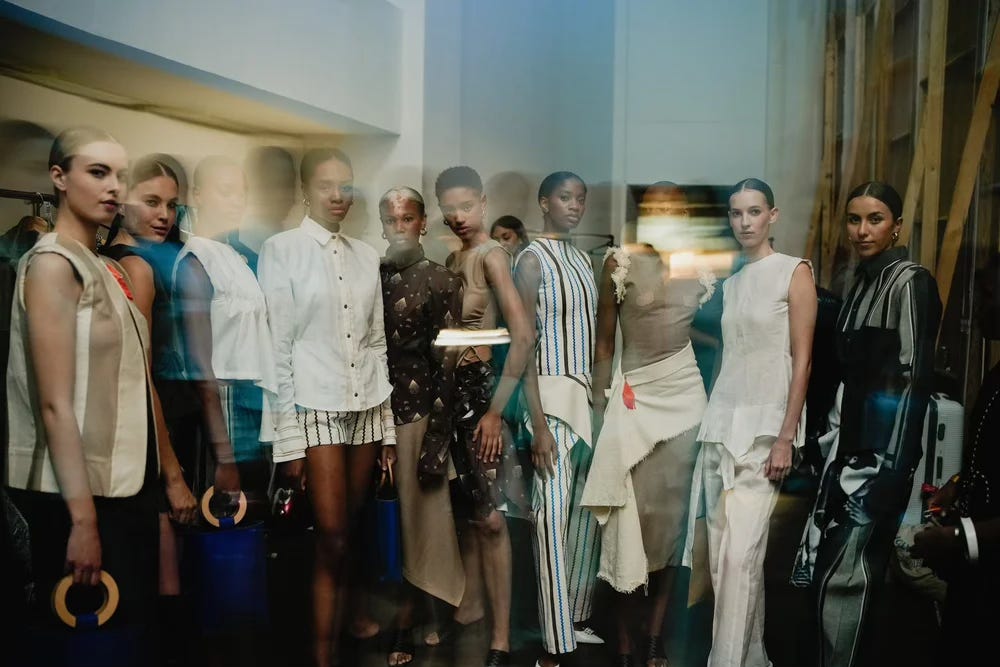
South Africa is home to several prominent fashion week events spread across its major cities but of all of them South African Fashion Week or SAFW in short is widely considered the oldest and most established one. Launched in 1997 by Lucilla Booyzen, SAFW is the cornerstone of South Africa’s local fashion scene and has played a pivotal role in developing its designers and the industry as a whole. So when Lucilla emailed me about the event taking a “strategic pause to recalibrate” I was surprised. Firstly because the announcement came three weeks before its biannual event was scheduled to take place later this month. And secondly, throughout my years attending SAFW, I don’t recall the organisers canceling a season of the event for anything. Not even during the height of COVID.
However, given the current state of fashion from a local, regional, and global perspective it’s not completely shocking. The industry is undergoing one of its biggest transformations of the last decade. From a luxury slowdown to a record-breaking number of creative director reshuffles in 2025 — at some of fashion’s biggest houses including Chanel, Gucci, Bottega Veneta, and more than a dozen others. Everyone has been affected one way or another. As a result of these industry-sweeping changes, some emerging brands across the board have also been forced to restructure and in some extreme cases completely shut down. This ongoing reset has also affected leading retailers like Farfetch and Matches Fashion.
SAFW has attributed skipping this season to a thoughtful recalibration driven by global supply chain shifts, the rise of fast fashion, and the urgent call for sustainability. In Lucilla’s words, the traditional model of fashion week no longer works.
With a repositioning of global superpowers and a new world order taking shape, the industry continues to face a moment of uncertainty. In South Africa, evolving consumer values and growing digital access is influencing how and what South African consumers buy. But it's also true that the country is the number one destination for luxury on the continent and accounts for 34% of Africa’s millionaire population, according to the 2025 Africa Wealth Report, presenting unique opportunities for local fashion to thrive.
In the last five years, SAFW has implemented multiple changes including a long-term influencer strategy to reach a broader and younger audience as well as switching its autumn/winter collections from October to September to be in-line with the international schedule. While these responses may contribute to much needed change, they have proven to not be sufficient.
Since the temporary “pause” was announced a few days ago there’s been outpouring messages of support as well as calls for greater inclusion and diversity within the system, something that Lucilla vaguely touches on in our conversation.
The industry’s been evolving for a while. What led to your decision to take this moment now to pause as opposed to say last year for example?
After 28 years of driving the South African designer fashion industry, we could see that the traditional model of fashion week no longer reflects the pace and the pressures of today’s fashion landscape. Between fast fashion, disrupted supply chains, and the urgency of sustainability, there are so many undercurrents affecting our industry. This season felt like the right time to step back and to pause so that we can realign the platform to the realities of the fashion landscape in South Africa, the Global South and the broader international market. Waiting another season would only delay the opportunity to rethink and future-proof SAFW.
How long do you expect this pause to last?
We are pausing for one season only. In January we will begin again, with the insights and feedback we gather during this time guiding the next phase. This is a recalibration, a springboard for what comes next.
What does your recalibration and realignment process look like behind the scenes?
It is a collaborative and research-driven process. We are engaging directly with designers, buyers, retailers, sponsors, and media to listen and collect insights. At the same time, we are benchmarking against global best practices, while considering the unique needs of the South African industry. Behind the scenes, we are mapping how to bring the entire value chain together, starting with the industry bodies and extending through design, production, retail, and sustainability — to ensure each part is better supported by SAFW going forward.
Are there any elements of the original format that will be preserved?
Absolutely. SAFW has always been designer-led, and that will never change. We will continue to champion South African talent, showcase collections, and connect designers with buyers and media. The runway remains a powerful storytelling tool, but we are also exploring how it can work alongside new hybrid formats, supported by our strong social media presence and digital marketing, to remain fully aligned with today’s world.
How are you involving past collaborators, sponsors, and attendees in this transition?
They are part of the conversation. We are speaking with our sponsors, partners, and long-time supporters to ensure that their voices are heard, and their expectations are factored in. Our social platforms continue to share designers’ journeys, new collections, and evolving work during this pause, so that audiences stay connected. We want everyone who has invested in SAFW — whether with time, money, or creativity to be part of shaping what comes next.
Could you elaborate on what your future-ready model looks like?
The new model will reflect agility, sustainability, and inclusivity. It will be less about following old formulas and more about creating a platform that is dynamic enough to respond to shifts in culture, technology, and retail. Think of it as a marketing platform for the creative fashion industry that integrates digital and physical experiences, strengthens designer businesses, and connects South African fashion more to the fashion markets.
How do you see SAFW addressing sustainability, fast fashion, and shifting global supply chains within this vision?
These are at the heart of our rethink. South Africa cannot and should not compete with the speed and volume of fast fashion. It undermines our designers and their creativity. Instead, we want to position SAFW as a leader in conscious, small-batch, and heritage-driven design. We are exploring ways to support local sourcing, highlight circular practices, and connect our designers to responsible local and global supply chains. Our goal is a platform that champions resilience, originality, and sustainability as competitive advantages for South African fashion.
This post is public so feel free to share it.
Thanks for reading this edition of Africa Fashion Decoded.
Comments
Nothing yet. Say the first thing.
Sign in to join the conversation.