
THIS WEEK IN BRIEF
The fragile ceasefire between the United States and Iran collapsed this week, with President Trump declaring the agreement "over" and U.S. forces trading strikes with Iran for a second straight day as of Thursday morning. For Africa, the consequences run deeper than oil prices. Sudan, already living through the world's worst humanitarian crisis, depends on the Gulf for more than half its fertilizer. Somalia, Kenya, Tanzania, and Egypt are among the countries the UN has identified as most at risk from a prolonged Strait of Hormuz closure. Washington's attention to Africa, always limited, is now further strained by the renewed conflict. Elsewhere, a U.S. push to reunify Libya is accelerating, built around a power-sharing arrangement between Libya's two dominant political families and designed in part to open the door to American energy investment. The Senate has still not moved on AGOA.
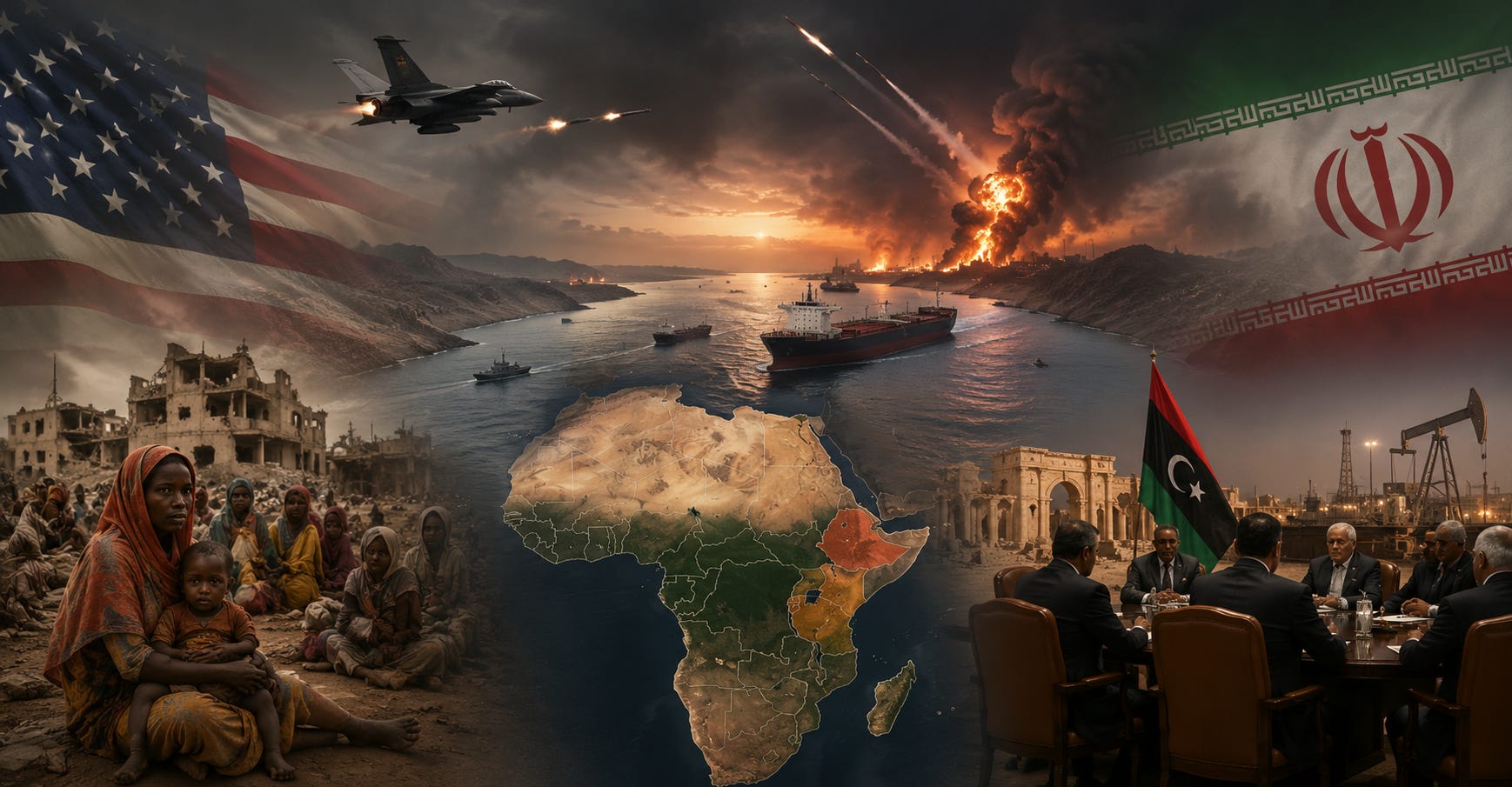
THE BIG STORY: THE CEASEFIRE IS OVER
The conflict that began on February 28, when the United States and Israel launched coordinated strikes on Iran, has entered a new and more dangerous phase.
Speaking at the NATO summit in Ankara on Wednesday, President Trump declared the Memorandum of Understanding reached with Iran in June to be finished. “As far as I’m concerned, it’s over,” he said of the ceasefire, adding: “I think we should just do our business.” U.S. Central Command announced strikes against more than 90 Iranian targets on Wednesday alone, describing them as a response to Iranian attacks on commercial vessels in the Strait of Hormuz. Iran struck back with drones and missiles targeting U.S. military installations across Bahrain, Kuwait, and Qatar. By Thursday, the two sides had been trading fire for two consecutive days.
The proximate trigger was a series of Iranian attacks on commercial shipping, including a Saudi oil tanker and a Qatari LNG carrier transiting in waters off Oman. The Treasury Department on Tuesday revoked the waiver that had allowed Iran to sell oil, removing one of Tehran’s main incentives for restraint. Iran’s IRGC said it would treat any country hosting U.S. military installations as a legitimate target.
For Africa, the timing is difficult. The Strait of Hormuz crisis that began in early March caused what the International Energy Agency called the largest supply disruption in the history of the global oil market. During the ceasefire period, fertilizer shipments had begun moving again, urea prices were falling, and supply chains were showing early signs of stabilization. This week’s collapse puts that tentative recovery directly at risk. The Strait handles roughly 30 percent of the world’s seaborne fertilizer trade. Urea prices had already surged from just under $500 per ton before the conflict to above $700 per ton at the peak. In Kenya, diesel prices hit a record high in May driven by the disruption, and the country sources roughly 26 percent of its total fertilizer supply directly through the Strait. In South Africa, grain farmers have faced input cost increases of up to 35 percent. The Food and Agriculture Organization has warned that even a 10 percent reduction in fertilizer availability could result in up to 25 percent less maize, rice, and wheat grown in sub-Saharan Africa, with Somalia, Kenya, Tanzania, and Mozambique among the countries it identifies as most exposed. Ocean carriers, which had already rerouted away from the Red Sea and around the Cape of Good Hope, adding weeks to transit times and hundreds of dollars per container in freight costs, now face renewed uncertainty about whether any normalization is possible.
The ceasefire’s collapse makes a rapid return to normal shipping look increasingly unlikely. CFR analysts noted this week that even before the latest escalation, the path to reopening the Strait faced significant obstacles: sea mines that Iran laid in the waterway, billions of dollars in infrastructure damage, prohibitively expensive war-risk insurance, and deep mistrust on all sides. The UN maritime agency, IMO, called on Wednesday for “maximum restraint and de-escalation,” and the UN Secretary-General warned that a return to full-scale hostilities would carry catastrophic consequences for the global economy. Talks between Washington and Tehran that had been scheduled in Doha appear to be in doubt; Trump said further negotiations would be “a waste of time,” though he also said he did not think full-scale war would restart.
This is a Washington story as much as it is a Middle East story. The decisions about strikes, the oil waiver, and the status of the ceasefire were made in Washington. The consequences are landing in Nairobi, Khartoum, Mogadishu, and Cairo.
SUDAN: A WIDENING EMERGENCY
Sudan was already the most acute humanitarian case before this week. The ceasefire’s collapse has made its situation more precarious.
The civil war between the Sudanese Armed Forces and the Rapid Support Forces has entered its fourth year. More than 28 million people face acute food insecurity. In Darfur, famine has been declared. UN experts have documented what they describe as the hallmarks of genocide by the RSF. More than 14 million people have been displaced since fighting began in April 2023.
The Hormuz crisis has compounded each of these problems directly. Sudan is the world’s most dependent country on fertilizer from the Gulf, sourcing 54 percent of its imports through the Strait. That fertilizer shortfall will reach Sudan’s harvest, not just its fuel pumps. Save the Children has reported that medical shipments for more than 400,000 people in Sudan are stranded in Dubai due to the Strait’s closure, putting more than 90 primary health care facilities at risk of running out of essential medicines.
Washington’s engagement with Sudan has been limited. Secretary of State Marco Rubio, asked about Sudan recently, described it as “a very frustrating situation,” characterized the conflict as a proxy fight between Saudi Arabia and the UAE, and said U.S. efforts are focused on identifying four cities, two on each side of the front line, to serve as humanitarian aid distribution points. That framing has defined the administration’s public approach.
The U.S. has also reduced its humanitarian funding commitment. A Berlin donors’ conference earlier this year aimed to raise $1 billion for Sudan out of a $3 billion annual crisis plan. That $3 billion figure is itself a reduction from $4.2 billion the previous year, driven by lower donor pledges across the board rather than any assessment of reduced need. Current funding runs at roughly 16 percent of needed levels.
CFR put the stakes plainly this week: the worst outcomes for Sudan, South Sudan, and Somalia can still be avoided, but only if the United States and Iran prioritize a humanitarian passageway through the Strait. There is no indication that negotiation is currently underway.
LIBYA: WASHINGTON’S REUNIFICATION PUSH
Amid the Iran crisis, the Trump administration is running one of its most active Africa initiatives in years, with U.S. energy interests at the center of it.
The U.S. push to unify Libya’s rival eastern and western administrations has been building since a secret meeting in Rome in September 2025, where Massad Boulos, the president’s senior adviser for Arab and African affairs, brought together Saddam Haftar, son and heir apparent of eastern military commander Khalifa Haftar, and Ibrahim Dbeibah, nephew of the Tripoli-based prime minister. On June 29, Saddam Haftar was received in Washington by Secretary of State Marco Rubio. On the same visit, the deputy defense minister of the internationally recognized Government of National Unity met with Boulos, the Deputy Commander of U.S. Africa Command, members of the National Security Council, and Deputy Secretary of State Christopher Landau. Then, on Tuesday of this week, Boulos flew to Misrata in western Libya to meet directly with political and military figures who oppose the U.S. initiative, a sign that Washington is trying to broaden support for the plan before announcing a deal.
Libya holds Africa’s largest proven oil reserves. The administration’s stated goal is to double Libyan oil production to 3 million barrels per day by 2030, with companies including Chevron, ConocoPhillips, and ExxonMobil already engaging with the country. The April 2026 agreement on a unified Libyan state budget, the first in over a decade, was a genuine diplomatic achievement that Boulos helped broker, and supporters of the initiative point to it as evidence that progress is possible when Washington applies sustained pressure.
The plan’s critics, however, are pointed. The proposed power-sharing arrangement would effectively install the Haftar family in the east and the Dbeibah family in the west as Libya’s dominant political actors for the foreseeable future. Analysts at the Atlantic Council and Chatham House have argued the approach risks entrenching the very actors who have sustained Libya’s dysfunction, rather than creating conditions for broader political participation. One Libyan institutional leader told Foreign Policy the deal would be “the end of Libya’s democratic hopes.” Municipal elections held in August 2025 saw 71 percent turnout in areas where voting was permitted, suggesting a population that wants a voice in its future.
Whether this initiative survives Washington’s current preoccupation with Iran is an open question. Libya has watched a long line of international envoys declare momentum and move on.
AGOA: THE SENATE STILL HAS NOT MOVED
The African Growth and Opportunity Act expires on December 31, 2026. The Senate has still not acted.
The House passed a three-year extension in January by a vote of 340-54 — one of the most lopsided bipartisan trade votes in recent memory, and a genuine signal that Congress sees value in the U.S.-Africa trade relationship. The Senate passed a one-year extension instead, folded into an appropriations package and signed by President Trump in February. A Senate version of a longer bill, the AGOA Extension and Bilateral Engagement Act, was introduced by Sen. John Kennedy of Louisiana, providing a two-year extension through 2027 with new review mechanisms for South Africa's eligibility. It has not come to a floor vote.
The situation on the ground has grown more complex since the extension was signed. AGOA-eligible imports are not exempt from the reciprocal tariffs the Trump administration imposed in 2025, which apply 10 to 30 percent duties on most African goods. That means African exporters are navigating both the tariff burden and eligibility uncertainty simultaneously. The Hormuz-driven shipping cost spikes have added a further layer of pressure on export economics.
In May, advocates from the ONE Campaign and the African Diaspora Network organized a Hill Day in Washington, holding 18 meetings with senior congressional staff and meeting directly with Sen. Chris Van Hollen and Rep. Terri Sewell, both longtime AGOA champions. They reported meaningful bipartisan support in those conversations. Whether that support translates to floor time in a Senate calendar now dominated by the Iran conflict and domestic budget battles is the open question. With five months left until expiration, the window for a multi-year renewal that would give businesses and investors planning certainty is narrowing fast.
IN BRIEF
Ambassador vacancies: As of April 2026, 37 of 51 U.S. ambassadorial posts in Africa were vacant. The nominee for Assistant Secretary of State for African Affairs, Frank Garcia, was nominated in March, 14 months into the administration’s tenure, and has yet to be confirmed. Thin diplomatic representation across the continent is relevant context for all of this week’s stories.
WHAT WE’RE WATCHING
Whether Washington pursues any form of humanitarian carveout for the Strait is the most important near-term question for Africa. Analysts have pointed to the Black Sea Grain Initiative as a potential model: an arrangement that made no attempt to resolve the underlying conflict but carved out a workable corridor for food and fertilizer. Turkey brokered that deal. Several analysts have called for something similar for Hormuz. There is no indication the Trump administration is currently pursuing one.
On AGOA, the Senate calendar is the constraint, and the calendar is now crowded. Every week the Strait remains closed is also a week in which the tariff burden on African exporters continues, AGOA’s post-2026 shape remains undefined, and the investment decisions that depend on that shape stay on hold.
Also worth watching: the role of the U.S. International Development Finance Corporation, which stepped in as an insurer of last resort during the Hormuz crisis, offering up to $40 billion in reinsurance capacity to keep commercial vessels moving when private war-risk insurers withdrew. That is a concrete U.S. contribution to keeping African trade afloat during the worst of the disruption, and it deserves a mention if the newsletter is to reflect the full picture.
On Libya, watch whether Boulos can secure the buy-in of western Libyan factions before the administration’s attention is consumed entirely by the Gulf. The window he has opened is real. Windows in Libya have a way of closing fast.
The Africa Desk: Washington D.C. is a publication of Africa.com. Forward this edition to a colleague who tracks U.S.-Africa policy.
Comments
Nothing yet. Say the first thing.
Sign in to join the conversation.