
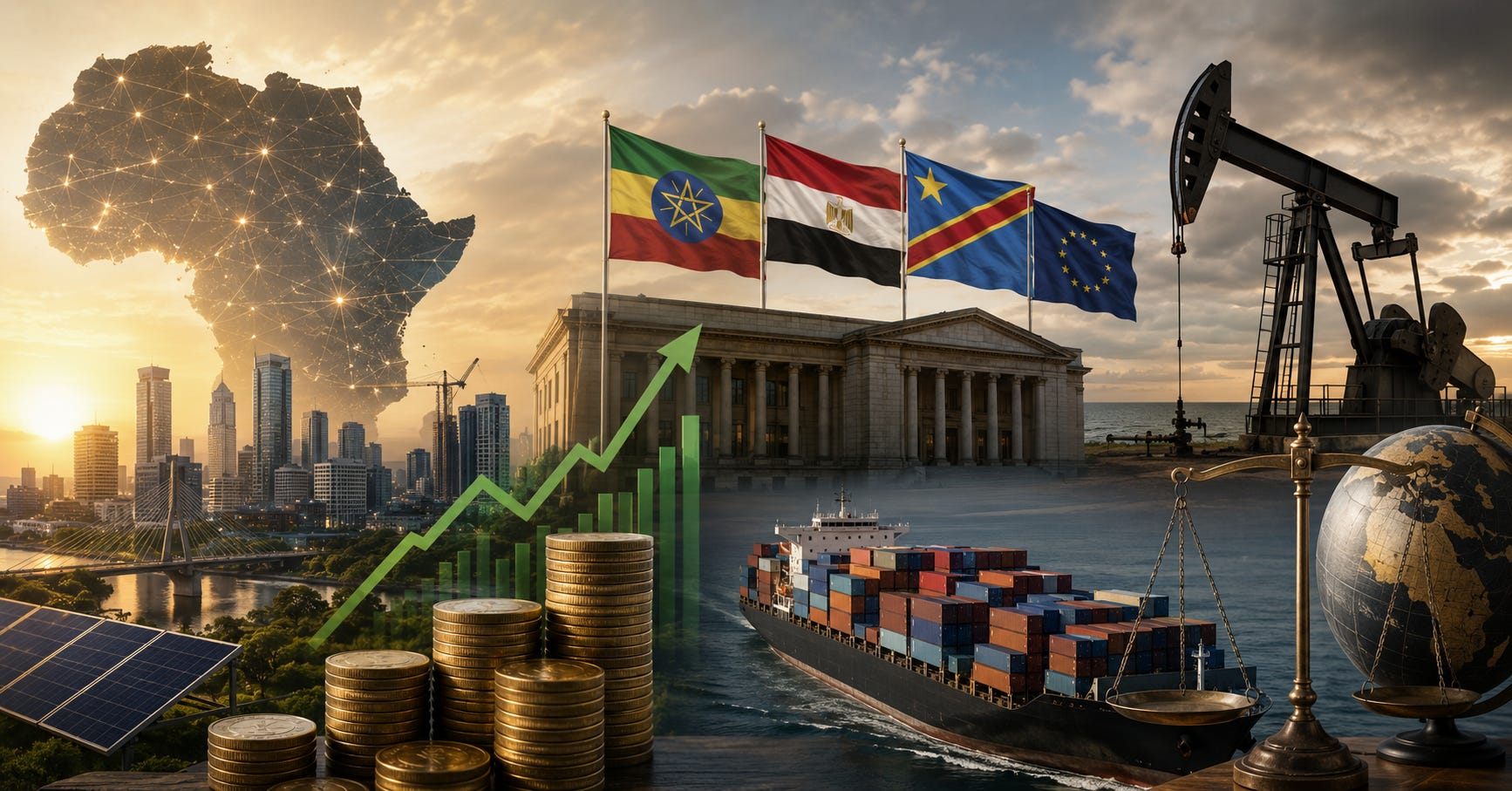
Three signals are converging this week. Africa's sovereign debt markets are reopening: Ethiopia restructured its defaulted Eurobond, Egypt received the first tranche of a 5.7 billion euro EU package, and the DRC's debut bond found four times its target. At the same time, Brent crude has fallen to around 72 dollars, providing the first sustained oil price relief since the Hormuz crisis began. And Washington's Section 301 tariff hearings open today with eight African nations in the dock. The continent's investment case is improving on multiple fronts simultaneously, even as new trade risks emerge from the West.
Big Picture »
Vodacom Completes a 2.1 Billion Dollar Acquisition of Safaricom, Gaining Control of East Africa’s Most Valuable Platform
The transaction closed June 30. It gives Vodacom 55% of Safaricom, full consolidation of M-PESA, and a direct stake in Ethiopia’s fastest-growing telecom market. It is the most significant corporate transaction in East African telecommunications history.
Vodacom Group completed its acquisition of an additional 20% effective stake in Safaricom on June 30, lifting its shareholding to 55% and securing majority control of Kenya’s largest company. The Court of Appeal cleared the final legal challenge on June 26. The total transaction is valued at 2.1 billion dollars, or R35 billion. Vodacom acquired 15% from the Government of Kenya for KES 204 billion and 5% from Vodafone for KES 68 billion, at KES 34 per share. The Government of Kenya retains a 20% stake. Safaricom remains listed on the Nairobi Securities Exchange.
Under IFRS accounting, Safaricom’s results now consolidate fully into Vodacom’s group accounts. Safaricom reported EBITDA of R29 billion in FY2026 and net income of KSh99.7 billion, up 67%. M-PESA contributes 44% of Kenya service revenue. In Ethiopia, service revenue grew 130.9% in the year to March 2026, and the operation is approaching EBITDA breakeven. Vodacom updates investors on medium-term targets around July 27 when it publishes Q1 results, the first to include Safaricom as a fully consolidated entity.

Why It Matters: Safaricom is not simply a telecom operator. It is the infrastructure layer for commerce, payments, and digital services across Kenya, and an early-stage platform in Ethiopia's 130-million-person market. Full consolidation gives Vodacom direct earnings exposure to M-PESA, one of the world's most influential mobile money systems, and positions it to extract value from Safaricom's cloud, IoT, and enterprise services as those lines grow. For competitors, Airtel Africa is the direct comparison: it is facing a parent buyout that may take it private, while Vodacom is consolidating a publicly listed, deeply profitable platform. Watch whether Bharti's move to delist Airtel Africa and Vodacom's Safaricom consolidation reshape how international capital accesses African telecom and fintech exposure.
This Week
Trade Policy · Washington DC
Section 301 Tariff Hearings Begin Today as Eight African Nations Face a 12.5 Percent Duty Threat
The USTR’s public hearings on proposed forced labour tariffs open today in Washington. The July 6 written comment deadline has passed. Eight African nations face proposed 12.5% additional tariffs: Algeria, Angola, Egypt, Libya, Mauritania, Morocco, Nigeria, and South Africa. Countries with partial forced labour prohibition frameworks may qualify for the lower 10% rate. Trade lawyers at White and Case note the USTR likely intends to have these tariffs in place by July 24, when the Section 122 global tariff authority expires. Egypt is the most exposed, with 2.6 billion dollars in annual US exports concentrated in textiles. South Africa and Morocco follow. Carve-outs cover energy products, certain metals, pharmaceuticals, coffee, and some agricultural goods, but the scope across manufactured goods is broad. Today’s hearings are the last formal public stage before the USTR makes its determination.
Sovereign Debt · East Africa
Ethiopia Reaches Agreement to Restructure Its Defaulted Eurobond, Restoring a Path to Debt Sustainability
Ethiopia reached an agreement to restructure its defaulted sovereign Eurobond in the week of July 6, a landmark step toward restoring debt sustainability and investor confidence in East Africa’s largest economy. Ethiopia defaulted in 2023, joining a small group of African sovereigns unable to service external debt during the post-pandemic tightening cycle. The agreement opens the path for Ethiopia to re-engage international capital markets. Ethiopia now joins Zambia and Ghana in having reached or progressed toward creditor agreements, suggesting the worst of Africa’s sovereign debt crisis has passed for its most prominent cases.
Geopolitics · Egypt / Europe
Egypt Receives the First Tranche of a 5.7 Billion Euro EU Package as Cairo Cements Its Strategic Value to Brussels
Egypt announced this week that it expects to receive a 1.5 billion euro first tranche of a 5.7 billion euro EU macro-financial assistance package. The EU views Egypt as a key strategic ally in North Africa and the Middle East, particularly for managing migration flows and providing regional stability. The package arrives at a moment when Egypt is simultaneously facing US Section 301 tariff exposure on its textile exports and managing a fiscal adjustment under its IMF programme. The EU capital provides additional balance of payments support and strengthens Cairo’s hand in managing its transition. For investors, the EU-Egypt strategic relationship provides a buffer against the worst-case Section 301 tariff impact and underlines why Egypt, despite its macro challenges, continues to attract multilateral support at scale.
Energy Markets · Pan-African
Brent Falls to Around 72 Dollars, the Lowest Since Before the Hormuz Crisis, as Oil Market Pressure Eases
Brent fell to around 72 dollars this week, its lowest level since before the Iran conflict. WTI is at approximately 69 dollars. The move reflects partial restoration of Gulf shipping, signs of progress toward a US-Iran framework, and weaker global demand. For African net oil importers, this is the most significant price relief since April. South Africa, Kenya, Ethiopia, and the WAEMU zone have absorbed fuel price increases of 20 to 40% since the Hormuz blockade. A sustained Brent at 72 to 75 dollars translates into measurable reductions at the next fuel price adjustment cycles across these markets.
Minerals · DRC / UAE
The UAE Has Cemented Its Position as the Primary Refining and Export Terminal for DRC Gold
The UAE has consolidated its role as the dominant refining and export hub for gold from the DRC, according to The Exchange Africa. Dubai now processes the majority of DRC gold leaving the region, with questions growing about how much of that gold passes through transparent supply chains versus conflict or artisanal sources. The DRC’s new lithium royalty reclassification and cobalt export restrictions have drawn significant international attention, but gold remains the country’s most traded and most opaque mineral export. For international buyers and investors with ESG obligations, DRC gold supply chain provenance is a compliance risk that is becoming harder to manage given UAE intermediation. The Mali government’s creation of a new artisanal gold regulator this week reflects the same underlying concern across West Africa.
Tanzania is absorbing more foreign investment than at any point in its history while simultaneously managing political tensions stemming from last year’s disputed election. Today, youth-led protesters have gathered in Dar es Salaam and other cities calling for democratic reforms and justice for the estimated 518 people killed in post-election violence. The government deployed military and police and banned all political rallies. This tension, between Tanzania’s genuine economic momentum and its narrowing political space under President Samia Suluhu Hassan, is the defining challenge for investors assessing the country’s medium-term operating environment.
The economic case is strong. Tanzania secured 1.5 billion dollars in industrial investment at the Bagamoyo Special Economic Zone this year. Russia committed 2 billion dollars in investments at St Petersburg in June. Singapore signed five bilateral agreements. GDP growth is projected at 5.5% in 2026. Gold, nickel, and gas resources are drawing sustained international attention. Perseus Mining injected 457.7 billion Tanzanian shillings into Tanzanian operations ahead of planned gold output increases. The Lobito Corridor, when complete, will improve Tanzania’s mineral export logistics. The governance situation warrants careful monitoring but has not yet materially disrupted the investment environment outside of reputational considerations for operators with public accountability obligations.
Opportunities: Gold, nickel, and gas extraction and related services. Manufacturing in Bagamoyo and other special economic zones. Agri-processing leveraging significant arable land. Port logistics through Dar es Salaam and Tanga serving landlocked DRC, Zambia, Malawi, and Rwanda. Tourism from a stable and growing sector.
Risks: Democratic governance concerns following the disputed 2025 election. Military deployment against civilian protesters narrows civic space and creates reputational exposure for operators with ESG obligations. Bureaucratic complexity and slow regulatory approvals. Electricity supply gaps outside major urban centres. Currency and foreign exchange access unpredictability.
Operating Tips: Swahili is the national language; English is widely used in business and government. Dar es Salaam is the commercial hub. Government relationships are essential for large projects, particularly in extractives and infrastructure. Community relations investment is expected and valued. The East African Community single customs territory membership eases cross-border trade logistics with Kenya, Uganda, and Rwanda.
Country intelligence sourced from the Africa.com Doing Business in Africa series. Read the full Tanzania profile, including IOA's research analysis.
In Brief »
Nigeria · Energy Policy » Nigeria officially became the first OPEC member to join the International Energy Agency as an Associate on July 3, signalling its recognition that long-term oil producer credibility requires engagement with global energy transition institutions. The membership improves Nigeria’s access to IEA data and forecasting tools and strengthens its positioning with international energy investors evaluating gas infrastructure and renewables alongside oil. Source: Business Tech Africa
Kenya · Capital Markets » The Nairobi Securities Exchange added KSh817.2 billion in investor wealth in H1 2026, with market capitalisation reaching a record KSh3.73 trillion by end-June. The gains were driven by a banking-led rally, record June performance, and the listing of Family Bank, the NSE’s biggest private-sector listing since 2009. Source: Kenyan Wall Street
South Africa · Economy » South Africa’s private sector returned to expansion in June, with the S&P Global PMI rising to 50.5 from 49.6 in May. Output and new orders grew modestly on improving domestic demand and easing cost pressures. Unemployment rose to 32.9% in Q1, with youth unemployment at 45.7%. The PMI improvement and oil price correction provide two modest positive signals for H2 planning, against a labour market that continues to deteriorate. Source: Business Tech Africa
Pan-African · Venture Capital » African startups raised 1.44 billion dollars in H1 2026, a marginal improvement on H1 2025 but well below the 3.21 billion raised in H1 2022. More significant than the total is the structure: only 146 deals were completed, down from 252 in H1 2025. Capital is concentrating in fewer, larger rounds in companies with proven revenue. Early-stage funding has thinned materially across the ecosystem. Source: TechCabal
Africa.com · Women and Capital » A new Africa.com analysis examines the structural gap preventing women-led businesses from accessing growth capital, drawing on BCG research showing women-led startups generate twice the revenue per dollar invested yet receive less than 1% of African venture capital. The piece identifies gender-lens funds and blended finance structures as the mechanisms beginning to close the gap. Read on Africa.com
What Investors Should Watch »
Section 301 Tariff Determination · Expected by July 24 » Today’s USTR hearings are the last formal public input before a determination. Trade lawyers expect the tariffs to be in place by July 24, when Section 122 authority expires. Companies sourcing from or exporting through the eight named African markets should be modelling the 12.5% cost impact now and evaluating whether supply chain adjustments are warranted before rates take effect.
Vodacom Medium-Term Targets · July 27 » Vodacom publishes Q1 results around July 27, the first to include Safaricom as a fully consolidated entity. Watch for updated EBITDA guidance reflecting the Safaricom consolidation, capex commitments in Kenya and Ethiopia, and any M-PESA monetisation strategy update. The targets will set the market’s earnings expectations for the enlarged group through FY2027.
Tanzania Political Situation · Ongoing » Today’s protest response and government actions over the coming days will shape Tanzania’s operating environment assessment for H2 2026. A government that contains unrest without significant escalation maintains a difficult but manageable investment environment. Escalation changes the risk calculus, particularly for operators with public ESG accountability obligations and portfolio companies with significant Tanzania exposure.
Comments
Nothing yet. Say the first thing.
Sign in to join the conversation.