
Keypoints:
The Paperless Revolution: ADAPT replaces archaic systems that required up to 30 entities to exchange 240 documents for a single shipment.
The Stablecoin Pivot: Global fintech leaders like Flutterwave (partnering with Turnkey and Nuvion) are bypassing traditional banks to offer near-instant settlement.
Proven Gains: Pilot programs in Kenya and Ghana have reduced border clearance times from six hours to just 30 minutes.
Beyond Finance: The platform introduces tokenization of critical minerals and a strategy to formalize the $10 billion informal food trade in West Africa.
As the global economic order fractures under the weight of Western isolationism and a retreat of traditional developmental aid, African nations are no longer waiting for external rescue. Instead, a new era of “African Agency” is being forged through the deployment of indigenous digital public infrastructure (DPI).
At the heart of this transformation is the Africa Digital Access and Public Infrastructure for Trade (ADAPT) platform. Launched in late 2025 as a joint initiative between the AfCFTA Secretariat, the IOTA Foundation, and the Tony Blair Institute, ADAPT is more than a technical upgrade - it is a sovereign response to a “poly-crisis” world. By integrating stablecoins as a standard settlement layer, the initiative aims to bypass the systemic frictions of correspondent banking, potentially unlocking over $70 billion in additional annual intra-African trade.
The African Continental Free Trade Area (AfCFTA) enters 2026 moving from vision to hard implementation. The ADAPT platform serves as its technological backbone, providing a unified network for identity, data exchange, and finance.
Utilizing IOTA’s public blockchain network, ADAPT establishes a “single source of truth” for trade documentation. This infrastructure is built on three core layers:
Trusted Digital Identity: Businesses gain secure, self-sovereign identities using decentralized identifiers (DIDs) integrated with national systems like Kenya’s eCitizen and Nigeria’s NIMC.
Cross-Border Data Exchange: Smart contracts and IoT-enabled tracking digitize the supply chain, cutting border clearance times by more than 90%.
Interoperable Finance Layer: Linking mobile money, traditional banks, and stablecoins into a single network for near-instant settlement.
A critical component of the ADAPT platform is the formalization of stablecoins (primarily USDT and USDC) as standard infrastructure. The traditional correspondent banking system is plagued by fees ranging from 6% to 9% and settlement times measured in days. ADAPT reduces these costs to under 3%, offering a practical tool for treasury optimization.
While the potential is immense, the transition faces structural hurdles. African nations possess a patchwork of varying rules regarding digital assets. Harmonizing these frameworks across 55 member states is essential for continental scalability. Furthermore, infrastructure challenges particularly unstable electricity and high compute costs in hubs like Nigeria remain a “binding factor” for the data centers required to host these blockchain workloads.
Emerging research from the Aspen Global Innovators Group identifies a “Trauma Tax” - a global $3.5 trillion economic burden caused by untreated psychological distress in conflict-affected regions. In Africa, ADAPT’s focus on stability is increasingly paired with “politics of care” movements. By reducing the administrative and financial stress of trade, the platform supports a “healing dividend” that increases job retention and productivity.
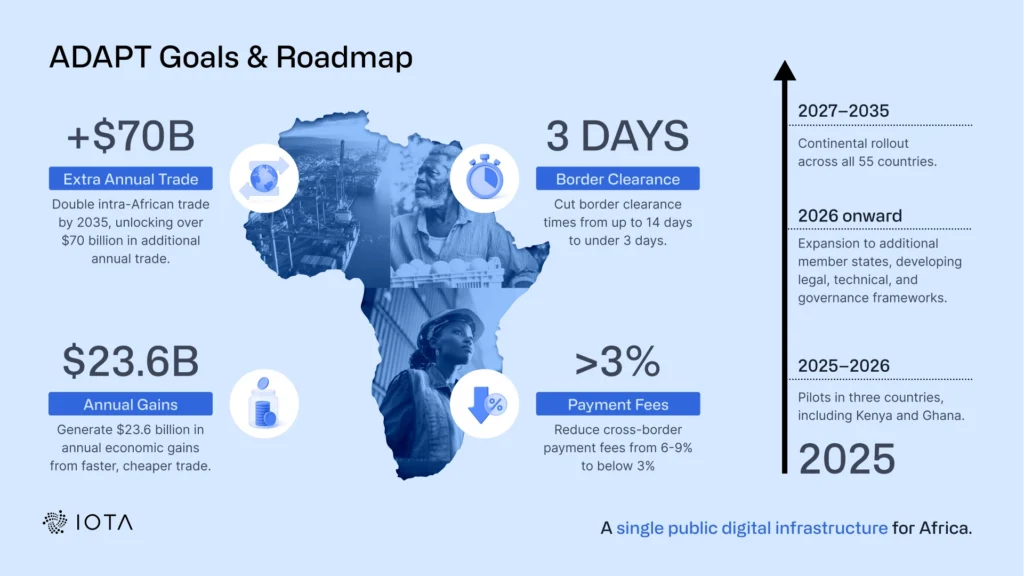
The ADAPT initiative is projected to double intra-African commerce by 2035, generating $23.6 billion in annual economic benefits. The successful rollout of this platform will separate “survivors from scalers” in the African tech ecosystem. As the “standalone fintech app” becomes a relic, the future belongs to the “invisible plumbing” of the ADAPT platform, which integrates payments, identity, and logistics into the very fabric of African commerce.
Comments
Nothing yet. Say the first thing.
Sign in to join the conversation.