
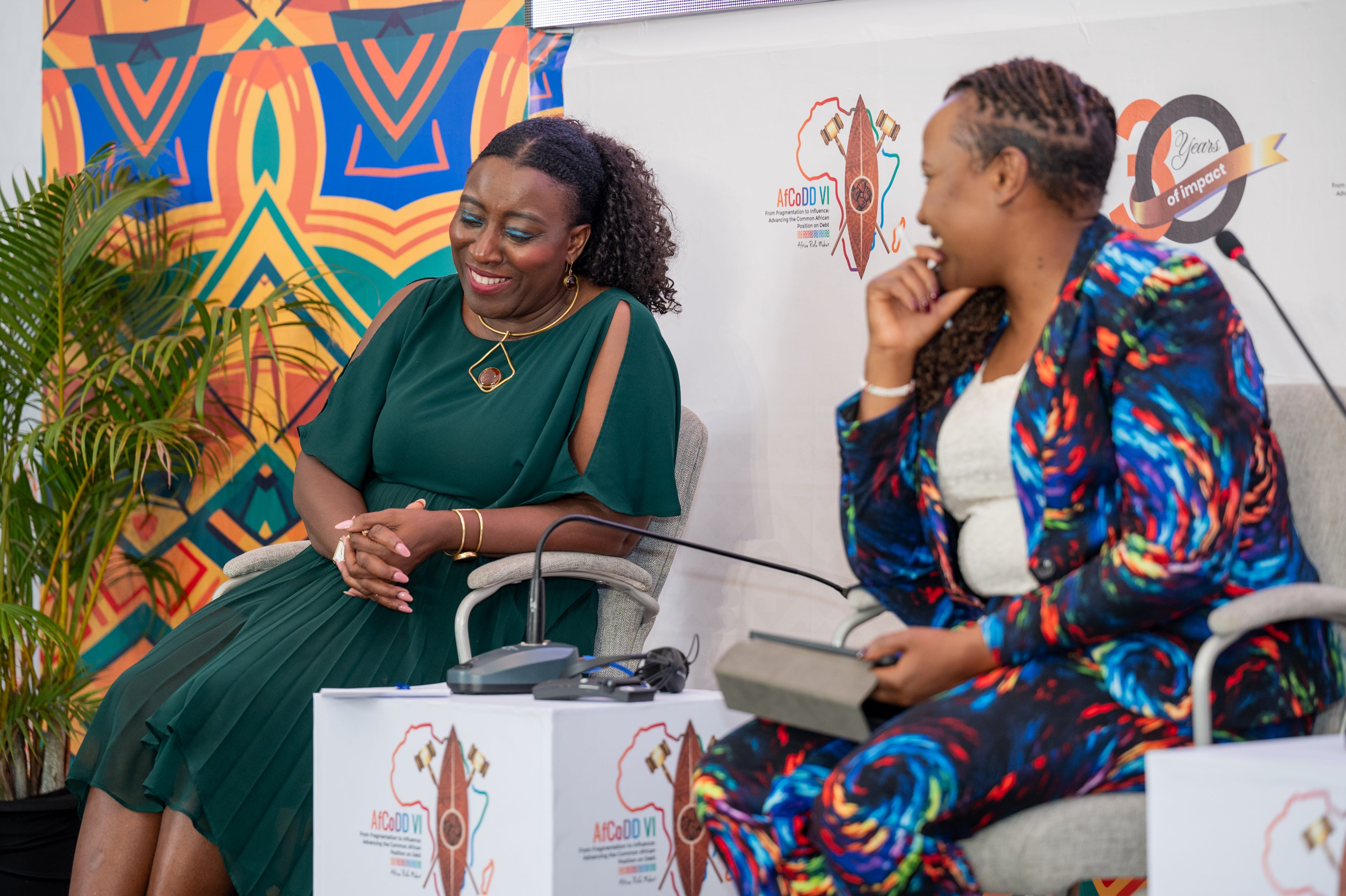
NAIROBI, Kenya — Leading Pan-African economic justice advocates launched the sixth annual African Conference on Debt and Development on Tuesday with a blistering critique of the global financial architecture, calling on African nations to dismantle centuries of systemic economic extraction and organize their collective power under the Common African Position on Debt, writes Winston Mwale.
The high-level gathering, known as AfCoDD VI, brought together senior state officials, civil society leaders, researchers, activists, and international diplomats at the Kilimanjaro venue in Nairobi.
The opening ceremony was marked by a call to shift Africa’s role from a historical rule-taker to an active rule-maker in the global financial system, rejecting temporary technical debt relief fixes in favour of deep structural transformation.
The conference, which runs from August 25 to 28, represents a critical mobilization of intellectual and political forces across the continent at a time when multiple African nations are facing acute debt distress, shrinking fiscal space, and mounting social unrest.
Barbara Kalima-Phiri, the chairperson of the Board of Trustees for the African Forum and Network on Debt and Development, welcomed delegates with a reminder of the historical mission that birthed the conference.
Addressing a packed hall of dignitaries, Kalima-Phiri emphasised that AfCoDD was created in direct response to Africa’s bitter experience with a global financial system that was never designed to facilitate African development, but rather to exploit its resources and maintain its economic subjugation.
She stressed that Africa’s economic destiny must no longer be decided in foreign capitals or behind closed doors in Washington, Paris, or London. Instead, the continent must assert its agency and build collective bargaining power to rewrite the rules of international finance.
“Afcodd was created in response to Africa’s experience with the global financial architecture and the urgent need for policy solutions to a system that was never put in place to deliver development to Africa and its citizens but to preserve the status quo of economic exploitation and subjugation,” Kalima-Phiri said.
She noted that the organization, AFRODAD, is celebrating its 30th anniversary this year, representing a transition from a youth movement into a formidable, mature actor on the continental stage.
“Someone told me that although you are a youth you still are a young adult. So bear with us that we’re just 30 years old but we have grown in terms of AFRODAD,” she said, referencing three decades of advocacy on debt justice, the historic Jubilee 2000 campaign, tracking illicit financial flows, and building the conceptual foundation for reparations and reparative justice.
The opening of AfCoDD VI occurs at a critical juncture for the continent, as public debt has reached unprecedented levels.
Kalima-Phiri presented sobering statistical evidence illustrating the devastating human and economic cost of political fragmentation across the continent.
She revealed that Africa’s total public debt has grown by a staggering 170 percent over the past decade, now standing close to $2 million, a figure she described as truly unprecedented.
This soaring debt burden is compounded by punitive interest rates in international capital markets, where African nations are systematically discriminated against based on racialized or biased credit risk ratings, forcing them to borrow at rates far higher than their Western counterparts.
“Our governments now borrow at close to 10% compared to the United States of America which borrows at under 3% even less so for those in the euro area,” Kalima-Phiri told delegates.
“This is the same money, right? It’s the same markets priced nearly four times higher simply because we are Africa.”
This extreme pricing disparity drains national budgets, forcing governments to prioritize foreign creditors over the basic survival of their citizens.
Kalima-Phiri reported that 27 African countries now spend over 10 percent of their national revenues solely on interest payments, a massive increase from just nine countries a few years ago.
The structural consequences are born by the poorest and most vulnerable populations on the continent who are deprived of public services [63].
“Across this continent, 791 million people live in countries where their government now spends more on interest payments than on investments in social services like health and education,” Kalima-Phiri said.
This deprivation of fundamental rights is maintained by a global governance structure that denies African nations any meaningful representation or voice [63]. She pointed out that Africa holds a mere 6.5 percent of the voting power at the International Monetary Fund.
Despite this negligible influence, the continent represents a massive share of the institution’s operations, with African countries accounting for close to half of everything the fund has lent out since the turn of the century.
“This arrangement does undermine the demographic strength and potential of the continent,” she asserted.
To reverse this systemic discrimination, the conference focused heavily on the Common African Position on Debt, which was adopted by African Union heads of state in February 2026.
Kalima-Phiri argued that the CAP provides a historic platform for Africa’s 55 nations to speak with a single, united voice, transforming their political commitments into tangible bargaining power.
However, she warned that a common position would only achieve its intended purpose if it translates into concrete institutional change rather than remaining a symbolic document on a shelf.
“A common position is only powerful if it changes behavior,” Kalima-Phiri said.
“You know it is only powerful when African countries can negotiate collectively.
It is only powerful when African institutions can coordinate themselves effectively and efficiently. It can only work if and when we change we balance power. So a common position cannot become another document that sits on the shelf. It must be an instrument of the African bargaining power.”
She observed that while African nations have historically possessed immense structural power, they have failed to organize it.
“The problem is that Africa has not yet organized its power. And I see that the common African position is a platform for us to organize that power,” she added.
Organizing this power requires building strong, African-led financial and regulatory institutions that can challenge the monopoly of Western-dominated entities.
Kalima-Phiri called for the immediate operationalization and strengthening of several key bodies outlined in the CAP, including the African Monetary Institute, a financing solidarity mechanism, the African Credit Rating Agency, and the African Debt Monitoring Mechanism.
She also highlighted the political potential of the newly constituted Borrowers’ Club, which represents a joint commitment by sovereign debtors to coordinate their negotiating strategies and end the practice of entering negotiations in isolated fragments.
“With all of these colleagues, ladies and gentlemen, and our distinguished guests, I think that we can begin to mobilize that power that we already have as Africa and negotiate collectively,” she said.
Kalima-Phiri urged the delegates—spanning government officials, civil society activists, academic researchers, journalists, and international development partners—to avoid the trap of endless diagnostic debates that lead to inaction.
“Over the next few days, I’m asking everyone in this room, government representatives, our activists, researchers, journalists, our development partners to resist the temptation to repeat the arguments that we often make without strong resolve going back to do paralysis. Is it analysis of paralysis of our problems? We want to move away from that. We will recognize them. We know they are valid, but we do not want to get caught up in that paralysis of analysis. What this week wants is that we want to make sure that we begin to suggest practical recommendations that will enhance the implementation of cup,” she said.
She added that a continent where these pan-African financial institutions are not strengthened “is a continent doomed for failure [67].” She concluded with a powerful mandate: “Africa does not need permission to exercise its power. It needs to organize it. I must stop. We must stop this cosmetic reform of financial systems and the architecture that again continuously reproduce extraction.”
Co-convening the event alongside AFRODAD was a powerful coalition of Kenyan and international civil society organizations, led by Diana Gichengo, the Executive Director of The Institute for Social Accountability.
Welcoming the global delegation to Nairobi, Gichengo praised the city as the pride of Africa, the home of champions, the cradle of mankind.
Gichengo, whose organization TISA is celebrating its 18th anniversary this year, noted the long and fruitful partnership they have shared with AFRODAD.
“We’ve walked a journey with AFRODAD who are our senior.
TISA is 18 this year. So we are an adult and AFRODAD is 30,” she remarked, reflecting on the growing maturity of Africa’s domestic accountability movements.
Gichengo, who also serves as the lead convenor for Okoa Uchumi—a broad-based civil society debt coalition in Kenya comprising over 100 organizations, including the Institute for Public Finance Kenya, Oxfam Kenya, Transparency International Kenya, and Christian Aid—emphasized that financial and economic policy can no longer be left in the hands of isolated technocrats.
“Financial and economic matters have become too important that we must bring as many voices, many actors on board,” Gichengo said.
She noted that previous editions of AfCoDD had systematically built a progressive intellectual framework for African economic liberation, moving from the baseline demand to transition from rule-takers to rule-makers, to reimagining a new pan-African world order, integrating a Pan-African feminist lens on debt justice, and exploring the concepts of reparations and reparative justice.
Today, Gichengo argued, the movement must rally behind the Common African Position on Debt to dismantle a reality where the everyday lives of African citizens are entirely defined by debt.
“The development, the dignity of Africans can no longer be controlled by debt. Our survival, who we are right now, is largely dictated and defined by debt,” Gichengo told the audience.
She pointed to Kenya’s own severe economic distress as a prime example of the broader structural crisis sweeping the continent, noting that debt servicing in Kenya has exceeded 64 percent of national revenues.
Gichengo challenged the traditional, creditor-biased definitions of debt sustainability that prioritize financial payments to external institutions over the basic socio-economic rights of the domestic population.
“Debt can never be called sustainable because creditors are paid on time,” Gichengo declared.
“We can no longer say we are not in debt distress just because creditors, a very small population globally, have been paid on time. Yet billions of people continue to lack essential services. That is something that we must now change and work on true debt sustainability. That must mean people live in dignity.”
Gichengo argued that Africa’s current economic subjugation stands in stark contrast to its immense structural advantages, particularly its demographic trajectory and unmatched natural resource wealth.
She reminded delegates that by 2050, the majority of the world’s population will reside in Africa, and that population will be composed of young, energetic, and highly capable citizens.
Furthermore, as the global economy transitions to green energy, Africa remains the primary custodian of the critical mineral resources required to power this new era.
“Which continent still has most resources? The continent that still has most resources remains Africa. Therefore, for us to re-imagine the future, we must change the fundamentals of international financial architecture. We need to institutionalize the African-led mechanisms that can help us to reclaim financial sovereignty,” Gichengo said, calling for the immediate operationalization of the African Debt Monitoring Mechanism and the comprehensive reform of sovereign risk and debt rating systems.
Gichengo questioned the unfair “African premium” that forces highly stable, resource-rich African democracies like Botswana to pay far higher interest rates on their public borrowing than Western nations, some of which are currently engaged in active warfare or facing severe political storms.
“Why is there an African premium for debt? What is there? Is there a European premium for debt? Is there an American one?” she asked.
Gichengo argued that overcoming this structural bias requires African states to build collective leverage and challenge outdated global financial frameworks by advancing the CAP as a non-negotiable bargaining position in all multilateral negotiations.
To achieve this, Gichengo stressed that Africa needs a new class of courageous and dedicated pan-African leaders who refuse to capitulate to external pressures.
“We have one challenge: to ensure that we bring on board credible Pan-African leaders who will not shy away, who will not retreat to make money, to cut deals, to weaken us, to cause fragmentation, but will dare to lead with courage and vulnerability of knowing the potential that we must get to and get us to where we need to be,” she said.
She also urged the continent to reject imported development models that do not align with African realities, referring to Kenya’s frequent rhetorical ambition to replicate Singapore’s developmental path.
“My country says we are headed to Singapore. I dare say that Africa must create blueprints after our own realities so that we can be with other nations a heritage to admire,” Gichengo said.
“We don’t need to cross those oceans. The rivers and the highways in between can bring us together to chart first a vision for Africa and then localize and cascade it in the best way possible to make us the leaders of the world.”
Gichengo concluded with a hopeful vision of a continent that has thrown off the imagery of perpetual victimhood and malnutrition to emerge as a global leader in human dignity and economic sovereignty.
“Ultimately, we want to ensure we are no longer used in pictures of malnutrition or disasters but we are the symbols of hope, the symbols of victory, and ultimately the symbols of human dignity,” she said.
The opening ceremony of AfCoDD VI featured an array of highly esteemed pan-African and international dignitaries, representing a broad coalition committed to debt justice and structural financial reform.
The conference’s organizers hope AfCoDD VI will produce concrete recommendations for implementing the Common African Position on Debt and strengthening African-led financial institutions.
The ultimate test, however, will be whether those recommendations translate into collective action beyond the conference hall.
As Kalima-Phiri put it: “We must stop this cosmetic reform of financial systems and the architecture that again continuously reproduce extraction.”
Janet Zhou, executive director of AFRODAD, is expected to deliver the official vote of thanks on behalf of the secretariat at the close of the conference Aug. 28.
Comments
Nothing yet. Say the first thing.
Sign in to join the conversation.