
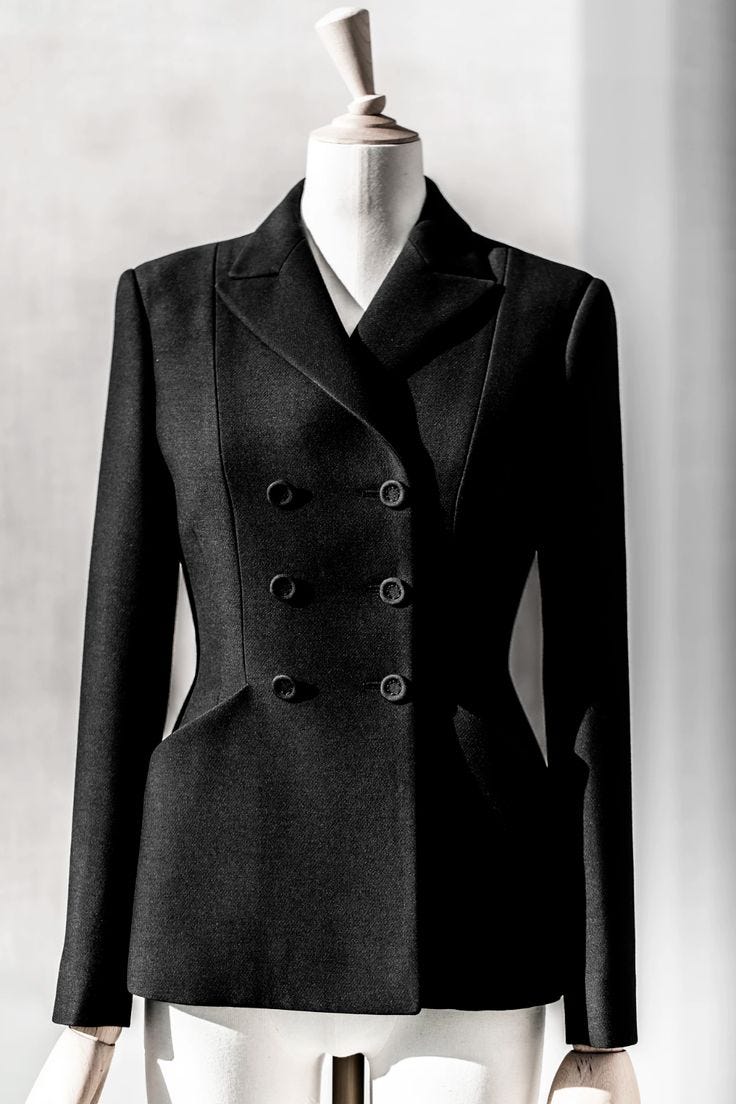
Living in France has given me an expensive new hobby.
I don’t buy antiques. I interrogate them.
Not the silver or the porcelain, although I have occasionally wondered who looked at a gravy boat and thought, Yes. This is exactly what’s been missing from my life. It’s the clothes that get me every time. Who wore this jacket? Where was she going? Did she save for it? Did she wear it to a wedding... or a funeral... or simply to buy onions on a Tuesday because life is rarely considerate enough to tell us which ordinary days will become memories?
France has an extraordinary ability to make slightly moth-eaten clothing look historically significant, which is how I found myself one Saturday morning in a brocante holding a beautifully tailored jacket that had clearly lived a more interesting life than I had that day.
It wasn’t dramatic. No famous label. No Hollywood glamour. Just beautiful tailoring and a waist that seemed... intentional. Not impossibly tiny. Not corset tiny. Just enough to make me wonder whether it had quietly corrected the posture of every woman who had ever worn it.
My first thought was considerably less sophisticated than anything Christian Dior probably had in mind.
Absolutely not.
I’ve reached an age where clothing requiring negotiations with my internal organs has lost much of its appeal. Besides, I was still recovering from the time I tried on a reproduction corset outside Bordeaux and, three minutes later, was standing so unnaturally straight I felt like I’d accidentally become a piece of furniture. The woman tightening the laces smiled approvingly and said,
“Now you look correct.”
Correct.
Not comfortable.
Not beautiful.
Correct.
That one word has been quietly following me around France ever since.
So there I was, standing in the middle of a dusty brocante, holding someone else’s jacket and staring at that deliberate little waist when another thought wandered in.
...unless?
Because that’s the problem with living in France.
Absolutely everything eventually develops a backstory.
A loaf of bread.
A butcher.
A village bench.
A jacket.
You pick something up on a Saturday morning and, before you know it, you’re standing in your kitchen three days later with six browser tabs open, explaining Christian Dior to absolutely no one while your coffee goes cold.
Somewhere around browser tab number four, I had the uncomfortable realization that I’d done exactly what I accuse everyone else of doing.
I’d decided what the jacket meant before I’d bothered asking why it existed.
I’d looked at those tiny waists and did exactly what people in 2026 are exceptionally good at doing.
I’d reached a conclusion before I’d asked enough questions.
France hates it when I do that.
It has become one of the country’s more exhausting personality traits. Just when I’m feeling wonderfully clever, it quietly wanders over, taps me on the shoulder and says,
“Yes... but...”
And that’s when I realized I’d been asking the wrong question all along.
I’d been wondering why women would ever want tiny waists again.
But maybe the waist wasn’t the story.
Maybe the year was.
Because what did a tiny waist mean in 1947?
Those are two very different questions.
It didn’t fit the story I’d been telling myself.
So I kept reading.
Not because I wanted to know more about Dior. I didn’t, not really. I had the increasingly familiar feeling that France was in on something and, once again, I’d arrived halfway through the conversation.
The timing was the part that refused to leave me alone.
After everything France had lived through, after years of rationing, shortages and making do with whatever happened to be available, why would anyone look at a dress that seemed to use an almost ridiculous amount of fabric and think, Yes. That’s exactly what we need.
No matter how I arranged it in my head, the war sat on one side of the table and the dress sat on the other, and neither one seemed remotely interested in helping me out.
I found myself looking less at the dresses and more at the photographs. Not fashion photographs. Photographs of France. Streets. Cafés. Faces. People who, only two years earlier, had been living through something I can barely imagine. It slowly dawned on me that I’d been looking at the whole thing backwards.
I’d been asking what the dress looked like.
What I should have been asking was what it felt like to put it on in 1947.
I kept trying to imagine that first fitting and, if I’m being completely honest, I couldn’t.
Not properly.
Because every version in my head involved central heating, online shopping, a return policy and knowing the war was over.
Which rather defeats the purpose.
I’d get as far as the mirror and then my twenty-first-century brain would wander in and spoil everything. It would start asking entirely the wrong questions. Was the dress comfortable? Could she sit down? Did it have pockets? How much did it cost? Was there a smaller size in the back?
None of those questions belonged in 1947.
Mine did.
Theirs didn’t.
And then, quietly, it hit me.
Not dramatically. France rarely works that way.
More like another one of those quiet little corrections it seems to enjoy making.
Eighty years later, standing in a warm house with a full refrigerator, I had absolutely no idea what it felt like to wonder whether life would ever become ordinary again.
No wonder I couldn’t make sense of it.
I wasn’t standing in front of the same mirror.
Of course, I don’t know.
How could I?
I wasn’t there.
I never queued for bread.
I never spent years making one dress last because there wasn’t another dress to buy.
I never walked into a fitting carrying the weight of the previous six years on my shoulders.
Perhaps that’s why I couldn’t quite imagine the mirror. I knew what I would have seen. I had no idea what she saw.
Not what the dress looked like.
What it felt like.
But for the first time, I stopped looking at Dior through my eyes and started trying, however imperfectly, to see him through theirs.
And suddenly the jacket hanging quietly in that brocante wasn’t asking me to admire it.
It was asking me to stop assuming I already understood it.
Which, now that I think about it, is something France has been trying to teach me for the better part of five years.
Apparently France had simply chosen a jacket to make its point.
This is Part III of The Line, an occasional series about France, fashion, and the curious things that happen when one question quietly leads to another.
This is Part III of The Line. If you’d like to start at the beginning:
Part I
Versailles and the Architecture of French Fashion
Part II
I Entered Chanel Wearing HOKAs and a Mild Delusion
No posts
Comments
Nothing yet. Say the first thing.
Sign in to join the conversation.