
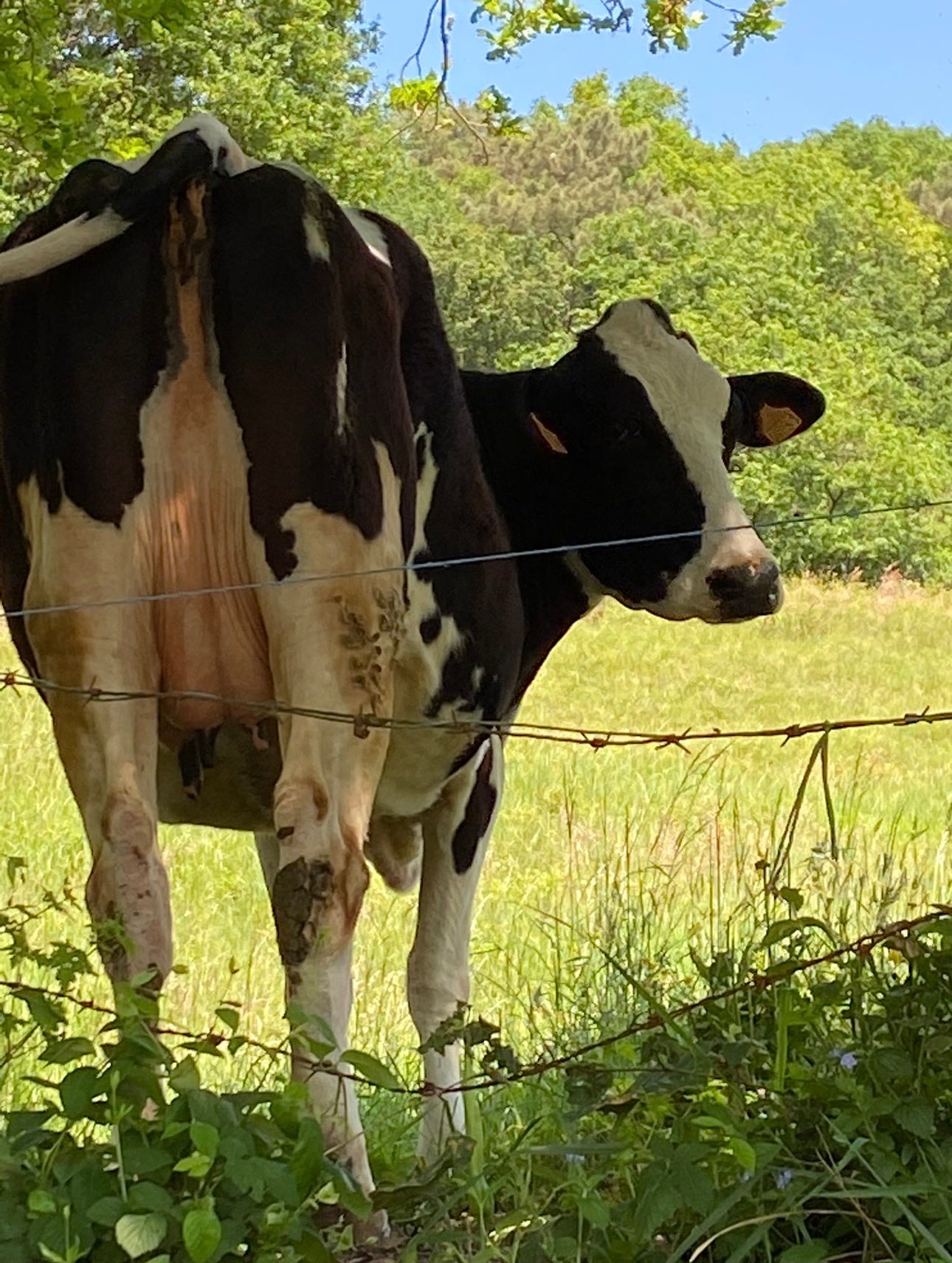
“How about you milk the cow?”
This was not a sentence I had expected to hear that morning.
I looked at the cow.
The cow looked at me.
Neither of us seemed particularly confident about the plan.
The cow, a large blonde creature with the calm authority of someone who had successfully been a cow for many years, lowered her head and continued chewing. I, meanwhile, was standing in a pair of shoes that had been selected for coffee, not livestock.
Somewhere between us stood my neighbor.
My neighbor had decided that after five years in rural France, it was finally time for me to become a farmer.
This was surprising.
Not because I lived in the countryside. I do.
Not because I owned a 400-year-old farmhouse. I do.
Not because I regularly wrote about village life, local markets, and French traditions. I do that too.
But because none of those things had ever suggested to me that I should be allowed anywhere near a cow's plumbing.
Yet here we were.
The cow.
The neighbor.
And me.
A woman whose agricultural experience consisted primarily of buying vegetables.
To understand how I arrived at this moment, staring at an udder like it was a complicated tax form, we need to go back several hours.
The day had begun with what I believed was a casual invitation.
That was my first mistake.
In France, particularly in rural France, there is no such thing as a casual invitation.
There are invitations.
And there are assignments disguised as invitations.
I arrived that morning dressed for the former.
Clean jeans.
A sweater.
Shoes entirely unsuited for any activity involving mud, manure, machinery, livestock, or reality.
My neighbor took one look at me and said nothing.
This should have worried me.
Instead, he nodded toward a tractor.
Not a modern tractor.
Not the sort of tractor featured in glossy agricultural brochures beside smiling families and financing options.
This tractor looked as though it had participated in several historical conflicts and won.
“Come,” he said.
I climbed aboard.
Immediately, I noticed the absence of several features I had come to expect from vehicles.
There was no heated steering wheel.
No touchscreen.
No Bluetooth.
No cup holder.
There may not have been brakes.
I’m still not entirely sure.
The tractor was apparently Step One.
This surprised me because I had always assumed tractors were something farmers used.
I had never considered the possibility that I might be expected to operate one.
Back in the USA, if someone wants to impress you, they might offer you the keys to a sports car.
In rural France, they point at a tractor and say, “Allez.”
The machine was enormous.
Not physically enormous. Emotionally enormous.
The sort of machine that looked capable of plowing a field, hauling a tree, delivering a calf, and surviving a minor war before lunch.
My neighbor climbed aboard with the ease of a man getting into his favorite chair.
I followed with considerably less elegance.
The seat appeared to have been designed by someone with strong opinions about comfort and an even stronger commitment to opposing it.
There was a steering wheel.
There were pedals.
There were several levers whose purpose I could only guess.
There may have been additional controls hidden in other departments.
I didn't ask.
Sometimes it's better not to know.
The tractor lurched forward.
I immediately grabbed onto everything within reach.
My neighbor glanced at me.
“Ça va?”
It was not.
But at this point I had lived in France long enough to understand that “ça va?” is rarely an actual question.
It's more of a cultural courtesy extended moments before something becomes significantly worse.
We rattled across a field.
Whatever beauty surrounded us was largely lost on me, as I was busy wondering whether tractors came with seatbelts in other countries. None of it felt particularly calming from the passenger seat of a machine that appeared to be held together by optimism and rust.
The tractor bounced.
I bounced.
Various internal organs bounced.
A coffee I had consumed two hours earlier briefly revisited the conversation.
Meanwhile, my neighbor drove with one hand while discussing weather patterns, soil conditions, and the quality of this year's hay as though we were sitting peacefully in a café.
I nodded.
This seemed safer than speaking.
The French have many gifts.
Cheese.
Wine.
Healthcare.
The ability to drive agricultural equipment over terrain that resembles the surface of the moon while remaining completely unbothered.
That may be the most impressive of all.
When we finally stopped, I assumed the lesson was over.
This was optimistic.
My neighbor pointed toward a chicken coop.
I followed.
At this point, I had begun to understand that rural French education operates differently from the version I grew up with.
There are no brochures.
No course descriptions.
No learning objectives.
You simply arrive and someone hands you a task.
The chickens were already waiting.
The coop smelled faintly of straw and dust.
I don't know how to explain this, but chickens always look like they know something.
Not something important.
Just something.
A secret.
A rumor.
The location of buried treasure.
The details vary.
The expression remains constant.
As we approached, several of them stopped what they were doing and stared directly at me.
I stared back.
This established nothing.
My neighbor entered the coop and began collecting eggs.
Effortlessly.
Like a magician performing a trick he had perfected decades ago.
I attempted the same thing.
The chickens were immediately skeptical.
One moved aside.
Another did not.
A third appeared to be evaluating my credentials.
Somewhere behind me, a rooster made a noise that sounded less like a bird and more like a legal warning.
I collected two eggs.
My neighbor collected what appeared to be several hundred.
I decided not to compare results.
By this point, my shoes had acquired a layer of mud thick enough to qualify as local soil.
One chicken had become unusually interested in me.
Everywhere I moved, it followed.
I stopped.
It stopped.
I moved again.
It moved again.
I still don't know what it wanted.
I only know that being quietly monitored by a chicken is surprisingly unsettling.
Eventually, my neighbor announced that it was time for lunch.
This struck me as excellent news.
Because while I had failed to distinguish myself as a tractor operator and had been thoroughly outperformed by poultry, lunch was finally an area where I felt confident.
I am not a farmer.
But I am very experienced at eating lunch.
The French, however, approach lunch with the seriousness of a constitutional obligation.
What I imagined would be a quick break turned out to be a multi-course event involving bread, wine, cheese, conversation, dessert, coffee, and absolutely no indication that anyone intended to return to work.
The tractor sat outside.
The chickens wandered freely.
The afternoon drifted past.
We sat beneath the shade of a walnut tree whose trunk was probably older than my country. Bread was torn, not sliced. The wine appeared without ceremony. At one point, someone disappeared into the house and returned carrying a tart. Nobody asked questions. This suggested a level of confidence in dessert that I deeply respected.
Stories were told.
More wine appeared.
Then more cheese.
I began to suspect that farming in France consisted primarily of eating and occasionally checking on animals.
It was a theory I was prepared to defend.
At some point after dessert, just as I was beginning to feel pleasantly reassured that the educational portion of the day had concluded, my neighbor pushed back his chair.
He stood.
I stood.
He looked at me.
Then he said the sentence that would alter the course of the afternoon.
"How about you milk the cow?"
We walked toward the field.
The cow looked up.
She was the color of fresh cream, with enormous dark eyes framed by impossibly long eyelashes. Had I encountered her in different circumstances, I might have described her as beautiful. Unfortunately, she was currently evaluating my qualifications.
I don't know much about cows, but I immediately had the distinct impression that she had been informed.
If the chickens had been skeptical, the cow was openly concerned.
She watched me approach.
I watched her watch me approach.
Neither of us appeared encouraged by what we were seeing.
Up close, she was considerably larger than I had remembered.
This often happens with cows.
You see them from a distance and think, "What a lovely animal."
Then you stand beside one and realize you've been admiring livestock the size of a small hatchback.
My neighbor, meanwhile, seemed entirely untroubled.
He greeted the cow.
The cow greeted him.
There appeared to be an existing relationship.
The sort of relationship built on years of mutual trust and agricultural competence.
I was not part of this relationship.
I was a co-star.
A temporary and deeply underqualified addition to the cast.
The cow seemed aware of this.
My neighbor positioned a stool beside her and motioned for me to sit down.
I did.
The stool was approximately six inches off the ground and somehow less stable than the tractor.
The cow shifted her weight.
I reconsidered my future.
"Like this," he said.
For the next several minutes, he demonstrated a skill that looked deceptively simple.
A little squeeze.
A little pull.
A satisfying metallic ping as milk hit the bucket.
Easy.
Elegant.
Almost artistic.
Then he stood up.
And handed me the stool.
This felt unnecessary.
I had already seen the demonstration.
I believed in the demonstration.
Surely that was enough.
Apparently not.
The French have a dangerous belief that observation should eventually be followed by participation.
I sat down.
The cow turned her head.
Not all the way.
Just enough.
The look she gave me was unmistakable.
It was the same look I once received from a Paris saleswoman after asking a question I should have known the answer to.
A look that said:
"Interesting."
Not encouraging.
Not discouraging.
Merely interested to see how badly this might go.
I reached forward.
The cow sighed.
I froze.
The cow sighed again.
My neighbor laughed.
This did not improve my confidence.
Somewhere behind us, a bird made a noise.
A fly landed on my arm.
The cow continued chewing.
The entire French countryside appeared to pause and watch.
I attempted the squeeze-and-pull maneuver.
Nothing happened.
I tried again.
Still nothing.
The cow remained patient.
Patient in the way a kindergarten teacher remains patient with a child attempting to eat glue.
My neighbor offered suggestions.
The cow offered silence.
Neither seemed convinced I was making progress.
Then, suddenly—
Ping.
A tiny stream of milk hit the bucket.
I stared at it.
My neighbor cheered.
The cow looked disappointed.
For one glorious second, I felt like a real farmer.
Then the cow lifted her tail.
And the situation changed dramatically.
I don't know how to explain this to people who weren't raised around livestock, but there are certain moments in life when you instantly understand that important information has been withheld from you.
This was one of them.
My neighbor took a small step backward.
The cow remained where she was.
I was still sitting on a stool the size of a decorative mushroom.
Nobody said anything.
That should have been my clue.
Instead, I smiled.
This was my third mistake.
What happened next occurred with remarkable speed and complete confidence.
The cow, having assessed the situation and apparently reached a decision, launched a biological event of considerable magnitude.
There are moments in life when language fails.
This was one of those moments.
Let's just say that some of it landed in places where no reasonable person would voluntarily store cow-related material.
The cow seemed relieved.
My neighbor laughed so hard he had to sit down.
I sat there in stunned silence.
The cow resumed chewing.
The lesson, apparently, was continuing.
For a moment, I considered leaving.
Not the field.
France.
Five years earlier I had arrived in the Dordogne dreaming of stone houses, local markets, long lunches, and picturesque village life.
At no point had I imagined that my journey toward French integration would involve being partially baptized by livestock.
Yet here I was.
A homeowner.
A host.
A reasonably competent French chef.
And a woman currently losing an argument with a cow.
My neighbor eventually regained the ability to breathe.
"You are lucky," he said.
Lucky.
This was not the word I would have chosen.
Apparently, however, surviving unexpected encounters with large farm animals without serious injury qualified as a successful outcome.
French standards differ.
The milking lesson resumed.
This time, with slightly less confidence on my part.
The cow, perhaps sensing that I had finally achieved the appropriate level of humility, became marginally more cooperative.
A few streams of milk found the bucket.
Then a few more.
Soon there was enough in the bottom to prove that I had, in fact, participated.
No one would mistake me for a farmer.
But I could no longer claim complete ignorance.
Eventually my neighbor nodded.
The lesson was over.
I stood carefully.
The cow looked at me.
I looked at the cow.
It felt appropriate to acknowledge what we had been through together.
Neither of us had enjoyed it.
But we had both done our best.
As we walked back toward the house, my shoes heavy with mud and my dignity noticeably lighter than when the day had begun, I realized something.
For five years, I had been trying to learn France.
The language.
The food.
The customs.
The rhythms.
The rules nobody explains.
What I hadn't realized was that France had been trying to teach me right back.
Not through books.
Not through grammar.
Not through polite conversations over coffee.
Through tractors.
Through chickens.
Through long lunches.
Through neighbors who disguised assignments as invitations.
And occasionally, through cows.
I came to France to restore a farmhouse.
Apparently France had other plans.
The cow, for the record, remains unconvinced.
What I didn’t know then was that this particular cow would eventually do me the biggest favor I’ve received in France.
But that’s a story for another day.
No posts
Comments
Nothing yet. Say the first thing.
Sign in to join the conversation.