
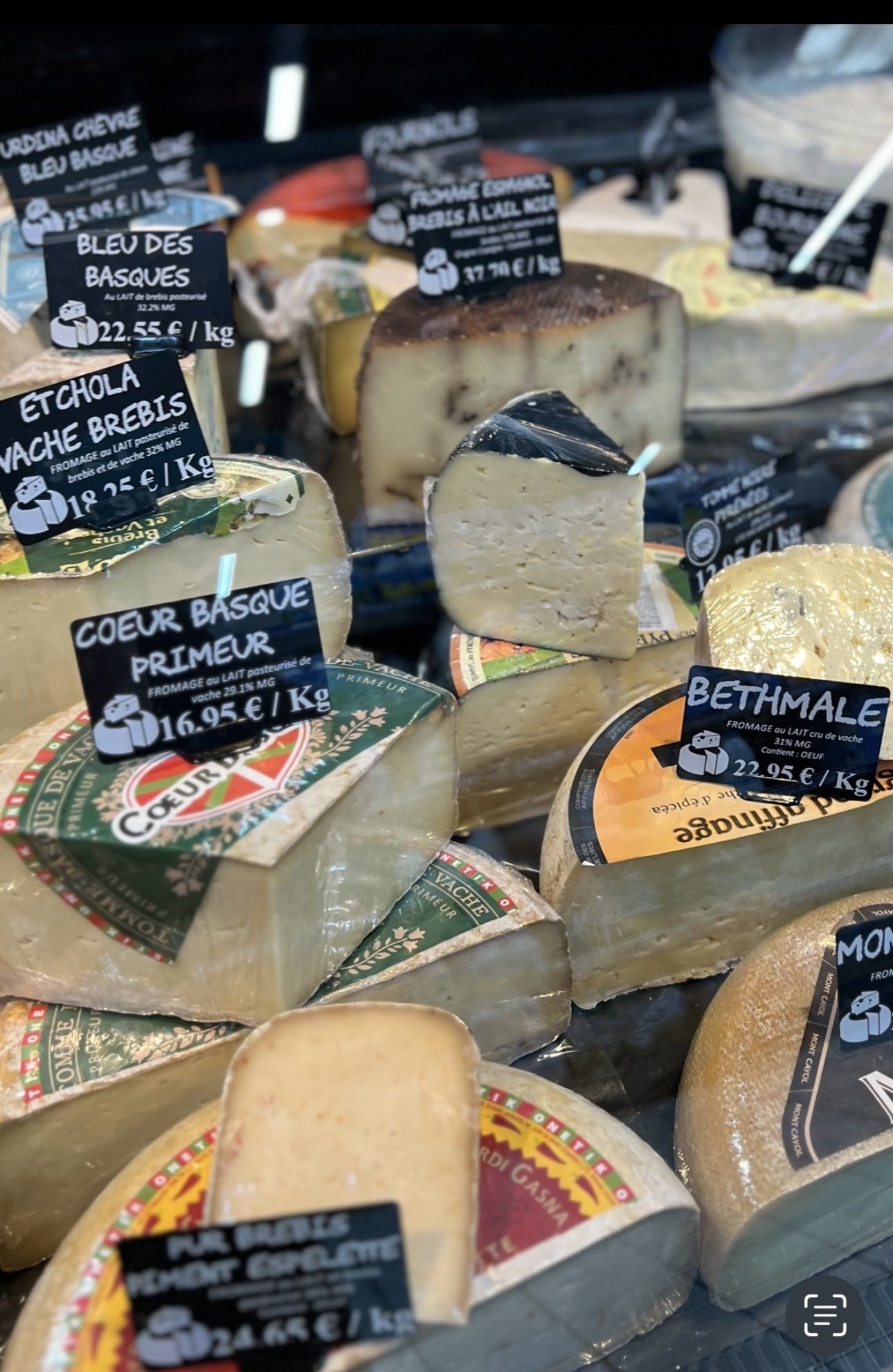
I went in for one cheese. Just one.
A nice soft wedge for dinner. Something humble, maybe a Camembert. Something French enough, but not so French it required a small ceremony or a second mortgage.
Five years ago, I moved to France thinking the hard part would be buying a 400-year-old farmhouse, navigating French bureaucracy, and learning a language that appears to contain fourteen ways to pronounce the same vowel.
Turns out the hard part was dairy.
The fromageries? Honestly, they’re operating at a level I have not yet unlocked.
Instead, I found myself frozen in aisle six of the local hypermarché, somewhere between the Roquefort and the Comté, locked in an emotional stand-off with an elderly woman and a stack of Coulommiers so fragrant they could’ve been used to start a perfumery.
She looked at me like I’d never known a real cheese in my life.
She was correct.
There were too many cheeses. Too many choices. I wish they had those tables set up like at Costco where I could walk around and try each one with my toothpick.
The labels read like a regional history exam I definitely didn’t study for. And the illustrations? They had little cows or sheep on them, just for me, I guess. Like children’s menus for lost adults.
Tomme des Croquants.
Saint-Marcellin.
Bleu de Gex.
Tomme Brebis.
Some were wrapped in straw. One had black dust on it, possibly ash, possibly something that should’ve come with a disclaimer. One came in a ceramic pot that looked far more confident than I felt. Do I get to keep the pot? Return it? Does someone refill it like a sacred dairy chalice?
Another one was leaking. I wasn’t convinced it wanted to be purchased.
I used to think I was a brave person.
I left my home all alone. I moved across the world. I rented cars in foreign languages, climbed fences in my underwear, and even held off a French striking mob.
And yet here I was, Googling “Is this cheese supposed to smell like moss and sadness?” and praying no one saw me do it.
Moving to France taught me many things. Mostly that confidence is a highly transferable illusion. One minute you’re signing paperwork and buying houses. The next, you’re standing in front of a refrigerated display case wondering if a cheese has gone bad or is simply expressing itself.
I tried organizing them in my mind. By region, by milk type, by likelihood of triggering an emotional collapse, but the only thing I knew for sure was that I couldn’t go back to the refrigerated aisle a third time without someone reporting me.
A small child walked confidently past me and whispered something like “Comté 24 mois” with the grace of a sommelier.
My first thought was:
That small child can speak French with more confidence than I’ve ever felt in my adult life.
I nodded, pretending I too was on a mission, when in fact I was spiraling next to a wheel of something called Tentation des Moines, which felt personal.
It sounded like a scandal and smelled like a dare.
The French Come Preloaded
Meanwhile, every French person in the aisle appeared completely calm.
Nobody was staring at labels.
Nobody was secretly Googling.
Nobody was holding a wedge of cheese at arm’s length like unexploded ordnance.
A woman tossed three cheeses into her basket without even slowing down.
Not reading.
Not comparing.
Just knowing.
The same way Americans know breakfast cereal. Or baseball. Or where the extra batteries are hidden.
I watched her disappear around the corner and thought:
There are toddlers in this country with stronger opinions about raw-milk cheese than I have about most major life decisions.
The French don’t seem to choose cheese.
They recognize it.
Like spotting an old friend across a crowded room.
Meanwhile, I was still standing there wondering whether “washed rind” was a description or a warning.
I reached for the cheese with the prettiest label and one with some sort of real flower petals all over it. That’s my vibe, don’t you think?
Oh, but what about the one with the cartoon cow and a hand-drawn alpine meadow?
Seemed friendly.
Manageable.
Maybe even forgiving.
I must keep remembering:
Just one, Jenny.
But I’m a Gemini, so naturally I took both. One for aesthetics. One for emotional support.
At this point, it feels important to note that Fifty Shades of Gruyère is not actually about cheese.
It’s about:
Forbidden wheels of passion
Bound by rind, aged to perfection
Smells like ambition and questionable decisions
Sharp on the outside, melty on the inside
Hand-tied with straw and a complicated backstory
Best paired with wine and an exit strategy
Aromas of betrayal and unpasteurized dreams
Warning: May cause emotional turbulence, impulse carb-loading, and irrational flights to the Jura region.
The Cartoon Cow Cheese Was a Liar
I got home, opened the package, and was immediately hit by a smell I can only describe as wet wool in a confession booth.
The cartoon cow on the label had the energy of a real estate listing.
Charming.
Quaint.
Completely detached from reality.
My dog sniffed it, looked at me with concern, and left the room. It was the same look she gives me when I attempt home repairs.
I briefly considered doing the same.
But I didn’t.
Because this was France.
And I had something to prove.
But here’s the thing.
The French weren’t treating cheese like food.
They were treating it like culture.
Cheese Interlude (You Knew This Was Coming)
To understand why this moment nearly broke me, you have to understand that in France, cheese is not just food.
It is legacy.
Geography.
Identity.
And occasionally a biohazard.
There are more than 1,600 distinct cheeses in this country, many with legal protections, regional loyalties, and family feuds that have probably outlasted several governments.
Each one is defined not just by ingredients, but by where it’s from, what the animals ate, how it’s aged, who makes it, and whether someone’s great-grandmother once produced it in a stone cellar next to a sacred spring.
Some are aged in caves.
Some are rolled in ash.
Some are washed repeatedly until they smell like a challenge to your personal values.
One may have been rubbed lovingly with walnut liqueur and forgotten until it developed a personality.
Cheese in France is not a side dish.
It’s a cultural institution.
A source of regional pride.
A national sport.
And judging by my performance in aisle six, an entrance exam I had not adequately prepared for.
So I ate it.
All of it.
With bread, and shame, and a splash of white wine I found at the back of the fridge.
And I survived.
Because this is what living in France is, sometimes.
Not the postcards or the cobblestones or the cinematic sunsets.
Not the village markets or the ancient stone houses or the impossibly beautiful photographs that make everyone back home think you’ve wandered into a fairy tale.
It’s the quiet, crumbling moment where you find yourself completely out of your depth.
Standing in a supermarket.
Staring at a cheese.
Wondering if you’ve made a terrible mistake.
And then deciding to try anyway.
The older I get, the less I think courage looks like certainty.
Sometimes it looks like moving across an ocean.
Sometimes it looks like starting over.
And sometimes it looks like buying the wrong cheese and eating it anyway.
I looked down at the empty wrapper, the abandoned bread crumbs, and the glass of wine beside me.
The dog still wasn’t speaking to me.
But the cheese was gone.
And somewhere between the first bite and the last, the panic had disappeared too.
I caught my reflection in the kitchen window and thought:
“You’ve got this.”
No posts
Comments
Nothing yet. Say the first thing.
Sign in to join the conversation.