
A few days ago, I was flying home to France after spending time with my daughter in New York.
The flight had no WiFi, no screens, and no plugs, which meant I was left alone with my thoughts for nine uninterrupted hours. A dangerous situation under any circumstances.
Somewhere over the Atlantic, while emotionally supporting myself with a barf bag and staring at a map that suggested our aircraft was roughly the size of Belgium, I found myself thinking about this house.
The one I’m returning to.
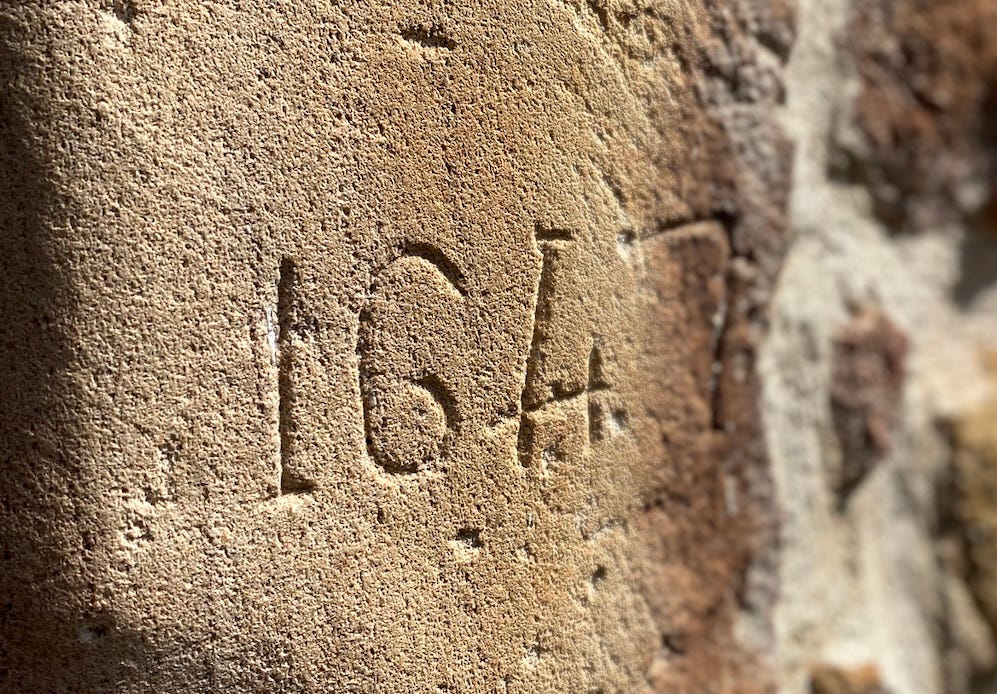
The one built in 1647.
The one with the pool, the gîte/cottage, the ducks, the occasional plumbing uprising, and a long history of making its problems feel like my fault. Many of you know this house.
You’ve seen the pool.
The renovations.
The ducks.
The occasional plumbing uprising.
What you may not know is that when I bought it, I had never actually stepped inside.
Which, in hindsight, feels like relevant information. The house, however, seemed perfectly comfortable withholding details.
Act I: The Search (a.k.a. The Spreadsheet of Insanity)
In my previous life, the one with income, structure, and reasonably functioning WiFi, I had a holiday home in the Dordogne. It was dreamy. We split time between the hustle of Seattle and the slow-bubbling cassoulet pace of rural France.
But when I blew up my life and set out on my Mamma Mia adventure (minus the singing but with considerably more paperwork), I told myself I needed something new.
Except I didn’t.
What I apparently needed was a French farmhouse, some ducks, and a fantasy involving a gîte (Cottage), a pool, and somewhere to park the contents of a 20-foot shipping container currently sweating in a warehouse in Málaga.
I flew up from Spain twice with a real estate spreadsheet the size of a medieval scroll and roughly the same number of footnotes. At one point I considered adding a scoring category for “general emotional stability,” but none of the houses would have passed.
My requirements were simple:
• Total privacy
• Room for guests
• Room for my vintage cookbook collection
• Room for my American delusions about laundry rooms
• And a kitchen large enough to host either a dinner party or a low-grade identity crisis
In retrospect, I should have included:
• Functioning electricity
• Basic wildlife boundaries
• A contractor who liked me
Act II: The Drive-By Purchase
I came very close to buying House Number Eleven.
It was charming. Private. Sensible.
The sort of house purchased by people who make reasonable decisions.
I decided that if the next and final house I was scheduled to see that day didn’t work out, I’d stop looking and buy it.
Enter: House Number Twelve.
We arrived.
The realtor forgot the code to the lockbox.
A strong opening.
He tried one code.
Nothing.
A second.
Nothing.
Several increasingly optimistic combinations.
Still nothing.
Eventually he suggested lunch while he figured it out.
And since this is France, “lunch” meant two hours, three courses, two carafes of wine, a discussion that drifted through local politics and duck production, and exactly zero progress on the lockbox situation.
By dessert, I had learned considerably more about regional foie gras than I had about the house.
We returned.
The lockbox remained undefeated.
At this point, most people would have considered this a warning.
I considered it lunch.
I had still never seen the inside.
So I walked around the property.
I peeked through a few windows.
I saw old shutters, crumbly stone, slanted slate, and a giant plane tree that looked like it judged everyone who had ever owned a leaf blower.
“I’ll take it,” I said.
The agent stared at me.
“You haven’t even seen the inside.”
“I can change the inside,” I replied.
“I can’t change the outside.”
Looking back, this may not qualify as due diligence.
But it was apparently enough.
A few weeks later, I became the owner of an estate built in 1647, complete with a pool, a gîte, two hectares, and a collection of surprises that had apparently been waiting patiently for my arrival.
Act III: The House Begins Negotiations
The day I moved in, the house began revealing its terms and conditions.
Unfortunately, none of them had been disclosed during the purchasing process.
The house wasn’t ready to be habitable. I hadn’t even laid eyes on the inside yet. The container was still in Málaga so I moved into the gîte.
First, I couldn’t get the front door open.
Then I discovered the previous owners had taken everything that wasn’t nailed down and several things that were.
By nightfall the gas bottle had given up entirely.
By the end of my first evening, I had managed to purchase a 1647 estate, run out of gas, and find myself watching YouTube tutorials on propane replacement while wearing socks and questioning the decision-making process that had led me across two countries and into this moment. The house seemed pleased.
The house was just getting warmed up.
First, mice chewed through the gîte’s electrical wires.
Then a mystery leak appeared in the ceiling.
I assumed it was water.
This was optimistic.
It turned out to be a fouine, otherwise known as a stone marten.
If you’re unfamiliar with stone martens, imagine a ferret with poor boundaries and a strong opinion about real estate.
Apparently, it felt the attic belonged to it.
Lightning struck a fence.
The fence shared the experience with a tree.
The tree fell into the pool.
Sidebar (and Spoiler Alert): At that time, I didn’t know a two-ton cow would one day follow it.
Act IV: The French Renovation Revolution
Buying the house was the easy part. Living in it was its own French Revolution.
The Contractor Firing Squad
Every rebellion needs a dramatic beginning. Mine came in the form of a contractor who, in a plot twist worthy of a melodrama, fired me. He fired me. This remains one of the more surprising performance reviews of my career. The house appeared to support his decision.
All I asked was to be informed when artisans were coming so I wouldn’t be ambushed mid-bathrobe. Apparently that was “too American,” and he rage-quit before anyone had so much as picked up a trowel. Diva status: confirmed. Him? Me? Your call.
The Beam Offensive
Then came the snow, and the delivery of four 600-lb antique beams in a flurry of sleet and second guesses. Just as I began to wonder if I’d be stuck with the world’s heaviest lawn ornaments, they showed up: a crew of French men in wool beanies and forearms sculpted by scaffolding. They installed all four beams in a single morning with the speed of a pain au chocolat sellout on market day.
I stood there breathing in sawdust and snow air, thinking: Okay. Maybe this is going to work.
But the house introduced another challenge.
The Great Flush Resistance
Main bathroom estimated time to remodel: two weeks. Actual time? Two months, one plumbing crisis, and a beehive behind the shower wall that may have been registered as a UNESCO site.
The first round of tiles looked like prison rejects. The second was grouted crooked, like the bathroom was winking at me in defeat. I lived with grout dust in my ears for weeks.
Also, surprise: the plumber forgot to connect the hot water line. I didn’t discover this until a chilly January morning when I emerged from the shower sounding like a 19th-century sea captain.
But now the hot water flows. The tiles stay put. The bathroom is small, bright, gloriously functional….and blessedly bee-free.
The Pool Mutiny
Ah, the pool. A beautiful blue rectangle of false hope. The pump didn’t work. The filter sounded like a tractor trying to yodel. At one point, the water turned a shade of green that can only be described as radioactive absinthe.
I once found a frog, a beetle, and a half-dissolved baguette floating in it, which honestly feels like a metaphor.
Looking back, I couldn’t have imagined that years later, a two-ton cow would fall in that pool. But that, my friends, is a story for another day.
Closing
Looking back, I thought I was buying a house.
What I actually bought was a relationship.
The house has strong opinions.
So do I.
For five years we’ve been testing each other.
The house introduces a challenge.
I introduce a solution.
The house raises the stakes.
I buy another ladder.
Somewhere along the way, we reached an understanding.
It occasionally wins.
So do I.
But if there’s one thing I’ve learned, it’s this:
Never assume you’ve seen everything an old French house can do.
Especially one that’s already survived nearly four centuries before you arrived with a spreadsheet and opinions.
Besides, I still hadn’t seen the strangest thing that could happen to that pool.
At this point, I think we’re both too stubborn to leave.
No posts
Comments
Nothing yet. Say the first thing.
Sign in to join the conversation.