
ACT I: RUSTIC CHIC
There are moments in life when you picture yourself participating in rural French traditions and imagine something cinematic.
Golden afternoon light.
Rustic baskets.
Maybe a scarf.
A weathered farmer nodding approvingly while you gather walnuts by hand beneath ancient trees, looking like someone who has strong opinions about heirloom pears.
This is not what happened.
What happened was agricultural combat.
Karen and I had been invited to help with the walnut harvest at a local farm near the village. Karen is British, which meant the two of us approached the situation with completely different but equally useless instincts.
My first concern was what to wear.
Not practical concerns like: Would there be mud? Would machinery be involved? Could I die beneath a tree?
No.
I was focused on achieving what I believed to be “rustic chic harvest energy.”
France, meanwhile, had organized an industrial walnut operation involving giant shaking machines, conveyor belts, tractors, and enough flying debris to qualify as a small weather event.
Now, to understand the seriousness of all this, you have to understand something about walnuts in the Dordogne.
Here, walnuts are not merely walnuts.
They are history. Economy. Identity.
There is an actual Route de la Noix winding through the region, which in hindsight should have warned me that the French were taking this far more seriously than I was.
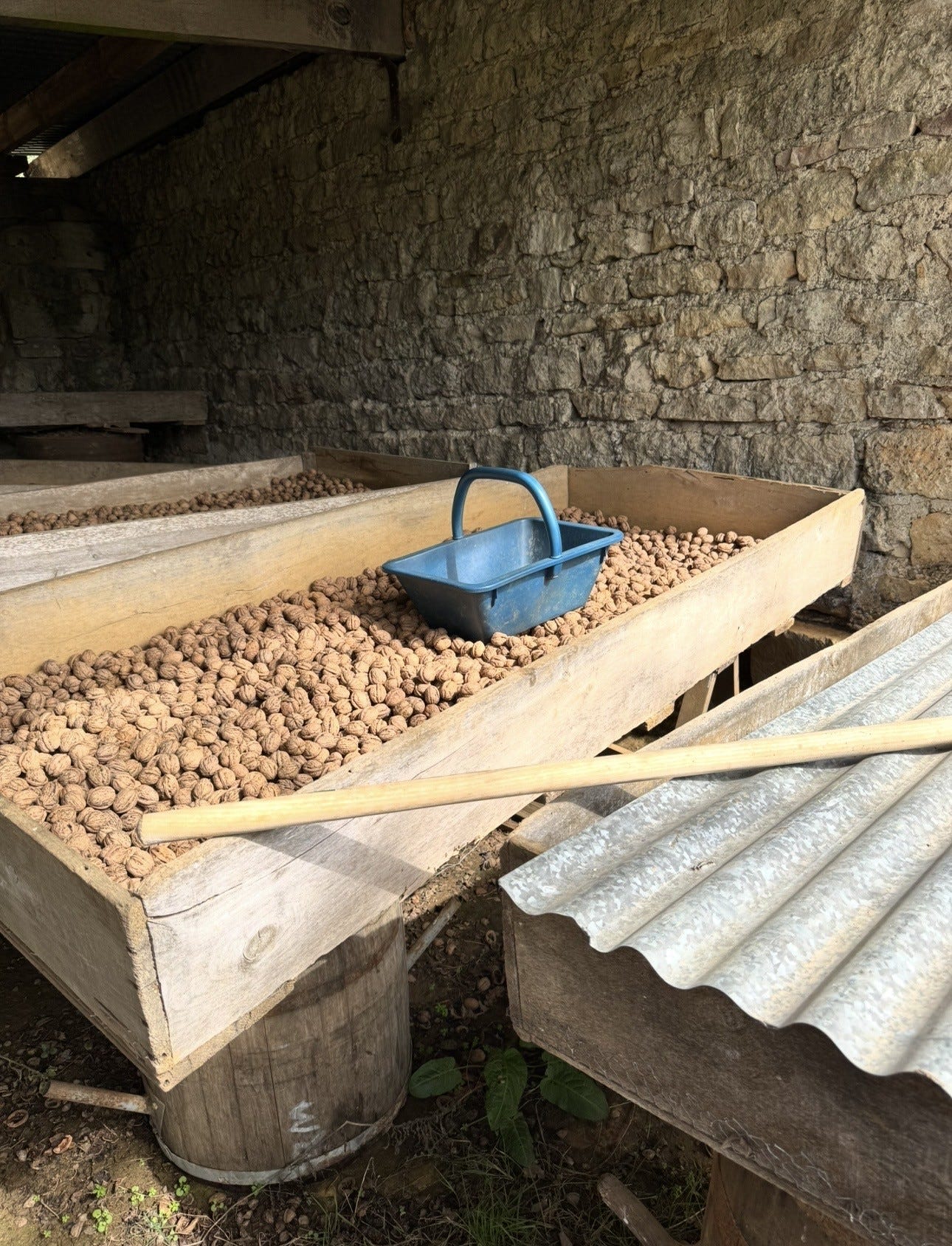
The walnuts here have protected status. Entire villages smell faintly of walnut oil and wood smoke in autumn. Markets overflow with walnut cakes, walnut wine, walnut liqueur, walnut bread, walnut pâté, and tiny jars of walnut oil displayed with the reverence usually reserved for religious relics.
Meanwhile I was arriving dressed for what I thought might be a charming countryside photo shoot.
ACT II: THE BOMBARDMENT
The first sign that I had misunderstood the assignment came when we arrived at the orchard and I noticed a massive machine gripping the trunk of a walnut tree like it was about to interrogate it for state secrets.
The entire farm smelled faintly of damp earth, crushed walnut husks, diesel fuel, and fresh wood. Tractors moved slowly between the trees while workers shouted to one another across the orchard in rapid French I couldn’t remotely follow. Somewhere nearby, someone had brought coffee in a thermos. Another man smoked quietly beside a mountain of walnuts as if this level of agricultural chaos were completely ordinary. And somehow, it already felt oddly familiar.
The machine began violently shaking the tree.
Walnuts exploded downward like nature had finally snapped.
Bonk.
Bonk.
Bonk bonk bonk.
Now, a reasonable person might step away from this situation.
I did not.
Instead, I stood directly underneath the tree staring upward while walnuts ricocheted off my shoulders and head like I was participating in some deeply specific French carnival game.
Nobody else appeared alarmed.
The French workers, walnut leaves stuck casually to their gloves and jackets, moved calmly through the chaos with the quiet confidence of people who had accepted long ago that being struck by falling walnuts was simply part of life.
Karen watched me getting hit repeatedly and laughed so hard she had to lean against a trailer.
“This seems unsafe,” she said in the driest British tone imaginable.
ACT III: THE FIRST SORTING STATION
The walnuts were eventually swept into large containers and hauled toward the sorting area, where Karen and I were assigned our first official task.
We stood at the end of a large flatbed while a burly French man shoved mountains of walnuts toward us with alarming speed. There were crates stacked everywhere.
Our job sounded simple.
Remove the bad walnuts.
Remove the tiny walnuts.
Keep the good walnuts moving toward the washing machine.
Before we began, someone handed us industrial gloves roughly the size of small kayaks.
The gloves made us look less like skilled agricultural workers and more like two women about to participate in underground boxing.
This system relied heavily on several assumptions:
1. That we knew what constituted a bad walnut.
2. That we possessed hand-eye coordination.
3. That Karen and I would not dissolve into complete hysteria within four minutes.
France dramatically overestimated us.
At first, we tried very hard to appear competent.
We nodded seriously.
We squinted at walnuts with investigative intensity.
We developed what we believed was a system.
Then the walnuts started coming faster.
Suddenly there were too many walnuts.
Every walnut looked suspicious. Several old men watched us in complete silence, like judges at an agricultural Olympics.
Karen held one up and asked, “Is this one diseased or just ugly?”
Meanwhile the French workers continued operating at the speed of Formula One pit crews while we descended into a kind of agricultural improv theatre.
The burly man pushing walnuts toward us began shouting instructions.
Faster.
More sorting.
Not that one.
The little ones over there.
Where was “there”?
Nobody clarified.
Walnuts rolled everywhere.
At one point I entered full survival sorting mode, throwing walnuts with the confidence of someone who no longer understood the system but refused to stop participating.
Which, if we’re being honest, is also how I handle my life.
ACT IV: THE CONVEYOR BELT
Eventually someone decided Karen and I might be more useful at the next station.
This was optimistic.
We were moved to the conveyor belt. After the walnuts had been washed, it’s where they emerge glistening and damp before heading into the drying barn.
If you have ever seen the famous I Love Lucy episode where Lucy and Ethel work at the chocolate factory while the conveyor belt speeds up beyond human capability, you already understand the emotional structure of what happened next.
The walnuts arrived faster and faster.
Pull out the bad ones!
Not those!
Too small!
Move faster!
Karen was laughing so hard she could barely stand upright.
One of the French workers had apparently decided this was an excellent time to flirt with her, which somehow made the entire operation even less efficient.
The walnuts began piling up at the end of the belt in increasingly dangerous quantities.
At one point, trying to steady myself while reaching for another walnut, I grabbed what I believed was a support rail.
It was not a support rail.
The conveyor belt immediately sped up.
The walnuts surged forward with horrifying enthusiasm.
Several workers began shouting at once. I was laughing so hard at that point I could barely breathe.
Every time I regained composure, Karen would make eye contact with me again and we’d both collapse immediately.
I attempted to fix the situation by touching more controls, which only deepened the crisis.
Somewhere behind me, a French man yelled something that sounded very fast and extremely disappointed.
I lost all ability to identify walnut quality and entered what I can only describe as survival sorting and random walnuts throwing.
At one point I locked eyes with another worker while desperately shoving walnuts forward with both hands like a woman trying to stop a tiny edible landslide.
Then, I looked around and realized something slightly astonishing.
Nobody was irritated with us.
The French workers weren’t rolling their eyes or sighing dramatically or questioning why two foreign women had been allowed anywhere near a nationally important agricultural process.
They simply kept working around us with the calm acceptance of people who understand that harvest season is chaotic, everyone starts somewhere, and occasionally an American needs to be rescued from a conveyor belt.
One man quietly reached over and redirected an entire avalanche of walnuts we had failed to manage.
Another gave me a look that seemed to say, kindly but firmly:
“You are not good at this.”
Which, to be fair, was accurate.
And somehow…
we loved it.
All of it.
The noise. The chaos. The speed. The laughter. The absurdity of two foreign women failing publicly in the middle of a walnut harvest while an entire French farm carried on around us with astonishing patience.
ACT V: THE BAG OF WALNUTS
By the end of the afternoon, I was filthy, exhausted, and carrying home a giant sack of walnuts.
Which was particularly ironic because I don’t even like walnuts.
I rank them only slightly above truffles on my personal list of foods that taste vaguely like expensive dirt.
Still, I carried them home proudly.
And when the farmers asked if we wanted to come back next year, I felt absurdly happy.
Because somewhere between the falling walnuts, the conveyor belt panic, and Karen nearly collapsing from laughter, something had quietly shifted.
This wasn’t tourism anymore.
I wasn’t observing village life from the outside.
I was in it.
Badly sorted walnuts and all.
No posts
Comments
Nothing yet. Say the first thing.
Sign in to join the conversation.