
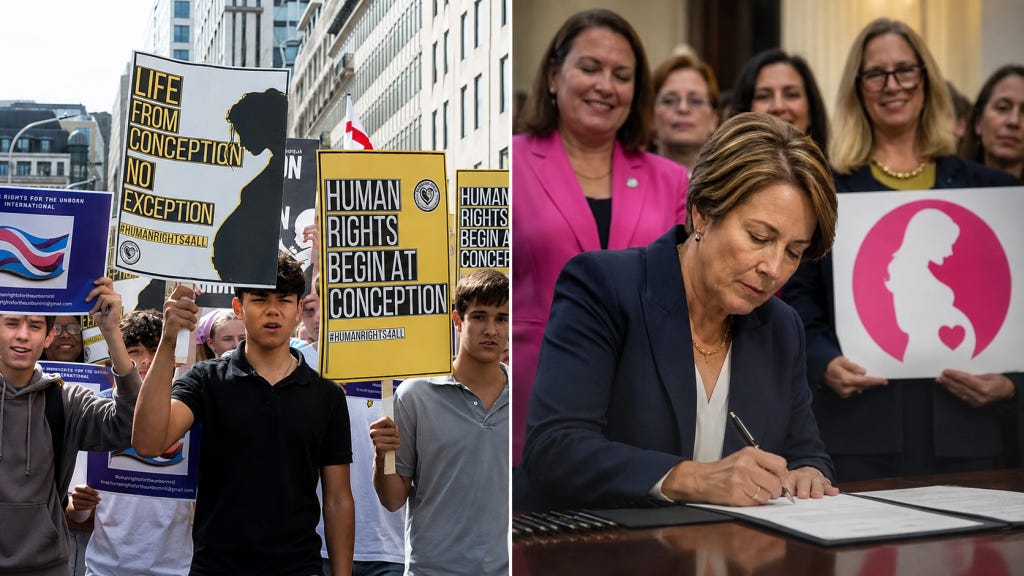
Massachusetts Governor Maura Healey has signed into law one of the most permissive abortion measures in the country, eliminating the state’s existing gestational limit and allowing abortions to be performed at any point in pregnancy, including up until the moment of birth. The signing, which took place on Monday, marks a significant and troubling escalation in how far Blue State Democrats are now willing to go on the issue of late-term abortion.
The legislation, known as H.5595 and branded by supporters as the Prioritizing Patient Access to Care Act, strips away the state’s previous 24-week gestational limit on abortion. Under the old law, abortions after 24 weeks were permitted only under narrow circumstances, specifically when a physician believed the procedure was necessary to save the mother’s life or protect her physical or mental health, or when the unborn child had a lethal fetal anomaly or would not survive outside the womb.
The new law discards that framework entirely. It replaces the list of specific medical conditions with a vague and sweeping standard that simply states an abortion may be performed by a physician based upon the professional judgment of the physician. In practical terms, that means there is no longer any specific medical justification required for a late-term abortion in Massachusetts. The decision rests entirely with the abortionist, with no legal protection whatsoever remaining for the unborn child.
Pro-life advocates were quick to point out just how significant this shift truly is. National Right to Life President Carol Tobias did not mince words, stating that Governor Healey and the Massachusetts legislature have erased the final protections for unborn children who can feel pain and who could survive outside the womb. Tobias noted the grim irony that, at the very stage when premature infants are receiving lifesaving care in neonatal intensive care units across the state, Massachusetts will now permit abortionists to end the lives of children of the same gestational age, or even older.
This Substack is reader-supported. To receive new posts and support our work, consider becoming a free or paid subscriber.
SBA Pro-Life America President Marjorie Dannenfelser was similarly forceful in her condemnation, calling the measure the Abortion Up Until Birth Bill and warning that the number of unborn children lost to abortion in Massachusetts will only rise as a result of Healey’s signature. Dannenfelser used the moment to renew her organization’s call for national action, arguing that the GOP must abandon a purely state-focused approach to abortion policy, since leaving the issue entirely to the states allows for exactly this kind of extreme late-term law to take hold unchecked.
The bill’s path through the legislature was notably rushed. Massachusetts Democrats fast-tracked the measure, bypassing the full committee process entirely so that the full legislative body could vote on it before the formal session adjourned on July 31. The House passed the bill on July 22 by a lopsided vote of 119 to 33 in the overwhelmingly Democrat-controlled chamber, leaving little room for the kind of deliberation such a consequential change to state law would typically warrant.
That haste is worth dwelling on. When lawmakers move to eliminate gestational limits on abortion while deliberately sidestepping normal legislative scrutiny, it raises legitimate questions about whether the measure could withstand a full and open debate. Rather than allow extended hearings, public testimony, and committee review, Democrats in Boston chose to ram the bill through in the final days of the session, a pattern that has become disturbingly familiar whenever state legislatures seek to expand abortion access beyond what public opinion would likely support if given a genuine airing.
In addition to eliminating the gestational limit, the new law also removes the requirement that abortions be performed in what state statute previously called a duly authorized hospital, further loosening oversight of where and how these procedures can be carried out. Combined with the removal of specific medical justifications for late-term procedures, the law represents a near-total deregulation of abortion access in the state.
Governor Healey defended the legislation during the signing ceremony by framing it as a matter of keeping government out of the exam room. She stated that health care decisions should be made between women and families and their doctors, not politicians, and pledged that abortion will remain safe, legal, and accessible in Massachusetts under her administration. It is a familiar line from abortion rights advocates, but one that conveniently sidesteps the fact that an unborn child capable of surviving outside the womb, and by many accounts capable of feeling pain, has no voice in that supposedly private decision.
Healey did not stop at framing the bill in personal terms. She explicitly cast the signing in a national political context, declaring that no matter what Donald Trump, Republicans in Congress, or the Supreme Court does, Massachusetts will continue to make reproductive health care available. She went further still during remarks tied to the signing, stating flatly that abortion is on the ballot this election, pointing to the recent Senate confirmation of Attorney General Todd Blanche and his reported comments to pro life groups as evidence that federal action to restrict abortion could be coming.
That kind of overtly political framing around a bill legalizing abortion up until birth is telling. Rather than defend the specific medical or legal merits of eliminating a 24 week gestational standard, Healey chose to position the law as a defiant response to the 2022 Supreme Court decision overturning Roe v. Wade, using the moment as a rallying point for her party ahead of the fall elections rather than engaging seriously with the ethical weight of what the law actually permits.
Massachusetts is not acting entirely alone in this regard, though that is a small consolation. The state now joins nine others, along with the District of Columbia, in removing gestational age limits on abortion altogether. Alaska, Colorado, Maryland, Michigan, Minnesota, New Jersey, New Mexico, Oregon, and Vermont have all adopted similarly permissive standards. As Dannenfelser noted, without a minimum national standard, the United States remains one of only eight countries in the entire world that allows abortion at any point in pregnancy, placing it in the company of nations not typically held up as models of protecting human life.
State Republicans in Massachusetts were vocal in their opposition, though their objections were ultimately overwhelmed by the Democrat supermajority in the legislature. Republican state Representative Alyson Sullivan-Almeida called it a very sad day for the commonwealth, warning that the precedent being set is that a mother can obtain an abortion up until the very moment of birth for a healthy, viable baby. That is not hyperbole. It is a plain reading of what the new law actually permits.
Supporters of the bill, including officials within Healey’s own administration, have attempted to frame the change as a matter of trusting physicians rather than legislators to make difficult medical decisions. Secretary of Health and Human Services Kiame Mahaniah, a physician himself, argued that nothing should get between a patient, a doctor, and a health care decision, and praised the law for ensuring those decisions are made in a physician’s office rather than a legislative chamber.
That argument, however, ignores the fact that under the new standard, there is effectively no meaningful check on what qualifies as an acceptable reason for a late-term abortion. When the sole requirement is the professional judgment of the physician performing the procedure, with no specific medical criteria attached, the law hands total discretion to the very individual financially incentivized to perform the procedure, a conflict of interest that seems to have gone largely unaddressed in the legislative debate.
Advocacy groups on the other side of the issue, including Reproductive Equity Now, celebrated the signing as a long overdue correction. One board member, describing herself as a later abortion patient, said she was grateful that state leaders were, in her words, righting a wrong she experienced personally in 2021, arguing that the previous 24-week ban was arbitrary and harmful. Whatever the personal circumstances behind that account, the broader legal effect of the new statute extends far beyond any single case, opening the door to elective late-term abortions performed for any reason a physician deems appropriate.
The new law is scheduled to take effect in 90 days, meaning Massachusetts will soon become fully operational under one of the most permissive abortion regimes in the developed world. For a state that already had among the most liberal abortion access laws in the country prior to this signing, the elimination of any gestational limit whatsoever represents a significant and, to many, alarming new frontier.
The broader national implications of this signing should not be understated. As more blue states move to eliminate gestational limits entirely in the years following the overturning of Roe v. Wade, the divide between red and blue states on the question of when, if ever, an unborn child’s life warrants legal protection continues to widen. Massachusetts has now placed itself firmly among the small number of American states and the even smaller number of nations worldwide willing to permit abortion without any gestational restriction at all.
For pro life advocates, the signing serves as a rallying cry for renewed national action. If states like Massachusetts are prepared to legalize abortion up until the point of birth, the argument goes, then a patchwork approach that leaves the issue entirely to individual states is no longer sufficient to protect the most vulnerable among us.
This Substack is reader-supported. To receive new posts and support our work, consider becoming a free or paid subscriber.
Thanks for reading! This post is public so feel free to share it.
Comments
Nothing yet. Say the first thing.
Sign in to join the conversation.