
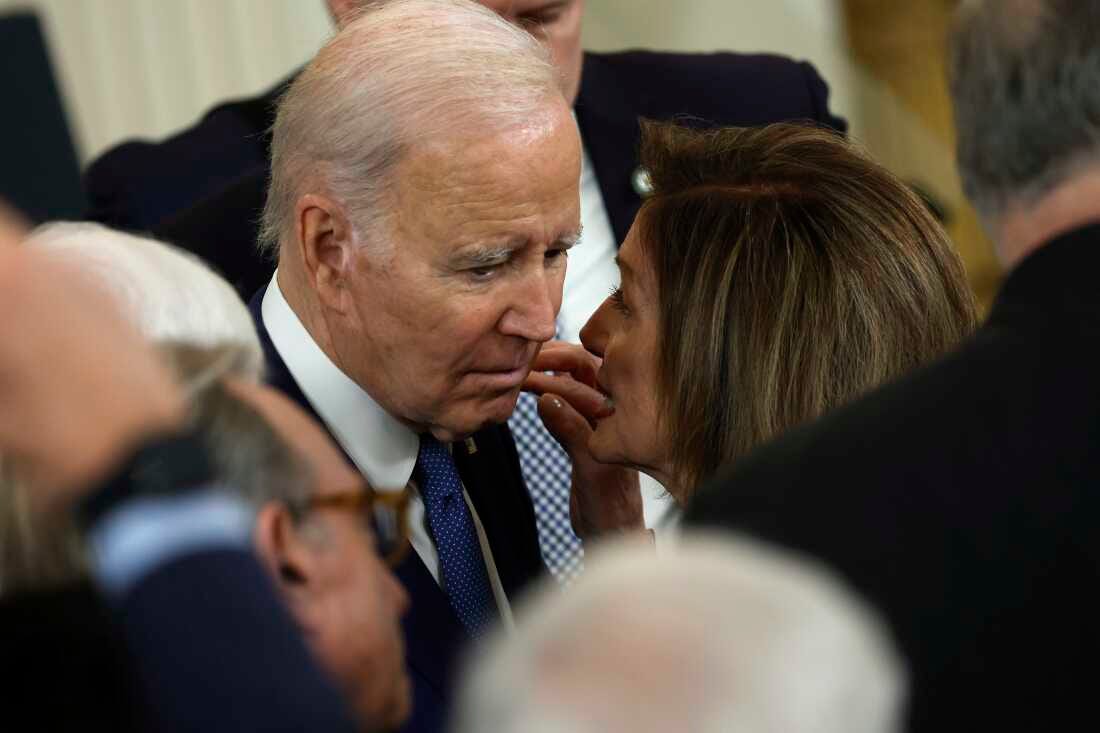
Former House Speaker Nancy Pelosi offered a remarkable claim this week, insisting that she had no idea Joe Biden was suffering from serious mental decline until she watched his disastrous June 2024 debate performance against Donald Trump, a statement that has drawn swift ridicule from critics who note that Biden’s cognitive struggles were being reported on and discussed publicly for years before that debate ever took place.
Speaking at Politico’s California Agenda Sacramento Summit, Pelosi attempted to explain why she, of all people, one of the most powerful and well-connected Democrats in Washington, somehow missed what millions of ordinary Americans had already concluded simply by watching Biden speak in public.
“You see, when I was Speaker, I saw the president all the time, but when I wasn’t then I saw him maybe three times that whole year, and so I didn’t know, and I think he had his sort of ups and downs,” Pelosi said, attempting to frame her limited in-person contact with Biden as the reason she failed to notice what had become painfully obvious to the rest of the country.
Pelosi then pivoted to assigning blame elsewhere, arguing that those closer to Biden bore the responsibility for failing to act on what they knew about his condition. “But I do think those who did know should have acted upon that information, whoever knew,” she said.
In a notably pointed moment, Pelosi appeared to take a veiled shot at Jill Biden without naming her directly, stating, “There was staff saying the family knew. The family said the staff.” The implication was clear even without naming names: someone close to the former president knew about his decline and chose not to act, and Pelosi wanted the public to understand it was not her.
Pelosi went on to pinpoint the exact moment she claims her own understanding of Biden’s condition changed. “When you think of the debate and how sad that was, that’s really when we learned,” she said, referring to Biden’s widely panned performance against Trump in June 2024, a debate so poor that it ultimately forced Biden out of the presidential race entirely just weeks later.
The problem with Pelosi’s timeline is that it conflicts sharply with reporting that emerged well before the debate ever happened. More than three weeks prior to that fateful night, the Wall Street Journal published a detailed investigative report in which more than 45 Republican and Democratic lawmakers and staffers described a president who spoke so softly during meetings that participants often struggled to understand him, who did not appear to know what policies were currently in place, and who regularly relied on aides to answer even direct and simple questions on his behalf.
Despite that reporting being widely circulated and discussed throughout Washington, Pelosi publicly praised Biden just one month later, touting what she described as his wisdom, experience, strength, and strategic thinking, language that stands in sharp contrast to her current claim of having been in the dark about his condition.
Author Chris Whipple, in his 2025 book Uncharted, reportedly quoted Pelosi herself describing a private encounter with Biden by saying, “He was not the same Joe Biden,” a remark that suggests she had, in fact, personally observed and privately acknowledged concerning changes in the president well before her public comments this week would have anyone believe.
Senator Ted Cruz was among the many conservative voices who pushed back forcefully against Pelosi’s claim online, posting simply, “Everyone knew,” capturing a sentiment shared widely across social media in the hours following her remarks. The reaction reflected a broader frustration among Republicans and even some independents that senior Democratic leadership spent years publicly insisting Biden was sharp and fully capable, only to later claim ignorance once his decline became impossible to hide from the American public.
Critics have also pointed out an inconsistency in Pelosi’s own explanation. She noted that she saw Biden far more frequently during her tenure as Speaker of the House, a position she held until January 2023. Yet by most credible accounts, including from Democratic officials themselves, Biden’s difficulty communicating clearly was evident well before his final two years in office, raising the question of how Pelosi could have missed the signs even during the period when she says she had regular in person access to him.
Pelosi’s comments arrived alongside a more detailed account of a private conversation she says she had with Biden shortly before he ultimately withdrew from the 2024 race. She pushed back on prior reporting about that meeting, telling Politico’s Jonathan Martin that accounts of the conversation had been mischaracterized. “Let me say what I did about Joe Biden, because it has been written about in a way that did not really happen,” she said, though she did not offer a dramatically different version of events beyond confirming that she had raised concerns with Biden about his polling and campaign strategy directly.
“Whoever knew, whoever knew, family knew, I don’t know,” Pelosi said at another point in the interview, repeating variations of the phrase as if trying to distribute responsibility as broadly as possible without landing on any single individual or group. “They should have, because this was a great man.”
That framing, praising Biden even while acknowledging that people around him should have spoken up sooner, has struck many observers as an attempt to have it both ways: defending Biden’s legacy and competence while simultaneously distancing herself from any responsibility for allowing his decline to remain hidden from voters for as long as it did.
The controversy touches on a broader and increasingly uncomfortable question for Democrats about who inside Biden’s inner circle knew about his condition, when they knew it, and why the information was kept from the public for so long. White House officials, including former press secretary Karine Jean-Pierre, spent months during Biden’s presidency insisting the administration had been fully transparent about his health, pointing to annual medical reports as evidence there was nothing to hide.
Yet those same officials also resisted calls for more rigorous cognitive testing, with Jean-Pierre telling reporters at one point that such testing was neither warranted nor necessary and describing concerns following the debate as the product of Biden simply having had a bad night rather than evidence of a deeper pattern.
Pelosi herself, in the immediate aftermath of the debate in 2024, publicly stated that she was not a doctor and could not predict what would happen years down the road but expressed confidence that Biden would continue to be a great president. She recommended at the time that Biden sit for a series of unscripted interviews with serious journalists to prove his capability to the public, a suggestion that itself implicitly acknowledged that questions about his fitness for office were serious enough to require some kind of public response.
Online reaction to Pelosi’s latest comments has been sharply critical, with many commentators expressing disbelief that a political operator as savvy and well connected as Pelosi could genuinely have missed what seemed obvious to millions of ordinary Americans simply watching news coverage or campaign appearances. Some pointed out the irony of Pelosi, herself now in her mid-eighties, offering commentary on another elderly politician’s cognitive state.
Thanks for reading! This post is public so feel free to share it.
No posts
Comments
Nothing yet. Say the first thing.
Sign in to join the conversation.