
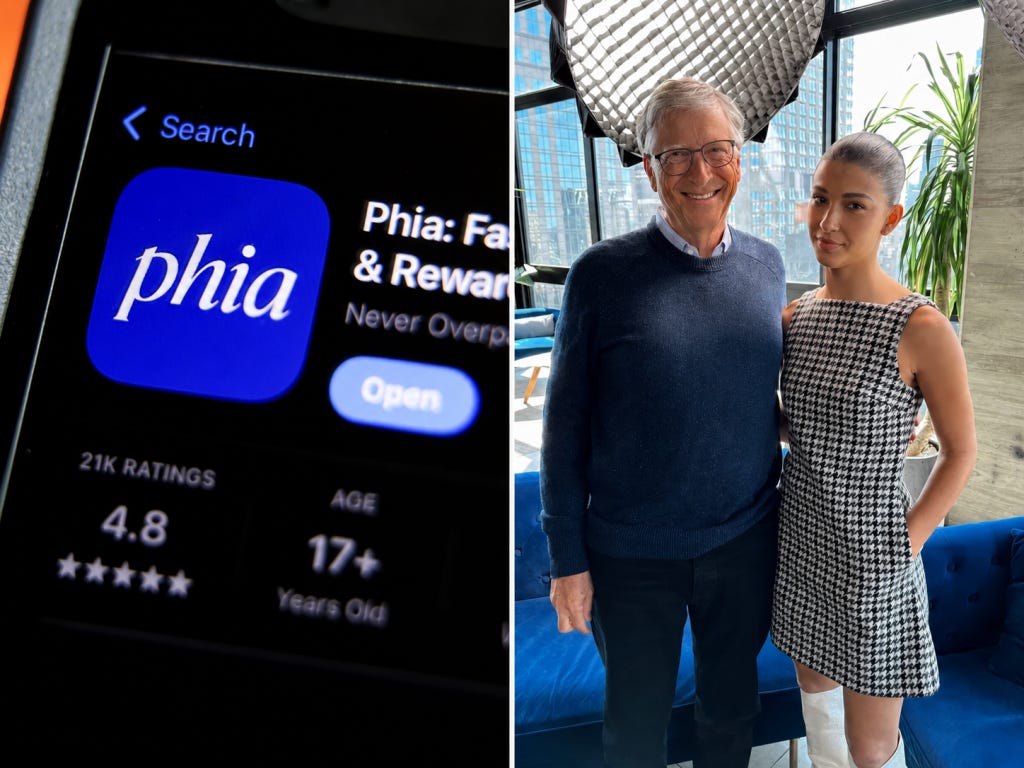
Phoebe Gates, the 23-year-old daughter of Microsoft co-founder Bill Gates, is now facing the kind of scrutiny that no amount of family wealth can make disappear. Her startup, Phia, stands accused of running a deceptive scheme known as cookie stuffing, a practice that federal prosecutors have treated in the past as wire fraud, carrying a maximum penalty of 20 years behind bars.
For a young woman who has spent years trying to convince the public she built something on her own merit rather than her father’s fortune, the timing could not be worse. Gates has repeatedly insisted that Phia would succeed with no ties to her privilege or her last name. That narrative is now colliding head on with internal company records that tell a very different story.
Phia bills itself as a digital personal shopping assistant. The browser extension scours the internet for discount codes and helps users find the lowest price when they shop online. Every time a customer completes a purchase through Phia, the company earns a commission from the retailer, similar to how many affiliate marketing businesses operate.
The trouble started in July when reports surfaced that Phia had been dropping far more tracking cookies than it should have been. These cookies allow a company to claim credit, and therefore commission, for a sale it helped generate. According to the allegations, Phia was taking credit for purchases it had no actual hand in driving, essentially skimming money that should have gone to other affiliates or platforms.
When the allegations first broke, Phia’s response was to call it a technical glitch. The company said it had only discovered the issue within the last 24 hours and promised a swift fix. That explanation has not aged well.
A more recent investigative report from Bloomberg alleges that Phoebe Gates and her co-founder, Sophia Kianni, were aware of the problem for at least seven months before it became public. Internal Slack messages reportedly reviewed by the outlet suggest the two young executives were not simply caught off guard by a rogue bug, but were actively involved in monitoring and possibly expanding the practice.
One message attributed to Gates, dated December 18, reportedly expressed concern that the cookie drop needed to be functioning across every site with a coupon in order to properly monetize gross merchandise value. Another message reportedly attributed to Kianni suggested dropping a cookie every time a user closed one of the app’s pop-ups, a tactic that would generate credit for sales regardless of whether Phia actually contributed to them.
The scale of the alleged scheme is significant. Reports indicate the questionable transactions accounted for roughly 51 percent of Phia’s merchandise value in June alone, and stretched across major retailers including Nike, Gap and Nordstrom. When the features were reportedly shut off in July, the company’s daily revenue is said to have collapsed from around 80,000 dollars to somewhere between 10,000 and 28,000 dollars, a drop that speaks volumes about how much of the business relied on the disputed practice.
Cookie stuffing is not a new phenomenon in the world of online commerce, and it has landed people in real legal trouble before. Two decades ago, eBay worked directly with the FBI to build a case against an affiliate marketer named Shawn Hogan, who was ultimately sentenced to five months in prison. Another individual involved in a similar scheme, Brian Dunning, received 15 months behind bars after pleading guilty to a single count of wire fraud.
Legal experts say the Gates case could be treated far more seriously given the scale and the alleged duration of the conduct. Ariel Givner, founder and principal attorney at Givner Law, said the practice is typically treated as federal wire fraud in American courts and warned that Gates could be looking at a maximum penalty of up to 20 years in prison, along with fines and restitution, should the case ever reach that point.
It is worth noting that no criminal charges have been filed against Gates or Kianni at this time. The 20-year figure represents the theoretical maximum penalty under federal wire fraud statutes, not a guaranteed or even likely outcome. Given the disparity between how ordinary Americans are treated by the justice system and how the well connected often fare, plenty of skeptics doubt she will ever see the inside of a courtroom, let alone a prison cell.
Still, the business fallout has already begun. Impact.com, an affiliate marketing platform that Phia relied on, suspended the company from its network and set aside commissions it had planned to pay out. A spokesperson for Phia said the company removed any features that could have caused misattribution back on July 7, and claimed it is now reviewing every transaction and committed to reversing payments to brand partners affected by the alleged misattribution.
The company also says it plans to hire a head of compliance to prevent anything similar from happening again. Whether that satisfies investors and partners remains to be seen, especially with reports suggesting the founders knew about the issue for months before acting.
Phia has attracted a remarkable amount of celebrity backing for a company barely two years old. Investors reportedly include Hailey Bieber, Kris Jenner, and the shapewear brand Spanx, among others. The company raised 30 million dollars in 2025 and pulled in another 35.5 million dollars in seed funding earlier this year, giving it a multibillion dollar valuation on paper. That kind of financial firepower has done little to shield the company from the current scandal.

Some commentators have pointed out the irony that eBay, a platform with firsthand experience prosecuting cookie stuffing schemes, was reportedly among the companies funding Phia. Independent marketplace journalists have suggested that eBay and Etsy could both have legitimate grounds for legal action given their past involvement in fighting exactly this kind of fraud.
Gates has been open in the past about the pressure of being what she herself calls a nepo baby. On her podcast, The Burnouts, which she co-hosts with Kianni, she has talked about the insecurity that comes with being Bill Gates’ daughter and her desire to prove she could succeed without relying on her father’s name or resources. Bill Gates has reportedly told his daughter in the past that he would not personally invest in her business, a decision that at the time was framed as a way to let her build something independently.
That independence narrative now looks considerably more complicated. If the allegations hold up, it would suggest that rather than building a business the honest way, Phia’s rapid growth was propped up in part by a scheme designed to inflate its numbers at the expense of legitimate retail partners and other affiliates who played by the rules.
Thanks for reading! This post is public so feel free to share it.
No posts
Comments
Nothing yet. Say the first thing.
Sign in to join the conversation.