
August 11, 2026
Oil prices were highly volatile on Tuesday. Brent crude surged above $90/b before retreating below $87/b and settling around $89/b. Trump’s “no war, no peace” approach appears to be generating its own volatility even without fresh statements. Meanwhile, the IRGC and its Houthi allies have stepped up attacks on ships in the Strait of Hormuz and Bab al-Mandab. The IRGC seems to interpret the current US posture as a retreat and is seeking to gain ground.
While some analysts describe the situation as a “frozen conflict,” they disagree on the price impact. One camp believes it would lock prices in the current range; another argues that a freeze would push prices higher. Our view is that the present no-war, no-peace stalemate is unsustainable—something has to give. Prolonged shortages of petroleum products, especially diesel, risk wreaking havoc on multiple economies and could prolong weak growth or tip them into recession.
In its monthly Short-Term Energy Outlook released today, the EIA highlighted persistent Strait of Hormuz constraints, raising near-term Middle East shut-in production estimates and projecting further global inventory draws of about 3.8 million b/d in Q3 2026. This supports Brent averaging around $85/b in the third quarter before declining to $78/b in Q4 and $69/b in 2027 as flows recover and most production returns by early 2027.
US crude production is nudged higher to 13.8 million b/d for 2026 (and 14.15–14.2 million b/d in 2027), with August output at 13.83 million b/d and a slight dip to 13.77 million b/d in September.
Demand is modestly trimmed. US commercial crude stocks are expected to stay below the five-year low through year-end. Wholesale gasoline and diesel prices were revised upward due to tighter balances, while Henry Hub natural gas is lowered on robust production and weaker LNG feedgas demand.
Overall, the outlook reinforces a tight near-term market driven by geopolitics, followed by gradual easing as non-OPEC supply expands and inventories rebuild—aligning with today’s volatile $82–89 range amid the Hormuz stalemate.
Our view of the EIA’s oil outlook is that it is not paying enough attention to the rest of the world, especially Asia, and how oil demand could be weaker than expected.
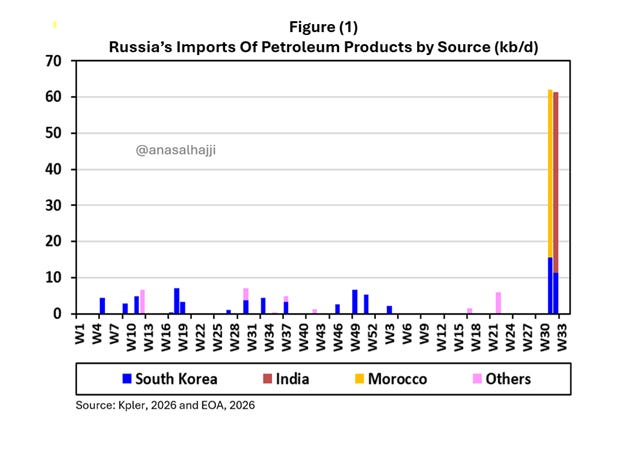
The increased drone attacks on Russian refineries and ports forced Russia to ban exports of certain products and begin importing gasoline and gasoil. Figure 1 shows the sharp increase in these imports, particularly from first-time sources such as Morocco and India. The imports from India originate from the Russian joint venture Nayara, while the imports from Morocco appear to be a one-time occurrence.
Comments
Nothing yet. Say the first thing.
Sign in to join the conversation.