
“If you gaze long into an abyss, the abyss also gazes into you.” —Friedrich Nietzsche
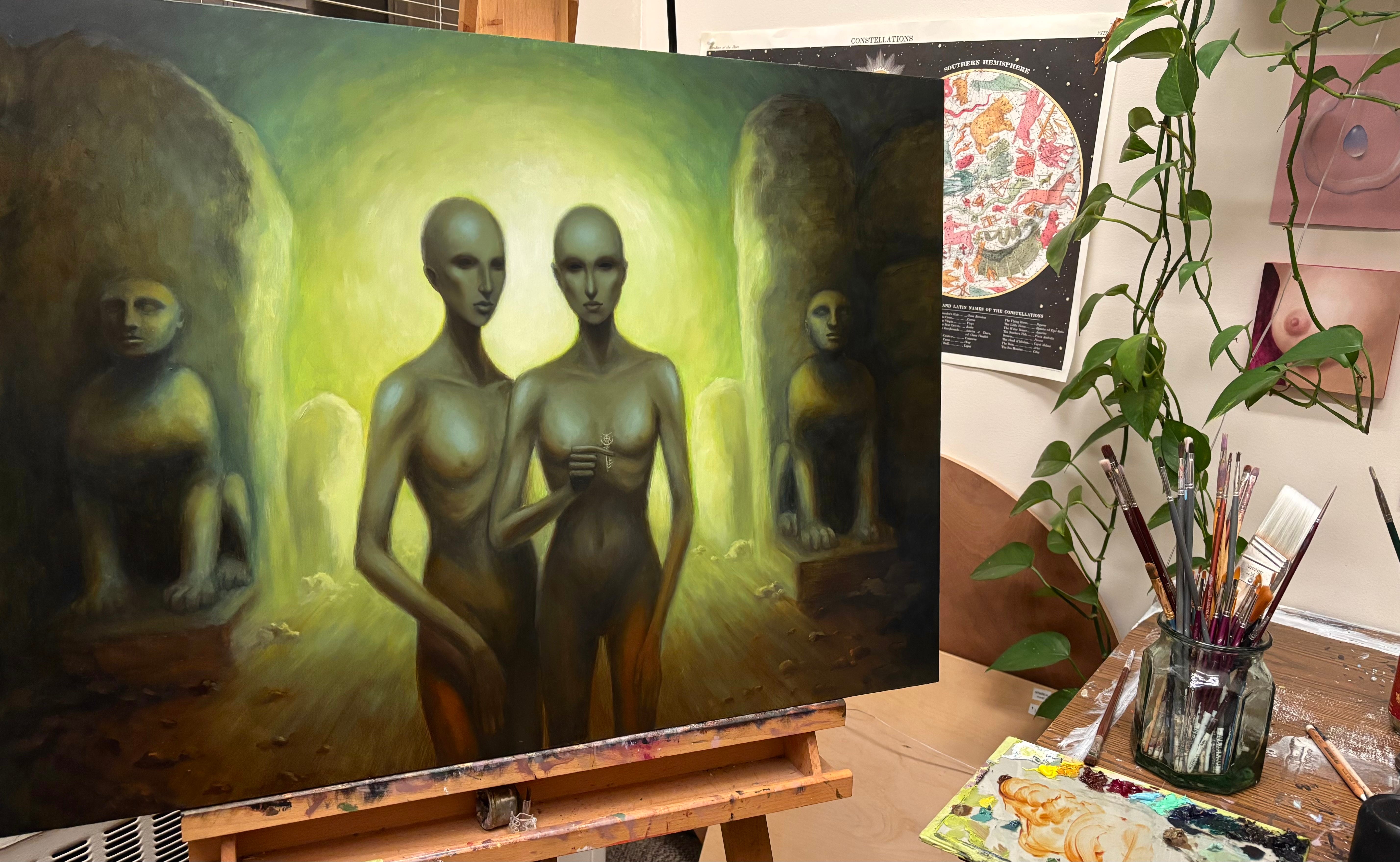
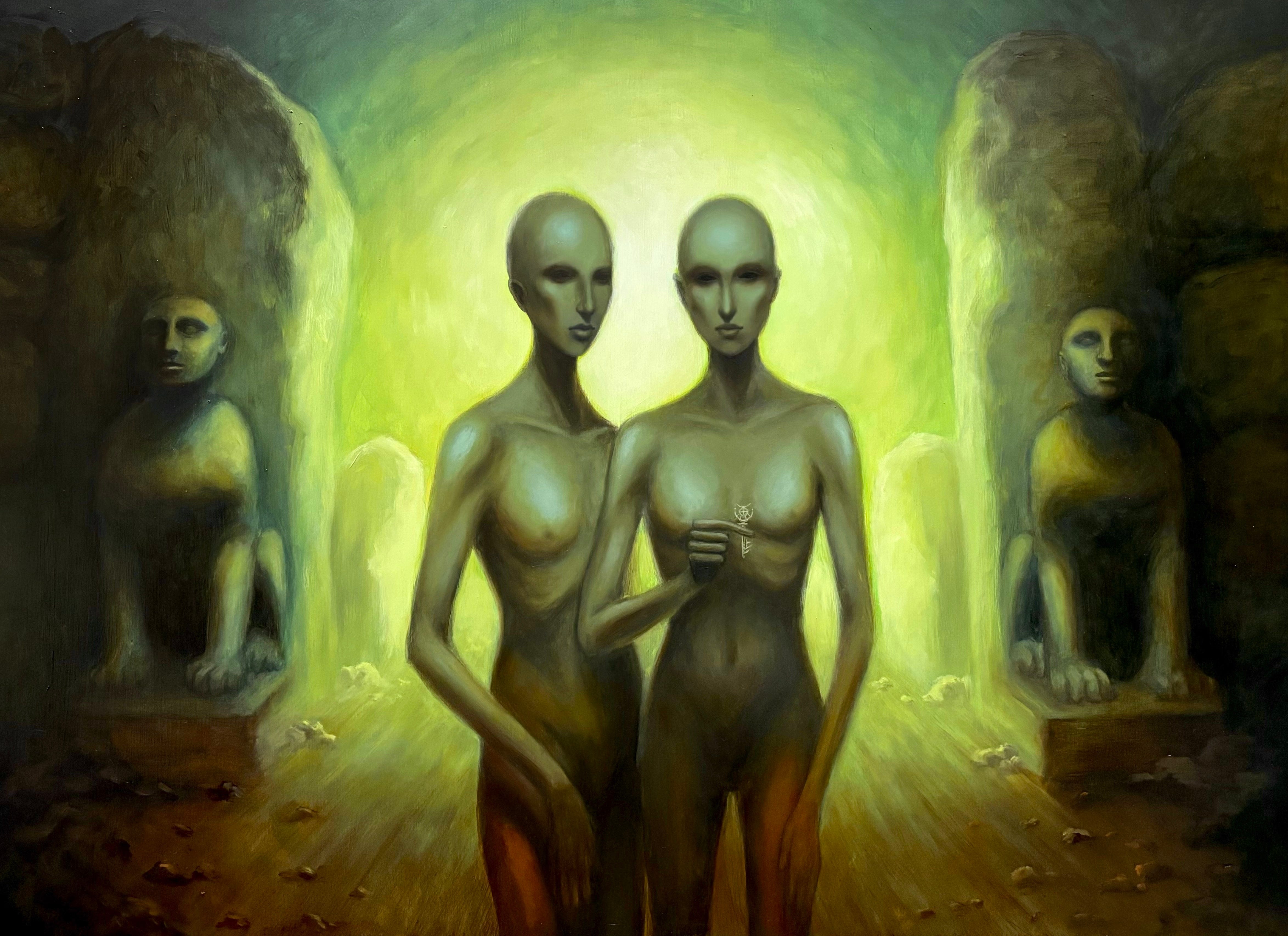
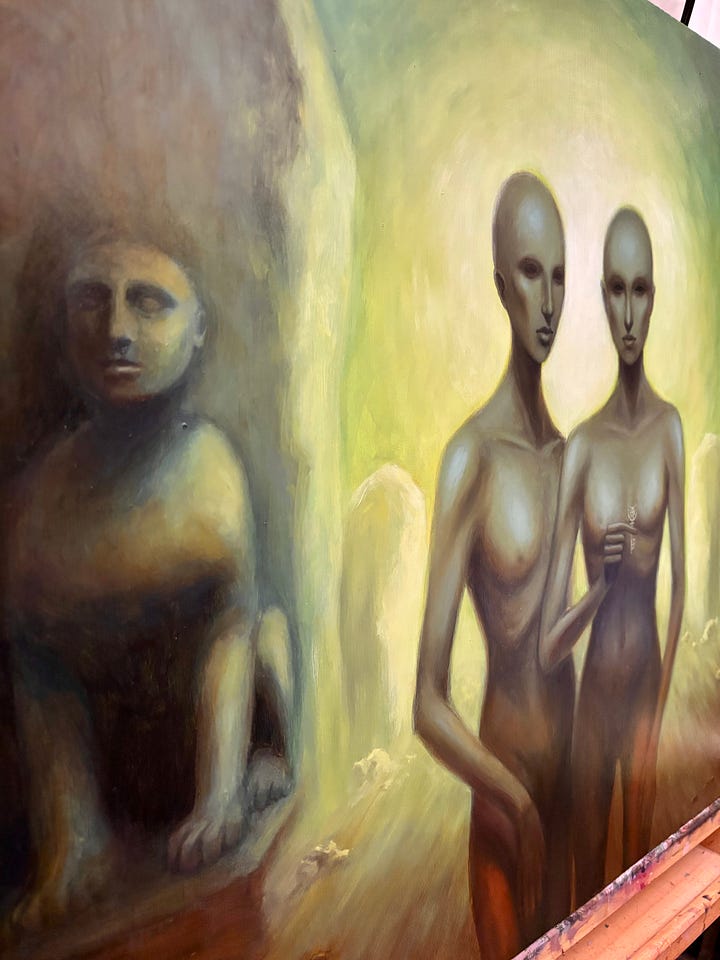
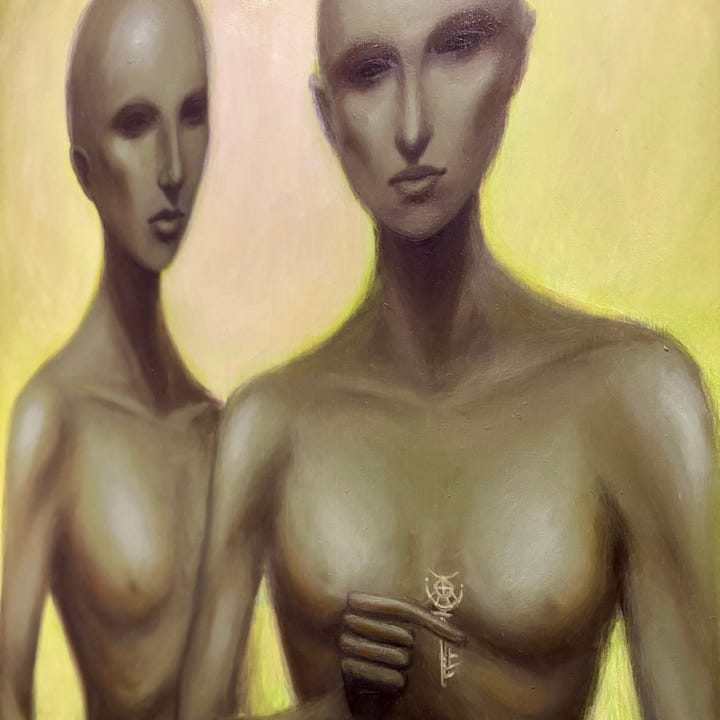
At last, I finished a new oil painting: The Encounter. Spooky, I know, and a bit outside the bounds of what I usually paint. I wrote about the piece’s genesis and more technical aspects in a previous Studio Notes. Here, I’ll share some of the reflections that have been percolating as I was painting it, mostly on the topics of technology, religion, and UFOs.
While painting The Encounter, I read American Cosmic (2019), an ethnographic study of the UFO phenomenon by Professor of Religious Studies Diana Walsh Pasulka. Over six years, she interviewed successful scientists, professionals, and Silicon Valley entrepreneurs who believe in extraterrestrial intelligence, thus dispelling the common assumption that UFO belief dwells on the fringe.
Pasulka argues that we are witnessing the emergence of a new kind of religiosity—one shaped by technology. Drawing parallels to early Christianity, she suggests that we are entering an era in which technology holds as much power over the human imagination as God did in the medieval world. This rings true to me.
Before reading Pasulka, I had never cared much about UFOs, which is odd given how I usually lean toward the weird and arcane. They seemed to belong to a different symbolic register. More sci-fi than esoteric.
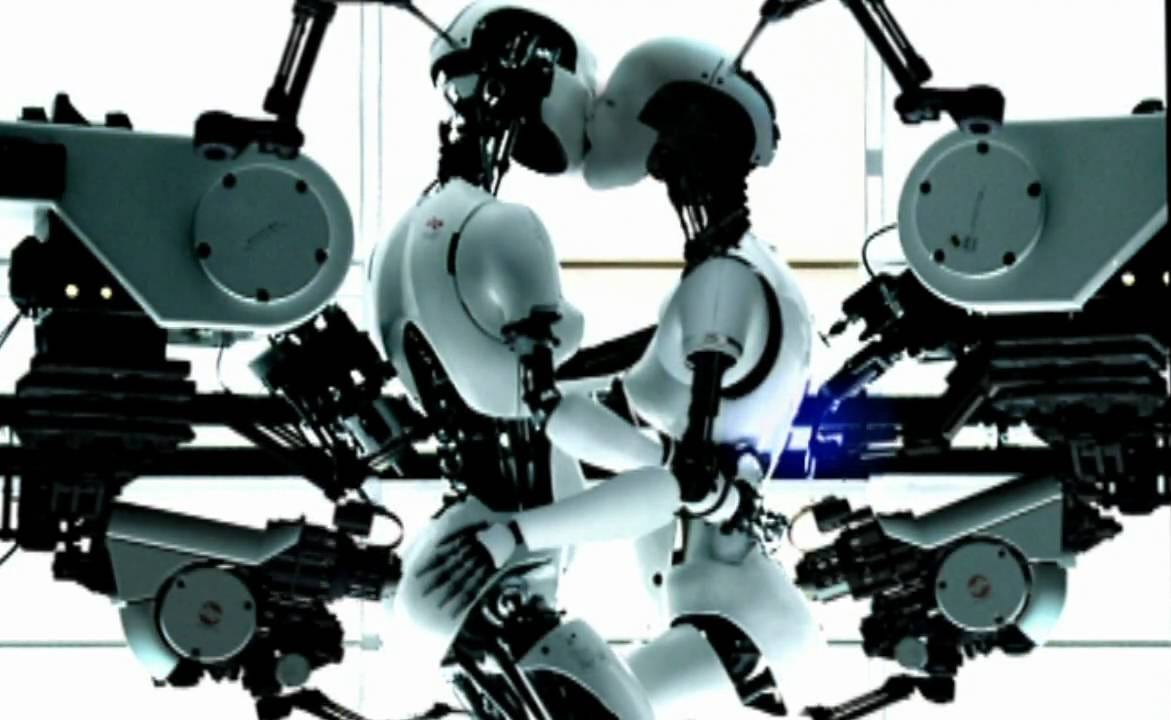
As I kept reading, though, something clicked, and I could finally see where UFOs and aliens, alongside the Cyborg archetype I’ve been exploring lately, fit within a larger constellation of emergent techno-mythic figures. UFOs are an essential presence in today’s pantheon of contemporary “gods.”
This realization made its way into The Encounter. What I thought would be another iteration of a megalithic cyborg instead gave way to an archetype I didn’t know I had been circling.
“Space may be the final frontier, but it’s made in a Hollywood basement.”—Red Hot Chili Peppers
At the heart of every cult and religion is an extraordinary encounter, a gnosis of some kind—powerful, life-altering, and unpredictable in its social effects. This is essentially the Phenomenon: a direct encounter with the weird, at once ambiguous, destabilizing, sometimes terrifying, sometimes revelatory. How such encounters are framed depends on a culture’s media ecosystem, the space where its myths are generated, sustained, and proliferated.
American Cosmic examines how beliefs are formed and how people interpret unexplainable experiences within the symbolic frameworks available to them. The interplay between technology, media, religion, and mystery is consequential.
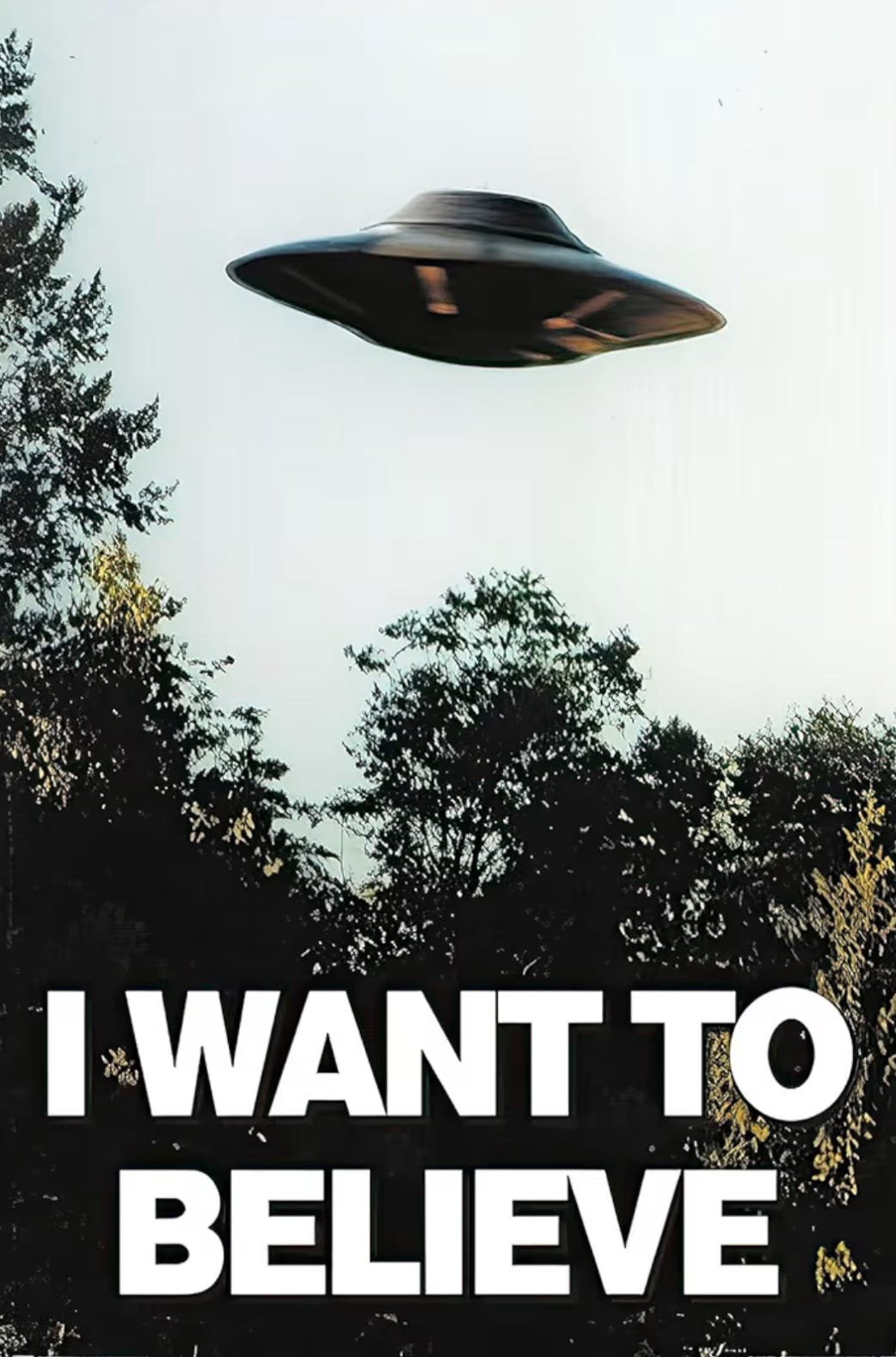
Pasulka discusses the key role media plays in belief formation, arguing that seeing is believing. The brain struggles to differentiate between virtual and real experiences, consolidating associations and absorbing representations, whether they are grounded in reality or not. Memory is malleable and the subconscious takes in images indiscriminately. In a screen-addicted culture like ours, the implications of Pasulka’s argument are significant.
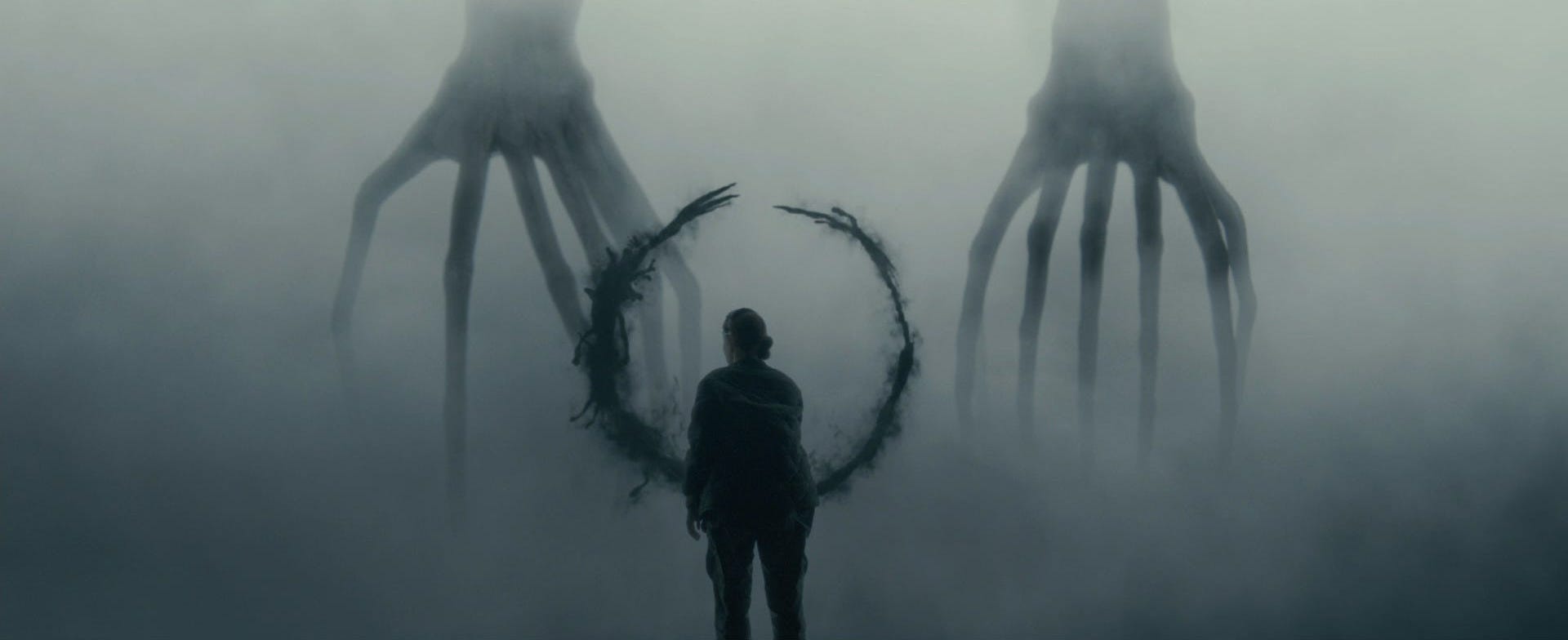
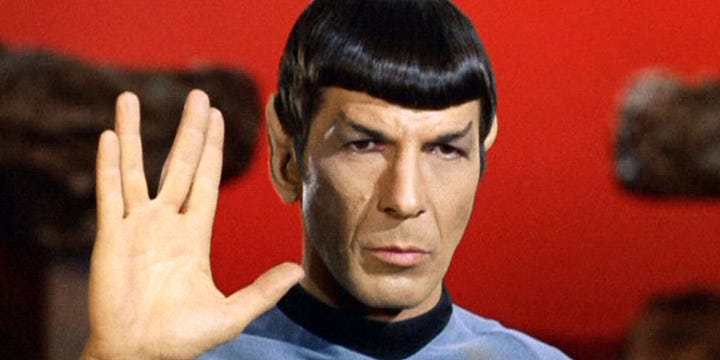
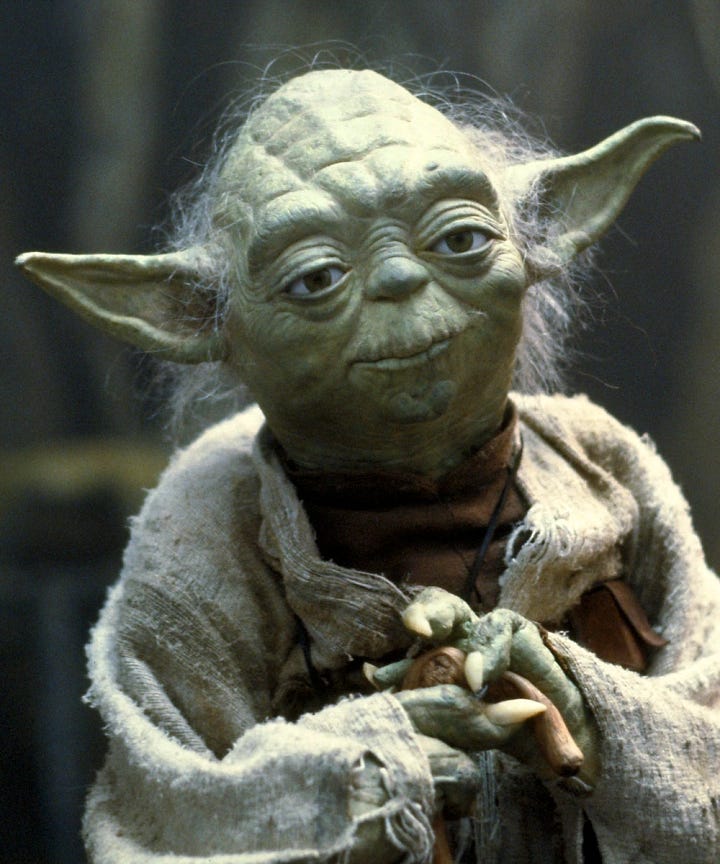
We find ourselves in a sort of phenomenological feedback loop, where mediated images not only shape belief but also shape experiences of the Phenomenon itself. Experiencers come to interpret what happens to them through the imagery they’ve already absorbed.
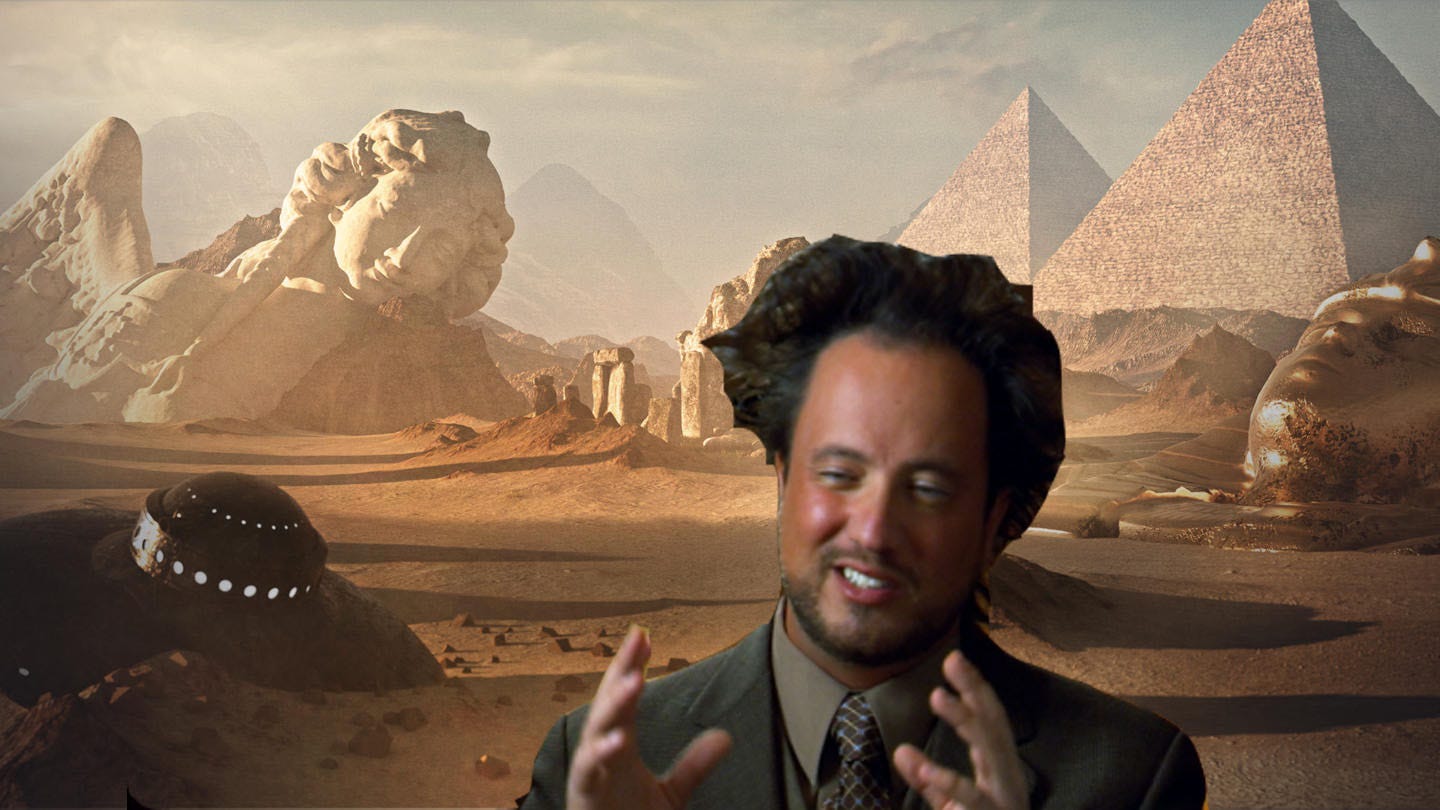
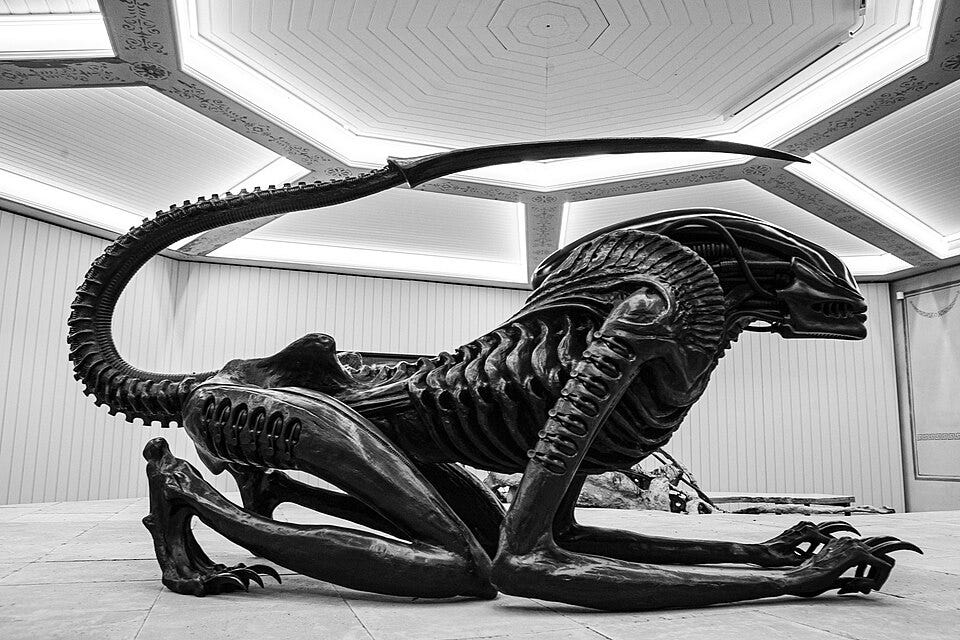
That being said, the chasm between the Phenomenon and its media representations doesn’t negate the reality of these mysterious experiences. They’ve been with us for a long time. Across folklore, religious texts, and historical accounts, we can trace consistent patterns of encounter. Religious scholars look beyond truth claims, understanding that beliefs are real in their social effects.
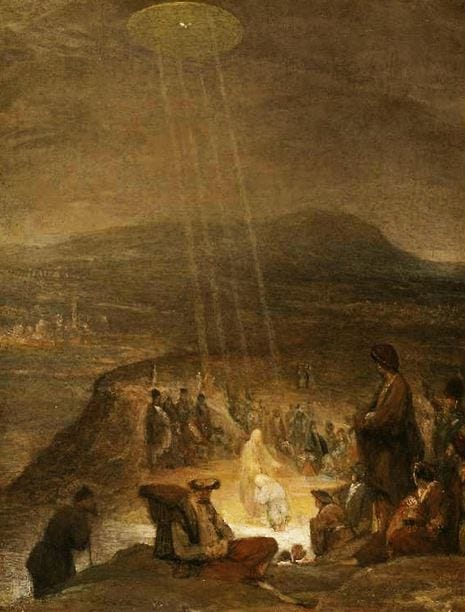
Religions are built upon the testimonies of believers. Since the Phenomenon cannot be studied directly, Pasulka relies on credible witnesses—in this case, the community of scientist-believers she follows in the book. We come to know two of them closely, introduced under the aliases Tyler D and James. The latter has since revealed his true identity as Professor Garry Nolan, a prominent immunologist at Stanford University.
The mysterious Tyler D is a former aerospace engineer who worked extensively with the American space program before becoming a wealthy biomedical tech entrepreneur with over 30 patents to his name—innovations he attributes to off-planet intelligences.
Like many of the scientist-believers Pasulka surveys, Tyler D understands the Phenomenon as functioning like a kind of communication technology, with the human being—body, brain, mind—serving as both receiver and transmitter of information. Through this interface, nonhuman intelligence may seek to make contact, and, with the right protocol, we can reach out to them as well.
This process is referred to as the download.
This techno-mystic perspective has been intertwined with space programs from the very beginning. In the United States, there was Jack Parsons—the Thelemite occultist, rocket scientist, and pioneering figure in the early space program—who believed that nonhuman entities interacted with humans to guide them toward space travel. In Russia, another foundational figure, Konstantin Tsiolkovsky, the father of rocketry and aeronautics, wrote:
We are made as the “ethereal beings,” existing beyond our dimensions of recognized reality. These higher beings are in communication with us, reading our thoughts and sending us messages through celestial symbols which most of us do not perceive, much less understand. A genius is one who comprehends and channels these messages from higher beings into technologies, products, and even art.
As an artist who understands genius and the creative process in similar terms, I find it absolutely riveting that this same mode of communicating with “the other side” is, in a way, further validated through its scientific and technological applications. For Pasulka, it’s the material reality of our technologies that will make this new type of religiosity so convincing and powerful. I believe that she is right.
Thanks for reading. Did you ever experience an encounter? Has the Phenomenon made contact? Let me know in the comments, as they say.
What I’m working on: Entering ideation mode. Nothing has started yet; everything is possible.
What I’m reading: Eros and Magic in the Renaissance by Ioan P. Couliano

Victoria people can find me on Saturday, Dec. 6, 12-4 pm, at the Luna x KWENCH Winter Market, the only event I plan on vending at this year. Along with 60 other artisans and creatives, I’ll be selling art prints, small works, and gift certificates to private classes. Come say hi and support local makers!
Comments
Nothing yet. Say the first thing.
Sign in to join the conversation.