
The original Benedictine Rule described autonomous monasteries governed by their abbots with no central authority. They were linked by their common use of the same rule and common ideals, not by a central bureaucracy. For instance, poverty was central to the Benedictine monastic life, though not a distinct vow. The monks’ now distinctive black robes were peasant garb, the sixth-century equivalent of blue jeans, a uniform to erase social distinctions within the brotherhood [[i]].
Under successive abbots, each monastery could develop its own customs on the basis of the Rule. This ordered life, elastic and practical, proved its worth by its long continuance. Its influence was immense. The monasteries were focuses of Christianity. It was not only their religious hold and the wealth that came to them which were influential. In a barbaric world of passion, impulse, violence, and disorder the monasteries at their best, and indeed when only perfunctory, were living examples of peaceful life by law and self-control. Their corruption, when it occurred, was an evil which spread far outside their walls [[ii]].
The extraordinary successes of monasticism bred great wealth and sometimes great corruption.
Reacting against the luxury of many within the Benedictine Order, an abbot, Robert of Molesmes (c. 1029–1111), founded the Cistercian Order in 1098. With the English abbot Stephen Harding (c. 1060–1134), they retired with a few companions to an isolated, marshy site in Citeaux (south of Dijon in Burgundy), seeking a stricter observance of the Rule of St. Benedict.
The Cistercians emphasized austerity, manual labor, and life in remote wilderness areas [[iii]]. Under the dynamic leadership of Bernard of Clairvaux (1090–1153), four daughter abbeys had grown to 343 by the time of Bernard’s death, and doubled again from there by the end of the thirteenth century [[iv]].
In their sincere desire to flee the worldly and commercial life of the cities the Cistercians went to live in areas “remote from habitation of man.” But by attempting to become independent of the outside world, they created an economic empire based on a highly centralized administration and on up-to-date technological expertise [[v]].
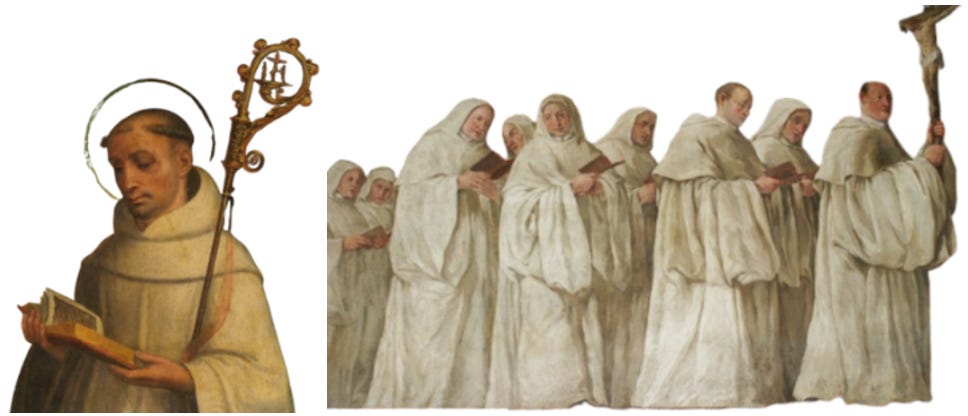
Before long, “[t]hey were running the most modern factories in Europe” [[viii]], and were leading producers of both wool and iron.
In 1095, just before the formation of the Cistercian Order, Pope Urban II (c. 1035–1099) called for a crusade at the Council of Clermont after the Byzantine emperor Alexios I Komnenos (1057–1118) requested assistance against the advancing Seljuk Turks. The resulting First Crusade captured Jerusalem in 1099 and established several Crusader states in the Holy Land. Among its leaders was Godfrey of Bouillon (c. 1060–1100), whose brother Baldwin I of Jerusalem (c. 1058–1118) became the first king of Jerusalem and helped consolidate the fragile new kingdom [[ix]].
The security requirements of pilgrims and the defensive needs of these new states soon gave rise to the Knights Templar. Founded around 1119 by Hugh of Payns (c. 1070–1136) [[x]] and a small band of knights, the order lodged itself on Jerusalem’s Temple Mount with the object of protecting Christian pilgrims and, according to some accounts, rebuilding the Temple [[xi], [xii]].
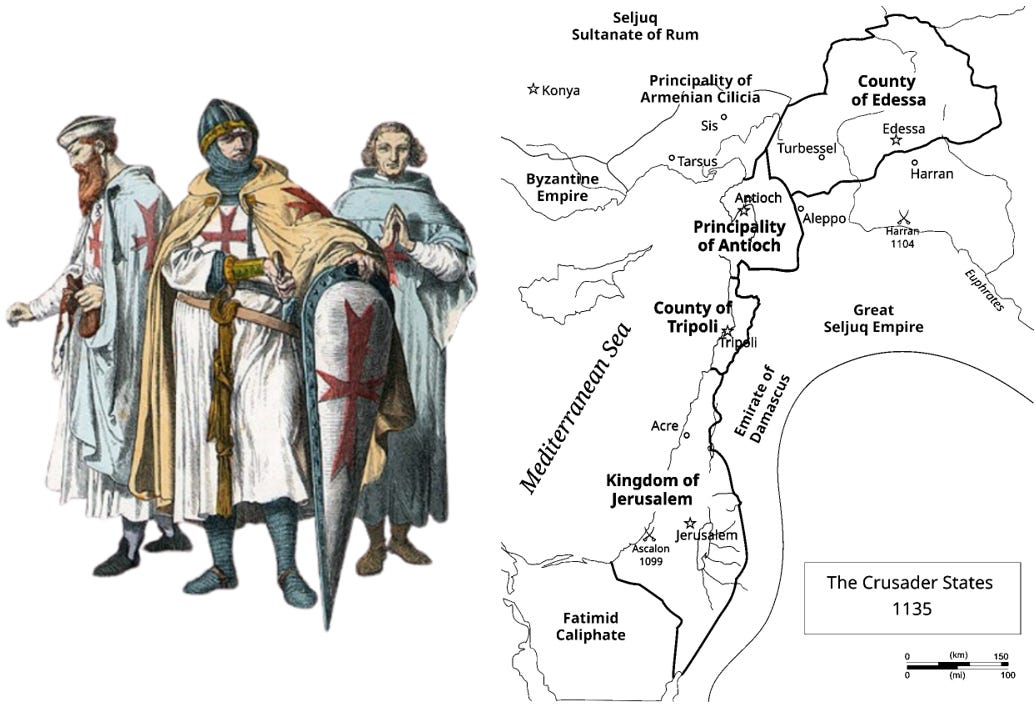
In 1128, the Council of Troyes recognized and sanctioned the Templars with the support of Bernard of Clairvaux [[xiii], [xiv]] who declared in his In Praise of the New Knighthood :
What could be perceived as more pleasant and deemed more suitable than seeing so great a multitude of men thronging to reinforce the few—unless it is seeing along them godless rogues, sacrilegious thieves, murderers, perjurers, and adulterers? At their departure, there is a twofold joy and a twofold benefit: their countrymen are as glad to be rid of them as their new comrades are to receive them. Both sides have profited from this exchange; one group gains protection and the other gets rid of a nuisance… The former gladly see their ruthless despoilers depart, while the latter gladly welcome staunch defenders. In the process, the one gets very welcome reinforcements, while the other gets some equally beneficial relief… Certainly the conversion of so many sinners and evil doers will now do as much good as their former conduct did harm [[xvii]].
Bernard’s In Praise of the New Knighthood helped transform a small band of knights into a recognized military-monastic order and, for better or worse, he established the enduring medieval ideal of the warrior-monk [[xviii]]. Bernard was “by far the most potent agent in bringing about the Second Crusade” [[xix]]. Over the next century and a half, the Templars became one of the most effective military forces in the Crusader states, garrisoning frontier fortresses, escorting pilgrims, and often serving as elite shock troops in battle.
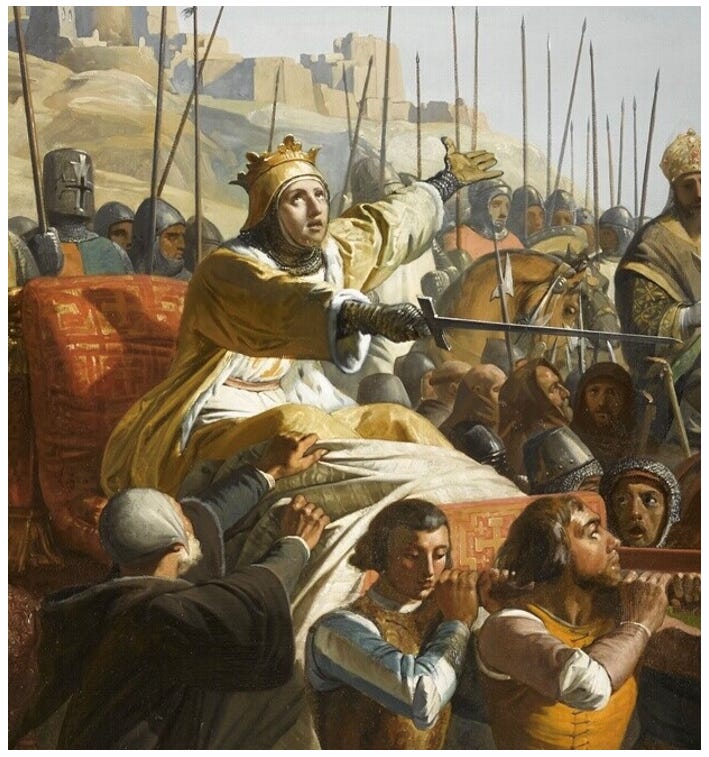
The Second Crusade launched after the fall of Edessa in 1144 but ended in failure. Baldwin IV (1161–1185) decisively defeated Saladin (1137–1193) at the Battle of Montgisard in 1177 [[xxi]], however Saladin ultimately besieged and conquered Jerusalem in 1187 after Baldwin’s death [[xxii], [xxiii]]. The Third Crusade saw Richard I of England (1157–1199), Philip II of France (1165–1223), and Frederick I Barbarossa (c. 1122–1190) recover portions of the coast, however Jerusalem remained under Muslim control [[xxiv], [xxv]]. Throughout these campaigns, the Templars and the Knights Hospitaller, founded even earlier by Blessed Gerard (c. 1040–1120), formed the professional military backbone of the Crusader states, despite rivalries between the two institutions [[xxvi]].
The movement reached a disastrous turning point during the Fourth Crusade. Instead of advancing to the Holy Land, crusaders captured and sacked Constantinople in 1204, the capital of the Christian Byzantine Empire. The event permanently damaged relations between Eastern and Western Christendom and severely weakened Byzantine power [[xxvii]].
Subsequent crusades achieved only limited gains. Despite occasional successes by Louis IX of France (1214–1270), Muslim powers steadily recovered Crusader territory. The process culminated in the Fall of Acre in 1291, which ended the last major Crusader foothold in the Holy Land [[xxix], [xxx], [xxxi]].
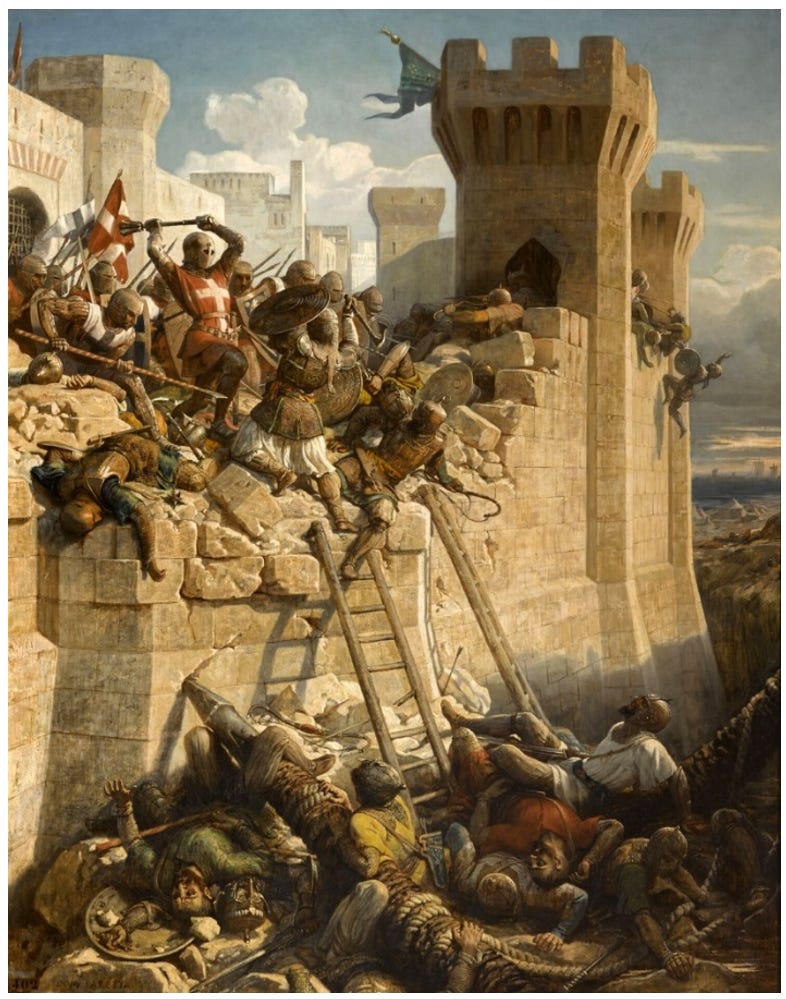
Even after Acre had fallen, the Latin kingdom of Cyprus, the knights of St. John at Rhodes, and the maritime power of Venice — all creations of the Crusades — combined to delay, if they could not stop, the advance of Mohammedanism [[xxxii]].
For the Templars, Acre’s fall was particularly significant. The order’s purpose was to defend pilgrims and the Crusader states; with the loss of the Holy Land, its principal mission effectively disappeared. Although the Templars relocated to Cyprus and retained their wealth and organization, they no longer possessed the clear purpose that had justified their existence. “Their valour was never questioned, but wealth and power brought corruption, greed, and suicidal rivalry with each other. The pride of the Templars in especial became proverbial and odious” [[xxxiii]].
King Philip IV of France (1268–1314) relentlessly pressured Pope Clement V (c. 1264–1314) to prosecute the Knights Templar, combining political pressure with a propaganda campaign that inflamed public opinion against both the order and the pope. In the early hours of Friday October 13, 1307, Phillip’s agents arrested Templars in France [[xxxiv]]. Confessions extracted under torture described initiates being ordered “to spit on the cross,” being kissed on the navel and the mouth, homosexual relations, and idol worship. Initiates described being beaten and denied food and water until they denied Christ.
Although investigations outside France often produced little evidence, and the Templars were acquitted in places such as Spain and Germany, confessions extracted under torture in France dominated the proceedings [[xxxv]]. At the Council of Vienne in 1312, Clement suppressed the order as a matter of political expediency rather than a formal declaration of guilt. Most Templar property was transferred to the Knights Hospitaller, while the last Grand Master, Jacques de Molay (c. 1243–1314) was burned at the stake in 1314, after retracting his confession and proclaiming his innocence [[xxxvi]]. Philip emerged with financial gains, but more significantly demonstrated the extent to which the French crown could dominate the medieval papacy [[xxxvii]].
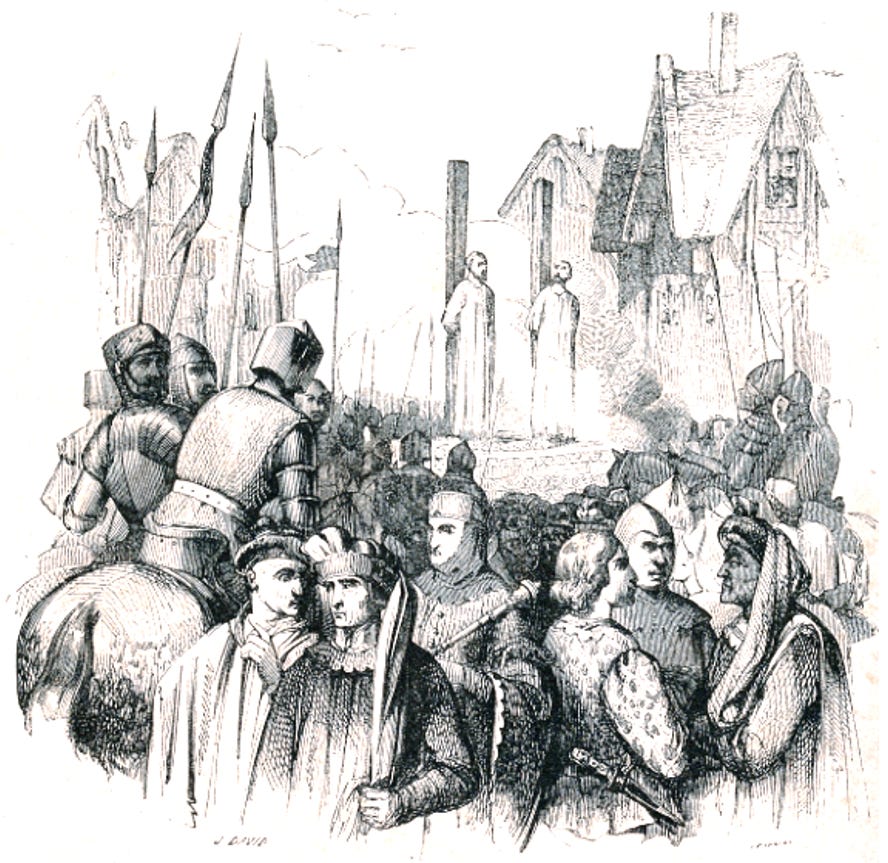
The Knights Templar earned enormous prestige by protecting pilgrims and serving as the professional military backbone of the Crusader states. Their success brought exceptional wealth, extensive privileges, and considerable political influence. “It is said today that their wealth is equal to the treasures of kings,” declared William of Tyre (c. 1130–1186), tutor and adviser to Baldwin IV [[xxxviii]]. However, he added: “They have also taken away tithes and first fruits from God’s churches, have disturbed their possessions, and have made themselves exceedingly troublesome” [[xxxix]].
These sins might have been forgiven were the Templars performing a vital mission, but after the 1291 Fall of Acre, these were “worldly, arrogant men, living a soft life on income that should have been used for redemption of the Holy Land” [[xli]]. Albert Pike (1809–1891), a lawyer, Confederate general, and prominent nineteenth-century Masonic author, claimed in his 1871 Morals & Dogma of Freemasonry:
The Templars were unintelligent and therefore unsuccessful Jesuits. Their watchword was, to become wealthy, in order to buy the world. They became so, and in 1312 they possessed in Europe alone more than nine thousand seignories. Riches were the shoal on which they were wrecked. They became insolent, and unwisely showed their contempt for the religious and social institutions which they aimed to overthrow. Their ambition was fatal to them. Their projects were divined and prevented [[xlii], [xliii]].
Pike’s interpretation reflects nineteenth-century Masonic tradition more than modern medieval scholarship, but he identifies a broader historical pattern. The Templars earned their wealth through generations of service, protecting pilgrims and defending the Crusader states. Yet after the 1291 Fall of Acre, their institutional machinery remained while their original purpose vanished. Wealthy, privileged institutions that retain their means yet outlive their ends are prime targets for governments seeking to consolidate political authority and confiscate that wealth.
Which brings us back to monasticism in general.
Thanks for reading Fields & Energy! This post is public so feel free to share it.
Reform movements such as the Cistercian Order illustrate both the enduring authority of the Rule of St. Benedict and the recurring need to restore monastic discipline as standards declined. By the early fifteenth century reform was again deemed necessary, prompting King Henry V (1387–1422) and more than 360 Benedictine abbots to approve measures for renewal [[xliv]]. One early 20th century historian declared [[xlv]]:
Critics maintain that monasticism encouraged withdrawal from family, civic, and economic life in pursuit of spiritual perfection, thereby weakening social institutions and promoting an unhealthy divide between the sacred and the secular. They argue that monastic culture often elevated asceticism above ordinary human flourishing, subordinated secular learning to religious aims, and concentrated cultural influence in institutions whose priorities did not always align with the broader needs of society.
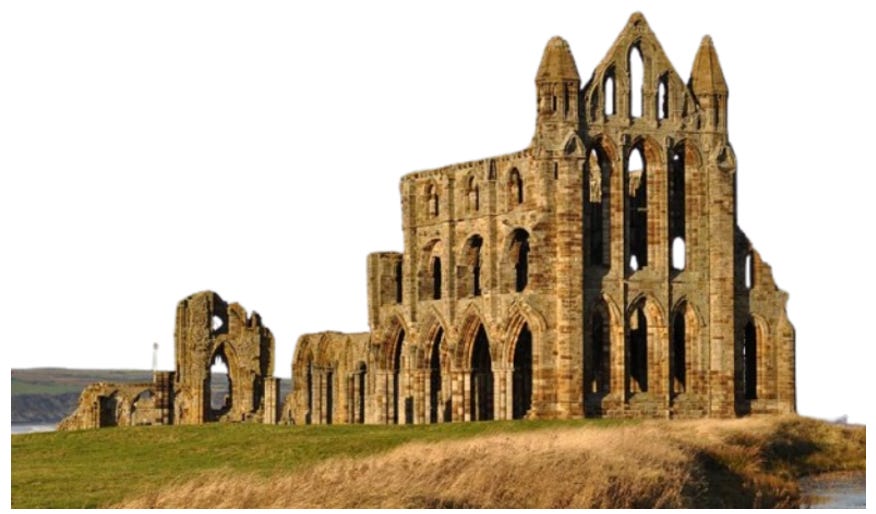
“That corruption had set in, is a fact recognized alike by both Roman Catholic and Protestant writers,” asserts one nineteenth-century English historian [[xlvi]]. For instance, John Hexham, abbot of Whitby from 1527 to 1538, became notorious for alleged abuses of power, including intimidation, interference in local affairs, violent conflicts, and dealings with French pirates. Nevertheless, he retained his position until resigning for health reasons shortly before the Dissolution of the Monasteries [[xlvii]].
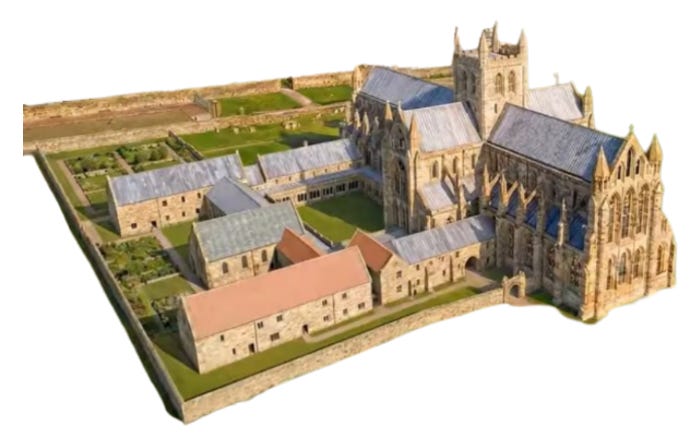
Thanks again to Andrew Oxby for kind permission to reproduce a still from his amazing restoration video here and in my book.
The broader problem was not so much corruption, however, as it was apathy:
The shell of English monasticism was, in the early 16th century, too big for its body. The abbeys were understaffed, and cloisters which in their heyday had housed a hundred or more monks now held less than thirty. Recruits were still coming in, in numbers just about sufficient to keep the orders going, but, with one or two notable exceptions, there was little enthusiasm for the religious life. Monasticism in England on the eve of the Dissolution had the momentum of an established institution, but little real vitality [[xlix]].
What combination of religious conviction, political ambition, and economic opportunity led King Henry VIII (1491–1547) to direct his Chief Minister, Thomas Cromwell (1485–1540), to dissolve the monasteries? “Finance is indeed the key to the proper understanding of the dissolution.” Although “[i]t has been argued that the religious orders formed a reservoir of pro-papal sentiment in England which might endanger the security of the new royal régime,” “[d]issolution was more likely to create than to remove opposition to the royal headship.” The initial stated motives included “sexual irregularities and the retention and veneration of relics of saints” [[l]]. Protestant critics of traditional Christian devotion to relics and icons viewed the practice as corrupt and idolatrous, particularly where popular reverence appeared to blur into superstition or commercial exploitation.
For instance, Boxley Abbey had a “Rood of Grace,” a celebrated mechanically-animated crucifix that attracted pilgrims for centuries before being publicly denounced and destroyed during the English Reformation. Martyrologist John Foxe (1516–1587) characterized the Rood of Grace (in language reflecting the Protestant polemics of his day), as follows:
What posterity will ever think the church of the pope, pretending such religion, to have been so wicked, so long to abuse the people’s eyes with an old rotten stock, called the Rood of Grace, wherein a man should stand enclosed, with a hundred wires within the rood, to make the image goggle with the eyes, to nod with his head, to hang the lip, to move and shake his jaws, according as the value was of the gift which was offered ? If it were a small piece silver, the image would hang a frowning lip ; if it were a piece of gold, then should his jaws go merrily. Thus miserably were the people of Christ abused, their souls seduced, their senses beguiled, and their purses spoiled, till this idolatrous forgery, at last, by Cromwell’s means, was disclosed, and the image, with all his engines, showed openly at Paul’s Cross, and there torn in pieces by the people [[lii]].
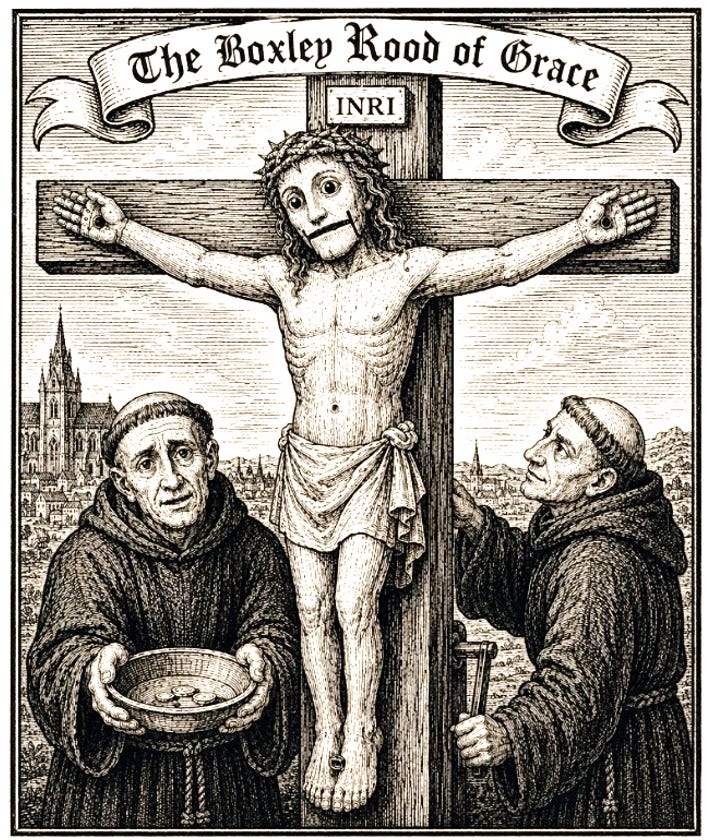
Of course, pilgrims may well have understood that the movements were mechanical while still finding it spiritually evocative [[liii]].
The public destruction of the Rood of Grace marked a decisive propaganda victory for the Tudor reformers, replacing centuries of devotional authority with a compelling narrative that portrayed the monasteries as institutions of idolatry, superstition, and manipulation, thereby helping legitimize their suppression [[liv]]. Some relics and miracle claims were undoubtedly questionable, but the Crown also had a strong incentive to portray popular religious practices as superstition in order to justify dismantling monasteries, confiscating their wealth, and consolidating royal authority. Their wealth, estimated variously as one-fifth the land and one-third the national wealth, was a rich prize [[lv]].
The monasteries had lost control of the cultural narrative. The symbols, stories, rituals, relics, and pilgrimages that had once legitimized their authority no longer persuaded as much of the public. Once their moral and symbolic capital had been exhausted, their economic and political capital proved remarkably easy to confiscate.
Tudor historian G.W.O. Woodward (1924-2005) observed:
IN April 1536, at the end of the twenty-seventh year of the reign of King Henry VIII, there were, scattered throughout England and Wales, more than eight hundred religious houses, monasteries, nunneries and friaries, and in them there lived close on ten thousand monks, canons, nuns and friars. Four years later, in April 1540, there were none. Their buildings and properties had been taken over by the crown and leased or sold to new lay occupiers. Their former inhabitants had been dispersed and were in the process of adjusting themselves to a very different way of life. The major social and religious upheaval of these four years is what we call the Dissolution of the Monasteries [[lvi]].
The ease with which King Henry VIII overthrew English monasticism followed from compromised, compliant, and suborned men in places of religious authority from the Archbishop of Canterbury, Thomas Cranmer (1489–1556), on down [[lvii]]. Henry’s chief minister, Thomas Cromwell, architect of the dissolution, “…kept a careful and continuous eye on monastic affairs, and quite regularly put forward and secured the election of his own candidates to vacant abbacies” [[lviii]].
The Dissolution was more than the suppression of monasteries. It dismantled an entire ecosystem of religious, educational, charitable, and cultural institutions. Cromwell destroyed famous shrines like Our Lady of Walsingham and the shrine of St. Thomas Becket (c. 1119–1170), seizing their treasures [[lix]]. Great libraries were dispersed and lost:
A few books from monastic libraries, mainly those with an antiquarian interest, were preserved for the royal collection which later was to become one of the nuclei of the British Museum Library, but countless others were disposed of for the sake of their parchment and vellum alone, without regard to the interest or value of their contents, or the beauty of their calligraphy or illumination [[lx]].
Some abbots who refused to yield gracefully to the dissolution of their abbeys faced execution [[lxi]].
The Dissolution did not destroy the inheritance of classical antiquity, much of which survived elsewhere. The greatest cultural loss was English: the dispersal and destruction of unique local chronicles, charters, saints’ lives, liturgical books, music, and records that preserved the memory of medieval England itself.
The Tudors’ “Great Reset,” recast the preceding centuries as an age of corruption from which they had finally delivered England. “…[W]e teach the moſt holy Goſpel of God… [T]he ancient Fathers, and the whole Primitive Church are on our ſide…,” boasted John Jewel (1522–1571) Bishop of Salisbury, the principal theologian and apologist of the Elizabethan Church of England, and author of Apology of the Church of England. “[W]e have… return’d to the Apoſtles and the ancient Catholick Fathers…” [[lxiii]].
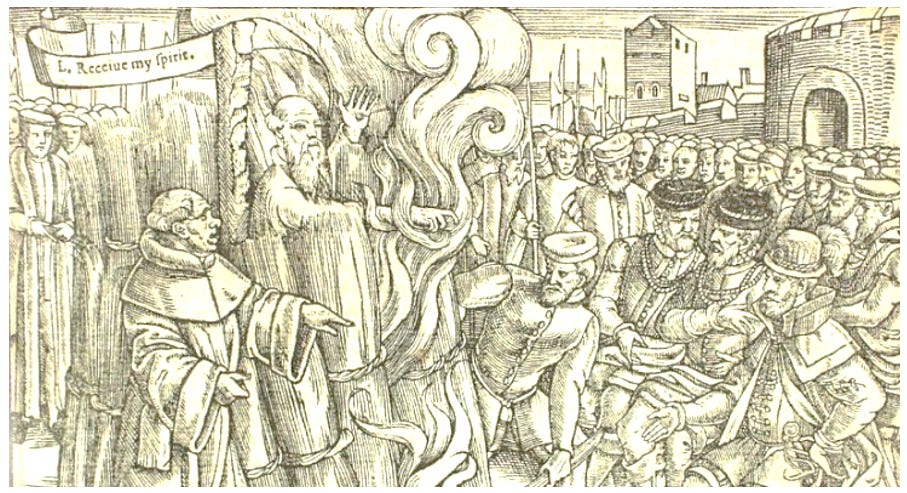
Like many revolutions, the English Reformation consumed some of its own architects. Thomas Cromwell was executed for treason in 1540. And after helping condemn others for heresy during Henry VIII’s reign, Archbishop Cranmer himself was convicted of heresy under Mary I and burned in 1556.
English monasteries fell to Tudor reform; many of their continental counterparts succumbed to the French Revolution. In the end, monasticism was overwhelmed by the centralized nation-state, secular politics, and new conceptions of authority that emerged from a civilization whose intellectual and educational foundations it had spent centuries helping to build.
That’s all for now. Remember always to keep calm, and make physics great again.
See you next week,
Hans
P.S. Pick up your copy of Fields & Energy Book I: Fundamentals and Origins of Electromagnetism, if you haven’t already:
Next time: II 1.7.3 Media & Communication Infrastructure: How Knowledge is Preserved and Transmitted
Enjoyed the article, but maybe not quite enough to spring for a paid subscription?
Then click on the button below to buy me a coffee. Thanks!

Full Table of Contents [click here]
You may follow me online in other places as well:
Telegram: 𝔸𝕖𝕥𝕙𝕖𝕣𝕔𝕫𝕒𝕣’𝕤 𝔸𝕖𝕥𝕙𝕖𝕣𝕤𝕥𝕣𝕖𝕒𝕞
Gab: @aetherczar
Twitter: @aetherczar
Amazon: Hans G. Schantz
[[i]] Brown, Peter, The Rise of Western Christendom, 2nd ed., Malden, MA, Blackwell Publishing, 2003, p. 225. See: https://amzn.to/4uv464j.
[[ii]] Previté-Orton, Charles William (1877-1947), Cambridge Medieval History, vol. 1, Switzerland: Castalia Library, 2024, p. 370. See: https://archive.org/details/shortercambridge0000prev/page/370/mode/2up
[[iii]] Gimpel, Jean, The medieval machine : the industrial revolution of the Middle Ages, New York : Barnes & Noble Books, 2003, p. 46. See: https://archive.org/details/medievalmachinei0000gimp_n8d4/page/46/mode/2up.
[[iv]] Previté-Orton, Charles William (1877-1947), Cambridge Medieval History, vol. 1, Switzerland: Castalia Library, 2024, pp. 502-504. See: https://archive.org/details/shortercambridge0000prev/page/502/mode/2up
[[v]] Gimpel, Op.Cit. p. 47.
[[vi]] de Vivar, Juan Correa (1510–1566), The work represents a San Bernardo de Claraval, canonized by the Catholic Church in 1174 and proclaimed Doctor of the Church in 1830. See: https://commons.wikimedia.org/wiki/File:San_Bernardo,_de_Juan_Correa_de_Vivar_(Museo_del_Prado).jpg
[[vii]] Molitor, Jan Petr / Johann Petr Molitor, “Cistercian monks,” murals in the Capitular Hall, Cistercian Abbey Osek, North Bohemia, before 1756. See: https://commons.wikimedia.org/wiki/File:Jan_Petr_Molitor_-_Cistercian_monks,_murals_Cistercian_Abbey_Osek.jpg
[[viii]] Ibid. p. 47.
[[ix]] Previté-Orton, Charles William (1877-1947), Cambridge Medieval History, vol. 1, Switzerland: Castalia Library, 2024, pp. 519-522. See: https://archive.org/details/shortercambridge0000prev/page/518/mode/2up
[[x]] Some sources say 1118, others 1119.
[[xi]] Pike, Albert (1809–1891), Morals and Dogma of Freemasonry, 1871, p. 531.
“The Templars, whose history is so imperfectly known, were those terrible conspirators. In 1118, nine Knights Crusaders in the East, among whom were Geoffroi de Saint-Omer and Hugues de Payens, consecrated themselves to religion, and took an oath between the hands of the Patriarch of Constantinople, a See always secretly or openly hostile to that of Rome from the time of Photius. The avowed object of the Templars was to protect the Christians who came to visit the Holy Places: their secret object was the re-building of the Temple of Solomon on the model prophesied by Ezekiel. This re-building, formally predicted by the Judaizing Mystics of the earlier ages, had become the secret dream of the Patriarchs of the Orient. The Temple of Solomon, re-built and consecrated to the Catholic worship would become, in effect, the Metropolis of the Universe; the East would prevail over the West, and the Patriarchs of Constantinople would possess themselves of the Papal power.” See: https://archive.org/details/PikeAlbertMoralsAndDogmaOfFreemasonryEN1871575P./page/n531/mode/2up
[[xii]] Sams, Marilyn, “Antonia: The Fortress Jerusalem Forgot,” Popular Archeology, Dec. 17, 2015. See: https://popular-archaeology.com/article/antonia-the-fortress-jerusalem-forgot/
[[xiii]] Previté-Orton, Charles William (1877-1947), Cambridge Medieval History, vol. 1, Switzerland: Castalia Library, 2024, p. 505. See: https://archive.org/details/shortercambridge0000prev/page/504/mode/2up
[[xiv]] Archer, Thomas Andrew and Charles L. Kingsford, The Crusades: The Story of the Latin Kingdom of Jerusalem, New York: Putnam, 1895, pp. 170-172. Note Hugh of Payns is alternatively Hugh de Payen. See: https://archive.org/details/39020000758303-thecrusades/page/170/mode/2up
[[xv]] “Drawing depicting three Templars (a serving brother, a knight brother, and a priest brother), with a red cross drawn on their garments. One also wears a helmet and carries a long shield bearing a red cross.” See: https://commons.wikimedia.org/wiki/File:Knights-templar.jpg
[[xvi]] By Amitchell125 - Own work, “A map of the territorial extent of the Crusader states, Edessa, Antioch, Tripoli, and Jerusalem, in the Holy Land in 1135, shortly before the Second Crusade. The nearest Christian states were the Kingdom of Cilicia and the Byzantine empire.” CC BY-SA 4.0, https://commons.wikimedia.org/w/index.php?curid=103890901
[[xvii]] Bernard of Clairvaux, In Praise of the New Knighthood: A Treatise on the Knights Templar and the Holy Places of Jerusalem, M. Conrad Greenia OCSO, trans., Piscataway, NJ: Gorgias Press, 2010, pp. 50-1. See: https://dokumen.pub/qdownload/in-praise-of-the-new-knighthood-a-treatise-on-the-knights-templar-and-the-holy-places-of-jerusalem-9781463218331.html
[[xviii]] Ehret, Matthew and Cynthia Chung, Black Sun Rising: Esoteric Nazism Past and Future, 2026, Location 492 of 6659 in Kindle Edition. See: https://amzn.to/4b1kd2H.
[[xix]] Archer, Thomas Andrew and Charles L. Kingsford, The Crusades: The Story of the Latin Kingdom of Jerusalem, New York: Putnam, 1895, p. 207. See: https://archive.org/details/39020000758303-thecrusades/page/206/mode/2up
[[xx]] By Amitchell125 - Own work, “A map of the territorial extent of the Crusader states, Edessa, Antioch, Tripoli, and Jerusalem, in the Holy Land in 1135, shortly before the Second Crusade. The nearest Christian states were the Kingdom of Cilicia and the Byzantine empire.” CC BY-SA 4.0, https://commons.wikimedia.org/w/index.php?curid=103890901
[[xxi]] Archer, Thomas Andrew and Charles L. Kingsford, The Crusades: The Story of the Latin Kingdom of Jerusalem, New York: Putnam, 1895, p. 255. See: https://archive.org/details/39020000758303-thecrusades/page/254/mode/2up
[[xxii]] Archer, Thomas Andrew and Charles L. Kingsford, The Crusades: The Story of the Latin Kingdom of Jerusalem, New York: Putnam, 1895, p. 278. See: https://archive.org/details/39020000758303-thecrusades/page/278/mode/2up
[[xxiii]] Previté-Orton, Charles William (1877-1947), Cambridge Medieval History, vol. 1, Switzerland: Castalia Library, 2024, pp. 528-529. See: https://archive.org/details/shortercambridge0000prev/page/528/mode/2up
[[xxiv]] Archer, Thomas Andrew and Charles L. Kingsford, The Crusades: The Story of the Latin Kingdom of Jerusalem, New York: Putnam, 1895, pp. 305-348. See: https://archive.org/details/39020000758303-thecrusades/page/304/mode/2up
[[xxv]] Previté-Orton, Charles William (1877-1947), Cambridge Medieval History, vol. 1, Switzerland: Castalia Library, 2024, pp. 530-532. See: https://archive.org/details/shortercambridge0000prev/page/530/mode/2up
[[xxvi]] Archer, Thomas Andrew and Charles L. Kingsford, The Crusades: The Story of the Latin Kingdom of Jerusalem, New York: Putnam, 1895, pp. 185-187. See: https://archive.org/details/39020000758303-thecrusades/page/186/mode/2up
[[xxvii]] Previté-Orton, Charles William (1877-1947), Cambridge Medieval History, vol. 2, Switzerland: Castalia Library, 2024, pp. 656-660. See: https://archive.org/details/in.ernet.dli.2015.149602/page/n29/mode/2up
[[xxviii]] Papety, Dominique (1815–1849), “The Hospitalier Master Mathieu de Clermont defending the walls in 1291,” Collections de Versailles, c. 1840. See: https://en.wikipedia.org/wiki/File:SiegeOfAcre1291.jpg
[[xxix]] Cartwright, Mark, “The Siege of Acre, 1291 CE,” World History Encyclopedia, September 17, 2018. https://www.worldhistory.org/article/1267/the-siege-of-acre-1291-ce/.
[[xxx]] Archer, Thomas Andrew and Charles L. Kingsford, The Crusades: The Story of the Latin Kingdom of Jerusalem, New York: Putnam, 1895, pp. 408-418. See: https://archive.org/details/39020000758303-thecrusades/page/408/mode/2up
[[xxxi]] Previté-Orton, Charles William (1877-1947), Cambridge Medieval History, vol. 2, Switzerland: Castalia Library, 2024, pp. 757-758. See: https://archive.org/details/in.ernet.dli.2015.149602/page/n129/mode/2up
[[xxxii]] Archer, Thomas Andrew and Charles L. Kingsford, The Crusades: The Story of the Latin Kingdom of Jerusalem, New York: Putnam, 1895, p. 449. See: https://archive.org/details/39020000758303-thecrusades/page/448/mode/2up
[[xxxiii]] Previté-Orton, Charles William (1877-1947), Cambridge Medieval History, vol. 1, Switzerland: Castalia Library, 2024, p. 505. See: https://archive.org/details/shortercambridge0000prev/page/504/mode/2up
[[xxxiv]] Barber, Malcolm, The Trial of the Templars, 1978, New York: Cambridge University Press, pp. 1-3. See: https://archive.org/details/trialoftemplars0000barb_t4w6/page/n11/mode/2up
[[xxxv]] Barber, Malcolm, The Trial of the Templars, 1978, New York: Cambridge University Press, pp. 58-71. See: https://archive.org/details/trialoftemplars0000barb_t4w6/page/58/mode/2up
[[xxxvi]] Archer, Thomas Andrew and Charles L. Kingsford, The Crusades: The Story of the Latin Kingdom of Jerusalem, New York: Putnam, 1895, pp. 184. “But their [the Templars’] power excited the fear, and their wealth the cupidity of a dangerous foe. Internal dissensions gave Philip IV. of France an opportunity to bring accusations of the most shameful character against the whole order. After nearly sixty knights had been burnt in May, 1310, the royal influence or tyranny prevailed upon Clement V to decree the suppression of the order in March, 1312; and two years later Jacques du Molay, the Grand Master, after a cruel imprisonment, shared the fate of his subordinates. The proceedings which thus terminated the existence of the Temple in France were a precedent for measures of less severity but like effect in other countries. The falsehood of the graver charges, immorality of the grossest kind, is now generally admitted, yet there seems no doubt that practices of an unseemly nature prevailed at least in the French provinces. Friendly intercourse with the Mohammedans had probably influenced the knights in matters both of belief and conduct, whilst it is more than probable that some taint of heresy had penetrated the order through the admission of Albigensian knights, compelled to choose between the service of the cross and the penalty of death.” See: https://archive.org/details/39020000758303-thecrusades/page/184/mode/2up
[[xxxvii]] Previté-Orton, Charles William (1877-1947), Cambridge Medieval History, vol. 2, Switzerland: Castalia Library, 2024, pp. 787-788. See: https://archive.org/details/in.ernet.dli.2015.149602/page/n159/mode/2up
[[xxxviii]] Archer, Thomas Andrew and Charles L. Kingsford, The Crusades: The Story of the Latin Kingdom of Jerusalem, New York: Putnam, 1895, p. 283. See: https://archive.org/details/39020000758303-thecrusades/page/282/mode/2up
[[xxxix]] William of Tyre (c. 1130–1186), Historia rerum in partibus transmarinis gestarum [A History of Deeds Done Beyond the Sea], XII, 7, Patrologia Latina 201, c. 1170-1184, pp. 526-27. Translated by James Brundage, The Crusades: A Documentary History, Milwaukee, WI: Marquette University Press, 1962, 70-73. See: https://sourcebooks.fordham.edu/source/tyre-templars.asp
[[xl]] Jacques de Molay, the last grand master of the Knights Templars, burnt alive as a lapsed heretic in Paris. Wood engraving by J. David. Via the Wellcome Collection: https://wellcomecollection.org/works/g7fvxkh8 See also: https://commons.wikimedia.org/wiki/File:Jacques_de_Molay,_the_last_grand_master_of_the_Knights_Templ_Wellcome_V0041760.jpg
[[xli]] Barber, Malcolm, The Trial of the Templars, 2nd ed., 2006, New York: Cambridge University Press, p. 304. Quoting Joseph Reese Strayer (1904–1987), Philip the Fair, p. 292. See: https://archive.org/details/malcolm-barber-the-trial-of-the-templars_202012/page/304/mode/2up
[[xlii]] Ehret, Matthew and Cynthia Chung, Black Sun Rising: Esoteric Nazism Past and Future, 2026, Location 492 of 6659 in Kindle Edition. See: https://amzn.to/4b1kd2H.
[[xliii]] Pike, Albert (1809–1891), Morals and Dogma of Freemasonry, 1871, p. 535. See: https://archive.org/details/PikeAlbertMoralsAndDogmaOfFreemasonryEN1871575P./page/n535/mode/2up
[[xliv]] Benedict, Saint, Abbot of Monte Cassino, The rule of S. Benet. Latin and Anglo-Saxon interlinear version, Logeman, H. (Henri), 1862-1936, ed., London: Early English Text Society, by N. Trübner and Co., 1888, p. xvii. See: https://archive.org/details/rulesbenetlatin00logegoog/page/n24/mode/2up
[[xlv]] Flick, Alexander Clarence, The Rise of the Mediaeval Church, And Its Influence on the Civilisation of Western Europe from the First to the Thirteenth Century, New York: Burt Franklin, 1909, pp. 223-225. See https://archive.org/details/bwb_S0-ACM-949/page/222/mode/2up
[[xlvi]] Benedict, Saint, Abbot of Monte Cassino, The rule of S. Benet. Latin and Anglo-Saxon interlinear version, Logeman, H. (Henri), 1862-1936, ed., London: Early English Text Society, by N. Trübner and Co., 1888, p. xvii. See: https://archive.org/details/rulesbenetlatin00logegoog/page/n24/mode/2up
[[xlvii]] Woodward, G.W.O. (George William Otway), (1924-2005), The Dissolution of the Monasteries, London: Blanford Press, 1966, p. 9. See: https://archive.org/details/bwb_KU-136-087/page/8/mode/2up
[[xlviii]] A photograph of the ruins of the 7th Century AD Whitby Abbey in North Yorkshire, England. The abbey was founded by King Oswy of Northumbria (642-670 CE) in 657 AD, and was placed under the guidance of its first abbess, St. Hilda of Whitby (614 - 680 AD). The abbey fell into disuse after the Dissolution of the Monasteries (1536 - 1545 AD) by Henry VIII (r. 1509 - 1547 AD). See: https://www.worldhistory.org/image/10480/ruins-of-whitby-abbey/
[[xlix]] Woodward, G. W. O. (George William Otway), (1924-2005), The dissolution of the monasteries, London : Pitkin Pictorials, 1975, p. 3. See: https://archive.org/details/dissolutionofmon00wood/page/2/mode/2up
[[l]] Woodward, G.W.O. (George William Otway), (1924-2005), The Dissolution of the Monasteries, London: Blanford Press, 1966, pp. 50–51. See: https://archive.org/details/bwb_KU-136-087/page/50/mode/2up
[[li]] A photograph of the ruins of the 7th Century AD Whitby Abbey in North Yorkshire, England. The abbey was founded by King Oswy of Northumbria (642-670 CE) in 657 AD, and was placed under the guidance of its first abbess, St. Hilda of Whitby (614 - 680 AD). The abbey fell into disuse after the Dissolution of the Monasteries (1536 - 1545 AD) by Henry VIII (r. 1509 - 1547 AD). See: https://www.worldhistory.org/image/10480/ruins-of-whitby-abbey/
[[lii]] Foxe, John (1516–1587), The Acts and Monuments of John Foxe: A New and Complete Edition, Edited by Stephen Reed Cattley (1807–1876), Vol. 5. London: R. B. Seeley and W. Burnside, 1838, p. 397. See: https://archive.org/details/book-history-john-foxe-foxes-book-of-martrys-the-acts-and-monuments-05/page/396/mode/2up Exact edition is uncertain.
[[liii]] Groeneveld, Leanna, “A Theatrical Miracle: The Boxley Rood of Grace as Puppet,” Early Theater, vol. 10, no. 2, January 2007. DOI: 10.12745/et.10.2.752. See: https://earlytheatre.org/earlytheatre/article/download/752/815 and https://www.researchgate.net/publication/254625866_A_Theatrical_Miracle_The_Boxley_Rood_of_Grace_as_Puppet
[[liv]] Reilly, Kara, Automata and Mimesis on the Stage of Theatre History, Houndmills, Basingstoke, Hampshire, UK: Palgrave Macmillan, 2011, pp. 19-23. “For generations afterwards the Rood was espoused as the paragon of Catholic popery and the monks of Boxley Abbey were depicted as cheats who ‘had gotten great riches by deceaving the people into thinckinge that the said image had so moved by the powere of God.’ Reformers asserted that the monks had financially profited from their ownership of the Rood and bamboozled their followers. The Rood offers an example of onto-epistemic mimesis that shaped spectators’ ways of knowing, and by extension their way of being. When the Rood was exposed as a fraud, Reformers could congratulate themselves on their righteous behaviour, confirming their belief in Iconoclasm. …the Reformers that smashed the Rood made the assumption that Catholic pilgrims to the Rood of Grace were gullible. But Catholic audiences had seen mechanical theatrical mirabilia or miracles in the medieval cycle plays for generations. For example, in Canterbury a mechanical golden angel was a central part of the procession in the Saint Thomas pageant. At Lincoln Cathedral a contraption with cords allowed the Holy Ghost, as a dove, to descend at Pentecost.”
[[lv]] The Sacred Heart Review, Volume 44, Number 24, 3 December 1910.
“Henry VIII suppressed six hundred and forty-four monasteries, ninety colleges, two thousand three hundred and seventy-four free , chapels and one hundred and ten hospitals, i These held one-fifth of all the land in the i kingdom and one-third the national wealth. jAt the same time nearly one hundred thou- ‘ sand male persons were thrown out of em- ; ployment. The land taken up by the king ! was bestowed upon his nobles and favorites, I and these, desirous of securing immediate and larger profits, enclosed immense areas and turned to the breeding and pasturing of sheep.” See:
https://newspapers.bc.edu/?a=d&d=BOSTONSH19101203-01.2.7
[[lvi]] Woodward, G. W. O. (George William Otway), (1924-2005), The dissolution of the monasteries, London : Pitkin Pictorials, 1975, p. 2. See: https://archive.org/details/dissolutionofmon00wood/page/2/mode/2up
[[lvii]] Benedict, Saint, Abbot of Monte Cassino, The rule of S. Benet. Latin and Anglo-Saxon interlinear version, Logeman, H. (Henri), 1862-1936, ed., London: Early English Text Society, by N. Trübner and Co., 1888, p. xviii. “In estimating the ease with which so many venerable monasteries were overthrown, it must be borne in mind that for some years previous to their final suppression, many steps had been taken by those in power to render that suppression more easy. One of these, and perhaps the chief, was the appointment by the Court of compliant and suborned men, already apostates at heart, to highest positions in the religious houses. No one was more prominent in this disgraceful intrigue than the highest ecclesiastical authority in the kingdom, the primate Cranmer” [Thomas Cranmer (1489–1556), Archbishop of Canterbury from 1533]. See: https://archive.org/details/rulesbenetlatin00logegoog/page/n24/mode/2up
[[lviii]] Woodward, G.W.O. (George William Otway), (1924-2005), The Dissolution of the Monasteries, London: Blanford Press, 1966, p. 57. See: https://archive.org/details/bwb_KU-136-087/page/56/mode/2up
[[lix]] Woodward, G.W.O. (George William Otway), (1924-2005), The Dissolution of the Monasteries, London: Blanford Press, 1966, p. 52-3. See: https://archive.org/details/bwb_KU-136-087/page/52/mode/2up
[[lx]] Woodward, G.W.O. (George William Otway), (1924-2005), The Dissolution of the Monasteries, London: Blanford Press, 1966, p. 129. See: https://archive.org/details/bwb_KU-136-087/page/128/mode/2up
[[lxi]] Woodward, G.W.O. (George William Otway), (1924-2005), The Dissolution of the Monasteries, London: Blanford Press, 1966, p. 114. “…any who still declined to yield to the will of the commissioners were to be committed for punishment as time and opportunity provided… What this last phrase might mean must have been only too clear to those of the religious who had observed the fate of the priory of Lenton and the abbey of Woburn in 1538, and the more recent, but very similar, cases of Colchester, Reading and Glastonbury in the autumn of 1539. These five houses were not surrendered. They came to the crown by forfeiture after the condemnation and execution of their heads.” See: https://archive.org/details/bwb_KU-136-087/page/114/mode/2up
[[lxii]] Thomas Cranmer’s (1489–1556) execution, burning in 1556. John Foxe’s (1517–1587) Book of Martyrs (1563). See: https://en.wikipedia.org/wiki/Thomas_Cranmer#/media/File:Cranmer_burning_foxe.jpg
[[lxiii]] Jewel, John (1522–1571), The Apology of the Church of England, London: Rose & Crown, St. Paul’s Churchyard, 1685, p. 13. See: https://archive.org/details/bim_early-english-books-1641-1700_the-apology-of-the-churc_jewel-john_1685/page/12/mode/2up
Comments
Nothing yet. Say the first thing.
Sign in to join the conversation.