
Others shared Origen’s (~185–~253) respect for pagan thinking.
The outlook of the fathers of the fourth century was no less liberal. St. Basil (~330–379) wrote a short treatise advising the young on the best method of profiting from Greek literature (Homily 32), and St. Gregory of Nazianzus (329–390) [also known as St. Gregory the Theologian] criticized the majority of Christians for their complete rejection of pagan works, some of which he believed to be useful. There was in general no attempt to alter the school curriculum by banishing the classical authors. … Julian’s [Emperor Julian, “The Apostate,” (331–363)] persecution of the Christians in 362 … soon ended, and pagan and Christian continued to use the same educational system without serious polemic or controversy [[ii]].

We may now better appreciate Augustine of Hippo (354–430). Augustine “was the principal channel through which the traditions of Greek thought passed into… Latin Christianity” [[iii]]. He articulated principles about the study of nature that later shaped Christian intellectual culture in the West. His critics argued “…the doctrines of St. Augustine have had the effect of thus placing theology in antagonism with science” [[iv]].
No one did more than [Augustine] to bring science and religion into antagonism ; it was mainly he who diverted the Bible from its true office — a guide to purity of life — and placed it in the perilous position of being the arbiter of human knowledge, an audacious tyranny over the mind of man [[v]].
Those accusations are difficult to justify. Augustine was not a Scriptural literalist. He emphasized the importance of knowing when to adopt a figurative interpretation of Scripture.
…[W]e must beware of taking a figurative expression literally. For the saying of the apostle applies in this case too: ‘The letter kills, but the spirit gives life’ [2 Corinthians 3:6]. For when what is said figuratively is taken as if it were said literally, it is understood in a carnal manner [[vi]].
He adds, “…when the words taken literally give an absurd meaning, we ought immediately to inquire whether they may not be used in this or that figurative sense which we are unacquainted with; and in this way many obscure passages have had light thrown upon them” [[vii]]. Augustine further cautioned that:
Usually, even a non-Christian knows something about the earth, the heavens, and the other elements of the world, about the motion and orbit of the stars and even their size and relative positions, about the predictable eclipses of the sun and moon, the cycles of the years and the seasons, about the kinds of animals, shrubs, stones, and so forth, and this knowledge he holds to as being certain from reason and experience. Now, it is a disgraceful and dangerous thing for an infidel to hear a Christian, presumably giving the meaning of Holy Scripture, talking nonsense on these topics; and we should take all means to prevent such an embarrassing situation, in which people show up vast ignorance in a Christian and laugh it to scorn [[viii]].
Like many of his contemporaries, Augustine affirmed and advocated the practice of appropriating pagan truths.
“Moreover, if those who are called philosophers, and especially the Platonists, have said aught [anything at all] that is true and in harmony with our faith, we are not only not to shrink from it, but to claim it for our own use from those who have unlawful possession of it” [[x]].
Note however that such truths had to be “in harmony with our faith.” In his Confessions he says upon reading Plato that:
…therein I read, not indeed in the same words, but to the selfsame effect, enforced by many and various reasons, that, ‘In the beginning was the Word, and the Word was with God, and the Word was God….’ [John 1:1] But that ‘the Word was made flesh, and dwelt among us,’ [John 1:14] I read not there” [[xi]].
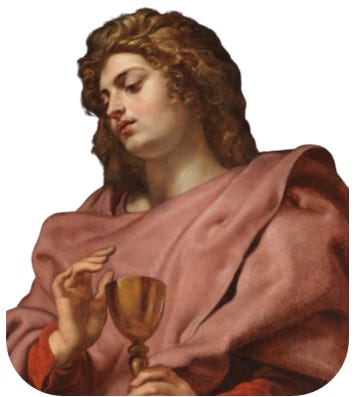
Augustine found philosophy in agreement with Scripture, but cautioned that a Christian “is on his guard, however, with respect to those who philosophize according to the elements of this world, not according to God, by whom the world itself was made; for he is warned by the precept of the apostle… ‘Beware lest any man spoil you through philosophy and vain deceit, after the tradition of men, after the rudiments of the world, and not after Christ’” [[xii]] [Colossians 2:8].”
In Augustine’s framework, philosophy serves theology; it does not judge it. Of the canonical books of Scripture, he said, “
…I most firmly believe that the authors were completely free from error. And if in these writings I am perplexed by anything which appears to me opposed to truth, I do not hesitate to suppose that either the manuscript is faulty, or the translator has not caught the meaning of what was said, or I myself have failed to understand it. As to all other writings, in reading them, however great the superiority of the authors to myself in sanctity and learning, I do not accept their teaching as true on the mere ground of the opinion being held by them; but only because they have succeeded in convincing my judgment of its truth either by means of these canonical writings themselves, or by arguments addressed to my reason [[xiii]].
While Augustine was not a Scriptural literalist, he believed that Scripture, rightly understood and interpreted, was inerrant, and belief is the prerequisite to a deeper understanding. For Augustine, pride blocks insight. Humility and faith enable understanding.
Dost thou wish to understand? Believe…. For understanding is the reward of faith. Therefore do not seek to understand in order to believe, but believe that thou mayest understand; since, “except ye believe, ye shall not understand” [Isaiah 7:9] [[xiv]].
Augustine did not reject reason. Rather he argued that some understanding leads to belief, and then belief leads to deeper understanding.
Before any systematic investigation of reality can proceed, one must assume that reality is intelligible, that it exhibits stable structure, coherence, and order capable of being grasped by reason. This assumption is not itself derived from empirical inquiry; rather, it underwrites the very possibility of such inquiry. In classical philosophy, this conviction was expressed through the concept of Logos: a rational principle structuring the cosmos. Both pagan philosophers and Christian theologians affirmed, in different ways, that the world is not chaotic but ordered and therefore knowable.
In Christian thought, this intelligibility is grounded theologically: creation reflects the rationality of its Creator, and human reason participates analogically in that rationality. In Greek philosophy, the same confidence appears metaphysically rather than theologically, as an affirmation and reflection of the cosmic rational structure. In either case, the expectation of order precedes and motivates investigation.
Belief in Logos does not provide scientific conclusions, nor does it determine particular theories. Rather, it sustains the conviction that inquiry is meaningful because reality is structured in a way that reason can, at least in part, comprehend. Without some such commitment to intelligibility, however articulated, systematic inquiry would lack its orienting confidence that nature is amenable to rational understanding. As we shall see, a rejection of Logos is a critical reason why physics went wrong.
Augustine was not a scientist, but he helped shape the intellectual framework within which Western science eventually developed. He affirmed that Creation is rationally ordered and intelligible because it proceeds from a rational Creator; that Scripture is uniquely authoritative but must not be defended with ignorance about the natural world; and that philosophy, while useful, must be judged in light of Christian doctrine. This established a hierarchy of knowledge in which reason was legitimate and necessary, yet ordered within theology, and nature became a legitimate object of sustained, rational investigation.
In fact, in his Letter to the Grand Duchess Christina (1615), Galileo Galilei (1564–1642) himself explicitly quoted and relied on passages from Augustine to argue that Scripture should not be interpreted precipitously or literally in matters of natural philosophy when doing so conflicts with demonstrable reality [[xv]]. But why then did it take so long to go from Augustine to Galileo?
If in the fifth century Augustine laid a philosophical framework within which science could flourish, why then did it take until the thirteenth century for Western science to begin to adopt the experimental method and undertake systematic investigations of nature?
That’s all for now. Remember always to keep calm, and make physics great again.
See you next week,
Hans
P.S. Pick up your copy of Fields & Energy Book I: Fundamentals and Origins of Electromagnetism, if you haven’t already:
Next time: II. 1.7 Logos Needs Logistics: The Catalysts of Science
Fields & Energy is a reader-supported publication. Sign up to receive new posts for free. If you enjoyed this article, and value independent scholarship on where physics went wrong, consider becoming a paid subscriber to support my work.
Enjoyed the article, but maybe not quite enough to spring for a paid subscription?
Then click on the button below to buy me a coffee. Thanks!

Full Table of Contents [click here]
Follow Online:
You may follow me online in other places as well:
Telegram: 𝔸𝕖𝕥𝕙𝕖𝕣𝕔𝕫𝕒𝕣’𝕤 𝔸𝕖𝕥𝕙𝕖𝕣𝕤𝕥𝕣𝕖𝕒𝕞
Gab: @aetherczar
Twitter: @aetherczar
Amazon: Hans G. Schantz
References:
[[i]] Philippe de Champaigne (1602–1674), “Saint Augustine by Philippe de Champaigne,” Los Angeles County Museum of Art: online database: entry 171584. See: https://en.wikipedia.org/wiki/Augustine_of_Hippo#/media/File:Saint_Augustine_by_Philippe_de_Champaigne.jpg.
[[ii]] Reynolds, Leighton Durham, Scribes and scholars : a guide to the transmission of Greek and Latin literature, London: Oxford University Press, 1968, p. 42. See: https://archive.org/details/scribesscholarsg0000reyn/page/42/mode/2up
[[iii]] Crombie, A.C., Augustine to Galileo, vol. II, Cambridge, Massachusetts: Harvard University Press, 1961, p. 13.
[[iv]] Draper, John William (1811–1882), History of the Conflict Between Religion and Science, New York, D. Appleton and Company: 1875, p. 58. See: https://archive.org/details/historyofconfli00drap/page/n87/mode/2up
[[v]] Draper, John William (1811–1882), History of the Conflict Between Religion and Science, New York, D. Appleton and Company: 1875, p. 62. See: https://archive.org/details/historyofconfli00drap/page/n91/mode/2up
[[vi]] Augustine (AD 354–430), De doctrina christiana (On Christian Doctrine), Book III, Chapter 5, §9 ~AD 397. See: https://www.newadvent.org/fathers/12023.htm Here “carnal” does not primarily mean sexual, but rather material, worldly, or merely literal-minded, interpreting spiritual or figurative truths in an excessively earthly sense.
[[vii]] Augustine (AD 354–430), De doctrina christiana (On Christian Doctrine), Book III, Chapter 29, §41 ~AD 397. See: https://www.newadvent.org/fathers/12023.htm
[[viii]] Augustine (AD 354–430), De Genesi ad litteram, Book I, chapter 19, §39. Quoted by David C. Lindberg (1935–2015), “Science and the Early Church,” collected in God & Nature: Historical Essays on the Encounter between Christianity and Science, David C. Lindberg and Ronald L. Number, eds., Berkeley: University of California Press, 1986, pp. 24-25. The quote continues: “The shame is not so much that an ignorant individual is derided, but that people outside the household of faith think our sacred writers held such opinions, and, to the great loss of those for whose salvation we toil, the writers of our Scripture are criticized and rejected as unlearned men. If they find a Christian mistaken in a field which they themselves know well and hear him maintaining his foolish opinions about our books, how are they going to believe those books in matters concerning the resurrection of the dead, the hope of eternal life, and the kingdom of heaven, when they think their pages are full of falsehoods on facts which they themselves have learnt from experience and the light of reason? Reckless and incompetent expounders of Holy Scripture bring untold trouble and sorrow on their wiser brethren when they are caught in one of their mischievous false opinions and are taken to task by those who are not bound by the authority of our sacred books. For then, to defend their utterly foolish and obviously untrue statements, they will try to call upon Holy Scripture for proof and even recite from memory many passages which they think support their position, although they understand neither what they say nor the things about which they make assertion.”
[[ix]] The Apostle Saint John Evangelist (AD ~6–100), by Peter Paul Rubens (1577–1640), (~1611). See: https://en.wikipedia.org/wiki/John_the_Apostle#/media/File:Rubens_apostel_johannes_grt.jpg
[[x]] Augustine (AD 354–430), On Christian Doctrine [De doctrina christiana] II.40 (§60). See: https://biblehub.com/library/augustine/on_christian_doctrine_in_four_books/chapter_60_moreover_if_those.htm
[[xi]] Augustine (AD 354–430), Confessions, Book VII, Chapter 9. See: https://www.newadvent.org/fathers/110107.htm
[[xii]] Augustine (AD 354–430), The City of God (Book VIII) Chapter 10. See: https://www.newadvent.org/fathers/120108.htm
[[xiii]] Augustine (AD 354–430), The City of God (Book VIII) Chapter 10. See: https://www.newadvent.org/fathers/120108.htm
[[xiv]] Augustine (AD 354–430), Tractate 29 on John 7.14-18, Section 6. See: https://www.newadvent.org/fathers/1701029.htm Note that Augustine is quoting the Septuagint version of Isaiah 7:9.
[[xv]] Galileo Galilei (1564–1642), Letter to the Grand Duchess Christina of Tuscany, (1615).
“Showing a greater fondness for their own opinions than for truth they sought to deny and disprove the new things which, if they had cared to look for themselves, their own senses would have demonstrated to them. To this end they hurled various charges and published numerous writings filled with vain arguments, and they made the grave mistake of sprinkling these with passages taken from places in the Bible which they had failed to understand properly, and which were ill-suited to their purposes.
“These men would perhaps not have fallen into such error had they but paid attention to a most useful doctrine of St. Augustine’s, relative to our making positive statements about things which are obscure and hard to understand by means of reason alone. Speaking of a certain physical conclusion about the heavenly bodies, he wrote: ‘Now keeping always our respect for moderation in grave piety, we ought not to believe anything inadvisedly on a dubious point, lest in favor to our error we conceive a prejudice against something that truth hereafter may reveal to be not contrary in any way to the sacred books of either the Old or the New Testament.’”
See: https://web.stanford.edu/~jsabol/certainty/readings/Galileo-LetterDuchessChristina.pdf
Comments
Nothing yet. Say the first thing.
Sign in to join the conversation.