
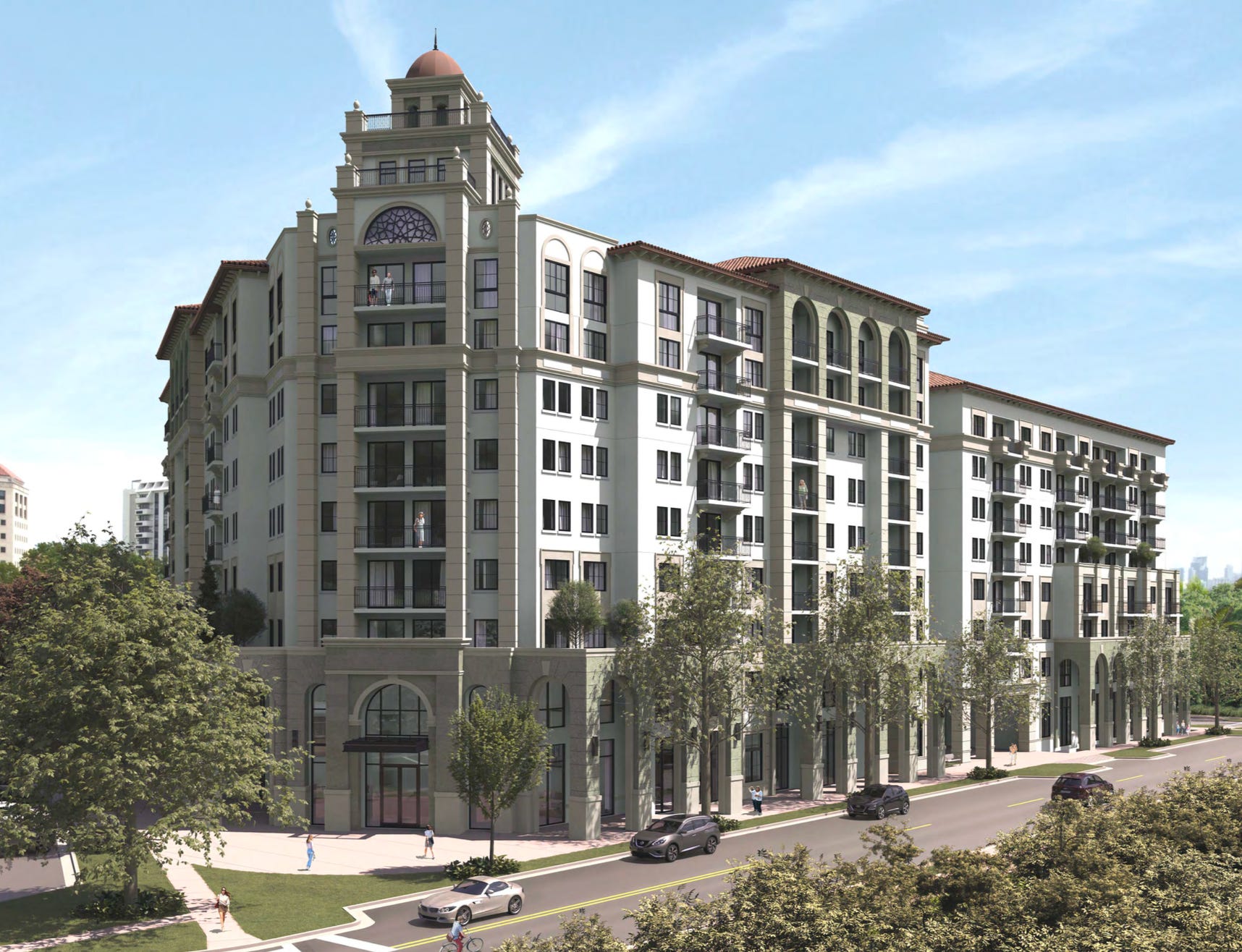
Note: This is a long post. But this type of issue requires and deserves this kind of attention. I'm taking a page out of Aesop’s book for this one, so I’ll provide a brief summary in the hopes that it’ll get you reading. 😉
Summary:
Crystal Residences advanced at the June 17th P&Z meeting after a five-year approval process marked by ongoing opposition.
The project is led by Fifield Companies and anchored by Crystal Academy, which will receive a new facility under a 99-year, no-cost lease.
Opposition claims (incompatibility, loss of green space, lack of public benefit) are contradicted by existing development patterns and staff findings.
The North Ponce neighborhood already supports similar or larger developments and is the most appropriate area for this type of density.
The project introduces publicly accessible green space, replacing what is currently private-use land.
City staff confirmed the project delivers clear public benefits, including open space, pedestrian improvements, and integrated community use.
Critics are increasingly relying on misinformation, particularly regarding Crystal Academy’s role and accessibility.
Bottom line: The project is compatible, process-compliant, and provides tangible community benefits.
On June 17th, the Crystal Residences project located at 110 Phoenetia Avenue was presented before the City of Coral Gables Planning & Zoning Board. Agenda items E-1 through E-4 all pertained to the Crystal Residences project, propelling the proposed development one step further to the approval it needs to break ground. For those who have been following along, the Crystal Residences has faced opposition every step of the way.
At the helm of the opposition is Bonnie Bolton, leading the charge against the project and advocating for the preservation of the Garden of Our Lord. The history of the Garden of Our Lord issue could be a post of its own. This mixed-use project has been five years in the making, as stated by the applicant’s attorney, Jorge Navarro of Greenberg Traurig. This is not an unfamiliar occurrence in Coral Gables. Development is often challenged. However, there is a difference between development for development’s sake, and a developer who genuinely wants to work hand-in-hand with the city and residents. Fifield Companies is the latter.
As a quick refresher, the property located at 110 Phoenetia was purchased by Century Homebuilders in 2021. Shortly thereafter, Fifield Companies, a luxury real estate developer based out of Chicago, entered into a purchase agreement with Century for the property, contingent upon the approval of the proposed project. However, due to the duration of the approval process and abuse of the appeal process by the opposition, Fifield finally made a full purchase of the property in 2026 in partnership with another company. Information about ownership, past and present, of 110 Phoenetia is available on the Miami-Dade County Property Appraiser website.
At the heart of this project is Crystal Academy, a premium therapy center and school for children with autism and developmental delays. Crystal Academy has become a beloved institution in our community and has made lasting impacts on the children who have been fortunate enough to call the school home. When Century Homebuilders originally purchased the property, they made a commitment to and an agreement with Crystal Academy to provide them with a brand-new, state-of-the-art school with a 99-year lease at no cost. Fifield has since made the same commitment and honored the agreement, placing Crystal Academy at the center of their mission to build an appropriate, community-driven development project in the North Ponce neighborhood of Coral Gables.
Despite this, opposition continues to be heavy handed and, in my view, misguided and even antagonistic towards Fifield and Crystal Academy. As became evident at the Planning & Zoning Board meeting on June 17th, residents are focusing their opposition on claims of incompatibility, elimination of green space, and lack of public benefit. This reveals that the challenges to this project extend beyond the preservation of the Garden of Our Lord. On either side of the aisle, residents are valuing one core aspect of the project over the other. From one perspective, this is a battle over whether residents value Crystal Academy over the Garden of Our Lord. From the other perspective, this is a battle over compatibility vs. incompatibility. Ultimately, both perspectives are intertwined. But what results is a battle of neighbor vs. neighbor and a misinformation campaign from the vocal, though limited, opposition. So it’s time to clear the record and offer a little clarity on the realities of this project and the opposition.
The P&Z Board, the Request, and the Timeline
For starters, it is important to note the purpose of the Planning & Zoning Board. As defined by the city, the function of P&Z is to “conduct, coordinate, recommend, monitor and oversee the effectiveness and status of the Comprehensive Plan and recommend to the City Commission such changes as may be required from time to time.” As is the case with this project, the applicant is seeking changes to the Zoning Code which would allow for the construction of the project as it is designed. The four specific changes are clearly outlined in the staff and applicant presentations:
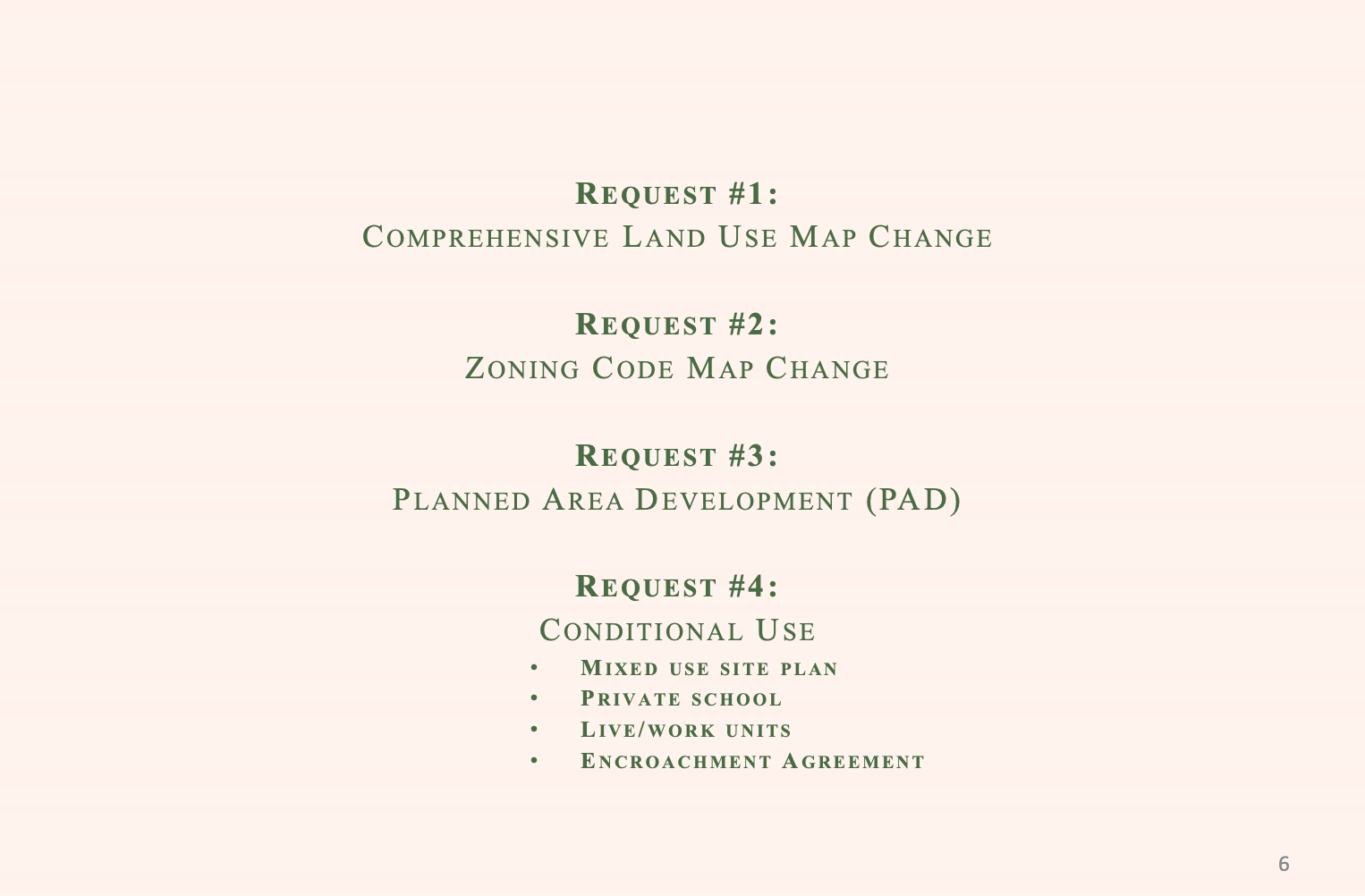
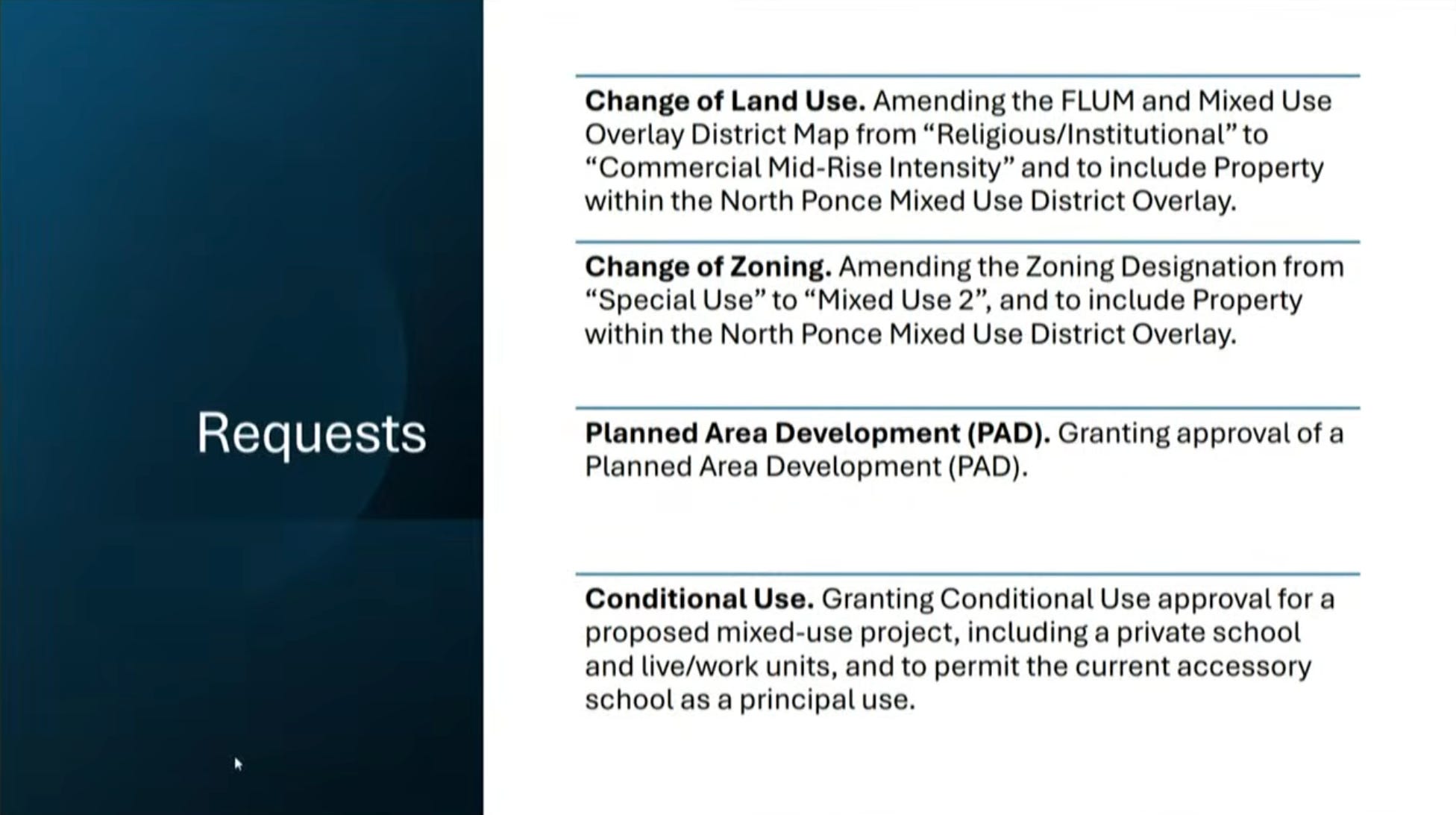
Despite the very clear function of P&Z, opponents expressed opposition to the design during public comments. For historical background, the design of this project was not only approved by the Board of Architects back on October 19th, 2023, it was also re-affirmed by the Board of Architects Special Masters on January 13th, 2026 and the City Commission on February 10th, 2026 as a result of Ms. Bolton’s appeal of the design. The process was appropriately followed, input was provided, and the project design was approved. Regardless of this fact, opponents misused the public comments section of the P&Z meeting to once more express opposition to the project from a design standpoint. In the grand scheme of the issue, this is minute. But it is worth noting as it demonstrates the lack of willingness among the opposition to recognize and respect the process, which has been diligently followed by the applicant:
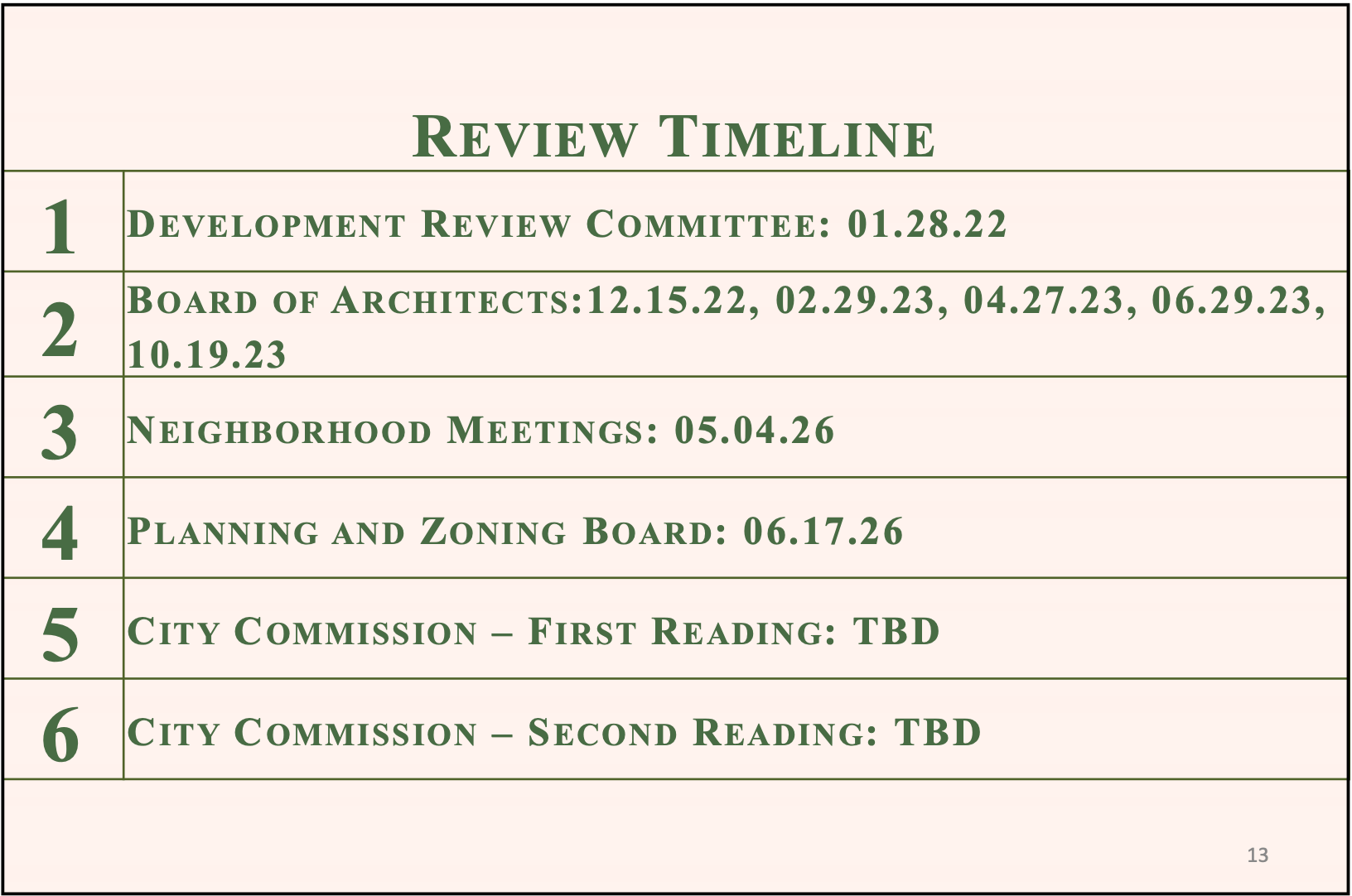
Aside from the Review Timeline, the rest of the Historic Review and Architectural review history as provided during the applicant’s presentation includes every single appeal, petition to circuit court, and conflict resolution meeting, amongst others:
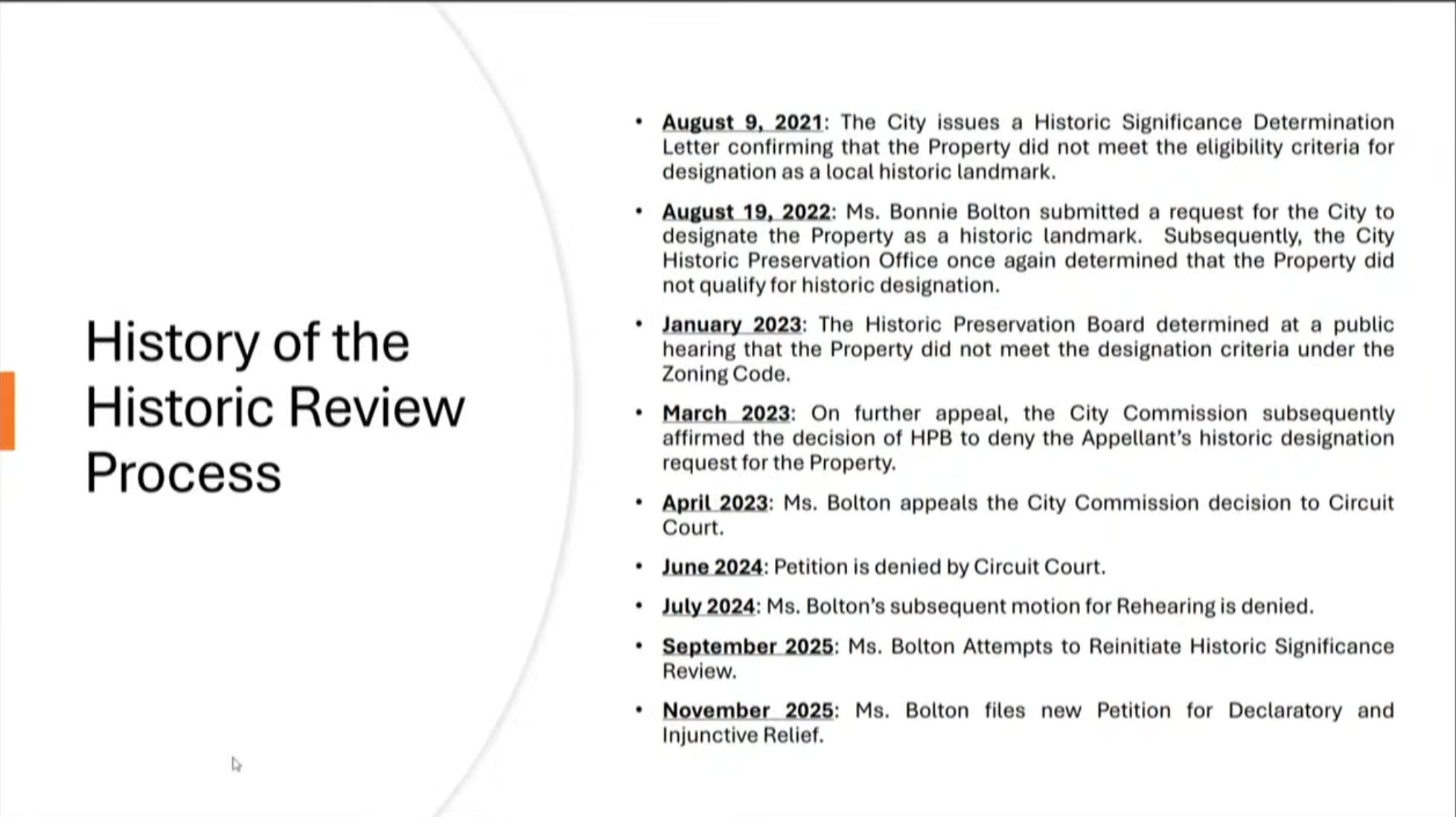
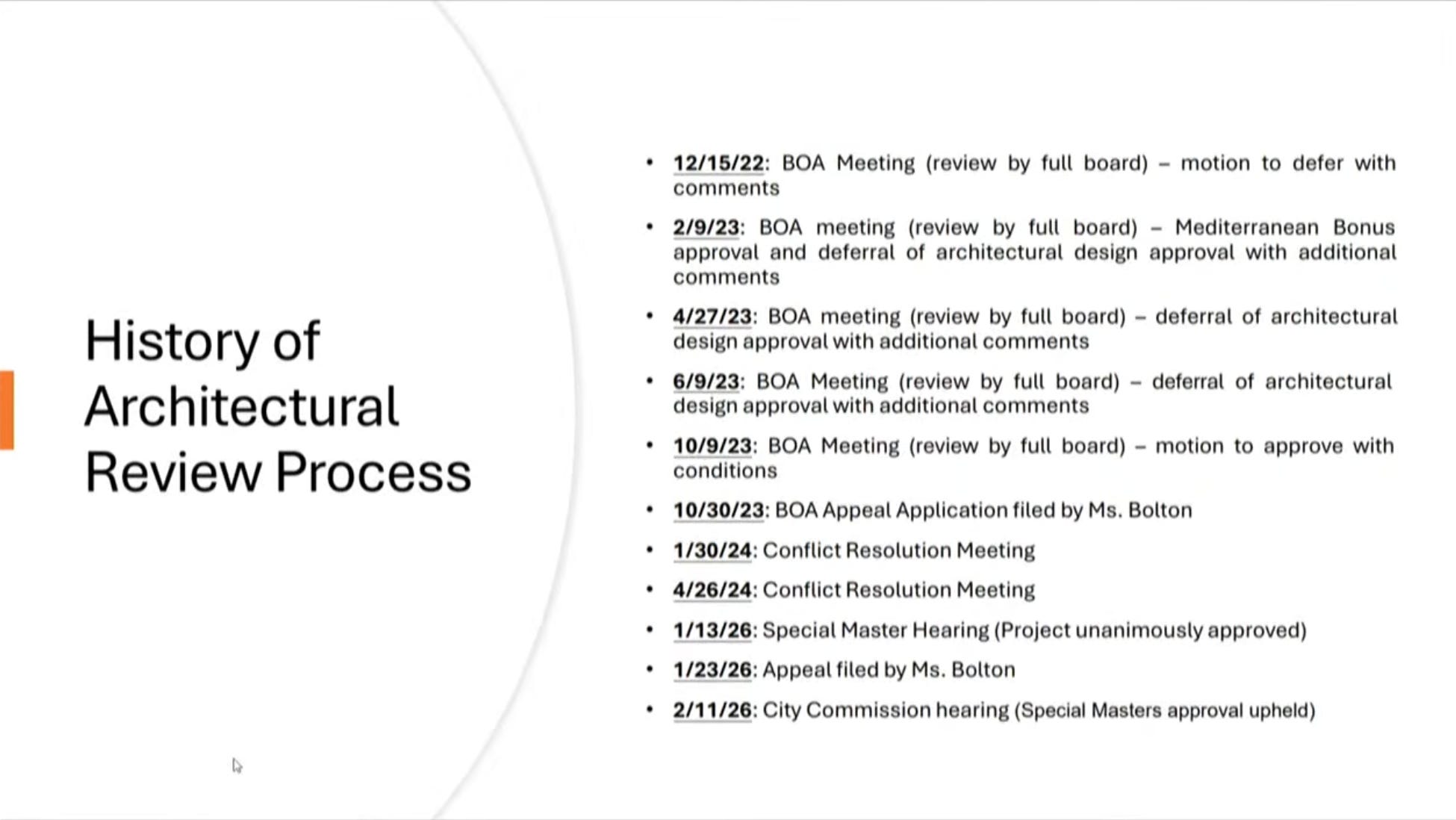
Aside from the clear abuse of the appeal process above and with the full history outlined, let’s turn our attention to the comments made at the P&Z meeting on June 17th. There are three opposition points which require some correction, each of which were brought up by residents during public comments: incompatibility, elimination of green space, and lack of “public benefit.” The project, in all of its aspects, maintains compatibility with all other developments in the surrounding area, provides publicly accessible green space where none currently exists, and provides a comprehensive public benefit. Now, let me make it crystal clear.
Compatibility
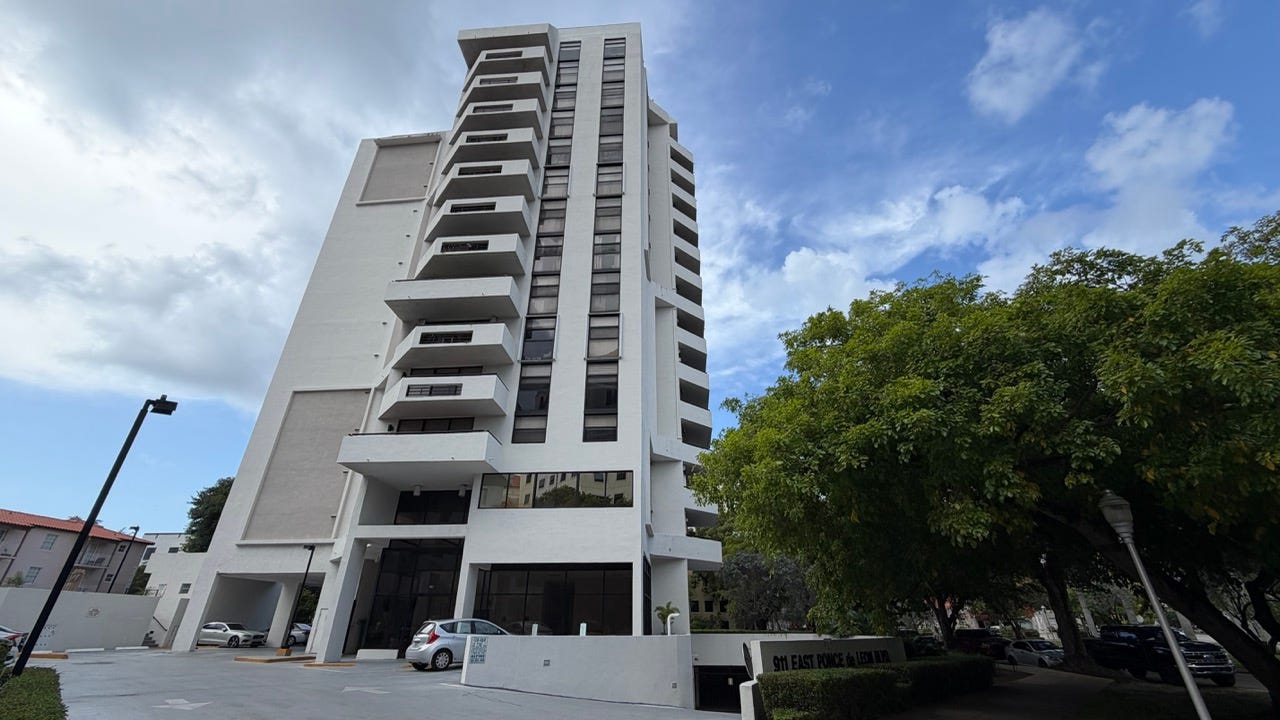
From the Douglas Entrance to the proposed Live Local project at 921 E. Ponce de Leon Blvd to the already existent 1300 Ponce and 911 East Ponce de Leon Blvd buildings, there are multiple examples of development projects in the area that do not fit into the “charming” two, three, and four story apartments style. These developments have already improved the landscape of the neighborhood, providing the appropriate type of density, live-ability, and economic backbone for businesses just steps from their front lobbies like Tinta y Café, Kojin 2.0, and the entirety of downtown Coral Gables. The neighborhood is walkable, accessible, and self-sustaining with a mini-Target, Publix, parks, schools, and office buildings within 5-10 minutes walking distance from any block. An aerial view alone shows how other developments of equal or larger size, many of which I already mentioned above, currently exist or are proposed within the North Ponce neighborhood:
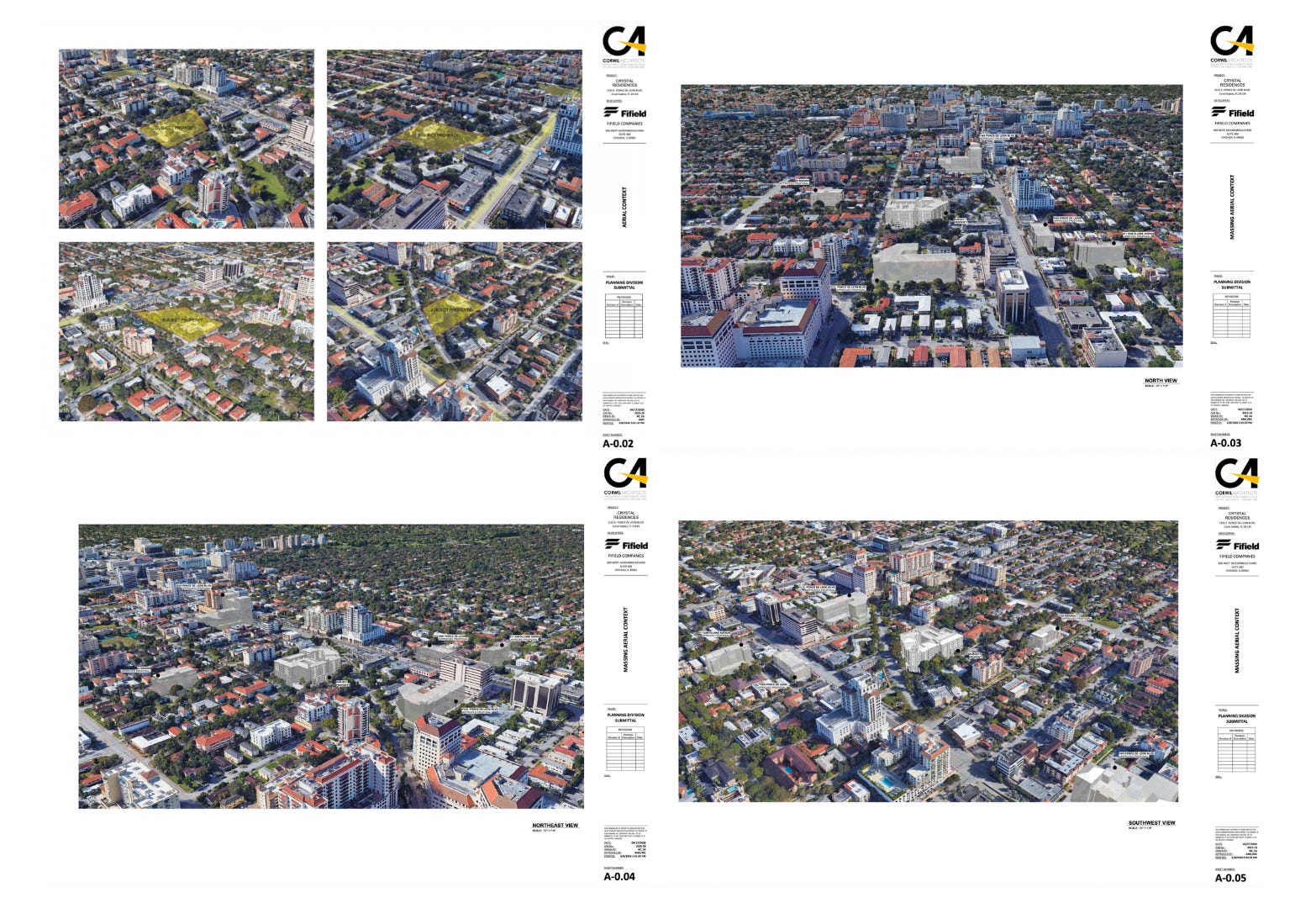
Compatibility is not an issue. The neighborhood has already transformed and the proposed Crystal Residences project fits into the mold of compatible development as defined by existing developments. Additionally, the developers have proposed reasonable heights for the project at 93 feet and nine stories, not exceeding the height of some of the other developments in the neighborhood, including 1300 Ponce at 12-stories. Fifield is not asking for med bonus, they are not building a live local project, and they are keeping their proposal within a reasonable density for a self-sustaining neighborhood.
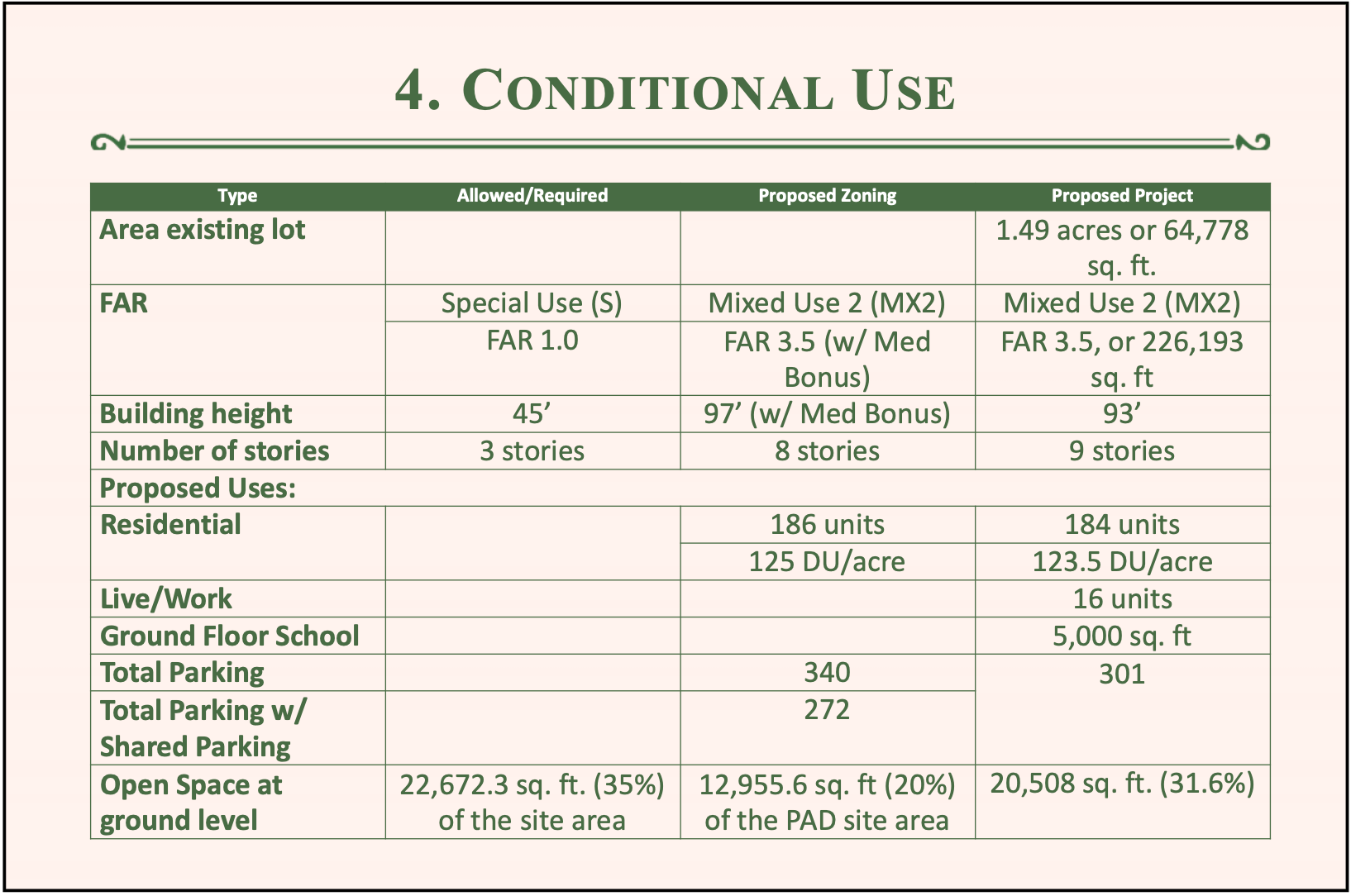
The North Ponce neighborhood located along the northeast quadrant of Coral Gables is the last, most ideal area of the city where this type of development is compatible. No ifs, ands, or buts. There are three reasons for this:
The North Ponce neighborhood has little to no historical significance, aside from the Women’s Club, the carriage house located at the site of MG Developer’s upcoming Alhambra Parc development just south of the Crystal Residences project, a few homes, and little else.
The North Ponce neighborhood is the most accessible area with SW 8th St., Douglas Road, and LeJeune Road as its perimeter and accessible roadways.
The North Ponce neighborhood is also the most transient section of our city with mostly rental apartment buildings and very few single family homes. Most of these two, three, and four story apartment complexes are not well cared for and offer few significant contributions to the architectural style of Coral Gables (they are not mediterranean).
Quick tangent - Keep in mind that just because a couple properties are deemed historically significant does not mean adjacent properties are also historically significant. If my house is historic and my neighbor’s isn’t, that doesn’t prevent my neighbor from tearing down his non-historic home to build a modern one. Same applies here. 110 Phoenetia is not historic, nor is there any historical significance to the Garden of Our Lord. The historic argument has been refuted and does not apply. Now back to our regularly scheduled programming…
This is what is considered “smart” development. The applicant is making a reasonable request. This developer has worked hand in hand with the city to ensure their project is “smart development”. Not development for the sake of development. The process has been followed, the intentions have been made loud and clear. As Mr. Navarro stated during his presentation, this is a mixed-used project (like 1300 Ponce, the Douglas Entrance and Puerta De Palmas) that offers the neighborhood both live-work, commercial, and residential opportunities. They have reviewed existing conditions and have proposed a project that satisfies compatibility appropriately with the surrounding area and adjacent properties.
Green Space
At the very start of public comments, a resident expressed concern regarding the loss of green space in the neighborhood. It is common knowledge that 110 Phoenetia currently enjoys a large green area. However, the green area is used by Crystal Academy and is NOT a publicly accessible green space. Full stop. Unlike the current conditions of the green space, Crystal Residences is proposing approximately 4,000 square feet of publicly accessible green space. That’s green space for Crystal Academy to use, for us to go lay out in the grass, and for our dogs to walk on (please pick up after your K-9 pals.) This is not a condition which currently exists. I can’t jump over the fence and take a leisurely stroll through the school’s playground without trespassing on private property. Not only does the proposed project alleviate this problem, it creates two other publicly accessible areas for the pleasure and use of the residents and neighbors:
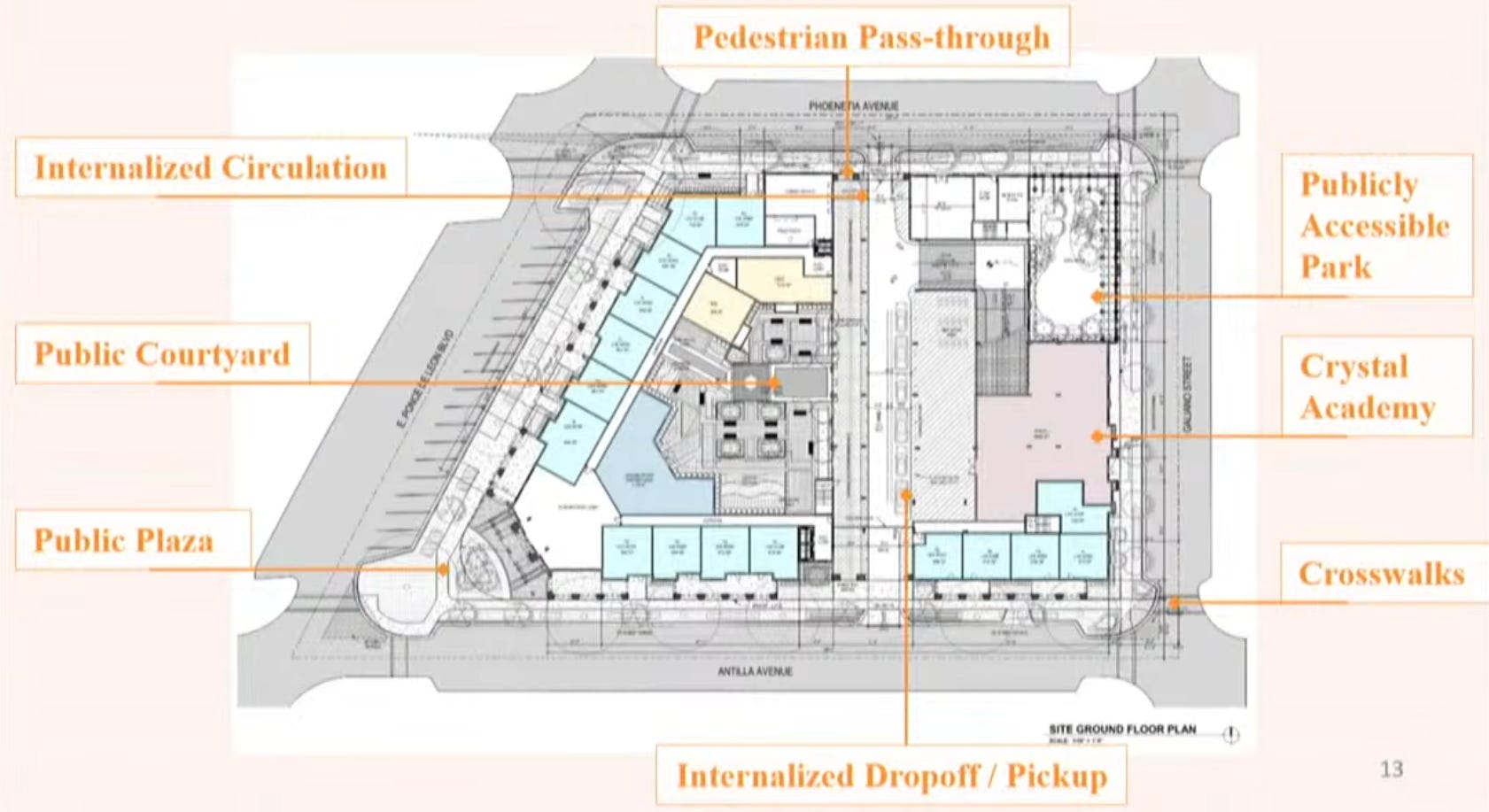
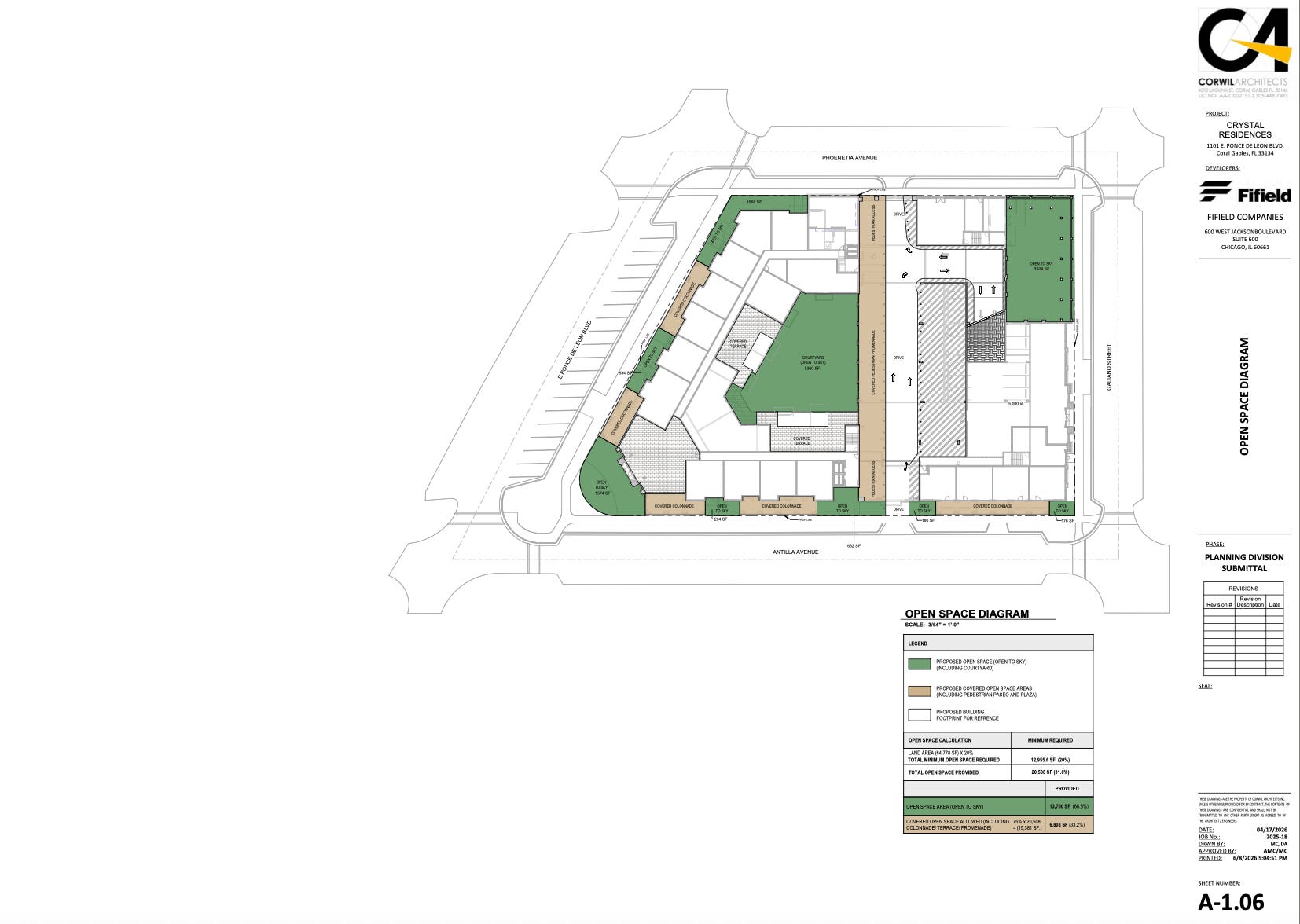
With a courtyard, a plaza, and a park, Crystal Residences is seamlessly integrating itself with the neighborhood and creating a welcoming, walkable, and accessible space. Green space may exist now, but the proposed conditions create a true public benefit.
Public Benefit
A public benefit is not subjective. It is based on criteria which are outlined well in the Staff’s Report, also presented during the June 17th P&Z meeting. The enhanced public benefit provided by Crystal Residences is defined on page 12 and 14 of the report, detailed as follows:
The project, proposed as a Planned Area Development (PAD), will provide public benefits, including enhanced landscaped open space, improved pedestrian circulation and streetscape design, and the coordinated integration of residential and educational uses within a unified site plan. A notable component of the proposal is the retention and enhancement of the existing educational institution, Crystal Academy, which serves as a community resource.
Staff’s Findings: Based upon the Findings of Fact provided herein, Staff finds the Application satisfies the provisions of the Zoning Code for the Planned Area Development (PAD). The proposed PAD is consistent with the applicable review standards, provides a coordinated and context-sensitive site design, and results in public benefits, including enhanced open space, improved pedestrian circulation, and the integration of residential and educational uses.
Those are very specific enhanced public benefits for the neighborhood. A non-profit is a public benefit, a park is a public benefit, a plaza and courtyard are public benefits. Staff even included this detailed outline during their presentation:
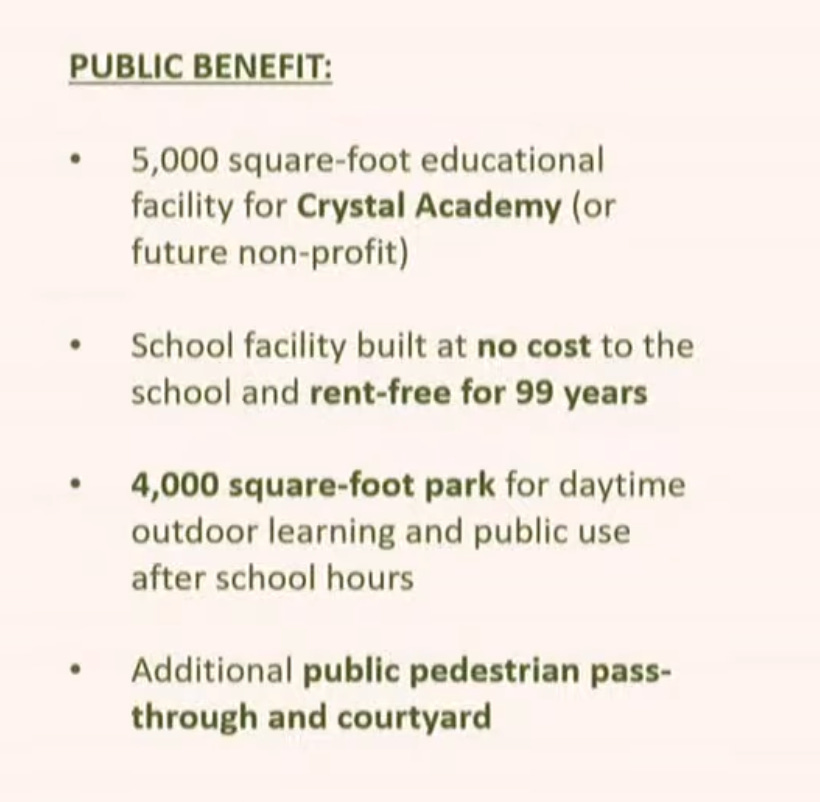
This is an objective analysis from staff on the public benefits provided by Crystal Residences. Staff have the obligation and the responsibility to provide an analysis and findings that have our best interests in mind, not their own. It is based on the real facts of the project. Each of the benefits listed above are an amenity, an infrastructure improvement, or a community advantage provided by Fifield in an effort to offset the impacts of the project. These are conditions which do not currently exist, but when they do come to fruition will serve the broader community and enhance the quality of life of the North Ponce neighborhood. They are substantial public benefits.
Back to Bonnie
There you have it. For every point of opposition, there is a fact to dispute it. Crystal Residences is providing the North Ponce neighborhood with publicly accessible green space, the project is compatible with adjacent properties, and there are significant enhancements to public benefits. Those are the facts. But before I bring this to a close, I need to bring this back to Ms. Bolton. Take a moment to listen to Ms. Bolton’s comments to understand how her efforts manipulate the narrative:
Did you catch that? According to Ms. Bolton, the non-profit Crystal Academy serves a very small segment of the population “that has severe Autism and is very wealthy.” There are two things to point out here. First, 40 students are 40 children with profound autism who need the care, resources, education, life skills, love and attention Crystal Academy provides them. This should NOT be a reason for opposition. Second, the tuition at Crystal Academy ranges from $28,677.30 to $41,293.68 based on a 10-month school year. Here is the full breakdown from the Crystal Academy website:
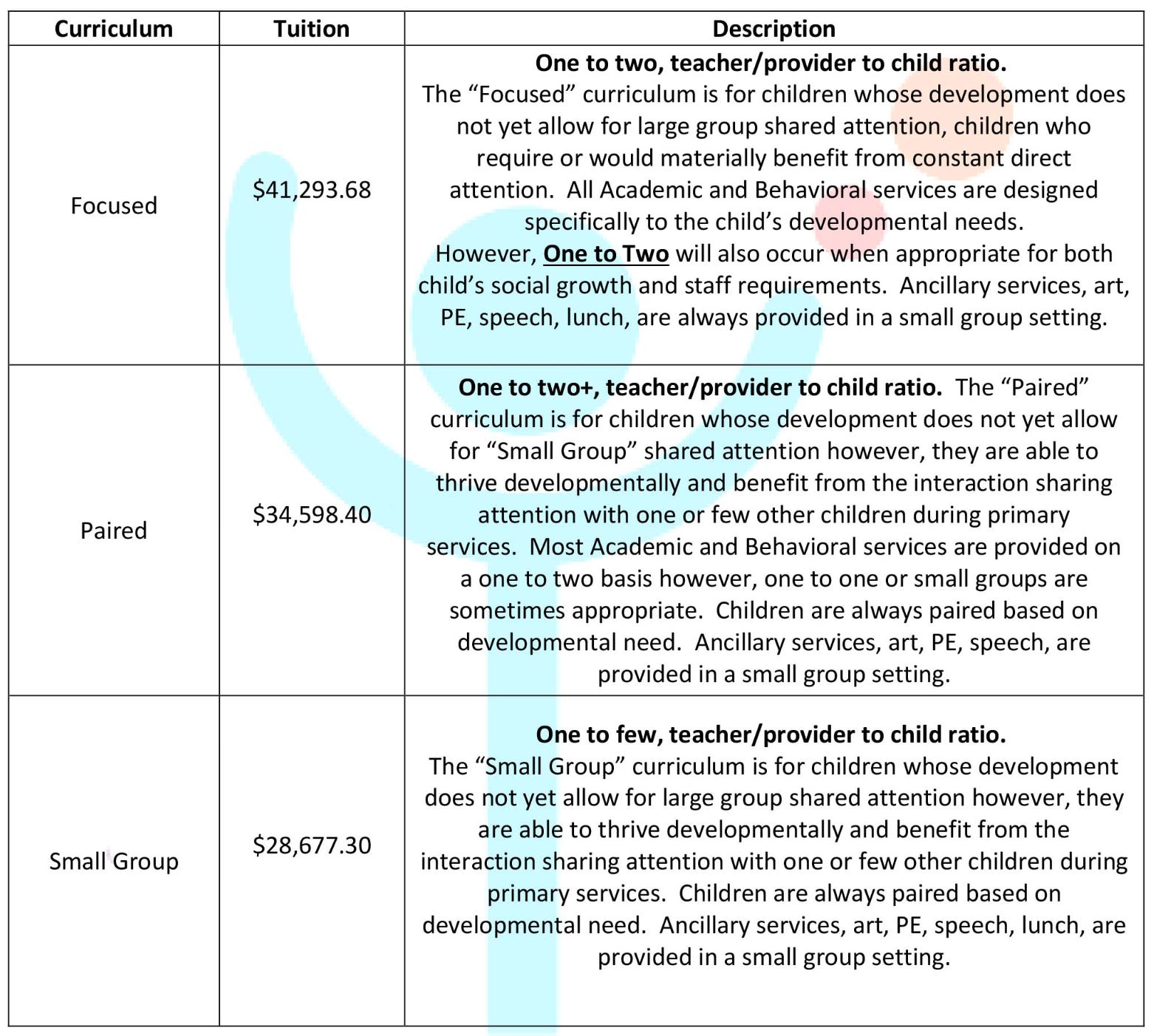
What Bonnie fails to mention is that Crystal Academy accepts insurance and there are a good portion of students who are on Medicaid. I spoke to the principals of Crystal Academy to get some clarity on tuition, staffing costs, and insurance. Through these conversations, I discovered that the average salary for a staff member is approximately $48k per year. This means that a single tuition cost does not cover the full salary of a staff member on average pay. On top of that, Crystal Academy employs two staff members to chase down payments alone, including Medicaid. Factor in facility and maintenance costs, lease costs, technological costs, resource costs, and so on and it’s not hard to understand how little a $41k tuition covers. So no, it is false and misleading to claim that the students are “wealthy” just because of tuition costs. Crystal Academy is not a gold mine and using this misstatement as a justification for opposition renders Ms. Bolton’s argument as misguided and ill-informed. For the children, for the parents who pay the tuition, for teachers and staff, and for the principals of the school, it is outright offensive.
Ms. Bolton also made the claim that the letters submitted in support of the project were primarily sourced from the Little Havana neighborhood. As a reminder, anyone speaking before the Planning & Zoning Board is required to be sworn in, ensuring that their testimony is the truth and nothing but the truth. The same goes for the representative of the applicant, Mr. Navarro, who provided this map of all the letters submitted in support of the project. I’m certain this was Ms. Bolton’s attempt to manipulate the narrative for her own advantage despite her sworn testimony.
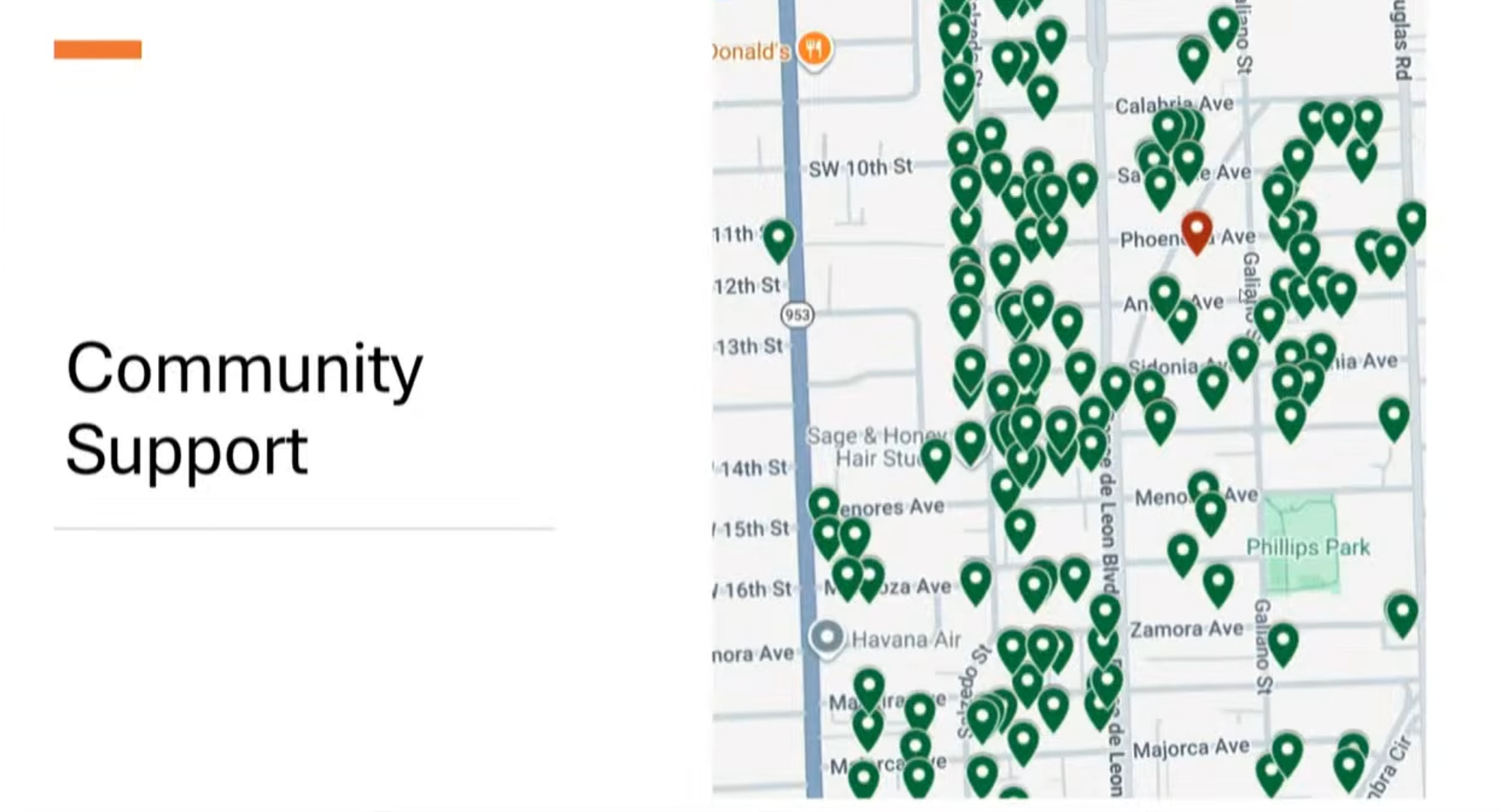
There were over 20 speakers during the public comments section on June 17th. I’m only sharing a recording of Ms. Bolton’s comments because she is at the helm of the opposition. If you wish to go back and watch the approximately four hour long meeting, here’s the link. Because I know facts are important, here is the link to the June 17th meeting from the city’s records. All of my data and screenshots above were sourced from here and from the meeting recording.
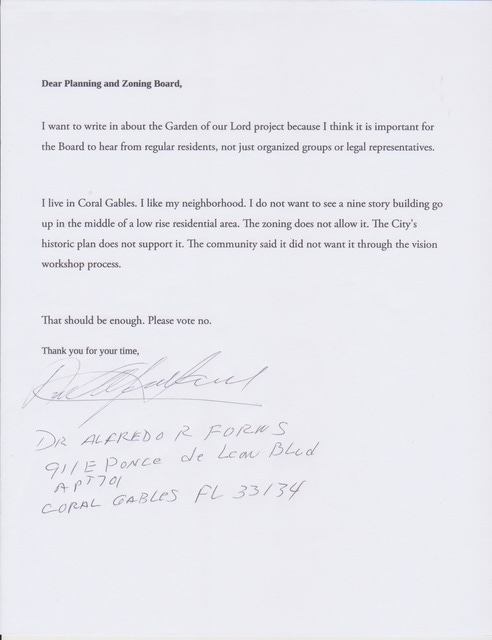
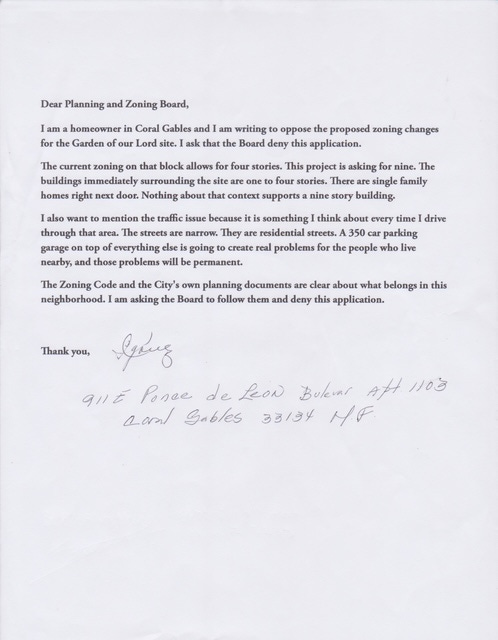
I have friends on both sides of the aisle. I commend each of them for taking a stance on this project, whether in support or in opposition. What I do not value are the false narratives, the targeting of an impactful and important community institution, and the misinformation. Take, for example, the two letters below. Both of these residents submitted the pre-written letters in opposition, including their signatures and addresses handwritten at the bottom. Both residents reside at 911 E. Ponce De Leon Blvd just a block away from the Crystal Residences site. The irony of these two letters is that they both oppose the project for its height, despite their own building being over twelve stories tall. You read that right. They live in a twelve story tall building (that is NOT mediterranean) but they oppose a 9 story building across the street. Oh and one of them also lives on the 11th floor. Makes sense, right?
Crystal Academy does not deserve to be the target of opposition simply because it’s at the core of this project. It’s at the core of this project because the developers are honoring a commitment and an agreement. They are fulfilling their responsibility and obligation to Crystal Academy. They are following the process. They are making themselves accessible and they are working with the community. The Crystal Residences project is going before the Coral Gables City Commission on Tuesday, July 7th. This will be another chance to come out, to speak during public comments, and to follow along. I’ll be there.
I’ll leave you with one last video. These are my own comments at the June 17th meeting. This post is an expansion of those comments, motivated by a need to make things crystal clear.
Comments
Nothing yet. Say the first thing.
Sign in to join the conversation.