
Through my professional background in Safety and Quality, Management Systems, Change Management and Auditing, my management style has evolved into a holistic approach.
One, where learning and decision-making are guided by a combination of factual data, human factors, and the broader context (the system).
In November 2022, I published an article titled The Cost–Benefit of Human Factors in the Royal Aeronautical Society, where I explored a holistic approach that integrates multiple concepts to encourage senior management engagement in safety and quality investments.
Recently, while reading The Fifth Discipline: The Art and Practice of the Learning Organization of Peter M.Senge, I came across Dr. W. Edwards Deming’s System of Profound Knowledge (SoPK), which further reinforced my perspective on combining data, human factors, and systems thinking.
Dr. W. Edwards Deming (1900-1993) was an important consultant that developed the concept of the Total Quality Management (TQM) with the strong believe that Quality was not only about meeting product or process requirements but exceeding customer expectations with a continuous improvement mindset and employee involvement.
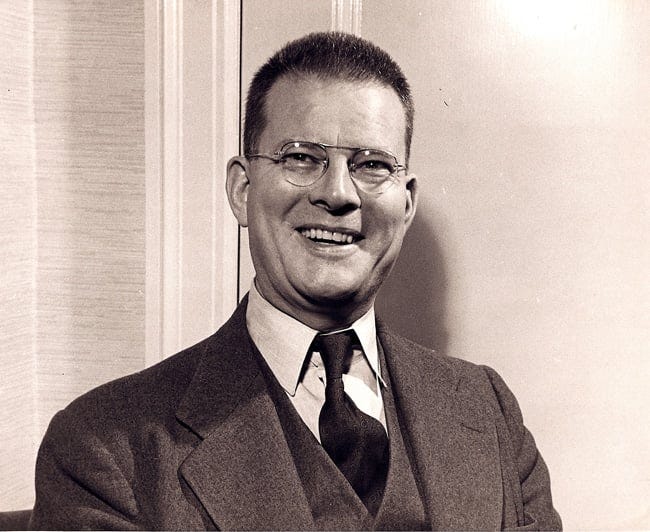
Source: https://deming.org
He had a strong influence on Quality Management as we understand it today, and he profoundly believed in and advocated for the System of Profound Knowledge (SoPK) as a holistic approach to managing organizations considering interconnected systems rather than treating them in isolation.
In his words:
The “System of Profound Knowledge” provides a map of theory by which to understand the organizations that we work in.
Deming, W. Edwards. (2018). The New Economics for Industry, Government, Education – 3rd Edition. Kindle Edition. MIT Press.
This idea is as relevant today as it was when Deming first wrote about it.
Over the next few weeks, I’ll take you on a six-part journey into the four core elements of the SoPK, and how they can help leaders think differently about management and improvement.
Here’s what I’ll explore:
Why the System of Profound Knowledge matters
Knowledge of Variation
Appreciation for a System
Theory of Knowledge
Psychology
How SoPK helps leaders think differently about management and improvement
In this first article of the 6-part mini-series, I’ll start with the foundation:
Defining the System of Profound Knowledge (SoPK)
An introduction to its four elements
Let’s dive in! 🤿
The SoPK is a framework that is made up of four interrelated components.
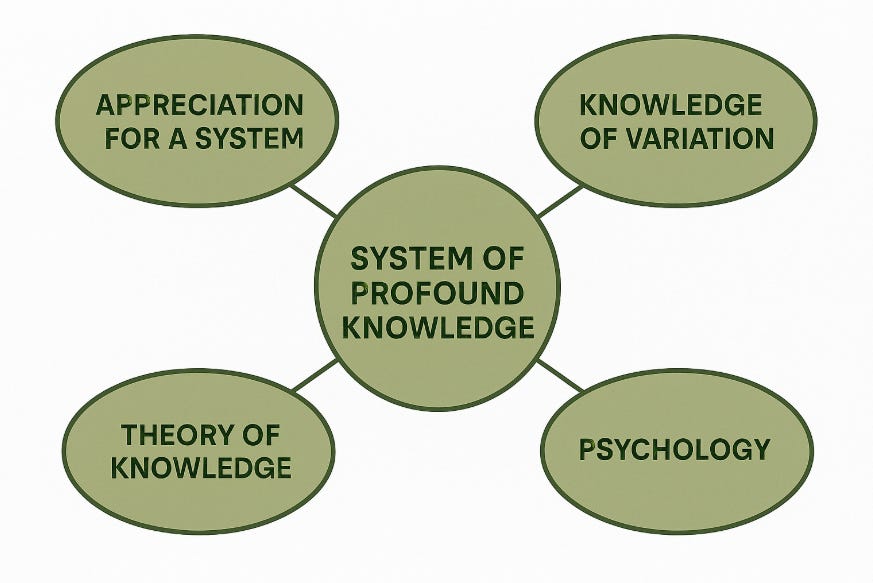
It primarily aims to:
help leaders better understand, improve, and transform organizations.
shift from reactive, short-term fixes to a holistic, long-term approach.
balances data, human factors, and systems thinking.
Knowledge of Variation: distinguishing between normal process variation and unusual causes.
Appreciation for a System: seeing the organization as an interconnected whole.
Theory of Knowledge: basing decisions on evidence, learning, and understanding principles.
Psychology: understanding human behaviour and creating an environment where people thrive.
Leading with awareness means seeing systems, variation, knowledge, and psychology as one. This integrated view helps us act with intention, shaping change that lasts.
In the next article, I will explore the first element: Knowledge of Variation.
See you next week. 👋
Senge, P. M. (2006). The Fifth Discipline: The Art and Practice of the Learning Organization (Rev. and updated ed.). Random House.
Chartered Quality Institute. Applying Deming’s System of Profound Knowledge. Retrieved from https://www.quality.org/knowledge/applying-deming-system-profound-knowledge
School Performance Institute. What Is the System of Profound Knowledge?. Retrieved from https://www.schoolperformanceinstitute.org/blog/2022/6/29/what-is-the-system-of-profound-knowledge
The Deming Institute. (n.d.). Retrieved August 16, 2025, from https://deming.org
Disclaimer: The information provided in this newsletter and related resources is intended for informational and educational purposes only. It reflects both researched facts and my personal views. It does not constitute professional advice. Any actions taken based on the content of this newsletter are at the reader's discretion.
No posts
Comments
Nothing yet. Say the first thing.
Sign in to join the conversation.