
WTI posts weekly gain on tariffs and aggressive Iran policy.
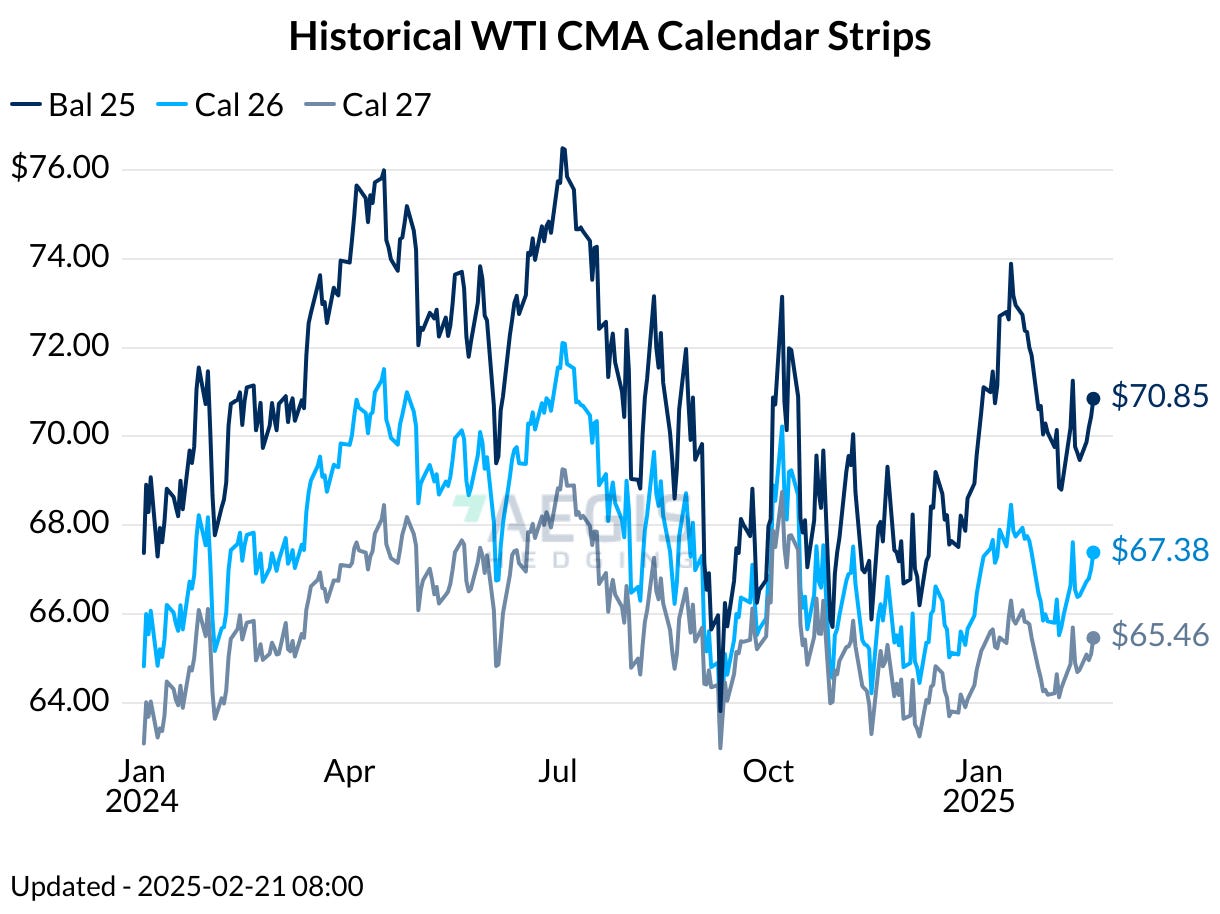
WTI prompt prices fell 0.8% on Friday, settling at $70.74/Bbl. Despite the drop, oil prices still added roughly 1% on the week and ended its three consecutive week slide.
President Trump and Russian President Vladimir Putin agreed to initiate peace talks to end the war in Ukraine. The announcement sent WTI below $72 a barrel, a more than 2% drop. A proposed peace plan could potentially include sanctions relief on Russian energy. The US imposed strict measures on 183 Russian ships on January 10, and 94 of those targeted now remain idle since the restrictions went into place. The peace talks serve as a bearish signal as disruptions to Russian oils flows could end.
Concerns over potential trade wars continue as Trump introduces reciprocal tariffs. These tariffs will be levied on countries deemed unfairly charging the US, and no details were specified on which industries would be the focus. Trump’s non-diplomatic approach injects volatility into the prospects of global demand growth. There is a tentative plan to introduce the reciprocal tariffs by April 1.
Friday morning, oil markets reacted negatively after US Treasury Secretary Scott Bessent reiterated Washington’s commitment to reducing Iran’s oil exports. According to Bessent, the Trump administration hopes to cut Iran’s oil exports to 100 MBbl/d. Despite some anxiety over disruptions to Iran’s 3.3 MMBbl/d crude production, the market still looks for proof of potential disruptions as the Islamic Republic has become quite adept at skirting US sanctions by virtue of their “dark fleet.”
AEGIS holds a neutral view on prices as oil prices hover near $70/Bbl. Given the fundamentals and wildcard like Trump’s
Cold weather lifts prices, while LNG feedgas reaches a record high.
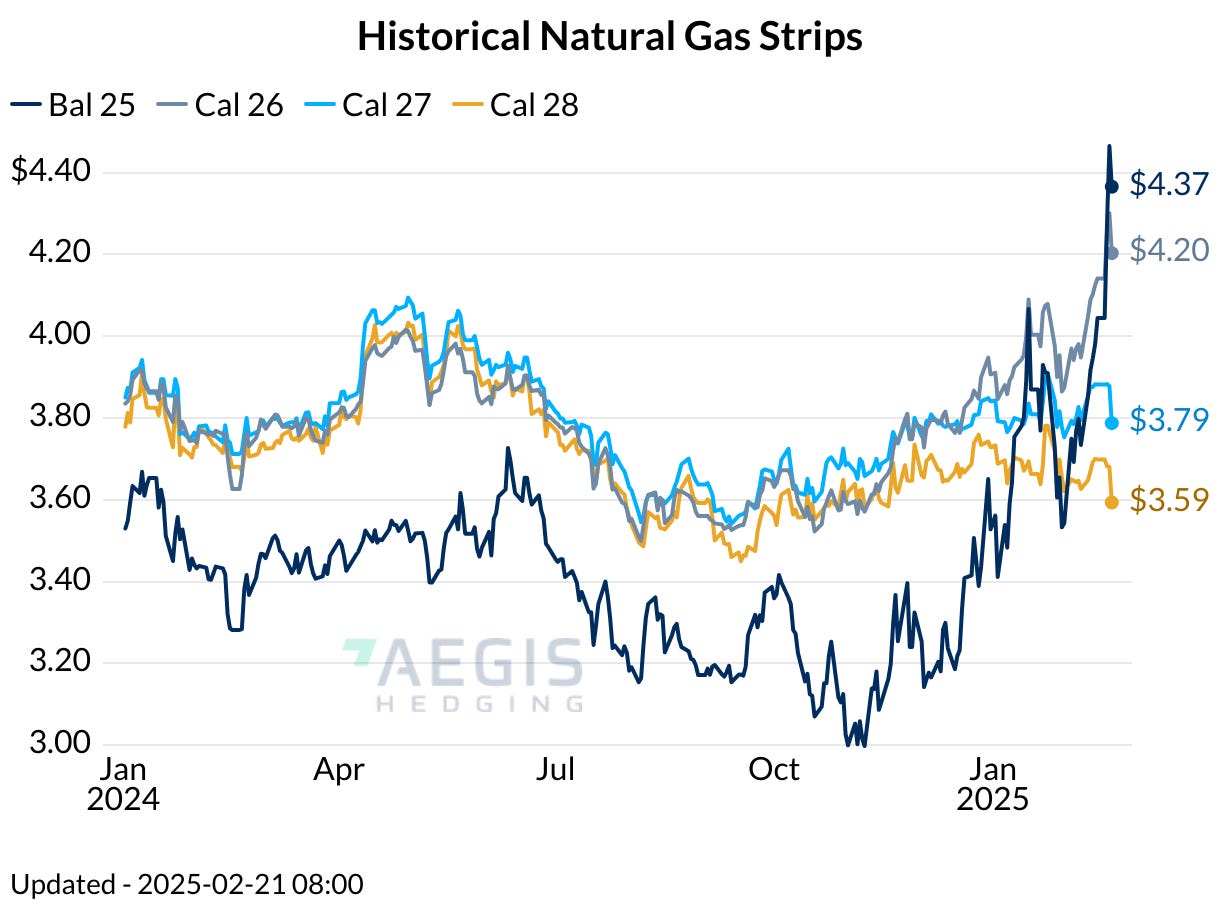
The March Henry Hub contract advanced more than 40c to settle at $3.74/MMbtu, as prices have pushed back toward recent highs. February weather forecasts reversed over the past couple of weeks and now shows February as one of the coldest of the past 25 years. Meanwhile, gas flows to LNG facilities reached a new high as Plaquemines LNG continues to ramp up.
Following one of the coldest Januarys of the past 25 years, forecasts for February originally showed normal to below-normal temperatures, leading prices to fall from last month's peak. However, forecasts began to shift cooler and continued to do so this week, leading to expectations of more above-average storage withdrawals. February is now expected to be one of the top three coldest of the past 25 years, and next week could be the second coldest week of this winter. This should result in a sizeable storage withdrawal of 200+ Bcf. Our estimate for the amount of gas remaining in storage at the end of winter has fallen to 1.76 Tcf or 140 Bcf, below the five-year average.
While price action has mostly been driven by weather, LNG feedgas demand has reached a new high, helping to tighten the market further. Total US LNG feedgas demand hit 15.99 Bcf/d, as Plaquemines LNG continued to see higher inflows, reaching 1.4 Bcf/d. Total LNG capacity is a bit more than 16 Bcf/d, with every facility operating near maximum levels right now, except for Calcasieu Pass, where flows have been reduced by about 0.5 Bcf/d for the past few months. By the end of 2025, LNG demand should reach more than 17 Bcf/d as Corpus Christi Stage 3 begins taking gas and Golden Pass LNG moves toward commencing operations.
AEGIS continues to recommend clients add hedges on weather-driven price jumps and take advantage of elevated call-skew in winter months.
Past performance is not necessarily indicative of future results. There is no guarantee that hedge program objectives will be achieved. For additional information, please visit www.aegis-hedging.com.
No posts
Comments
Nothing yet. Say the first thing.
Sign in to join the conversation.