
Wire Laser Additive Manufacturing (WLAM) is an advanced Directed Energy Deposition (DED)–based metal additive manufacturing technology that uses metal wire as feedstock and a high-power laser as the heat source. The laser selectively melts the wire and substrate, depositing material layer by layer to produce near-net-shape metal components with excellent structural integrity.
Unlike powder-based systems, WLAM offers:
Higher material utilization
Cleaner processing (no powder handling)
Superior control over deposition efficiency
Enhanced mechanical performance
WLAM is increasingly adopted for large-scale, high-value metal components where strength, reliability, and customization are critical.
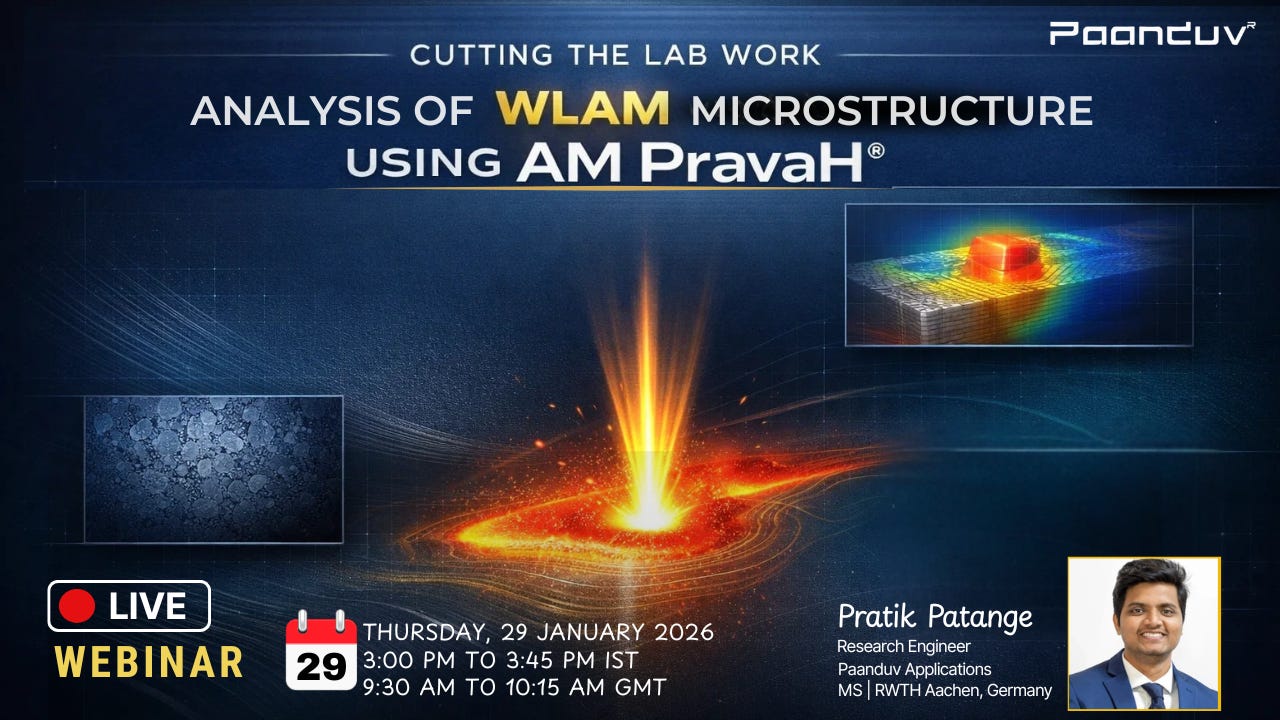
Join our technical webinar to explore how physics-based simulation can help analyze WLAM microstructure and significantly reduce dependency on time-consuming lab experiments.
📌 Register now:
How WLAM Works – Basic Understanding
In the WLAM process:
A continuous metal wire is fed into a laser-induced melt pool
A high-energy laser melts the wire and a small region of the substrate
Molten metal solidifies rapidly, forming a metallurgical bond
Successive tracks and layers are deposited to build the final geometry
Precise control of:
Laser power
Wire feed rate
Deposition angle
Travel speed
Thermal gradients
is essential to achieve consistent bead morphology and defect-free builds.
Thanks for reading! Subscribe for free to receive new posts and support my work
Metallurgical Advantages of WLAM
The laser-induced wire melting mechanism enables controlled thermal conditions, resulting in:
Fine microstructural development
Reduced porosity and inclusions
Minimal lack-of-fusion defects
Improved grain refinement
As a result, WLAM-produced components exhibit:
High tensile strength
Superior fatigue life
Increased hardness
Excellent structural integrity
Compared to traditional manufacturing and powder-based AM, WLAM significantly reduces common metallurgical weaknesses.
Industrial Applications of WLAM
Automotive Industry
Large engine blocks
Transmission housings
Brake discs
Structural chassis components
Tooling dies and molds
Aerospace & Defense
Turbine casings
Wing spars
Landing gear components
Rocket nozzles
Structural panels
Healthcare & Medical
Customized orthopedic implants
Large joint replacements
Prosthetic components
Rehabilitation aids
Surgical tooling
WLAM is particularly valuable where large part size, customization, and mechanical reliability are essential.
WLAM Simulation with AM PravaH® by Paanduv Application Software
To fully exploit the potential of WLAM, accurate process modeling and simulation are essential.
This is where AM PravaH®, developed by Paanduv Application Software, plays a transformative role.
WLAM Module of AM PravaH®
The WLAM Module in AM PravaH® enables detailed, physics-based simulations of the wire laser directed energy deposition process, with a strong focus on:
Melt pool dynamics
Bead morphology
Thermal behavior
Metal transfer modes
This allows engineers and researchers to predict, analyze, and optimize WLAM processes before physical trials.
Why Model WLAM Using AM PravaH®?
Accelerating Material Innovation
Rapid evaluation of new alloys and wire materials
Reduced trial-and-error experimentation
Defect Mitigation
Predicts non-uniform deposition
Identifies lack-of-fusion regions
Controls excessive heat accumulation
Process Optimization
Optimizes laser power, wire feed rate, and travel speed
Analyzes molten metal transfer modes:
Globular transfer
Liquid bridge transfer
Unstable transfer
Cost & Resource Reduction
Minimizes experimental cost
Reduces material wastage
Shortens development cycles
Key Software Features of AM PravaH® WLAM Module
Accurate wire movement simulation reflecting real process conditions
Molten metal deposition modeling with:
Variable wire feed angles
Adjustable feed rates
Dynamic laser power
Controllable laser spot diameter
Multitrack and multilayer deposition simulation for metal alloys
Alloy- and process-specific optimized numerical settings
AI-based learning models for rapid prediction and decision-making
Physics Captured in AM PravaH® WLAM Simulation
AM PravaH® incorporates advanced multiphysics models to ensure high-fidelity simulation:
4-phase multiphase modeling, including:
Solid metal
Liquid melt pool
Vapor phase
Shielding gas interactions
Temperature-dependent material properties to capture:
Marangoni convection
Phase transformation and solidification
Laser–material interaction modeling:
Multiple reflections
Absorption based on material and laser type
Accurate prediction of:
Liquid bridge transfer
Droplet transfer
Final bead shape and morphology
Conclusion
Wire Laser Additive Manufacturing (WLAM) represents a next-generation metal AM technology capable of producing high-performance, large-scale components with superior mechanical properties.
With the WLAM Module of AM PravaH®, Paanduv Application Software empowers manufacturers, researchers, and engineers to:
Understand WLAM physics deeply
Optimize process parameters confidently
Reduce development risk and cost
Accelerate innovation in metal additive manufacturing
AM PravaH® bridges the gap between simulation and real-world WLAM production, making it a powerful enabler for the future of advanced manufacturing.
Comments
Nothing yet. Say the first thing.
Sign in to join the conversation.