
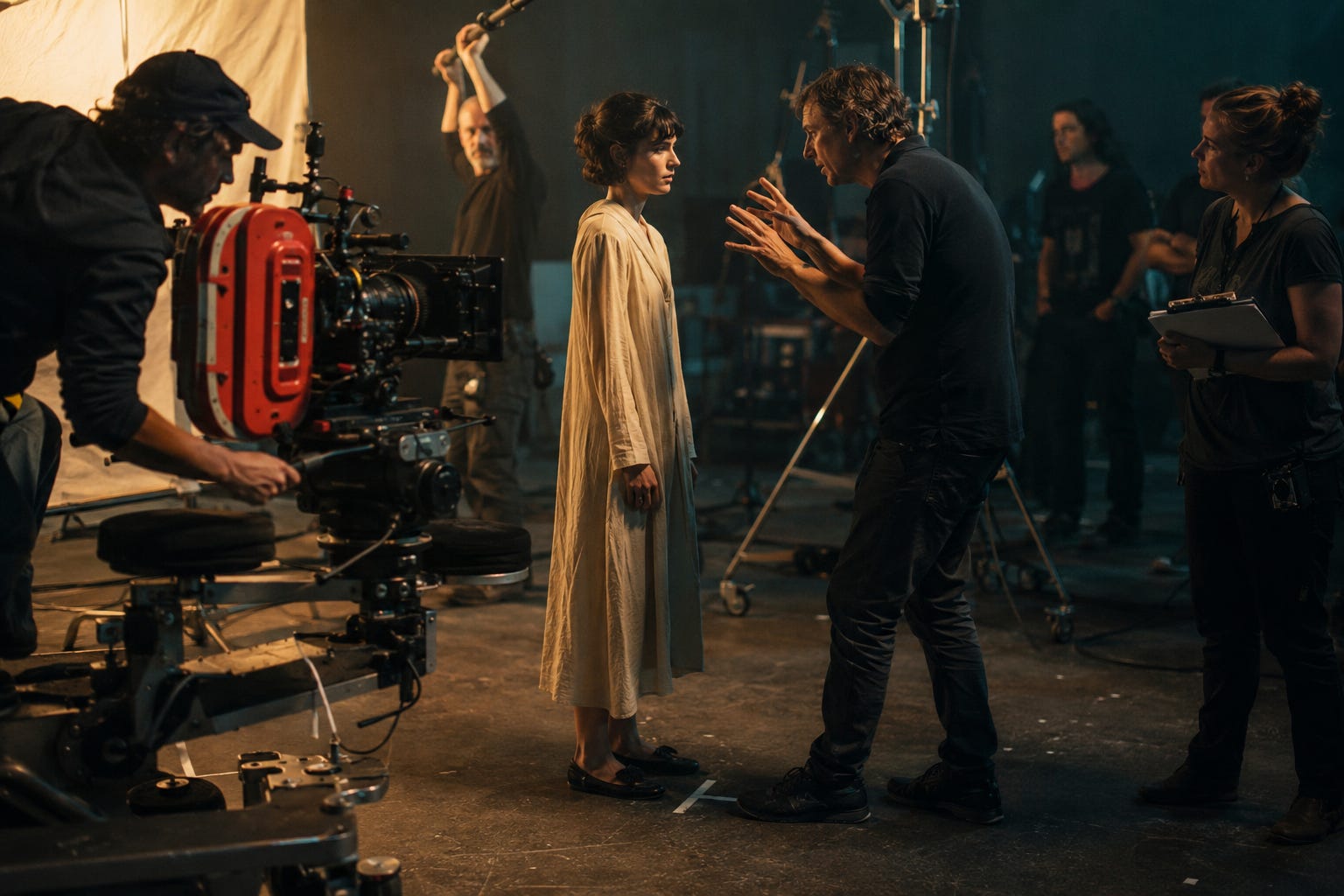
Three seconds. That’s roughly how long you have between “cut” and the AD calling “back to one” before the director, the agency creative, and the client are huddled at the monitor whispering about your last take. Whatever they decide, you’ll get a sentence — maybe a fragment — and you’ll be expected to fold it into the next take without flattening everything that worked.
Taking direction between takes on camera is its own skill set, separate from auditioning, separate from theater, separate from the work you did in your living room with the sides. I’ve blown takes by overcorrecting. I’ve watched scene partners freeze after a single agency note. Then I figured out the patterns, and now I coach actors through them. This is the practical playbook — the shorthand, the resets, and the on-camera technical layer that makes adjustments stick.
Thanks for reading Advice For Actors! Subscribe for free to receive new posts and support my work.
The Quick Version
Director shorthand is a code, not a critique. Phrases like “less,” “find the button,” and “do it again but different” each ask for a specific mechanical change.
Adjust one variable at a time so you keep what was working and only shift what was asked for.
Reset the body before the emotion — breath, jaw, eyeline, then re-enter the moment.
Frame size dictates performance size. A close-up wants thought; a wide wants action.
On commercial and industrial sets, the note often isn’t from the director. Learn to read the room behind the monitor.
Decoding What Directors and Agency Creatives Actually Mean
Most notes between takes are compressed. The director isn’t being vague to torture you — they’re trying to keep the day moving while twelve people watch. Here’s the translation key I wish someone had handed me at 24:
“More energy” 🎬 Pick up the pace, raise your stakes, or sharpen the consonants — not “yell louder.”
“Take it down” 🎬 Bring it closer to conversation; the lens is doing the work.
“Less” 🎬 The thought is reading, but the face is doing too much.
“Find the button” 🎬 Land the end of the line with intention — give the editor a clean out.
“Pick up your cues” 🎬 Reduce the air between your partner’s last word and your first.
“Do it again but different” 🎬 They’re covering options; don’t repeat, don’t reinvent — vary one color.
“Make it your own” 🎬 They’ve stopped giving notes because they trust you, or they’ve given up — read the room.
“One more for safety” 🎬 The take was good; don’t change anything, just match it.
The “do it again but different” trap. Newer actors hear this and throw out the whole performance. Veterans change one thing — the rhythm, the focus of one line, the physical attitude in the body. The director is shopping in the edit. Give them adjacent options, not a different store.
The note is almost never about acting more. It’s about acting less, or acting on a different beat.
Adjusting Without Losing What Worked
The biggest mistake I see, and the one I made constantly when I started booking commercials, is treating every note like a full rebuild. You did something right — that’s why they’re refining instead of recasting. Hold onto it.
The one-variable rule. When you get a note, identify the single element it’s asking you to change. Speed? Volume? Internal stakes? Eye behavior? Change that one thing and protect everything else. If the director says “take it down,” don’t also speed up, don’t also soften your eyes, don’t also shift your weight. Just dial the dimmer on intensity.
Anchor lines. I pick one or two lines in the copy or scene that I know are working and mentally label them as anchors. Whatever the note is, those anchors stay. It gives me a spine to hang the adjustment on, so I don’t drift into a totally new performance and lose the cuts they already shot.
The “yes, and” reply. When a director gives me a note, I say some version of “got it,” and if I need one beat of clarification, I ask a single concrete question. Not “what’s my motivation now?” but “do you want that on the second line or throughout?” Specificity protects you. It also signals you’re a pro who can absorb fast.
Resetting Emotionally Between Takes — Fast
On a film set you might get two minutes between takes. On a commercial with thirty setups in a day, you might get twenty seconds. The reset has to be portable. Here’s the routine I use and teach:
Exhale fully. Not a deep breath in — a deep breath out. It drops the shoulders and resets the nervous system faster.
Soften the jaw and tongue. Tension lives there first, and the camera reads it as effort.
Re-find the eyeline. Whether it’s a mark on the lens, a tennis ball, or your scene partner’s left pupil, touch it with your eyes before the roll.
Re-enter one beat early. Don’t start at the first line. Start with the thought that made you say the first line.
Let the note in last. The adjustment is the final layer, not the foundation. Build the performance, then tilt it.
The actors I coach who struggle with this usually try to think their way through the reset. The body is faster than the brain on set. Train the physical sequence and the emotional reset rides along.

The On-Camera Technical Layer Nobody Warns You About
Taking direction on camera means the note isn’t only about emotion — it’s often about geometry. Your performance lives inside a frame, on a mark, with continuity from the last setup. Miss any of that and the best acting in the world doesn’t make the edit.
Frame size changes everything.
Wide shot: Your whole body is acting. Gesture lives. Bigger physical choices read.
Medium / cowboy: Hands and torso matter. Watch where your gestures break the bottom of frame.
Medium close-up: Thought is doing most of the work. Gestures become punctuation, not paragraphs.
Close-up: The eyes are the scene. A flicker of thought reads like a monologue. Anything bigger looks like mugging.
Extreme close-up: Even blinking is a choice. Stillness is not nothing — it’s everything.
When a director says “less,” check the frame first. If they just pushed in to a close-up and you’re still playing the medium, that’s the note. They’re not asking for a smaller performance — they’re asking for a performance that fits the lens.
Hitting marks without acting like you’re hitting them. Find your mark with your feet during rehearsal, then forget it exists. Use peripheral cues — the edge of an apple box, the seam in the floor, the leg of a C-stand. If you’re looking down for your mark in the take, you’re not in the scene.
Eyelines. If the reader is off-camera left and the director moves them to right of lens for the close-up, your whole inner geography flips. Take a second before the roll to re-map where your scene partner “lives” in space. Mismatched eyelines are the number one continuity flag that gets a take killed.
Matching for continuity. If you crossed your arms on “I don’t know” in the master, you cross them on “I don’t know” in the close-up. Script supervisors are your friends — when they give you a note about a gesture or a prop position, that’s not pickiness, it’s saving your scene from the cutting-room floor.
The Client and Agency Dynamic on Commercials and Industrials
Here’s where commercial and industrial work diverges hard from film and TV. On a narrative set, notes flow from the director. On a commercial, notes might come from the director, the agency creative director, the agency copywriter, the client’s brand manager, and occasionally the client’s boss who flew in for the day.
What you actually see: the director walks over after a sidebar at video village and gives you a note that sounds like it was written by a committee. Because it was. How to handle it:
Take every note from the director, even when you can tell it started at the client tent. The director is your single channel. Don’t try to manage the room behind them.
Watch for the “smile with the eyes” note. This is agency code for “the product moment isn’t landing warmly enough.” It almost always means soften the face and slow down the hero beat with the product.
“Can we get one more, just a little more natural?” translates to “the client thinks you look like you’re acting.” Drop the performance level a full notch and trust the lens.
Don’t argue, even when the notes contradict. If they say faster, you go faster. If five minutes later they say slower, you go slower. The edit will sort it out. Your job is to give them coverage.
I once did an industrial for a medical device company where I got the note “more authoritative, but also more approachable, but also more like a friend, but also like a doctor.” I nodded, did one take leaning authoritative, one leaning warm, and one down the middle. They used the middle one. Sometimes the smartest direction-taking is delivering options without trying to reconcile the unreconcilable.
A Reset Routine You Can Run in 20 Seconds
Tape this inside your sides if you have to. Between “cut” and “back to one”:
✅ One long exhale.
✅ Hear the note — repeat it back internally in five words or fewer.
✅ Pick the one variable to change.
✅ Re-find your eyeline and mark.
✅ Recall the thought before line one.
✅ Let the adjustment ride on top — don’t lead with it.
That’s it. Six beats. You can run it while wardrobe checks your collar and the DP tweaks a light.
The Actors Who Book Again Are the Ones Who Adjust Cleanly
Taking direction between takes is, at the end of the day, a craft of listening with your whole body and adjusting without panic. Directors rebook actors who make their day easier. ADs whisper to casting directors about who was quick on set. The agency producer remembers who absorbed the client note at hour eleven without ego. Every reset you handle well is an audition for your next job.
Start small this week: next time you self-tape, give yourself a fake note between takes — “less,” “find the button,” “pick up your cues” — and practice changing only one variable. Build the muscle before you need it on a closed set with the meter running.
What’s the hardest direction you’ve ever been given on camera, and how did you handle it in the moment?
Thanks for reading Advice For Actors! Subscribe for free to receive new posts and support my work.
Comments
Nothing yet. Say the first thing.
Sign in to join the conversation.