
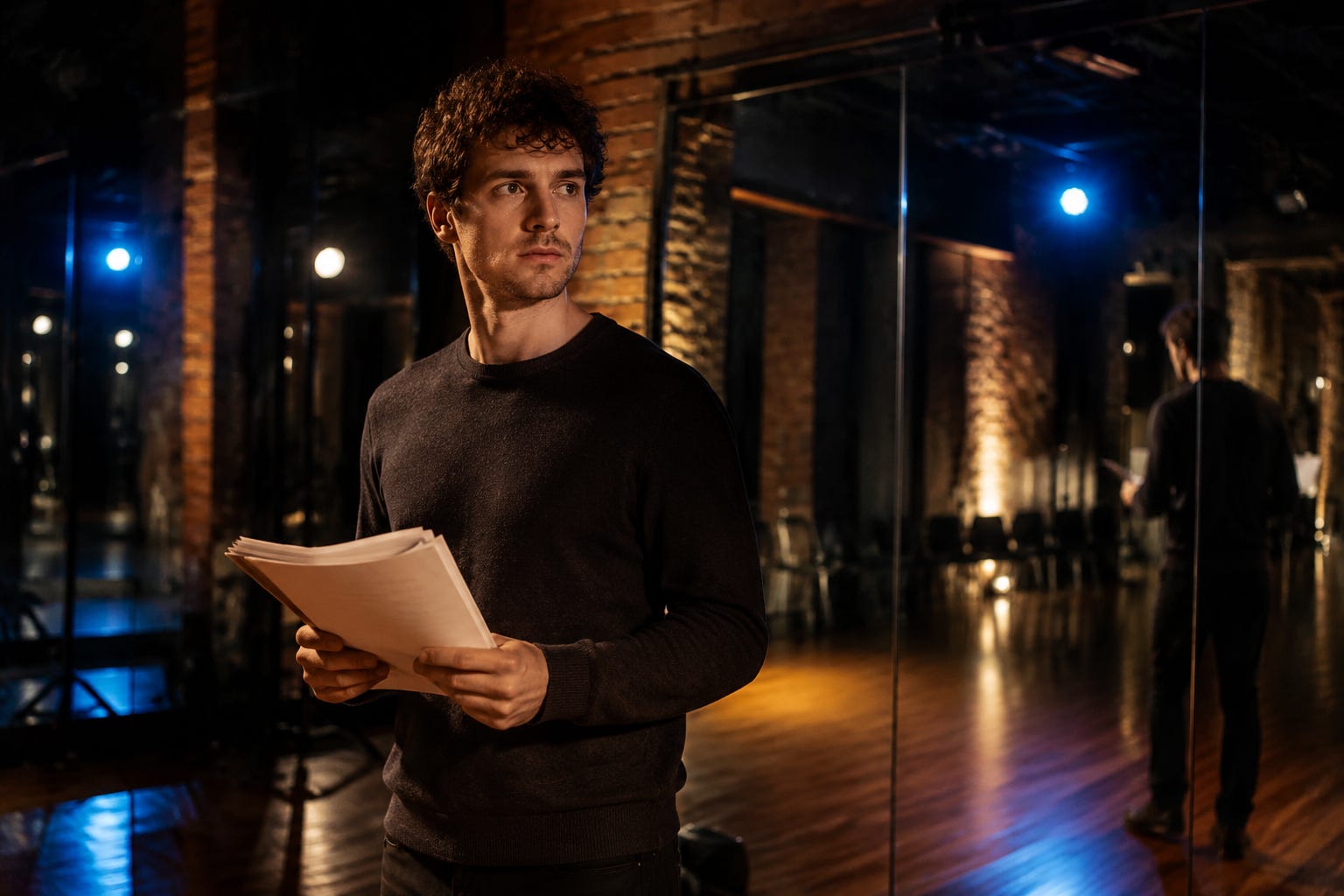
The first cold read that ever mattered to me was one I almost walked out of. I’d driven I-95, in massive traffic for a callback I thought I understood, and the second I sat down the casting director slid a fresh page across the table and said, “Actually — read this instead.” Different character. Different scene. Twelve lines I’d never seen. My stomach flipped, and all I could say is “Shit.”
I booked it. Not because I read it perfectly — I fumbled a word and skipped a beat — but because I’d been taught the secret that took me years to trust: looking prepared in a cold read has almost nothing to do with knowing the words.
Let me explain what I mean, because this is the part nobody tells you when you’re starting out.
Here’s the most common mistake I see, and I see it constantly in the coaching room. Actors treat a cold read like a spelling test. They put their head down, white-knuckle the page, and try to get every syllable right, as if accuracy is the thing being graded.
It isn’t. One acting studio that runs audition-series classes puts it plainly: the strongest cold reads prioritize the relationship and the emotional stakes of the scene over flawless line delivery[1]. The room is watching how fast you find the human being in the text, not how fast you can recite it.
Chasing perfection actually makes you look less prepared, because it reads as fear. The audience for your audition — one casting director or a self-tape reviewer scrolling through hundreds of submissions — can smell apology from across the room. Confidence is the costume. The words are just thread.
If you want to look prepared, you need your eyes to outrun your mouth. That’s the mechanical truth underneath every great cold read.
Voice actors talk about this openly. One working VO pro describes the drill: read out loud while letting your finger move across the page faster than you speak, so your eyes are always gathering the next phrase while your voice delivers the last one[2]. It feels awkward for about a week. Then it becomes a superpower.
A conservatory-level coaching site frames the same idea from a slightly different angle — the more words your eyes are used to seeing, the faster your brain comprehends them, so practicing with scripts, poems, even magazine articles trains you to lift words off the page in a glance instead of a stare[3]. You will never have time to memorize a cold read. You will have time to glance, grab, and look back up. That rhythm is the entire game.
So here’s your homework, and I mean this literally: grab anything with words on it and read it out loud at the dinner table tonight. Build the muscle now, when nothing’s at stake.
This one reorganized my whole approach. When you cold read word by word, you sound like a GPS. When you read in thought units, you sound like a person.
An LB Acting Studio guide breaks it down beautifully: a nine-word sentence might hold two or three distinct thoughts, and your job is to take only what you need for the next beat or idea[4]. You’re not consuming the line; you’re picking up an intention. Look down, grab the thought, look up, say the thought to the person across from you.
That last part matters more than anything. Which brings me to the technique that separates the bookers from everyone else.
Here’s a tactic I give every actor I work with. You don’t need to memorize the scene. You need to memorize two things: the very first line and the very last line.
An Australian audition studio nails why this works — committing the opening and closing to memory lets you deliver them with conviction and intimacy while looking directly at your scene partner or the camera[5]. You walk in owning the top of the scene. You walk out owning the button. Everything in between can be glance-and-grab, and nobody will notice, because the bookends told them you knew exactly what you were doing.
There’s a physical version of this too. A conservatory coaching site warns that if you keep tilting your head down to find words, seventy percent of your audition will be the top of your skull in frame[6]. Only your eyes go down. Your head stays up. Keep your face — your actual instrument — pointed at the reader.

Small thing, huge impact. Backstage shares a casting note that has stuck with me for years: avoid the two-handed, desperate, white-knuckle death grip on your sides, because nothing kills a cold read faster than an awkward silence while you wrestle with turning a page[7]. The fix is almost insultingly simple — fold a small corner so the page flips clean.
Hold the sides low and to the side, never blocking your face. The script is a prop you happen to be holding, not a shield you’re hiding behind. The moment you treat it casually, the room relaxes with you.
Reading well is one thing. Reacting well is what makes you look like you’ve lived in the scene for a week. There’s a partner exercise I love, drawn from an acting studio’s audition workshop, and it goes like this: look at your partner and receive their line, breathe it in, then look down and find your thought, breathe that in, and share your line back with full presence — staying connected until you receive again[8].
Receive. Breathe. Find. Share. That loop is the heartbeat of a great cold read, and the studio notes you can build real muscle memory within a few hours of focused practice[8]. Grab a friend, grab two random scripts, set a timer for ten minutes, and run it.
If you came up the way I did, cold reading used to feel like an occasional ambush. Those days are gone. As one casting blog put it recently, cold reading isn’t a pressure test anymore — it’s the audition standard, whether you’re in the room or taping at home[9].
And the clock has gotten brutal. Casting teams now routinely expect tone-accurate self-tapes delivered within twelve to twenty-four hours of getting the breakdown[10]. When the material can change overnight and the turnaround is measured in hours, the actor who can pick up cold sides and make them live immediately has a working advantage over the actor who needs a week with the script. Speed of interpretation has quietly become one of the most valuable things you can offer.
That’s the reframe I want to leave you with. Cold reading isn’t the obstacle between you and the role. It’s the audition itself — the truest demonstration of how you actually think on your feet, listen, and play.
Next time someone hands you fresh sides and says “take ten minutes,” what’s the first thing you’re going to do with those ten minutes — bury your face in the page trying to memorize, or find the relationship, mark your first and last lines, and look the reader dead in the eye?
I already know which choice books the job. I’d love to hear how it goes when you try it. Drop a comment and tell me about your scariest cold read — and whether you walked out of it grinning or shaking. Mine was both.
Comments
Nothing yet. Say the first thing.
Sign in to join the conversation.