
Last week, we hosted researcher and product leader Nicole Zeng for a conversation with founders on how the economics of building have changed in the AI era.
For years, research was expensive. Whether it was customer interviews, competitive analysis, surveys, or usability testing, every question came with a cost—and time. Teams had to prioritize only the questions with the clearest business case, leaving countless curiosities unexplored.
As the speed and cost of research drops dramatically with AI, researchers no longer have to reserve their time for only the highest-priority questions. They can afford to follow hunches, investigate odd behaviors, and explore around the corners of their product—often uncovering insights that prove far more valuable than the question they originally set out to answer.
This shift is similar to what happened in engineering with open source. When the cost of building foundational infrastructure collapsed, developers stopped spending time reinventing the basics and started experimenting in entirely new directions. AI is creating a similar inflection point for product teams: as the cost of learning falls, the opportunity shifts from answering known questions to discovering entirely new ones.
Nicole has spent her career at companies operating at very different frontiers—from Airbnb and Slack during their hypergrowth years and, most recently, Kalshi. While the products and technologies have changed dramatically, she argued that the defining characteristic of exceptional teams hasn’t.
The teams that win won’t just build faster. They’ll learn faster.
Nicole describes the biggest opportunities in a business as its jagged edges—the uncomfortable, unintuitive insights that don’t show up in dashboards or quantitative analysis. They’re the observations you only uncover by getting proximate to customers, competitors, and the product itself.
Most teams spend their time optimizing what they already know, but the best teams spend their time searching for what they don’t.
That distinction becomes even more important in the AI era. As more of the routine work becomes automated, the highest-leverage work isn’t writing documents or synthesizing surveys—it’s discovering the next question worth asking and answering.
Today, people often define a super builder as someone who produces dramatically higher output because they’re exceptional at leveraging AI.
Nicole offered a different definition: a super builder is someone who compresses the learning cycle.
AI has enabled teams to write more code, generate more ad creatives, outbound more customers - all in record time. But the really meaningful unlock in terms of impact is when customer feedback and understanding is as continuous as code deployment. When output and feedback are orchestrated together, we can test assumptions earlier, prototype ideas faster, pressure-test decisions, and absorb feedback before everyone else.
In other words, in Nicole’s definition the advantage isn’t output, it’s learning iteration.
Every additional cycle of shipping, observing, and learning creates another opportunity to uncover a jagged edge that competitors haven’t seen.
Nicole illustrated this with a story from Airbnb.
Her team spent months investing in professional translations for listings. The hypothesis seemed obvious: if guests could better understand listings in their native language, bookings would increase. After six months, however, the results barely moved.
Nicole traveled to Thailand to meet with real humans, where she realized guests weren’t hesitating because they couldn’t understand the listing. They were worried about accidentally offending their hosts by unknowingly violating local customs—whether that meant hanging clothes to dry instead of using a dryer or navigating other everyday cultural differences that made staying in someone else’s home feel intimidating.
The problem wasn’t translation. It was social comfort.
Rather than investing just in localization, the team built products that reduced social uncertainty. They shipped a badge showing someone from your country had previously stayed at a listing. They surfaced reviews from travelers with similar backgrounds. They made it easier to exchange photos before booking.
While optimization work kept metrics afloat, it was chasing after the jagged edges that became the lightning bolt.
The lesson wasn’t simply to conduct more user research. It was to get closer to reality when the data alone stops explaining what’s happening.
Nicole saw the same pattern again at Kalshi—but with one major difference.
AI had fundamentally reshaped how product teams worked.
Competitive analysis, survey synthesis, experiment write-ups, and research summaries—the work that once consumed entire teams—could increasingly be handled by AI. Rather than replacing product thinking, AI had eliminated much of the repeatable work surrounding it.
That gave the team more time to chase jagged edges.
One example came from observing user behavior, in-person, at major sporting events. Nicole leveraged AI to take over baseline insights and duties, so the team could go to a game and look for the unknown unknowns.
Ideas from that trip have gone on to generate major wins (there were more details, but you had to be there!).
Throughout the conversation with Adverb founders, Nicole returned to the same idea: AI increasingly handles the known work, leaving humans to focus on pursuing the unknown.
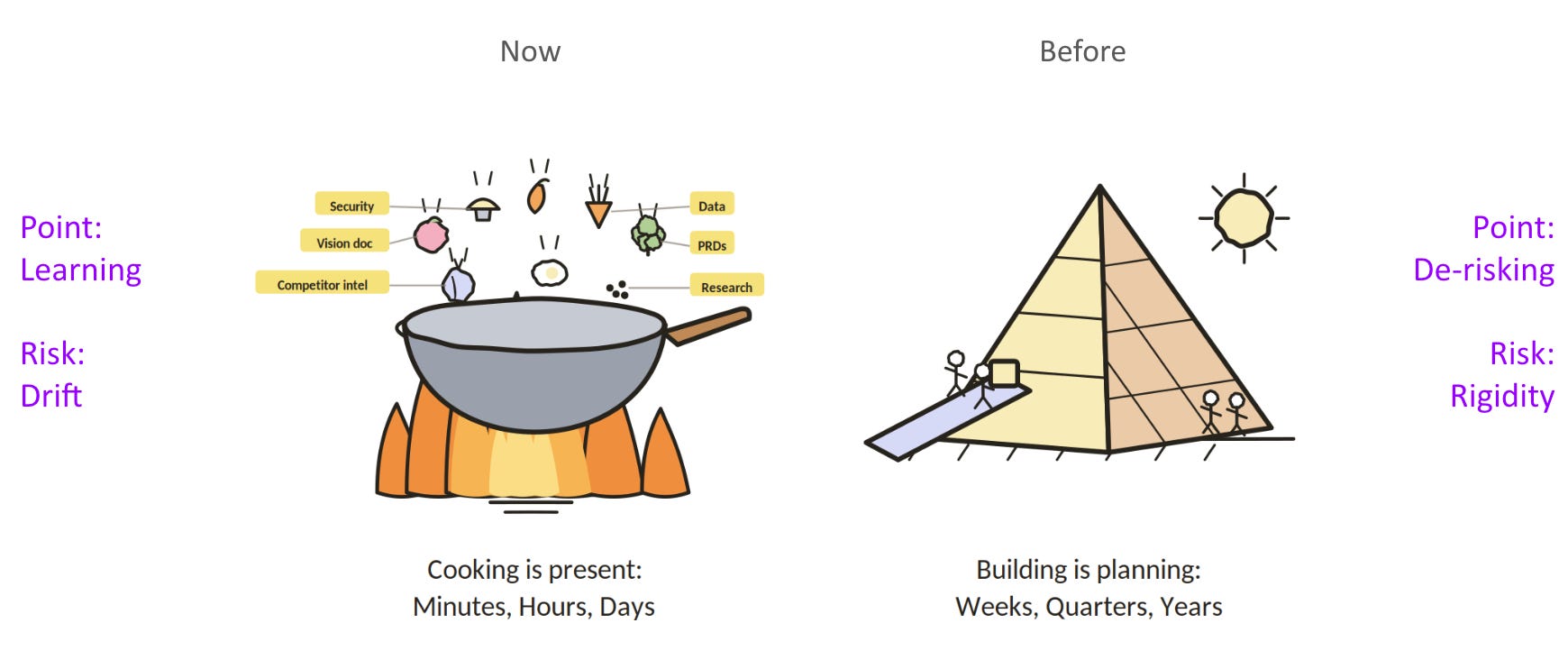
Instead of talking about building, she posits that product development is moving towards a process more akin to cooking. Building suggests long planning cycles and reducing uncertainty before work begins, where cooking is iterative. You taste as you go. You adjust. You ask your roommate if they think it needs more salt. You respond to reality instead of trying to predict it perfectly in advance.
The strongest AI teams increasingly operate this way: ship, observe, learn, repeat, where speed isn’t the goal but learning is.
Nicole closed with a broader question: if AI changes how individuals work, how should organizations evolve alongside them?
Her answer wasn’t to hire only super builders.
The strongest teams pair people who excel at finding jagged edges with teammates who bring exceptional craft, execution, and strategic direction. One group discovers the opportunities. Another turns those opportunities into polished products. Leadership ensures the company continues moving toward the right destination rather than simply moving faster.
She left founders with three questions to keep asking:
Where are the jagged edges in your business that no dashboard will reveal?
Where do you need something deeply customized, and where is “good enough” actually enough?
How adaptive do you want your company to become—and does your team structure reflect that?
The AI landscape will continue to evolve, but Nicole’s advice felt surprisingly durable.
The companies that build lasting advantages won’t simply be the ones that adopt the newest tools first. They’ll be the ones that learn from the reality of their users faster than everyone else.
No posts
Comments
Nothing yet. Say the first thing.
Sign in to join the conversation.