
From Nature to Strength: A Proof-of-Concept Study Integrating a Nature-Based Intervention with Virtually Supported Resistance Training in Young Men. Published in the journal Healthcare.
The full paper is freely available here: https://www.mdpi.com/2227-9032/14/7/937
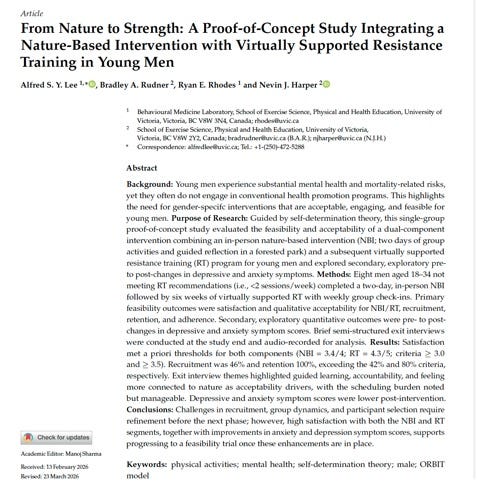
This post provides a brief overview of the study, and a hint at the broader context of nature contact + resistance training for young men today. This is a topic on which I have written two earlier posts recently. Specifically on declining testosterone, and moralizing masculinity. Consider this Part 3, intended to be written months ago as the third in the series.
My friend Brad decided to go to grad school and become a registered clinical counsellor. I worked with him as his academic supervisor and while it took longer than both of us would have preferred, this study was the final product of his most excellent thesis. But not the end result of his efforts though, as plans are in the works to repeat the study and for him to build this research out as a part of his private practice.

This is Brad. He likes nature and lifting heavy things.
Young men, nature connection, muscles, and mental health might seem like disparate topics, but this new proof‑of‑concept study suggests they can come together in a surprisingly simple way; resistance training, plus spending more time in nature, with a bit of virtual support along the way. We utilized self-determination theory as a baseline understanding of how we engage in change and growth. This program design was intentionally kept simple and focused on developing relatedness (cohesion with other young men in nature and online) + autonomy (choosing how, when and where the training takes places) + competence (success in noticing and sharing benefits).
We know from a larger body of research that spending time in nature can produce a wide range of health benefits. We know the same for resistance training. We thought this was a ‘no-brainer’ to test. And if you are at all familiar with my background, you will recognize the “outdoors + active = health” is in my “lane” where I have been a practitioner, researcher and author for decades.
This study, in obvious ways, mimics the challenge of outdoor living and travel. Brad and I both used to work as guides of youth on adventure expeditions. While it would be dreamy that every young person was able to experience the challenge and growth experience of an expedition, we have to sometimes make do with what is more available and affordable. Working ‘out’ outdoors is primarily a free and accessible option for health and wellbeing practices:)
We wanted to test a simple intervention program that combined our two favourite human development ingredients:
A nature-based intervention encouraging young men to be in natural outdoor settings (like parks, forests, or green spaces) in intentional ways. This was a social cohesion element as well as a nature connection opportunity.
Group (+virtually) supported resistance training program with weights and exercise machines or bodyweight exercises). Practice could be solo, paired, group, at home, outside, or at the gym. One night each week the group checked in online to report on progress and set goals for the next week.
The focus was on young men, a group that often struggles quietly with mental health but may be more comfortable with “doing” activities like hanging out outdoors or exercise than with traditional talk‑based supports. Research shows this population now carries decreasing health and educational outcomes. Men suffer more suicide, all-cause mortality, are doing poorer in academic achievement, and ask for help less often than women. Far more detail on this front in the full paper, if interested.
Because this was a proof‑of‑concept study, the main goal was to see: “Can we make this program work in real life, and will young men actually do it?”
Participants were invited to:
**Two days of group cohesion activities and guided reflection in a local park.
**A 6-week structured resistance training routine, supported virtually (for example, via online check‑ins, instructions, or remote coaching).
·***Optional: Spend regular time in nature, using outdoor environments as part of their movement, reflection, or recovery.
The researchers then looked at things like:
—Do young men sign up and stick with it?
—Is the format engaging and manageable for them?
—Are there any early signs of benefits for mood, wellbeing, or physical health?
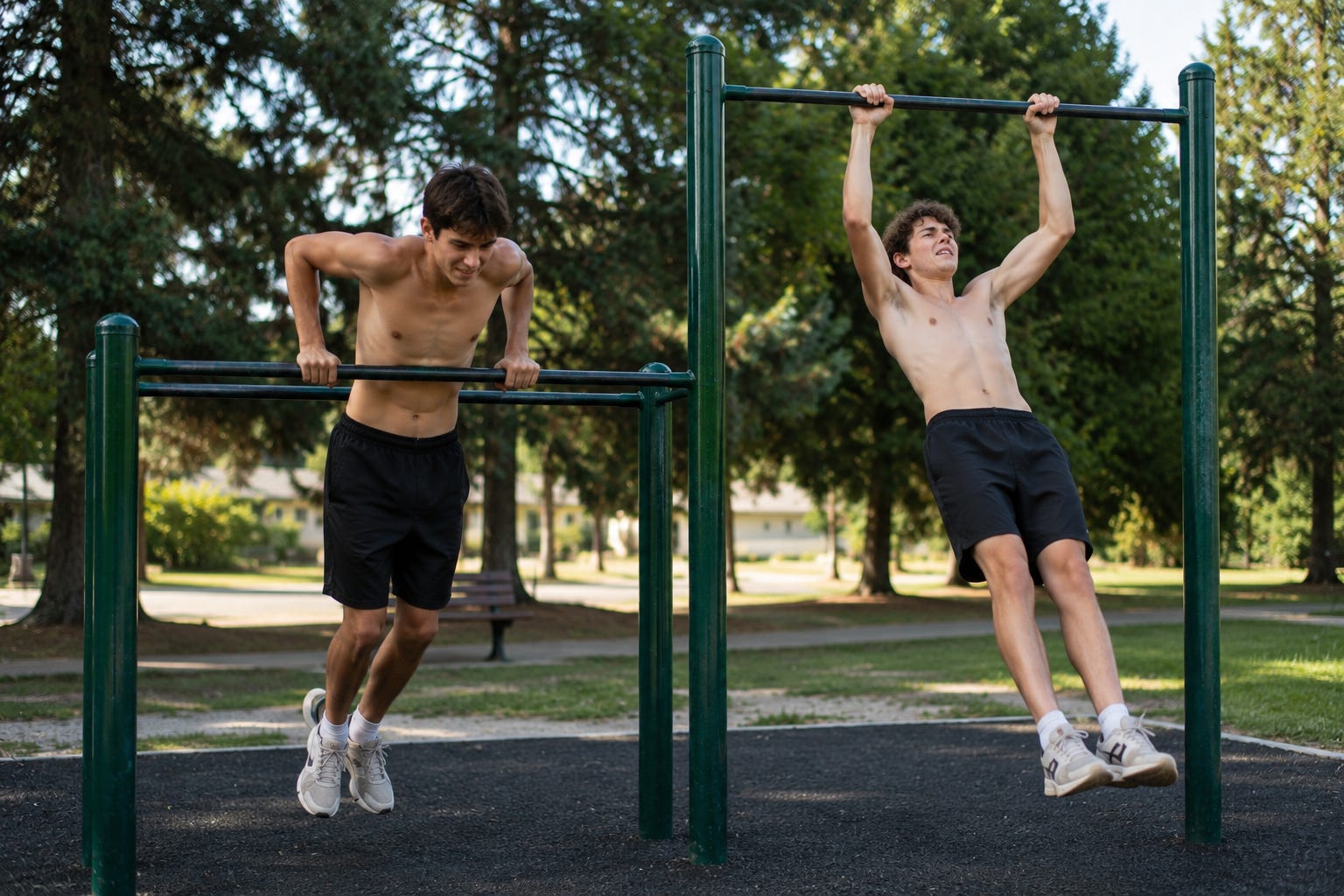
ChatGPT image: Can you see its glitches?
For a small, early study, the results were promising:
8 men 18-34 years of age who met the criteria (not active in resistance training) for participation were recruited for the study. Recruitment of this population was found to be difficult, and may be the most likely impediment to scalability.
The combined program was feasible in that young men were willing and able to take part. Fidelity to the program was near perfect.
It was acceptable in that participants generally viewed the nature‑plus‑training approach as realistic and positive in their lives. Participant satisfaction was measured as high. Qualitative interviews provide context, and 2 common standardized measures of mental health/wellbeing showed reduction in depression and anxiety symptomolgy.
There were encouraging signs of improvement in areas like mental wellbeing and physical strength, though the study was not large enough to make statistical claims about outcomes let alone cause and effect yet.
In simple terms, the study showed that this kind of program can work in practice and seems worth testing on a larger scale.
Many young men experience stress, low mood, loneliness, or anxiety, but often do not seek formal mental health care. Nature exposure and strength training both have growing evidence behind them for supporting mental health and resilience. Putting them together, and delivering support virtually, might:
—Meet young men where they are (outside of mental health clinics, with phones/online, and through action‑oriented activities).
—Reduce barriers like stigma, transportation, or gym access.
—Create a more “whole person” approach, building both physical and psychological strength.
Because this was a first, small‑scale test, the next steps are about seeing if we can repeat the outcomes on a larger scale, and, improve recruitment as that was the most difficult aspect in the first study.
—Running larger studies to see if the benefits hold up with more participants.
—Comparing this combined program to usual care or to exercise‑only or nature‑only programs, to see what difference the full package makes.
—Exploring long‑term effects. Are gains in mood, confidence, or strength maintained months after the program ends?
This proof‑of‑concept study is an early but encouraging step in using simple, familiar tools—time in nature, resistance training, and virtual support—to create more accessible, appealing options for supporting young men’s health.
Tell me what you think. What did this study get you thinking about?
If you were designing the next version of this program for young men in your own community, what is one change or addition you would make to make it feel even more inviting or realistic? And, if you have ideas about recruitment strategies, please let me know. :)
Be well,
nevin
Thanks for reading adults in the room.! This post is public so feel free to share it.
No posts
Comments
Nothing yet. Say the first thing.
Sign in to join the conversation.