
We all know the programmatic supply chain is a mess. It seems so simple. My first thought was, "Why don't DSPs just build smarter templates? Why not just bid on the good stuff and avoid all the nonsense?" It seems economically sound to buy only the auctions you have a high probability of winning instead of bidding on a thousand game apps you know you can’t resell.

But it's not a lack of effort. It's a fundamental conflict of interest. In an auction that lasts mere milliseconds, a DSP's algorithm makes split-second decisions based on limited data. This system isn't built for a quality audit; it's built for speed.
And that speed is directly tied to their business model.
Big DSP players, like The Trade Desk and DV360 operate on a revenue share so they take a cut of every single dollar of media spend no matter where it goes.
Whether that dollar buys a premium ad on a major news site or a shady impression on a junk app, the DSP still gets paid. The system is designed for speed because their revenue model is built on buying broad, cheap inventory.
And, the faster they do that, the more they profit.
My own experience with a "bidder-as-a-service" like Beeswax - Freewheel proved that it's absolutely possible to create those tight, clean templates. I could build the guardrails I wanted and be far more efficient. It wasn't a complex black box but it was a transparent system I could actually control.

The catch? Boy, it required a lot of my time and expertise. This is the central conflict. The most efficient way to get quality requires human intervention, but the entire programmatic system is designed to reward the opposite. The automated DSPs that handle the bulk of media dollars aren’t trying to do a bad job. It’s just their algorithms are achieving peak performance on a dead end.
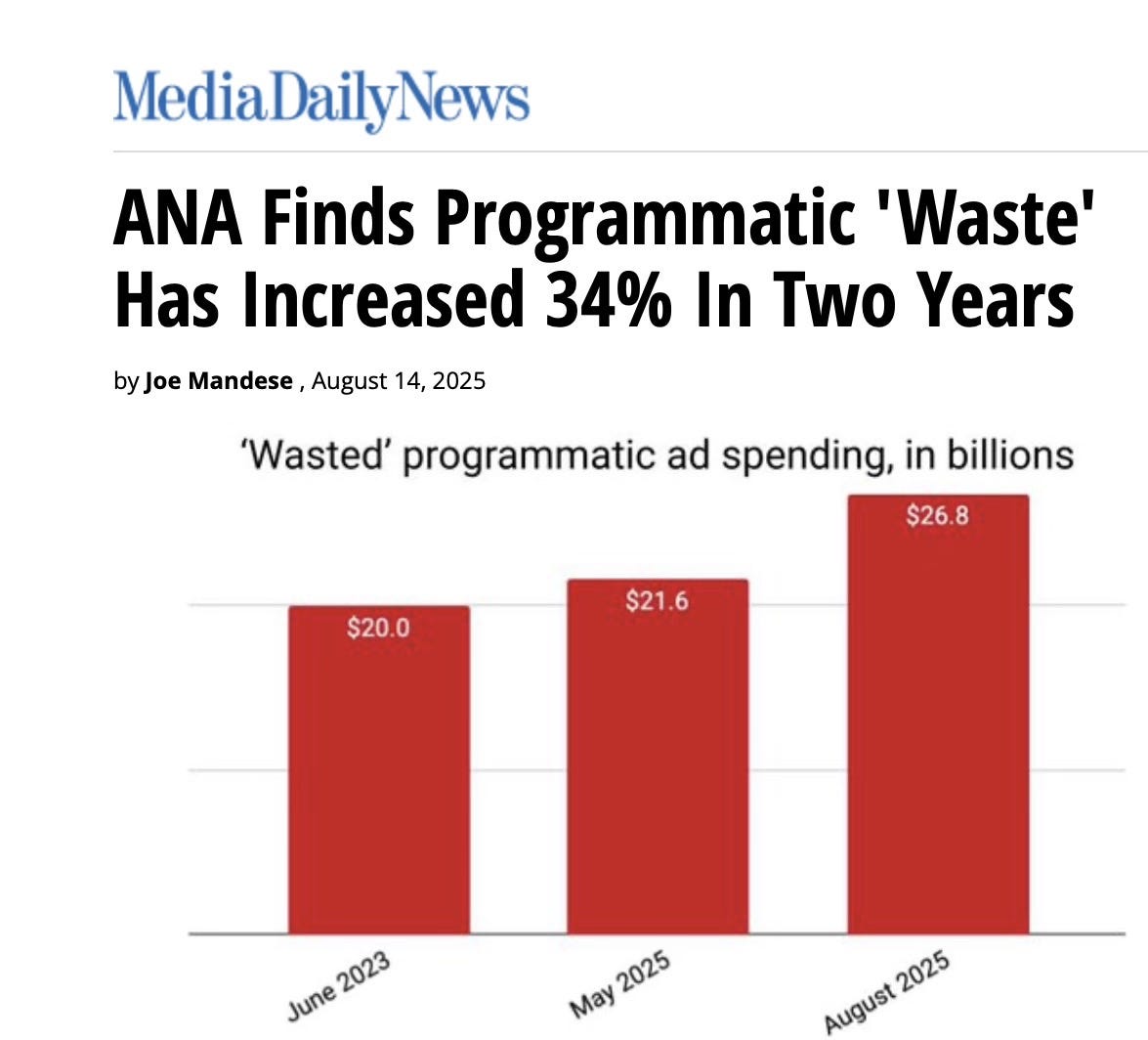
They are built to optimize for volume and scale, not quality. If their algorithm can meet a CPA goal by buying a thousand bad impressions for every good one, it’s considered a win. This is why the ANA says programmatic has the most waste ever. I’ve said this before, but the system really is working exactly as it's designed to when it’s prioritizing the flow of money over the quality of the impression.
Why AI can't fix this? AI is working with the same flawed inputs. The algorithm can only build models based on the messy ecosystem it operates within. It learns to meet your “goals” by doing what's easiest and most scalable.
So while a better way is possible, it requires a human to wrestle with the mess. The easy algorithmic path is built for volume and it will continue to contribute to the industry's waste problem until the incentives themselves are fundamentally changed.
There is a better way to build the algorithms that run this industry. The next generation of AI should be a total overhaul the market is already demanding.
AI-Driven Supply Chain Optimization: The current algorithms are trained to find the cheapest path. The new mandate for our algorithms is to find the cleanest and most direct path to a user. This means training AI to become the ultimate supply chain auditor. Trained to avoid sketchy exchanges and dodge publishers with a history of low quality traffic.
Automated Template & Strategy Creation: The manual lift of creating tight templates is a huge lift. AI needs to automate this. It should be able to analyze our first-party data, the people who willingly give us their information, and automatically generate bidding strategies that find more people like them in high-quality environments.
Predictive Contextual Targeting: The old way was creepy. The new way is brilliant. Instead of following a user, AI should be trained to analyze a page’s content and predict what a person in that context might be interested in. This lets us deliver a relevant ad in a high-quality environment without a single piece of personal data.
Okay, yes, I said the quiet part out loud: Time to outsource the creepiness to AI.

This is truly a billion dollar question, isn't it? If the solutions are so clear why aren't the giants like DV360, The Trade Desk or Amazon leading the charge?
Why aren't they investing in this new, quality-focused AI?
The answer, I suspect, comes down to the same economic incentives that caused the problem in the first place.
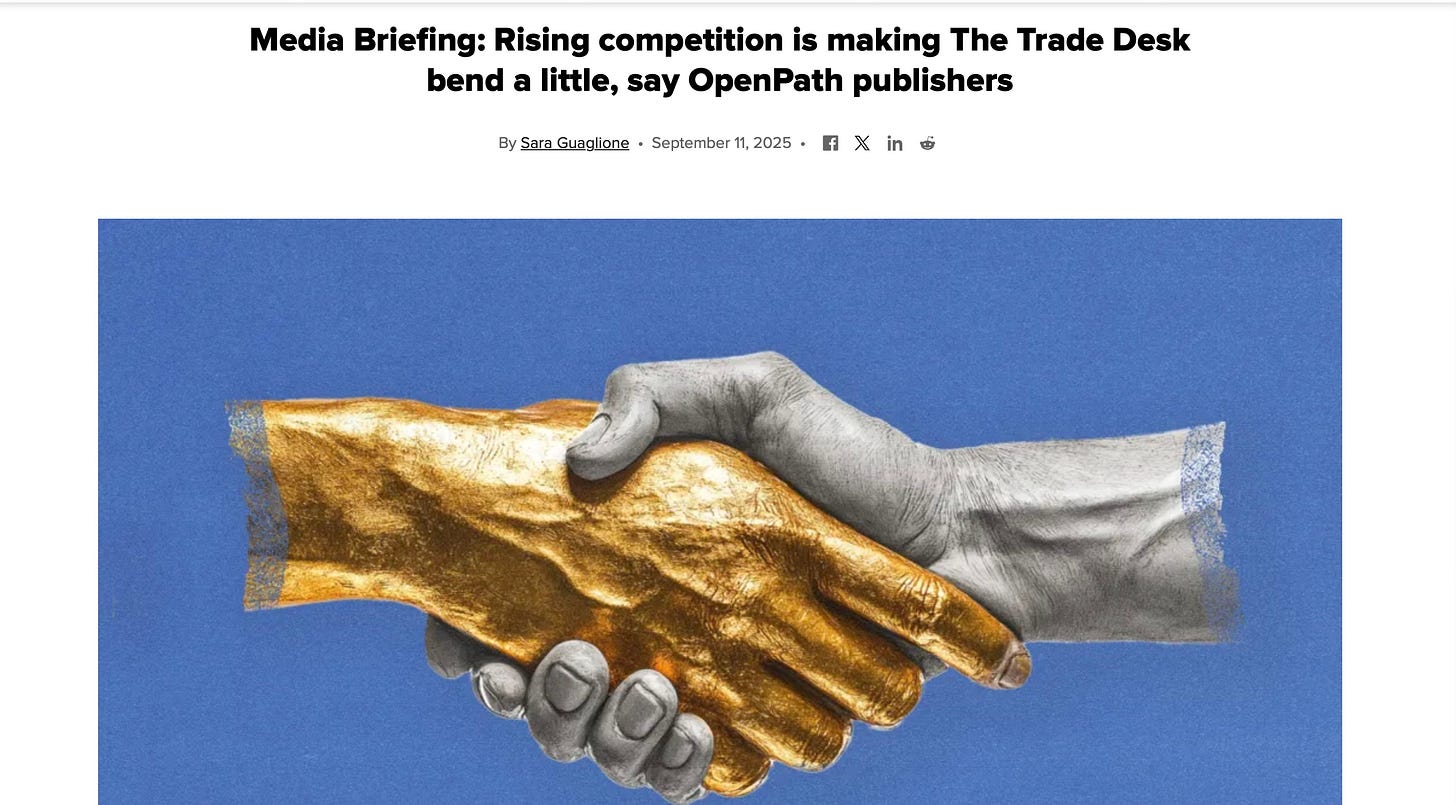
The business model of a DSP like The Trade Desk or DV360 is built on revenue share. They take a percentage of every single dollar of media spend that flows through their platform. Whether that dollar buys a premium ad on a major news site or a fraudulent impression on a background app, the DSP still gets its cut. So, it’s no surprise that Digiday recently published that The Trade Desk is being looser with OpenPath.
Think of it this way: their primary KPI isn't the quality of your ad spend; it's the sheer volume of ad spend they process. The current system, despite all its flaws, is an incredibly efficient machine for processing a massive amount of volume at a breakneck pace.
Why would they invest to cut out the long tail of low-quality inventory? That long tail still adds to their total managed spend, and therefore, to their bottom line. A more efficient system might deliver the same results with less money, which would mean less revenue for them.
They profit from the complexity and a lack of transparency. The DSP acts as a sophisticated black box, taking your ad dollars and promising to deliver a return. The average advertiser doesn't have the tools or the expertise to audit every transaction or trace every impression back to its source.
Because they are the ultimate gatekeepers of the data and the buying process, they can command a premium for their service. They have no incentive to make the process perfectly clean or transparent because their current model is so incredibly profitable. Why would they fix something that’s making them billions?
In the end, it's not a conspiracy; it's simply a perfectly aligned business model. Their profit is directly tied to the system’s volume-over-value approach, and until that incentive changes, they will continue to profit from the waste.
We can't just wait for the giants to catch up. We need to do two things, and we need to do them now.
First, we must demand more transparency and accountability from our partners. We need to be the squeaky wheel that forces them to clean up the supply chain. We should use the ANA study and others as ammunition to demand that our money isn't being used to fund a flawed, wasteful system.
Second, we must start acting like the new generation ourselves. We need to move our own teams from a focus on volume to a focus on quality.
We need to be willing to do the manual work to create those tight templates and to invest in the data that gives us a clear view of our audience.
Because in the end, it's not a DSP's job to fix our problems.
It's ours.
Thank you for reading. Please leave your feedback.
Comments
Nothing yet. Say the first thing.
Sign in to join the conversation.