
It’s been a few months since I last posted. In AdTech years, that’s roughly a decade.
Rest assured, I haven’t been on a sabbatical in the Maldives. I’ve been in the trenches of operations, managing paid media and wrestling with the very thing everyone else is breathlessly hyping on LinkedIn: Artificial Intelligence.
After spending the last quarter in GA4 and launching campaigns, I’ve come to a conclusion that might sound contradictory. AI is the best consultant I’ve ever hired. It is also, frequently, the worst employee I’ve ever managed.
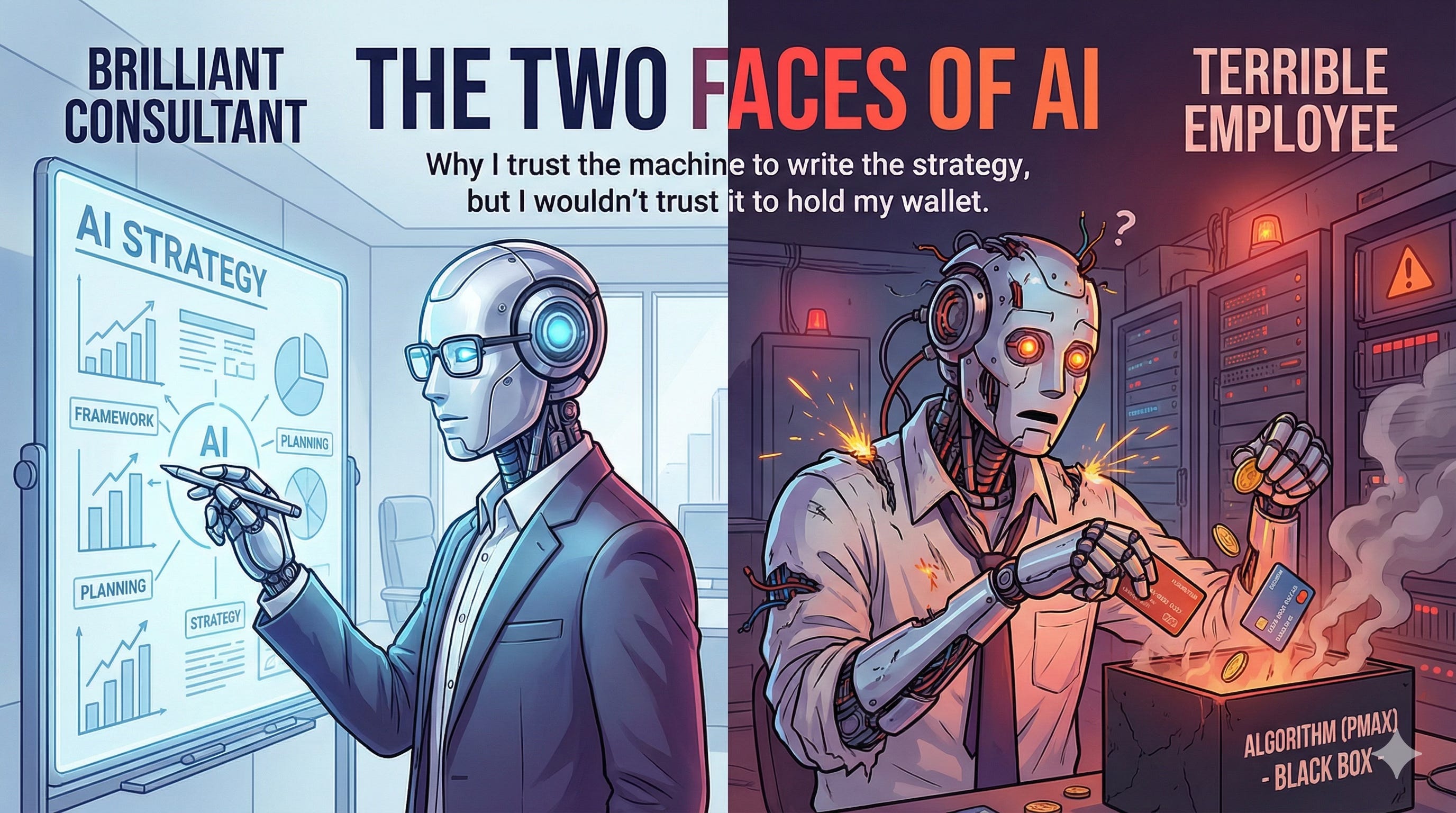
The Brilliant Consultant
Lately, I’ve been deep in the weeds of keyword research and campaign structuring for a new AI consulting vertical. This is where the robots actually earn their keep.
When you treat AI as a strategist, it’s a force multiplier. I can feed it raw data, ask it to analyze semantic clusters for “AI strategy,” and within seconds, it gives me a framework that makes me look like I spent three days thinking about it. It maps out the intent of a CEO versus a CTO perfectly. It drafts the “perfect” structure for an ad group without complaining about coffee breaks.
In this mode, AI is the ultimate sounding board. It clarifies my thinking and organizes the chaos. It’s “McKinsey in a Box.”
The Terrible Employee
But then, you have to actually run the ads.
This is where the “Consultant” leaves the building, and the “Algorithm” clocks in. And frankly, the Algorithm is an HR nightmare.
If you’ve tried to set up a YouTube campaign or a Performance Max (PMax) asset group recently, you know the vibe. The platform looks you in the eye and says, “Don’t worry about the details! Just give us your credit card and your assets, and our magical AI will find your customers.”
But it doesn’t “find customers.” It finds conversions. And often, the AI defines a “conversion” as “anyone with a pulse (or a bot script) who accidentally clicked a banner on a flashlight app.”
It’s like hiring a salesperson who hits their quota by selling your premium enterprise software to teenagers. Technically, they made a sale. Operationally, they made a mess.
The “black box” nature of these tools is the antithesis of good operations. My job is to know why something worked.
Was it a qualified lead?
Was it a decision-maker?
Or was it just the algorithm optimizing for the path of least resistance?
The AI “employee” doesn’t care about your ROAS goals; it cares about spending your daily budget by 11:59 PM. It requires the kind of micromanagement I thought we left behind in 2015. You have to constantly check its homework, negate the junk, and force it to behave.
The Re-Emergence Reality
This dichotomy is why I’m back writing. The industry is selling the dream of “Set It and Forget It,” but the reality of the last four months has proven that “Set It and Forget It” is just a fancy way of saying “Set It and Waste Money.”
AI can write the strategy doc. It can help us sound smarter and move faster during the planning phase. But it cannot be trusted to drive the bus.
We need clear steps. We need clean data. And we need to stop pretending the “Magic Button” works without a human adult in the room to supervise it.
Comments
Nothing yet. Say the first thing.
Sign in to join the conversation.