
Early Friday morning, before sunrise, I settle into the driver’s seat and begin the 850-mile drive to adopt a puppy. Leaving town, with the lights of the suburban-scape behind me, I drive south toward the Colorado Plateau. I follow the southwestern tip of the Sante Fe Trail past the “rounded rocks of Raton” into New Mexico. It is not until I have driven almost a hundred miles that I realize I am traveling a section of the same route Sal and Dean travel in Kerouac’s On the Road. Sal Paradise, Jack Kerouac’s fictionalized alter ego, and his frenetic friend, Dean Moriarty (based on Neal Cassady), cross the Colorado-New Mexico border and head southeast toward Texas. I cross the Santa Fe trail, crossing through Springer, and drive on to Albuquerque.
Text within this block will maintain its original spacing when published
O sad American night! Then we were in New Mexico and passed the rounded rocks of Raton and stopped at a diner, ravingly hungry for hamburgers, some of which we wrapped in a napkin to eat over the border below. "The whole vertical state of Texas lies before us, Sal," said Dean. "Before we made it horizontal. Every bit as long. We'll be in Texas in a few minutes and won't be out till tomorrow this time and won't stop driving. Think of it." Entering Jicarilla Apache Nation, I cannot help but feel like I am entering sacred space. Kerouac once commented that On the Road “was really a story about two Catholic buddies roaming the country in search of God. And we found him. I found him in the sky, in Market Street San Francisco (those 2 visions), and Dean (Neal) had God sweating out of his forehead all the way. THERE IS NO OTHER WAY OUT FOR THE HOLY MAN: HE MUST SWEAT FOR GOD. And once he has found Him, the Godhood of God is forever Established and really must not be spoken about.” Driving through the American Southwest, the Sangre de Cristo Mountains in the foreground, alpenglow filling my windshield, I can see what Kerouac was talking about. After about five hours of driving, highway hypnosis makes the surrounding landscape feel soft and dreamy, perfect for a theophanic experience. I drive on, passing Pueblo communities, taking mental photographs of the relics of Indigenous nations scattered between rest stops and Indian stores that advertise Navajo frybread and tacos. So much has been lost to Westward Expansion or reduced to tourist tchotchkes. And yet, among the faded billboards and abandoned buildings, real people are living real lives.
Every stop I make, I meet friendly people. This region, known as the Empty Southwest, is not empty. It consists of ancient trade routes, and land that was lived on and farmed for thousands of years. It is filled with people living their lives as best as they can. Whitman says, "In all people I see myself, none more and not one a barley-corn less, / And the good or bad I say of myself I say of them.” Stopping along the way, talking to strangers, I feel connected to our shared humanity, even if we do not have a shared heritage. This is Whitman’s America: innumerable people connected through space and time, human and dehumanizing history, collective joy and trauma.
Text within this block will maintain its original spacing when published
I celebrate myself, and sing myself,
And what I assume you shall assume,
For every atom belonging to me as good belongs to you.
This, too, is our America.
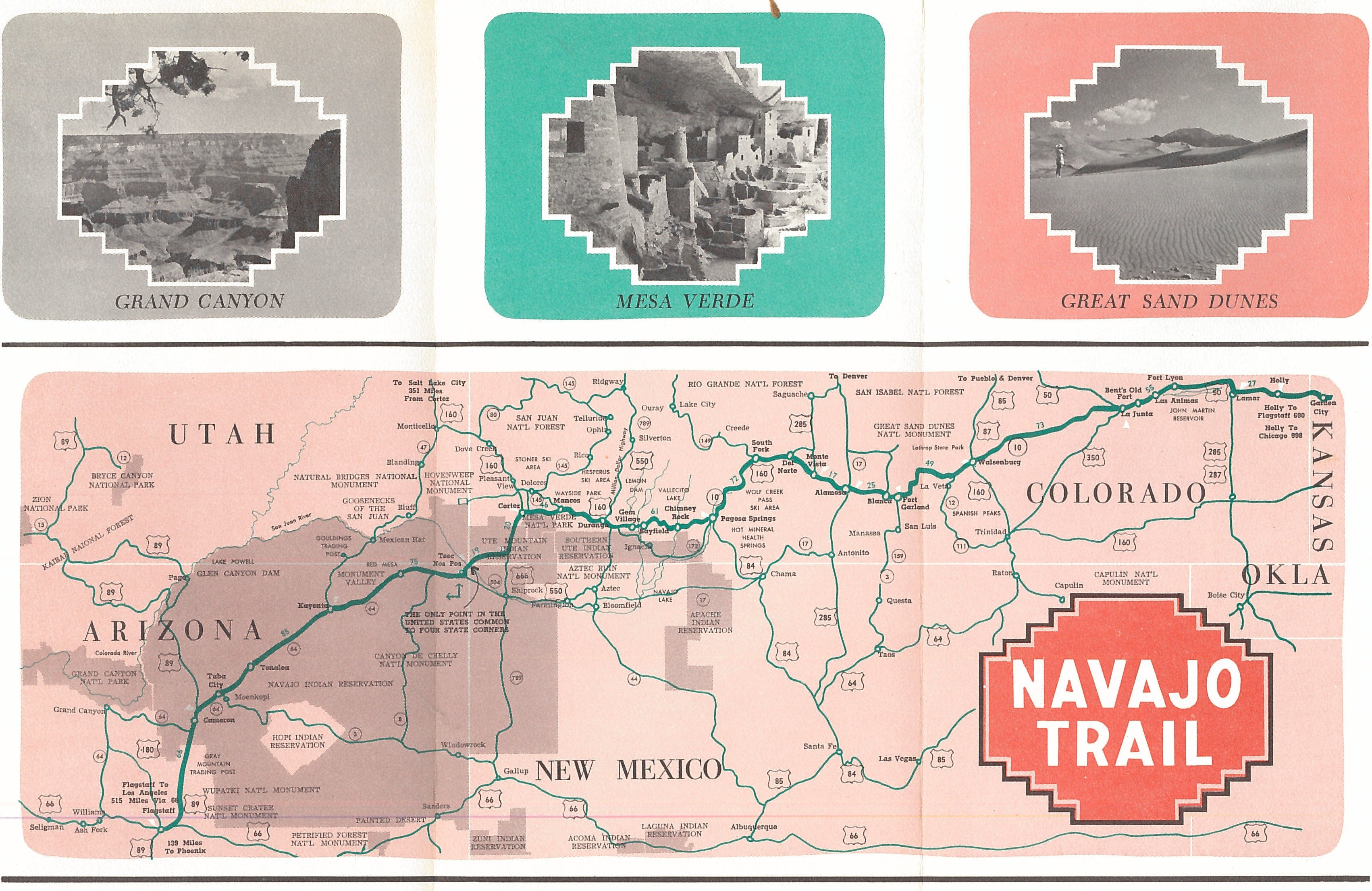
65 miles west of Albuquerque is Acoma Pueblo. Known as Sky City, it is one of the oldest continuously inhabited communities in North America. Fewer than 50 Tribal members live year-round in the earthen homes of Sky City. Archeological evidence dates the Pueblo’s oldest extant remains to around 1100 C.E., suggesting the Acoma people lived in the desert surrounding the mesa during earlier times, and at some point decided to move their village to the top of the massive, 357-foot tall mesa. The San Estevan del Rey Mission Church is breathtaking. Built by Spanish Franciscan friars in the mid-1600s, it is the oldest surviving European church in New Mexico. While Kerouac zoomed across the Arizona desert, I find the deeper I get, the slower I want to drive. I do not want “the great dry West [to be] accomplished and done.” I want to “lean and loafe at my ease” observing the desertscrub and pinyon-juniper.
Kerouac has Sal and Dean crisscross the United States, dipping into Mexico, on first glance, in a great quest for freedom and a raw American experience. It is easy to see Sal and Dean as two hedonistic wanderers, always chasing their next high. Sure, there are some crazy experiences with strange people (and lots of alcohol), but I see it more as a pilgrimage than a bender. Sal never spends much time in New Mexico, just “passing Las Cruces in the night” to arrive in Arizona at dawn. My Americana road trip takes me just south of The Navajo Nation (Diné Bikéyah) through New Mexico.
15 hours of continuous driving offer me ample time to ruminate. Why am I driving across the Southwest for a puppy? I spend a lot of time thinking of my oldest son. It is no secret that I miss him. And I know very well that a dog, even a cute puppy, will never replace my child. Perhaps I am not yet through with caregiving. As a teacher, I have always viewed myself as nurturing. In many ways, I care for my students like they are my own children. Maybe this is why I enjoy teaching: it lends itself to giving care.
This road trip has me feeling nostalgic for my young children and my younger parent self. Driving through the Arizona desert toward Flagstaff, I replay so many memories of my son: learning to walk, saying his first words, taking him to the library every Sunday for storytime and to load up on picture books, introducing him to his new siblings, finishing elementary school, starting high school, and finally, enlisting in the Marine Corps. Driving past red-rock buttes and steep canyon walls, I long for the past. I think we all do, in some way, long for younger versions of ourselves. We wish we knew then what we know now because knowing would have made us better. Better parents, teachers, people. Sometimes we long for better outcomes. But we can only teach and parent and live as best as we can with the resources we have available to us. Getting an eight-week-old puppy is not going to magically evaporate my saudade. Every time I hear certain songs or cook certain meals, I remember and think of those times, as a young parent, doing the best I could with what sense I had (it wasn’t much).
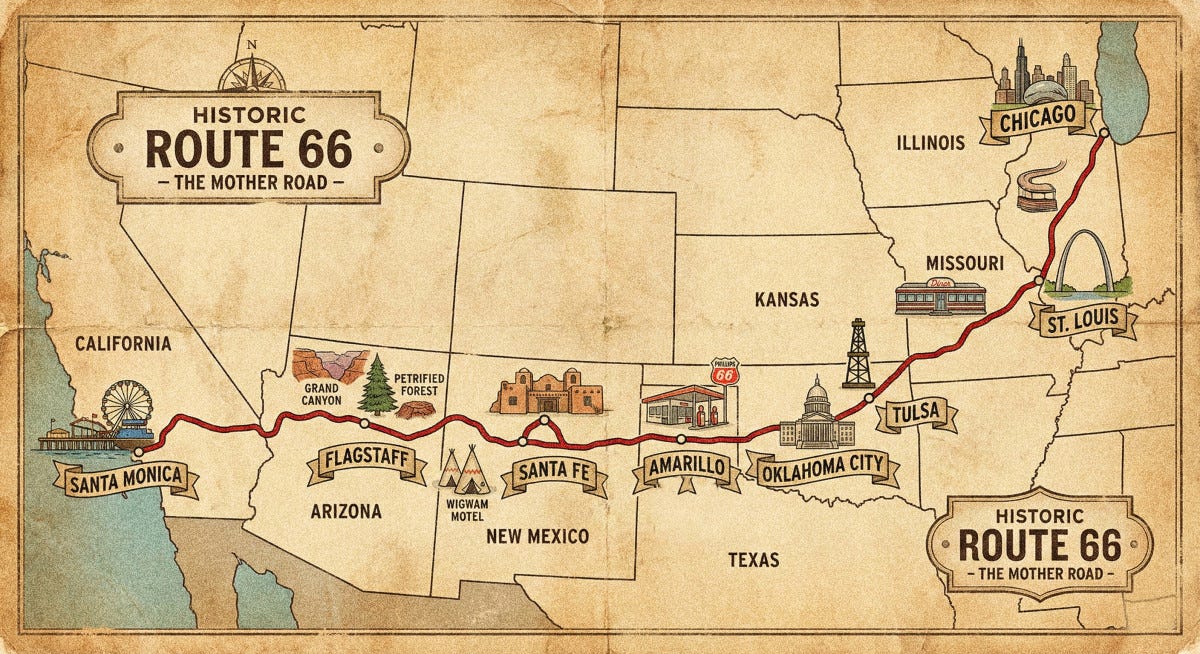
2026 marks the 100th anniversary of Route 66. Promoted as the shortest route between the Great Lakes and the Pacific Coast, The Mainstreet of America, offered a direct route from Chicago to Los Angeles, connecting the Midwest to the Southwest. Cyrus Avery was an Oklahoma businessman and highway commissioner known as the “Father of Route 66.” He championed this scenic route from the Ozark region, to the Texas Panhandle, and the Grand Canyon in Arizona as a thoroughfare for Americans wanting to explore America. Storefronts, towns, gas stations, and cafes were built along the highway to lure Americans to travel across the country. Billboards advertised vacancies for Motor Courts and local dining deals. Instead of expensive hotels, motels were designed so travelers could park directly outside their cabin door. Route 66 is 2,448 miles long stretching from Chicago to Santa Monica. 487 miles of the route is in New Mexico and 385 miles are in Arizona. From Gallup, I drive west toward Flagstaff, through the Halona Idiwan’a (Middle Place) of the Zuni Reservation.
[Migrants] come into 66 from the tributary side roads, from the wagon tracks and the rutted country roads. 66 is the mother road, the road of flight.
John Steinbeck, Grapes of Wrath
In The Old Ways: A Journey on Foot, Robert Macfarlane says, “paths are human; they are the traces of our relationships, in some ways.” Fleeing from the terrible effects of the Dust Bowl, many migrants fled west along this “mother road” in search for work in California. Steinbeck beautifully captures the immense suffering of the Joad family as they travel from Sallisaw, Oklahoma, to California’s Central Valley along the 66. I find that as I drive on, I can feel an ache for Americana, or at least my own personal one.
Route 66 has Americana baked into the asphalt. Driving along this 100-year-old road gives one a sense of connecting to the past; a past that is shaped by the diverse peoples indigenous to this land. That past also includes our collective ideology that white Americans are destined to expand from coast to coast, taking Indigenous lands. Our Americana past includes the thousands upon thousands of immigrants who came to this land looking to build a better life for themselves and their families. My own Americana is filled with familial artifacts and touchstone memories. My son’s Bee (baby blanket); memories of teaching him to swim, play chess, and helping him with his homework. Now that he has moved out, started his life in the Marine Corps, I miss our daily interactions, my connection to his workaday life. I miss seeing him every day.
I was surprised, as always, by how easy the act of leaving was, and how good it felt. The world was suddenly rich with possibility.
Jack Kerouac, On the Road
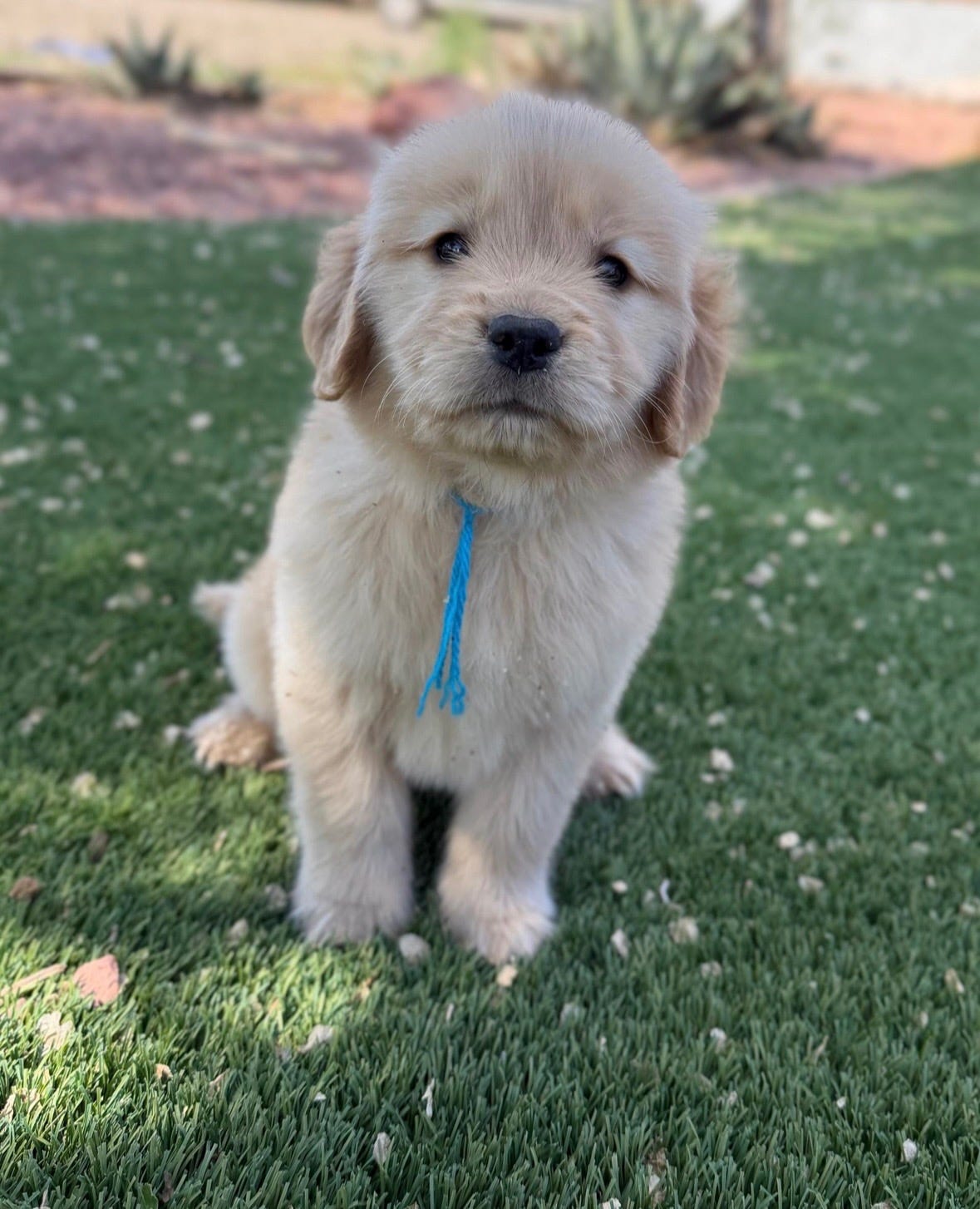
I used my wife’s 45th birthday as a guise to get this puppy. I intentionally chose a puppy 850 miles away because I think, deep down, I wanted to believe that this particular dog is meant for me, and that I was chosen to be this puppy’s caregiver. The universe entrusted this dog to me and my family in the same way the universe blessed me and my wife with three beautiful children. I know this puppy will help me tap back into my personal Americana: sleepless nights, potty training, snuggling, teaching.
Rolling into Prescott, Arizona, I am exhausted. 15 hours, straight through, makes my hips ache and my eyes blur. I check into a Days Inn, shower off the road, and fall asleep quickly. I sleep deeply, my dreams filled with sehnsucht. I wake early, splash cold water on my face, and prepare to meet the the newest member of our family.
Driving home with Agnes, all I want to do is go. I drive fast. I am tempted to drive the northern route through the Coconino County and the Hopi Reservation, but I want to see the Sangre de Cristos again; I have no interest in crossing Strawberry Pass. This road trip gave me time to interrogate myself. Yes, I miss my son. I will miss each of my children when they grow up and move away. But I am still making memories. Each evening I call my oldest and get updates about his Marine schooling in 29 Palms. I am teaching my youngest daughter to drive. Our long treks on suburban streets give us time to chat and connect (and listen to a lot of BTS). My middle son is preparing to enlist in the Air Force. I am helping him study for his ASVAB test. It is incredible to see your child reach for something and work for it because they want it so badly.
And now we have Agnes and Wilbur. These next weeks will be challenging, but I plan to relish in the banalities of being a parent, whether to my own children or fur-babies.
“Nothing behind me, everything ahead of me, as is ever so on the road.”
Jack Kerouac, On the Road
Have a great week!
— Adrian
Thanks for reading Adrian’s Newsletter! This post is public so feel free to share it.
The Long Walk of the Navajo (1864–1868) was the forced removal and imprisonment of the Navajo (Diné) people by the U.S. Army, where 10,000 people were forced to walk 250–450 miles from their Arizona/New Mexico homeland to a desolate, overcrowded internment camp at Bosque Redondo. Often termed a “scotched-earth” ethnic cleansing, it was designed to break the Navajo, resulting in over 3,500 deaths from starvation, disease, and harsh treatment during the march and four years of imprisonment. This website has a ton of information.
The Jicarilla Apache Nation Indian Reservation spans more than 879,917 acres in north central New Mexico. The Reservation is located in the upper reaches of the San Juan River Basin and the Rio Chama in north central New Mexico, straddling the Continental Divide. The Reservation’s northern boundary borders the Colorado line and the western boundary of the reservation is about 15 miles east of Navajo Reservoir. This landscape is beautiful. I highly recommend you see it!
The Catholic Kerouac by Matthew Malone
This piece by Matthew Malone is fascinating. In preparation for my travels, and after reading this article, I reread sections from On the Road with a new lens. Malone says, “Jack Kerouac’s Catholic faith was the beating heart of his work and life. Whilst his work will always be tied to counterculture, I think he would’ve liked to have been remembered as a Catholic artist in the tradition of fellow novelists Flannery O’Connor and Graham Greene.”
Mapping Kerouac's On The Road | ArcGIS | Cristian Bourgeois
This is one of the coolest projects! Cristian Bourgeois decided to use ArcGIS to map out all of the routes Sal and Dean travel in On the Road. The map is dynamic with quotes from the book that correspond with specific locations.
Everything you need to know about Route 66’s centennial birthday is crammed into this website. You can find commemorative celebrations near you, buy merch, or just learn a ton about this historic highway.
The Main Street of America Documentary
In celebration of the centenary, documentary filmmaker, John Paget, is revisiting the beloved Route 66 with a new film. Route 66: The Main Street of America will premiere as a moving celebration: a cross-country film screening tour down Historic Route 66. This looks like such a cool celebration, I’m considering getting back on the road!
As always, PBS created a wonderful video that showcases the ancestral homelands of the Jicarilla Apache. Created in partnership with the Jicarilla Apache Nation, Rocky Mountain PBS shares the Jicarilla Origin Story, discusses the Jicarilla Apache relationship to plants, and illustrates the role of water to the Jicarilla people.
Comments
Nothing yet. Say the first thing.
Sign in to join the conversation.