
I have three weeks until the end of this school year. Realistically, I have about two more weeks of actual instructional time. Honestly though, as the last day of school nears, I will be lucky if I can keep my students working for another week or so. Fifth-graders are like high school seniors: they are the oldest students on campus, their next grade level is the start of a new schooling system, and they suffer from senioritis.
Amidst the craziness of these final weeks, I try to spend at least a few days thinking about the next school year. I am exhausted. The students are ready to be finished. And yet, there is still a small ember of curiosity and excitement about next year. So, before I say farewell to my students, before I close up the classroom, and before the pool opens, here are five things I am doing now to help me prepare for the next school year.
I am a reflective teacher. I spend a lot of time embedding reflective practices in my pedagogy. Since the beginning of the school year, I have students reflect on what and how they are learning. Whether it is a weekly Reading Reflection (modified from Marcus Luther’s Two-Week Reading Reflection), students reflecting on the trimester in preparation for conferences, or a Family Meeting to discuss tweaks to the classroom, my students are used to having reflection be a part of their learning.
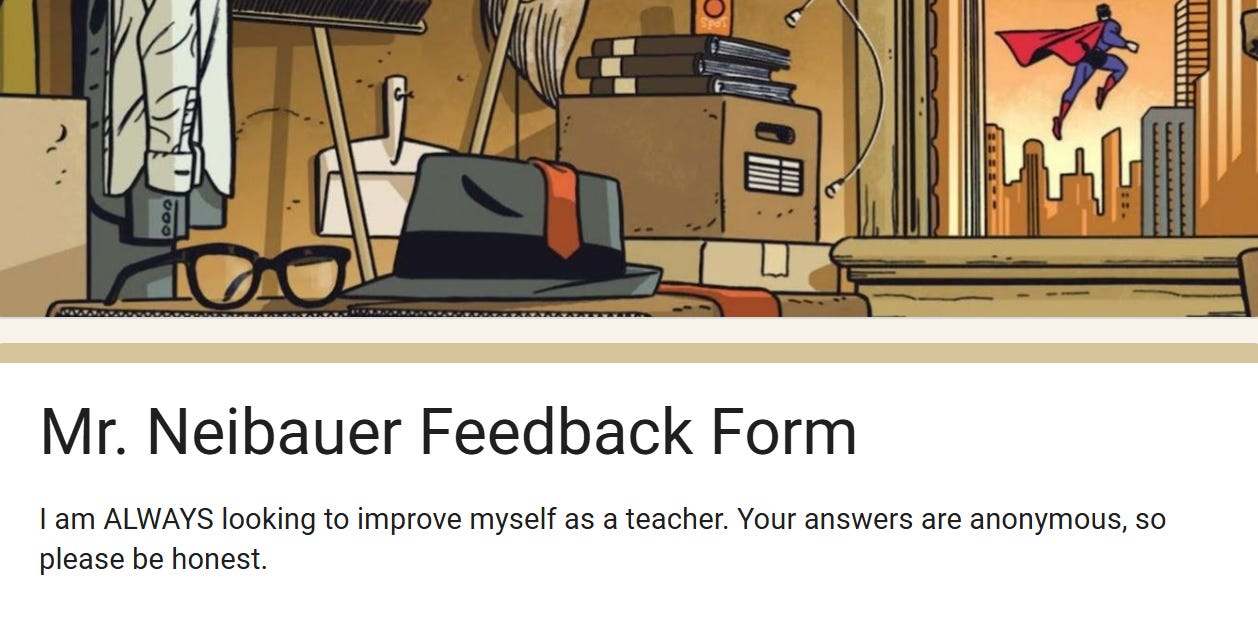
I also solicit feedback from my students often, and the last week of school will be no different. Instead of discussing specific parts of a particular learning experience, during the last week of school, I have my students fill out a teacher feedback form. I update it around this time of the school year based on our classroom community this year and what learning experiences I taught. Some of my favorite questions include:
How well do you feel that I met your needs as a learner?
What types of things do you wish we had done in 5th Grade?
What is ONE thing you will remember most about being in Mr. Neibauer's class?
I can usually predict which learning experiences are students’ favorites (Socratic Seminars rank high). My favorite reponses, however, are in answer to how well I met (or did not meet) my students learning needs. Here are a few comments from last year:
You did so much for me and you taught me so much! I can’t ask for a better teacher!
You don’t need to improve anything. You teach. You make kids learn.
On Fridays sometime instead of having us learn something new you helped us in our individual needs.
While it is always nice to receive kind and affirming messages from my students, I concentrate most on feedback that helps me improve. Here are some responses to the question, If I didn’t meet your needs as a learner, please explain how I could have done better.
Checked on me more please.
Maybe you can have strikes for people so there’s more good behavior.
I asked if you can pull me every Friday to help me do math but you never did.
To address these, I restructured my math and literacy blocks this year to meet with more students individually. For example, on Fridays I held small groups, but instead of just students meeting with me, I arranged to co-teach with our multilingual student support teacher and neurodiverse student support teacher. Between the three of us, every student got individual support at least once a week. It made a huge difference.
Taking time to have students reflect on our school year helps me locate my blind spots and improve my pedagogical practice. When students see how much I care to improve, they take just as much care in providing me feedback and helping me grow.
A freshly designed classroom is full of potential. It holds all of my hopes for the new school year, and maps out how I plan to engage with my students. In August, before students arrive, I take before and after pictures of my classroom. I want to capture my beginning-of-the-year creative energy, so that I can draw on it later in the school year.
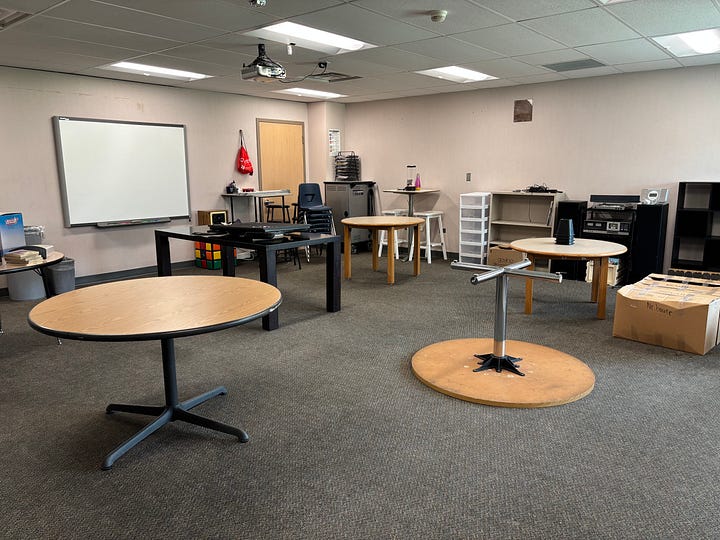
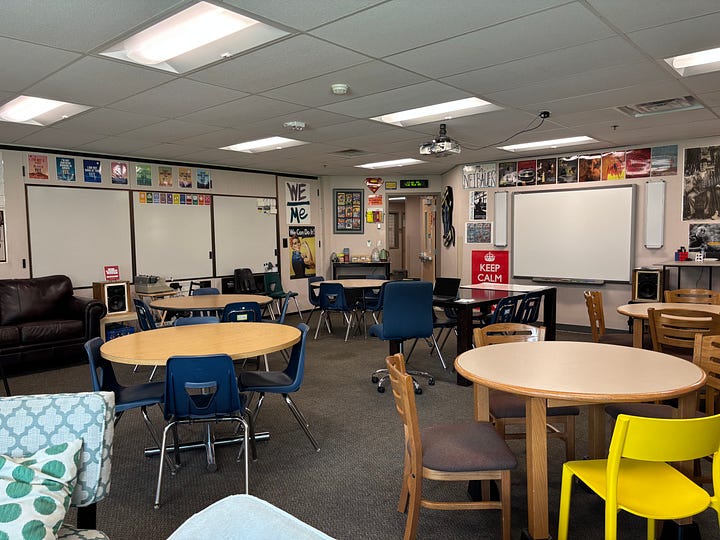
But I also take pictures of my classroom at the end of the school year. These pictures reflect the classroom reality of the year; they show me what worked and what did not. By May, my classroom is pretty messy, but valuable information can be found in the disarray. Whereas an empty classroom has possibility, a messy classroom has been actualized. These final pictures tell me how my students used our learning environment. Which pieces of furniture were frequently moved? Which flexible seating options did students use most? What was the flow of traffic in the room? Every classroom has a choreography and taking pictures before the last day of school helps me better design the next learning environment for my next batch of students in August.
This year has been a particularly challenging one. I was forced to cut many of my intended learning experiences so that I could teach 15-Day Challenge learning cycles. Any time I had a creative idea for teaching a particular standard, I was reminded about the importance of teaching the curriculum with fidelity. Instead of creatively teaching academic standards, I standardized my pedagogy to match my teammates.
No matter the school year, at the end, I always flip through my plan book and conduct a Past Year Review (PYR). I draw two columns: one positive and one negative. I go through my plan book noting the peak positive or negative learning experiences from the school year. I write the most powerful positives on an index card to remember for the next year. If I have the forethought, I update my syllabus, too. I want to keep building and improving learning experiences where everyone is engaged. I take the negative experiences (the ones that were either total failures or the lessons that left me feeling lackluster about teaching or had my students feeling disinterested and bored), put them on a “Not To Do” list, and tape it to the front of next year’s plan book.
I love having my students write letters to my future fifth-graders. I encourage them to share advice, tips, or just reassure students. I have students seal it in an envelope so that next year, my new students can open it and read it on the first day of school.
Recently, I started writing a letter to my future self. I borrowed this idea from Marcus Luther. He uses FutureMe to write emails to himself that he can read during the first week of the new school year. Since starting this practice, there is a point during the summer when I have forgotten what I wrote to myself in May. I begin to get excited to read my own advice! This activity in forethought, was popularized in Dr. Susan David’s best-selling book, Emotional Agility. Having a regular practice of writing a letter to your future self has many benefits, both for teachers and students. This year, I plan to write both an email and physical letter to August, 2026 Mr. Neibauer.
At the end of the day, I enjoy a quiet room, alone with my thoughts. I turn my classroom lights off and reflect. What went well today? What will I do differently tomorrow? What if I tweak this learning experience? What about my thinking, learning, or teaching brought me the most satisfaction? Why? What challenge is frustrating me? How will I deal with that frustration? I try not to question everything I do, rather, I want to celebrate what went well and get curious about how I can improve for tomorrow. I am always striving to evolve my pedagogy, and daily reflection helps me do this.
Though my introspective practice remains the same at the end of the school year, what changes is the scope of my reflection. What went well this year? What will I do differently next year? How can I tweak this learning experience for next year? What about my thinking, learning, or teaching this year brought me the most satisfaction? Why? What was the most frustrating thing this school year? How can I better deal with that frustration next year? Journaling the answers to these questions grounds me in my values while giving me space to question the system that often operates antithetical to my beliefs. I realize I cannot change public education in one school year. Most likely, I will not teach long enough to see any liberatory systemic changes. However, I can (and do) continue to recenter myself in what I believe to be true, especially at the end of the year. Having strong foundational values motivate me to keep dreaming no matter what happens.
One of the most important things I do to at the end of the school year (and just before school starts again) is what Chanea Bond calls freedom dreaming. On an episode of The Broken Copier, she explains how she freedom dreams over the summer.
I always take time to freedom dream over the summer. If I could make one thing happen this year, what is it that I am going to do?
I find this practice particularly powerful both at the end and the beginning of a school year. At the end of the year, my creativity is lacking; I am exhausted and just trying to keep my students from erupting into total chaos before the last day of school. My freedom dreams from May show the constraints I experienced during the school year. However, when paired with my Past Year Review, this gives me a chance to dream in a way that builds on the peak learning experiences from the school year. For example, I struggled this year with being hamstrung in how I taught literacy. Instead of reading novels, short stories, and poems, I was forced to march students through basal textbooks. However, when I reflected, What can I make happen this school year for my students? I found a way to read and study short stories with students. For 20 minutes per day, students studied theme by reading stories such as O. Henry’s Gift of the Magi, Chekhov’s The Bet, and most recently, Charles by Shirley Jackson. I wanted to give my students access to reading literature instead of textbook passages. It was not a big idea, but it gave me just enough room to fulfill my dream during this challenging year.
I plan to sit down this month to reflect, journal, set intentions for the next school year, and freedom dream. These are what keep me going and coming back each year. I do not know what is in store for me next year, but I do know that no matter what, I will find ways to engage my students and teach with love, creativity, and joy.
Have a great week!
— Adrian
What are some things you like to do in preparation for the next school year?
FutureMe for Teachers, with Marcus Luther
The concept of FutureMe is simple: Write a letter to yourself. Pick a date you want it sent do you. Hit send. That’s it! In the above blog article, Marcus Luther discusses how he first learned about FutureMe and how he uses it personally, professionally, and with his high school students.
I love everything about this article! California 100, by itself, is such an impressive initiative that has created some phenomenal work. But team them up with the Wakanda Dream Lab? Prepare to be utterly stunned! Wakanda Dream Lab is a collective fan driven project that bridges the worlds of Black fandom and #Blacktivism for Black Liberation. Be sure to check out the California Freedom Dreaming workshop recap here and read a sample of the dreams they created.
Co-Designing Schools Toolkit | The Teachers Guild x School Retool
This Co-Designing Schools Toolkit is the product of ten years of iterative work of The Teacher’s Guild and School Retool. Spending time in schools and communities, facilitators, local collaborators, and organizers co-designed, iterated and refined these tools; the administrators and teachers who helped to design, test, and make it their own provided some excellent feedback. I was lucky enough to be a small part of this community over the summer. I am in awe by what this community created for teachers, administrators, parents and students.
The Value of Soliciting Student Feedback | Edutopia
Feedback is the best way I have found to monitor the climate of my classroom. I solicit feedback often. While gathering student feedback is important, what does not get discussed much is how important it is to act on that feedback. Students need to see that their words have power and you take their suggestions seriously. This Edutopia article offers a lot of great advice, practical application, and research for the importance of valuing student voice in the classroom.
I have already discussed many of these end-of-year activities. Having students reflect on challenges they have overcome, celebrate their achievements, and dream of what is to come next year, is never a waste of precious class time.
I do all of the tips suggested in this Edutopia video and accompanying article. I cannot say for certain that fifth-graders in May always remain calm and engaged. I can say that these tips do work to end the year on a positive note with students.
I have no plans to make Adrian’s Newsletter a pay-to-read place. However, if you do want to contribute financially (and are able), consider upgrading to PAID. Thanks!
Want more of Adrian’s Top 5? Check out a few of my archived posts.
Comments
Nothing yet. Say the first thing.
Sign in to join the conversation.