
I recently had a conversation with my fifteen year-old daughter. She came home from school exasperated and annoyed. In her English class, they had just started reading A Midsummer Night’s Dream. I excitedly peppered her with questions. Who’s your favorite character so far? What do you think of Puck? Have you got to the scene where Puck puts the love potion in Demetrius’ eyes so he falls in love with Helena? How do you think it’ll end?
Instead of the wonderful repartee I imagined having with my teenage daughter, I was shocked by her response. There is no way my daughter was saying this to me.
I don’t see what the big deal is about Shakespeare. It’s not that deep, bruh!
Being children of two teachers, especially ones who love literature, my kids have grown up with rich storytelling. When they were babies, we read to them constantly. Our bookshelves are lined with dozens of picture books. As they got older, we introduced them to Roald Dahl. Bedtime stories included The BFG, Charlie and the Chocolate Factory, Matilda, The BFG, James and the Giant Peach, Fantastic Mr. Fox, my favorite of his novels, The Witches, and my wife’s favorite, The Twits. We never questioned whether a story was too difficult to understand. The more they begged for stories, the more we read aloud together or, eventually, they read independently.
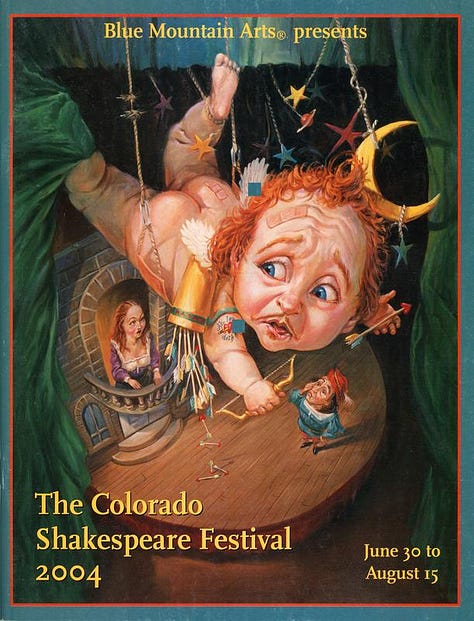
It was inevitable, then, that we would share Shakespeare with them. In college, my wife and I attended summer plays performed by the Colorado Shakespeare Festival. The Mary Rippon Outdoor Theatre was on campus, so after our summer classes finished for the day, we would pack a picnic to eat on the lawn, and enjoy Shakespeare under the stars. It was during these summers I really fell in love with the Bard. The plays I cursorily read in high school, and had only a surface understanding of, came to life on the stage. Live theater, especially Shakespeare, is a magical experience.
By the time our children were of school-age, they already knew many Shakespearean stories. Their favorite plays had some of the silliest plots. Their first experience at the Colorado Shakespeare Festival was watching Twelfth Night. Their uproarious laughter at seeing Bottom transform into a donkey on stage is a memory I will cherish forever. In preparation for seeing Shakespeare performed, we always read (or reread) the play. There are many wonderful children book adaptations of Shakespeare’s plays. It was not essential to me that my children understand Early Modern English before seeing Shakespeare performed. The story kept their attention rapt. The Shakespearean English probably confused them at times, but it never detracted from their experience.
How could my only daughter, the same one who begged me to read Romeo’s monologue over and over again because it “felt swoony”, how could she think Shakespeare is not a big deal? Where did I go wrong as a father? How have I failed?
Text within this block will maintain its original spacing when published
O, speak again, bright angel, for thou art
As glorious to this night, being o’er my head,
As is a wingèd messenger of heaven
Unto the white-upturnèd wond’ring eyes
Of mortals that fall back to gaze on him
When he bestrides the lazy puffing clouds
And sails upon the bosom of the air.
I know my daughter loves Shakespeare, so after I recovered from my initial shock, I settled into a conversation about what happened at school that would make her now feeling nonplussed. She told me that her English teacher was making the class read aloud and analyze A Midsummer Night’s Dream. The teacher assigned parts to be read, and students took turns reading (sometimes painfully) the play. At the end of each scene, students answer comprehension questions on the computer to turn in before the next class. No discussion of the play. No acting out the scenes. No watching any film adaption or performance. Students are reading and answering questions.
I now understood. My daughter was not hating Shakespeare or his play; she was hating the teaching of the play. The story sat lifeless on the page. The characters were not alive and speaking to the audience; they were names on multiple choice questions.
This is why many children hate Shakespeare. They do not “get it” because of how it is presented. It is like teaching a child how to ride a bicycle by lecturing on the history and mechanics of bicycles, testing them along the way to demonstrate their mastery. Bicycles are meant to be ridden; plays are meant to be performed. Literature is meant to be appreciated, not analyzed to death. You can analyze the joy out of anything.
To be fair, literary analysis is important. Close reading, as a technique and practice, is an important thinking skill to model and teach in school. Josie Barboriak, writing in The New Critic, puts is beautifully. Students need to learn how to critique.
To criticize properly is to show the process of judgment as available to another person, to cultivate a reflective and critical attitude — to struggle with what we like. This means we should ask more of our readers. A more Socratic model of the critic is one with faith that judgment can be taught. A good teacher can think with you, and a good critic invites you into the practice of judging with them. The critic with this attitude towards the reader understands the connections between teaching good reading, good thinking, and good writing. Close-reading, allowing oneself to be affected by a text, understanding why they are affected by it, and wrestling with the text’s ideas, leads (by mediation of this stilted form) to the good thinking which can become that writing which truly is good.
Students will not be affected by any art form when it is presented in such a lifeless, standardized methods. My daughter’s English teacher is not thinking with the students, and students are definitely not thinking deeply about Shakespeare. In order for students to intellectually critique anything, whether literature or politics, they must learn how to think deeply. Close reading and literary studies are important to teach, but never at the expense of what is being analyzed. Students will never gain an appreciation of the humanities, nor mathematics or the natural and formal sciences, if they treat them as corpses, performing postmortem, mechanical autopsies. Anthropologist, Susan D. Blum, calls this schoolishness. Dissecting Shakespeare into testable questions is not the purpose of the play (or any literature). Shakespeare wrote stories to be told on a stage, using language that is meant to be listened to first. Analysis is important, but only after you get sucked into the story. Children are inherently curious. Humans love storytelling and have a natural drive to learn. When you strip away the story, you deaden the art. Students need to feel the aliveness of art. They will never fully appreciate all that literature as to offer if public education continues to kill it so that we can test it. I want my students talking about Hamlet, not fretting about whether they answered the standardized testing questions correctly.
My daughter was expecting to discuss A Midsummer Night’s Dream in class. What she got was mind-numbingly boring class periods listening to her peers butcher Shakespeare’s iambic pentameter, and then quietly clicking through endless quizzes.
Luckily, my daughter has other Shakespeare experiences she can count on. She knows that on any given evening, she can complain about Helena’s behavior or ask about the chaotic, Athenian love quadrangle. Our dinnertime conversations include far-ranging topics and there are no tests. There are no grades. Our kitchen table is a safe place to ask questions, push each other’s thinking, and practice criticism. After my daughter shared her frustrations with her English class, our conversation shifted. She asked a thought-provoking question that I am still thinking about.
If Shakespeare is such a big deal, why don’t more people appreciate his plays?
The easy answer is because of how Shakespeare is taught in schools. But my daughter kept pushing. She wanted to know why cannot Shakespeare’s art resist the way teachers ruin it. If Shakespeare is so great, shouldn’t we all just immediately fall in love with it, even if we don’t understand it? I thought of Billy Collins’ poem, Introduction to Poetry.
Text within this block will maintain its original spacing when published
I want them to waterski
across the surface of a poem
waving at the author’s name on the shore.
But all they want to do
is tie the poem to a chair with rope
and torture a confession out of it.
They begin beating it with a hose
to find out what it really means.
My wife and I valiantly defended the beauty of Shakespeare’s verse. It does resist! We tried to explain that the plays can withstand even the worst classroom treatment. Great literature is great despite how poorly it is taught. She was not convinced. Her English teacher is trying to force students to enjoy and appreciate Shakespeare, by “beating it with a hose / to find out what it really means.” Even if I believe Shakespeare’s plays can withstand such torture, the truth is that you cannot force others to appreciate art, just for art’s sake. And if you try, most likely, you will ruin it for them, probably for life. If someone does not appreciate art, either because they do not understand it or had a horrible schooling experience with it (or both), where does the responsibility fall to prove again it’s worth? Does Shakespeare have to prove to me why his writing is superb? Where does the responsibility lie in appreciating art?
This is where our conversation exploded. My daughter was quick to remind me of how I did not initially like BTS’ new album, ARIRANG, because I “didn’t get it.” She refused to force me to appreciate BTS, feeling that their talent spoke for itself. She is right! Her interest and devotion to the group piqued my curiosity. The more I listened to the album, read about this globally renowned seven-member South Korean boy band, and watched their intensive, precise choreography, the more I came to appreciate their music and artistry. SWIM, NORMAL, and 2.0 are so damn catchy!
We cannot force students to learn or appreciate the things we think they should. Educator, Kate Roberts, in conversation with Marcus Luther, reminds me that teachers often overemphasize having a love of reading as a prerequisite to literacy. As much as wish my literary enthusiasm was contagious, I cannot force students to love a novel, play, or poem as much as I do (and think they should, too). What I can do is create a learning environment and multiple learning experiences where my students will be open to the idea of loving what I value and love. It is easy for me to dismiss BTS’ popularity as Gez Z thing. But when someone I care about, and whose opinion I value, cannot stop listening to and watching this South Korean boy band, I take notice. I want to know what the fuss is about. Is this something I might care about, too? When my daughter is forced to take comprehension quizzes, just because it is Shakespeare, she will hate it. Schools prevents students from seeing the inherent beauty and overall greatness in many academic things, from Shakespeare to Calculus.
My own children fell in love with Shakespeare because my wife and I created an environment where the greatness of the art could speak for itself. We read them stories, took them to see plays performed on stage, and discussed characters and crazy plots at the dinner table. We helped them connect to Shakespeare. I never cared whether they could analyze A Midsummer Night’s Dream. Those were not prerequisites to experiencing the plays. And the best part is, when my children fell in love with Shakespeare on their own, they found the symbols and themes and willingly shared their analyses with us. I did not have to threaten a grade for them to understand.
This is where having a both/and mindset is helpful. Where does the responsibility lie in appreciating art? I believe art is for everyone; teachers and education institutions should not position themselves as gatekeepers to great literature. Everyone should have access to art. But appreciation does take work. The onus is on us (as lifelong students) to take the time to read the words, listen to the music, gaze at the portrait, and find an appreciation for its greatness. And, teachers have the great responsibility of removing obstacles that prevent students from accessing and understanding art. When teachers find themselves trying to force feed students, they have already lost. Not every student needs to love everything you teach, but if you want your students to have a fighting chance in appreciating poetry, paintings, or math problems, tying it to a chair with a rope is not the way. There are no guarantees. As teachers, we must remain hopeful and patient; even if a student does not come to love Shakespeare as much as we do, hopefully, they will learn to appreciate his mastery of the English language and deep insight into human nature. Teach to the human, not to the test.
Artists create art for its own sake, not to prove the artist’s worth or the art’s value. Teaching, in its most human (and humane) form, is an invitation. Collins explains,
Text within this block will maintain its original spacing when published
I ask them to take a poem
and hold it up to the light
like a color slide
or press an ear against its hive.
Collins is not commanding his students to analyze a poem in a certain way. He is not threatening his students to find certain literary elements. He is asking them to engage with a poem in a couple of different ways, hoping they will discover poetry's pleasure. This initial invitation is not a deep dive. Invitations are on the surface, out in front. Collins sees a poem’s title as a marquee sign hanging over a building’s entrance, and the first lines as a welcome mat, piquing the reader’s curiosity to enter and explore.

If students do not see anything amazing or hear anything interesting, once inside, they can begin exploring the way one does in a museum, moving from room to room.
Text within this block will maintain its original spacing when published
I say drop a mouse into a poem
and watch him probe his way out,
or walk inside the poem’s room
and feel the walls for a light switch.
When teaching is done in this way, teachers are akin to museum docents. The goals are always for students to develop an appreciation for the art, no matter its form (prose, poem, play, painting), and to learn something about themselves. Some exhibits may stand out, while others are less interesting, but appreciation cannot be forced. Students may leave class without finding a love for Shakespeare, but at least they will have had opportunities to do the work of forming their own opinions without the pressure of knowing if is the “right answer.” Will some students resist the necessary work to dig into Shakespeare? Sure. Is appreciation a certainty? Never. There will always be a handful of students that do not understand the hype. It’s not that deep, bruh! But that is what is involved in a classroom designed for a community of learners. The ideal outcomes, learning and a shared appreciation, are important goals for both the teacher and students. Even if appreciation is not certain, and some students still think Shakespeare is just some random, dead, white guy, at least they will have formed their own opinion, independent of their academic success in the classroom.
I am sure I read and analyzed the plays most commonly taught in American high schools: Romeo and Juliet, Macbeth, Hamlet, and King Lear. I may have even read A Midsummer Night’s Dream and Othello, but these experiences left no indelible trace in my dyslexic brain. What I do remember is first seeing Hamlet performed in 2003.


I left that performance hungry for more. I wanted to reread Hamlet so that I could see the words I had heard so eloquently spoken on stage. I wanted to know what others thought. I purchased Harold Bloom’s Shakespeare: Invention of the Human and began poring through the tome. Did I agree with (or even understand) everything Bloom said? All that mattered was that I was hooked and wanted to learn as much as I could.
I did not appreciate Shakespeare while I was in high school because, like my daughter), I was set up to see Shakespeare as just another schoolish have-to. It does not matter if you are a humanities teacher or a science teacher. If you want to increase the likelihood that your students will see the importance of your academic content, if you “want them to waterski / across the surface of a poem / waving at the author’s name on the shore” you must begin with the value, beauty, and greatness within. Show students what treasure awaits them on the other side of the endeavor. Hand them a flashlight, offer them advice, and let them see how deep the rabbit hole goes. And if that still does not work, just tell them to do it for the plot. It is worth it.
Have a great week!
— Adrian
If you have any interest in reading, watching, or teaching anything written by William Shakespeare, you need to bookmark the Folger Shakespeare Library. Their collection of resources is extensive! I love their resources and activities for children and all of their teaching guides and resources for the classroom.
The Role of Experience in Art Appreciation and Role
In this planksip article written by Emily Fletcher, Fletcher discusses how art appreciation is a sensory experience, one of “self-discovery, recognizing that the beauty and profundity we find in a masterpiece often reflect the richness of our own human sense and experience.” You cannot separate your lived experience from any critical reflection. I found this article interesting, particularly the Dimensions of Personal Experience in Art Appreciation table.
I used to hate Shakespeare | Royal Shakespeare Company
In this short blog post from actor, Byron Mondahl, he shares his initial school experiences with Shakespeare, and the moment he changed his mind. He writes, “Then I saw Titus Andronicus again, directed by Andrew Hilton, at Shakespeare at the Tobacco Factory in Bristol and suddenly my life and understanding changed. I will never forget watching that absurd and bloody play with its brutal extremes and learning about my life now, feeling like it was speaking to me but not only that, that I was speaking back...in iambic pentameter. I suddenly understood every word and by the end, finally got why so many people around me passionately embraced a dead playwright. So I started dreaming a new dream.”
Why Leo Tolstoy hated William Shakespeare | Big Think
I had no idea of this conflict between Leo Tolstoy and William Shakespeare, especially how Tolstoy hated King Lear so much. This Big Think article is fascinating! What’s most interesting, is how extensively Tolstoy read Shakespeare before forming his opinion. They each have two very different ways of looking at life and art. Thank goodness George Orwell decided to mediate the conflict!
Catherine Oliver is a home-education mother of two children. She writes about her experiences homeschooling her children, always providing excellent resources for parents and teachers. This post contains an incredible reading list for children aged 6-12. I was chuffed to see many books in her Shakespeare section that I have read with my students and own children at home.
I wrote this Top Five piece last year. I have included some resources for introducing students to Shakespeare, including Henry Oliver’s excellent piece, How to Read Shakespeare.
I love when I learn something new about any subject. For anyone who wants to diver deeper into Shakespeare’s history, this Weird History video offers a lot of great information about The Bard.
We all know Shakespeare is the most celebrated playwright and poet in history. If you (or your students) still don’t fully understand the hype, check out this video by Mastering Knowledge. They provide a decent overview of his plays and popularity.
Dr. Ellie Anderson, philosophy professor and co-host of Overthink Podcast, discusses John Dewey's theory of experience. Dewey’s 1934 book, Art as Experience argues that art is not separate from life. Instead, it is an intensified, unified experience that emerges from ordinary activities, connecting the artist, the artwork, and the audience. This tracks with my own experiences in experiencing art, teaching, and learning. In my classroom, I am always trying to improve the aesthetic experience for my students so they are more likely to engage.
For those ambitious learners, this site from TheCollector, Art as an Experience: An In-Depth Guide to John Dewey’s Theory of Art, goes into great detail about Dewey.
Comments
Nothing yet. Say the first thing.
Sign in to join the conversation.