
Sharing something you love, with people you care about, is one of the best feelings. I remember watching my oldest son watch Star Wars Episode IV: A New Hope for the first time. He was around six or seven years old, and watching him experience this brand new Star Wars universe is a parenting highlight. He was mesmerized, talking through the entire movie, asking hundreds of questions. What’s that called? Who’s that? Is he good or bad? How does a lightsaber work? While I was initially annoyed, settling in to this experience was something I will never forget. As my children have since aged into teenagers, we have had similar experiences with movies, music, and television shows. Each time I share something with my children I loved growing up, I get excited. I want them to love it as much as I do. Sometimes they do not fully understand (like the time we watched Jim Henson’s The Dark Crystal); sometimes they absolutely hate it (trying to get my teenagers to appreciate The Doobie Brothers); and sometimes it takes time for them to fully appreciate it. They thought I was crazy when I cranked up Il Volo’s Grande Amore in the car. “Dad, what the heck are we listening to?”
It is okay that my children and I do not like the same things. But taste cannot be developed without exposure to variety. If I want my children to develop well-rounded opinions, I need to keep sharing a variety of different art forms.1
I love teaching poetry for the same reason. I cannot force my students to love poetry, or even appreciate particular poems, but I love do sharing what I love.2 Students can feel my enthusiasm and sometimes they get as excited about a poem as I do. There are dozens of poems I want my students to experience before the end of the year, but I must be discerning; we have eight weeks of school left, and I cannot share them all.3
Here are five poems I want my students to read before they leave for middle school.
5. Song of Myself, 20 by Walt Whitman
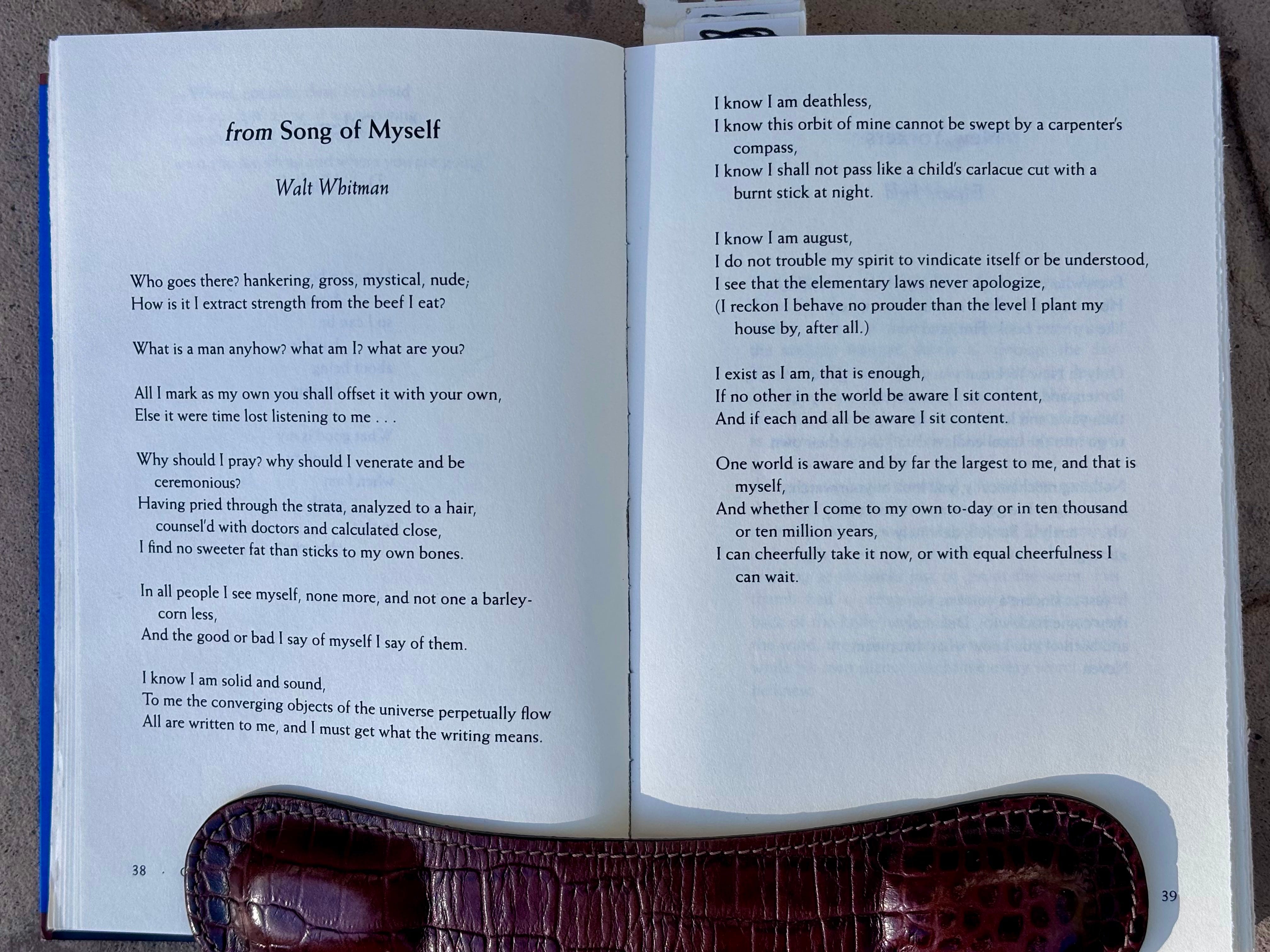
In a perfect teaching world, I would spend the entire school year teaching Song of Myself. We would read, discuss, and write about all 52 sections, tackling one per week. But if I had to choose just one section for students to experience, it would be no. 20.
I exist as I am, that is enough.
Many of my students are already succumbing to their insecurities and the peer pressure to look or act a certain way. Whitman encourages us not only to accept, but to celebrate our bodies. Since we all made of bodies, Whitman believes this to be the very basis of democratic thinking. Once my students enter middle school, they will be bombarded with messages of less than. They will have to figure out who they are while navigating cliques, social media, and societal standards for beauty, masculinity, and femininity. Whitman’s declaration to sit content and know I am solid and sound, is exactly the message I want my students to hear as they enter their adolescence.
4. Speech to the Young, Speech to the Progress-Toward by Gwendolyn Brooks
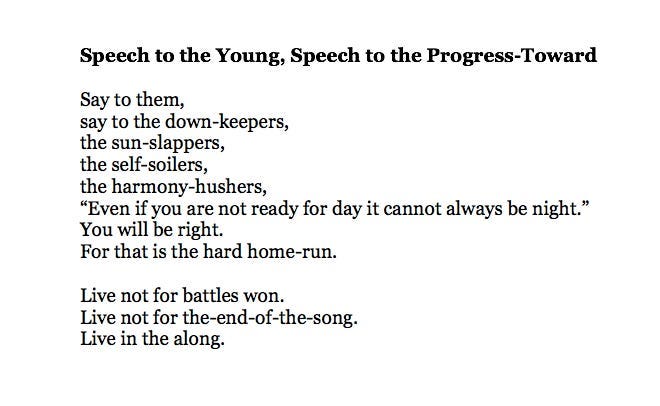
Brooks wrote and published Speech to the Young, Speech to the Progress-Toward amidst the Civil Rights Movement and the burgeoning Black Power Movement. This poem-speech is an inspiring directive to youth, telling them to persevere and ignore the sun-slappers, / the self-spoilers, / the harmony-hushers. While the line, “Even if you are not ready for the day it cannot always be night” captures those overwhelming days my students will certainly experience, feeling like all hope is lost and that they cannot face the day, my favorite line is Brooks’ last: Live in the along. I cannot stress enough how much I want my students to be present in their lives and do their absolute best.
Live in the along.
This generation, more so than others, is at great risk of frittering away their lives online. I see students spend their entire weekends playing video games and scroll TikTok. Some have a sport they play, but for the most part, when they are alone with their thoughts, they numb with blue screens. Brooks reminds them to find joy in the struggle and enjoy the process. As the great Ferris Bueller once said, “Yep. I said it before and I’ll say it again. Life moves pretty fast. If you don't stop and look around once in a while, you could miss it.” I do not want my students to miss their lives.
3. A Ritual to Read to Each Other by William Stafford
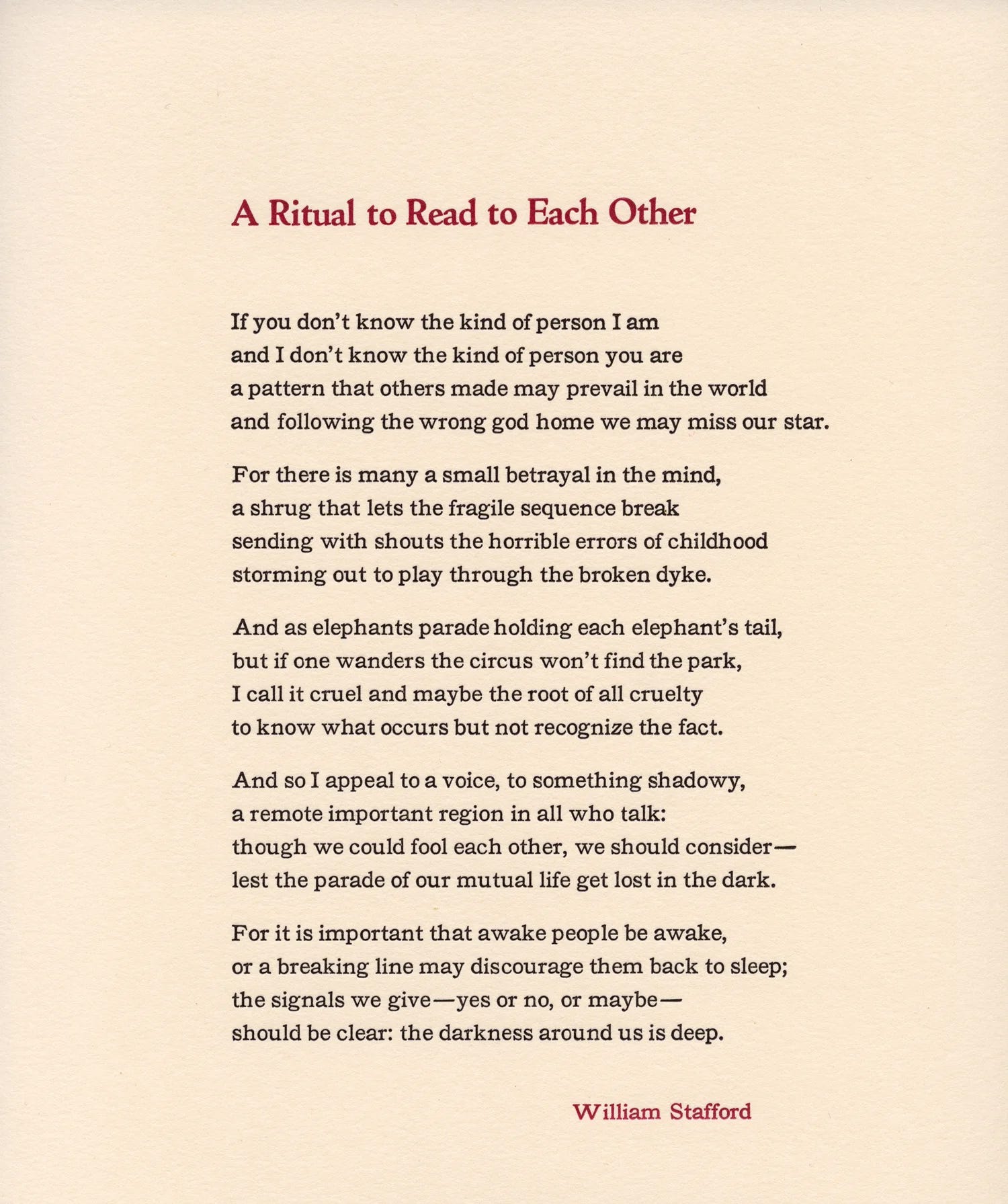
Originally published in The Way It Is: New & Selected Poems, which compiles Stafford’s poems from the final year of his life, A Ritual to Read to Each Other is a poem I often return to when the darkness around us feels far too deep. I hope that if nothing else, my students remember how in our classroom, I valued our collective humanity and I worked to make our classroom humane. Empathy and authentic human connection are what we need as a society, lest we follow the wrong god home and miss our star.
If you don’t know the kind of person I am
and I don’t know the kind of person you are
a pattern that others made may prevail in the world
and following the wrong god home we may miss our star.
Stafford urges us to overcome our fear of otherness. Sikh activist and filmmaker Valarie Kaur, offers a similar message in her phenomenal book, See No Stranger: A Memoir and Manifesto of Revolutionary Love. When she encounters others who hate her or see her as a stereotype, she offers, “You are a part of me that I don’t yet know.” It is easier to criticize or dismiss others we disagree with, hiding behind online personas, than it is to understand someone as a person. I want my students to remember that they must be vigilant in fighting apathy through conscious acts of reading, listening to, and speaking with each other, especially when they encounter dissenting opinions.
2. eschatology by Eve L. Ewing
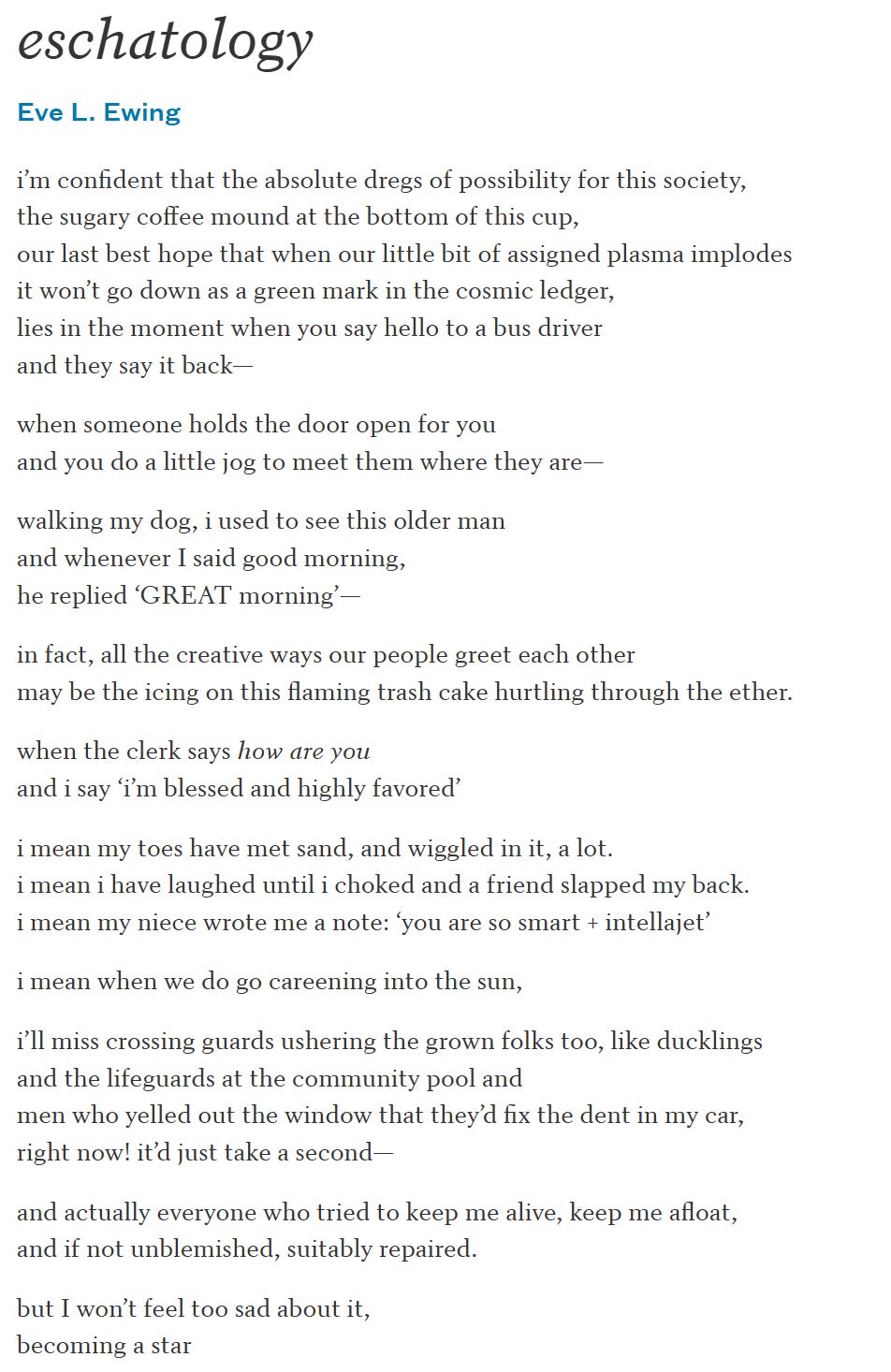
Eve L. Ewing says of eschatology,
This poem started out as being about the everyday moments that sustain us, born from an interaction with a bus driver. Due, probably, to both the times we live in and my generally apocalyptic character, it also became a poem about the end of the world. From the perspective of Western theology, eschatology often implies a straight line between the beginning of time and our inevitable doom. As an Afrofuturist, I have a less linear view of life and death. I think the links between ancestry and the future are blurry and cyclical. Anyway, we really are stardust.
I call these everyday human moments, the ones Ewing says keeping her afloat, glimmers in my classroom. We need each other. The sooner my students learn that it is okay to ask for help and offer help to others, the more fulfilling their lives will be. It is vital that we be human with each other. Life is hard enough without saying hello to the bus driver or holding the door open for someone. Why not celebrate these sugary coffee mound[s] at the bottom of [the] cup that is our “one wild and precious life.”
lies in the moment when you say hello to a bus driver
and they say it back—
As much as I have tried to slow things down in my classroom, I know the pace that awaits my students as they enter middle school, and then high school. It is a maddening, workaday velocity that adults promise will prepare them for the real world. And while I want them to work hard to achieve their goals, I do not want them to sacrifice their integrity because they think they must to get ahead in life. At the end of it all, no one will remember their grades or test scores; people will remember the small moments when they were human to each other and received human kindnesses.
1. The Peace of Wild Things by Wendell Berry
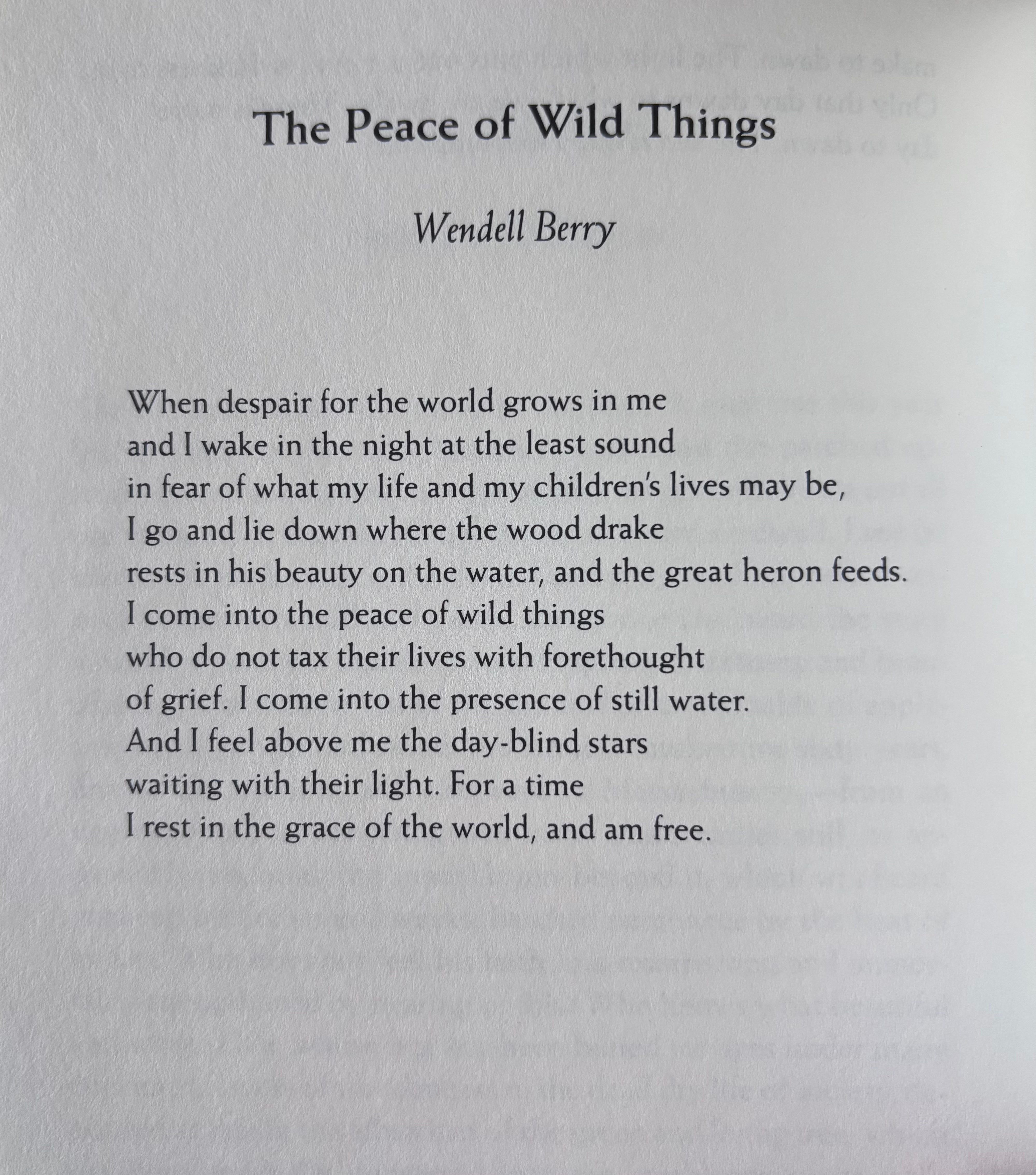
Wendell Berry wrote The Peace of Wild Things in 1968, at the peak of the Cold War and Vietnam War, after the successive assassinations of John F. Kennedy and Dr. King. Growing up is filled with anxiety. Children are trying to figure out their identity, what they stand for, and how these operate in our complex, often volatile, world. Berry is more than a poet in this poem; he is an environmental activist and critic. There was much to despair in 1968, and nature, as always, offers a balm. “When despair for the world grows in me / and I wake in the night at the least sound / in fear of what my life and my children’s lives may be, / I go and lie down where the wood drake / rests in his beauty on the water, and the great heron feeds.” It is in nature where we feel most at ease and our most human selves. I want my students to experience the perpetual healing properties of nature; to go and touch some grass instead of hiding indoors.
For a time
I rest in the grace of the world, and am free.
The Peace of Wild Things also uses one of my favorite poetic devices: enjambment. The teacher in me wants to use enjambment to illustrate that life does not stop at the end of the line; margins do not need to dictate how you move through life. You do not need to follow prescribed paths because it is what’s expected of you. Instead, find your own path. When despair for the world grows, come into the peace of wild things. I promise my students that going for a walk or sitting by a stream is much better for them than sitting in front of their screens. And even if the presence of still water does not solve all of the world’s problems, rest[ing] in the grace of the world helps make them manageable.
Have a great week!
— Adrian
Narrowing this list down to five poems was quite a challenge! What are some of your favorite poems you feel every adolescent needs to experience at least once in their life?
Resources
Poetry for Teens | Academy of American Poets
The Academy of American Poets is the largest member-supported nonprofit organization in the U.S. dedicated to supporting poets and fostering an appreciation for contemporary poetry. Founded in 1934, it established April as National Poetry Month and produces the popular website Poets.org. This collection of poems, essays, recommended reading lists, anthologies, and interviews is one I visit often throughout the year. I would bookmark it for later!
Poetry for Teens | The Poetry Foundation
The Poetry Foundation is a Chicago-based foundation dedicated to amplifying poetry, celebrating poets, and fostering spaces for creative expression. Established in 2003, it publishes the 1912-founded Poetry magazine and operates a public library, hosting, and educational programs. This collection of poetry for teens is a treasure trove of resources for everyone, not just teenagers.
I recently discovered Benjamin McEvoy’s videos through my book study of Anna Karenina. His YouTube channel, Hardcore Literature, is filled with tons of great videos discussing various works of literature. He also has a Patreon page. In this video, McEvoy discusses Whitman’s Song of Myself. The video is quite long, but well worth your time if you love Whitman as much as I do.
I have been following Whitman, Alabama, a documentary project by filmmaker Jennifer Crandall. For two years, she has crisscrossed Alabama inviting people to look into a camera and share a part of themselves through Song of Myself. Here is Robin, Nathan, and the Golden Tiger of Tuskegee University reciting Verse 20.
Gwendolyn Brooks is a poet that I think more children need to read in school, and not just We Real Cool and The Bean Eaters. I find that her words are easily accessible for young children, offering students chances to discuss racial injustice, poverty, and everyday humanity. In this interview, you can see why. She loves working with young children, helping them express themselves creatively. If you want to learn more about Brooks’ life, this mini-documentary by Untold History is good. I often use their videos in class with my students.
William Stafford was a conscientious objector during WWII and taught literature and writing at Lewis & Clark College for thirty-two years. In this video, Oregon Public Broadcasting shares archival pictures of Stafford and incredible readings by , Paulann Petersen, Kim Stafford, and Stafford himself.
I have shared this interview with Eve L. Ewing before when I preordered her book, Original Sins. In this video, Ewing spends time discussing her earlier book, Ghosts in the Schoolyard and her views of public education. My favorite part is at the 44:20 mark where she gives a call to action for educators. If you want to hear Ewing reciting her poetry, check out this talk she gave for Lannan Foundation.
I have been reading a lot of Wendell Berry in this past year. From his essay collection, The World-Ending Fire: The Essential Wendell Berry to his poetry, I find that his words shake me out of my cynicism and despair, and push me into resolved action. This video was produced by On Being and illustrated by English artist Charlotte Ager. I love that Wendell Berry reads it himself. English actor, Asa Butterfield, also does a wonderful job reciting the poem as well.
I have no plans to make Adrian’s Newsletter a pay-to-read place. However, if you do want to contribute financially (and are able), consider upgrading to PAID. Thanks!
Want some more of Adrian’s Top 5? Check out a few of my archived posts.
This point was addressed in the most recent episode of podcast with Kate Roberts when she says that teachers have overemphasized having a love of reading. “If a kid doesn't love it, we've made them feel like they're not in the club.” This really shifted my thinking about whether I can truly instill in my students a love of reading.
Unfortunately, the churn of 15-Day Challenges continues until the end of the year.
Comments
Nothing yet. Say the first thing.
Sign in to join the conversation.