
The Space Development Agency’s $52.5M “disposal-as-a-service” (DaaS) contract with Starfish Space made headlines, and is being touted as a validation of satellite servicing economics in LEO. But a closer look at the orbital mechanics, regulatory timelines, and the debris environment at the altitude of the SDA’s interest reveals that we need a lot more nuance when digesting what this contract actually represents.
Regulatory jurisdiction note
SDA satellites fall under “NTIA coordination” and “U.S. Government Orbital Debris Mitigation Standard Practices” (25-year disposal guideline), not FCC’s 5-year rule for commercial operators. The DaaS contract represents voluntary alignment with stricter commercial standards - a policy choice, not legal mandate.
Let’s look at the timeline: SDA’s Tranche 1 satellites were designed and solicited in 2021, with contracts awarded in February 2022 under the longstanding 25-year disposal guideline. By September 2022, the FCC adopted its new 5-year disposal rule for commercial operators, setting a precedent for responsible space operations.
While SDA operates under more permissive government guidelines, voluntary adoption of FCC-equivalent standards serves multiple strategic purposes:
Policy leadership: Demonstrating that government programs don’t exempt themselves from standards imposed on commercial operators—avoiding double-standard criticism.
Operational flexibility: Commercial DaaS pathways provide backup disposal capability without $300M-$600M satellite redesign costs or 18-24 month schedule delays.
Future-proofing: Government ODMP may be expected to update toward FCC’s 5-year standard as the double-standard is stark when the same finite orbital real-estate is shared with commercial satellite.
“I want to be able to take more risks on my satellite, not have redundant propulsion, things like that,” then SDA Director Derek Tournear said in late 2024. “There’s several companies that are working on that, and I hope they’re successful.” Source: DefenseNews.
The strategic calculus is elegant: by contracting external disposal services, SDA can claim dual-mechanism compliance. Primary onboard propulsion plus a commercial backup service without redesigning satellites already in production. With Tranche 1 satellites reaching end-of-mission around 2030, a 2027 Starfish capability provides an 8 year operational buffer before critical need. But the contract, while seeming to be reactive, has addressed more than policy optics. In fact, SDA publicly discussed disposal-as-a-service interest as early as March 2024, awarded study contracts in September 2024 under their STEC BAA, and finalized the Starfish contract in January 2026.
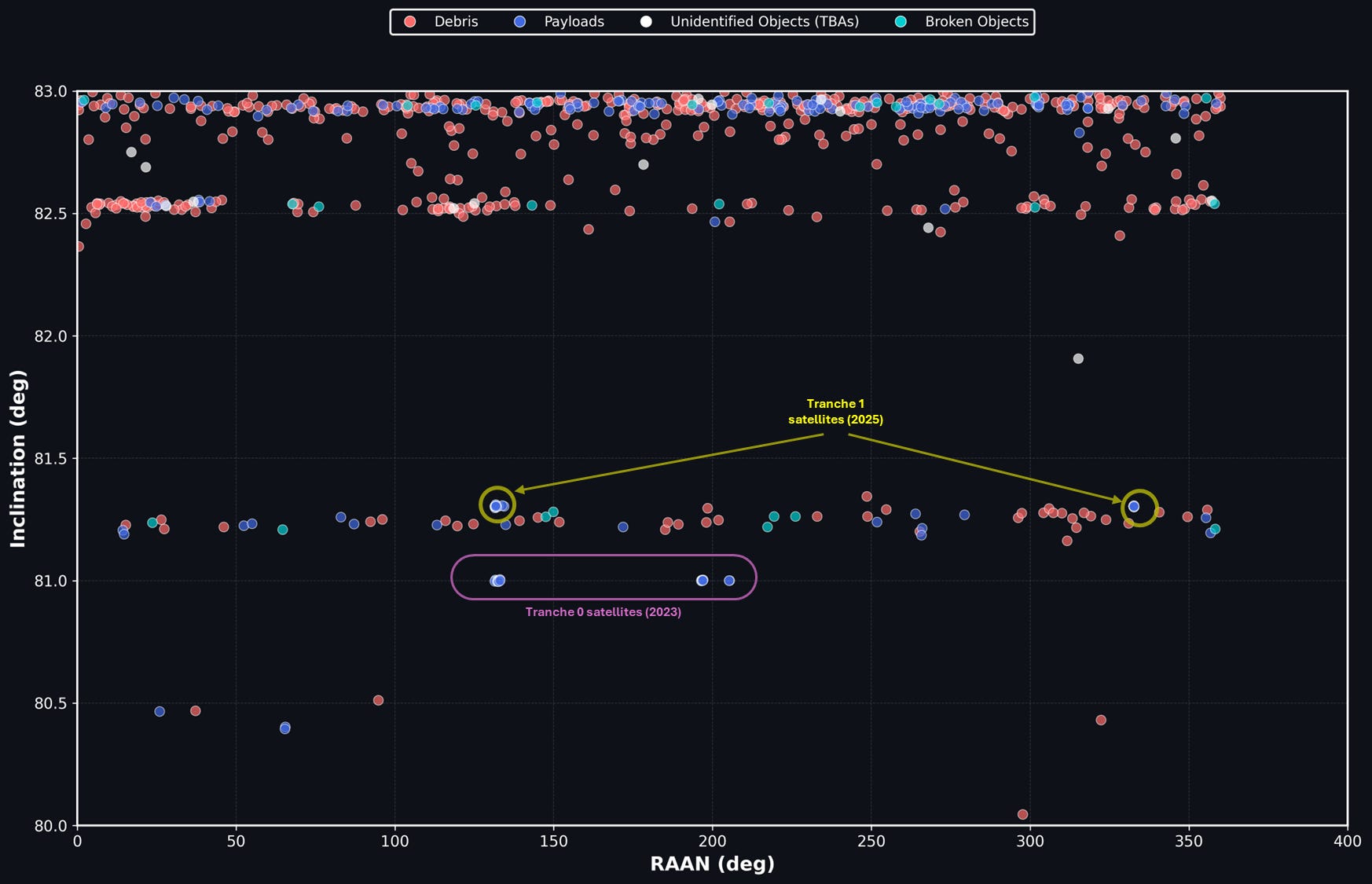
Analysis of the orbital regime where the Proliferated Warfighter Space Architecture (PWSA) constellation will operate reveals why backup disposal matters. At 850-1050km altitude and 80-83° inclination, SDA’s operational environment contains 525 debris objects, mostly from the 1960s-1980s SL-3 (the debris spread out at the same inclination as Tranch 0 and Tranche 1 satellites) SL-8 rocket, COSMOS and METEOR programs. There are also 16 objects of unknown origin (called TBAs) - most likely launched by Russia and China which may be executing clandestine inspection missions.
Space law prohibits removing another nation’s registered objects without permission, so these legacy debris pieces remain. But their presence creates two strategic imperatives for SDA:
Higher collision risk environment means failed satellites become greater liabilities
Technology protection becomes critical as PWSA satellites carry sensitive optical crosslink terminals, tracking sensors, and crypto modules that cannot be left accessible to adversary inspection
The DaaS contract addresses both: guaranteed disposal prevents adding to the debris problem and ensures rapid removal of failed U.S. assets.
An additional role played by this service, implicitly, could be to serve a “sentry” function through inspection capability. The dual-use cover for proximity operations enables space domain awareness through plain operational presence.
SDA’s DaaS strategy also serves as a hedge against documented delivery challenges:
Tranche 1 delays: Originally scheduled for a September 2024 launch, the program slipped by nearly one full year to September 2025. Supply chain bottlenecks hit critical systems, where optical communication terminals struggled to scale, propulsion vendors faced “business issues,” and encryption device approvals created bottlenecks.
Tranche 3 uncertainty: The FY2026 budget initially zeroed out funding for Tranche 3 Transport Layer, pausing the competition in favor of studying alternatives like MILNET (based on SpaceX’s Starshield). While Congress restored $500M in December 2025’s NDAA, execution remains uncertain as the Space Force conducts an Analysis of Alternatives on future LEO architecture.
Propellant fungibility: If an external servicer enables disposal, then ~200 m/s reserved for disposal can be reallocated for station-keeping, potentially extending operational life. This creates an implicit hedge against tranche slippage - not a planned life extension, but operational margin if Tranche 2 or 3 face further delays.
SDA may not publicly acknowledge this because it breaks their “cheap-expendable-replaceable” architectural narrative. Though, any constellation operator would recognize the leverage that SDA now holds.
The Starfish contract appears to validate LEO servicing, and might make some extrapolate the model to megaconstellations, yet the economics suggest otherwise. My analysis in “The Orbital Servicing Wars Part II” argues that LEO mega-constellations are fundamentally servicing-immune due to:
Replacement economics: Continuous launch cadence is cheaper than distributed servicing infrastructure
Cross-plane constraints: You cannot easily maneuver servicers between orbital planes in a timely manner - better to launch to each plane separately
VLEO alternatives: Self-cleaning orbits (below 450km) eliminate disposal needs entirely
Large constellations like Starlink and Amazon’s Kuiper are gravitating toward VLEO precisely to opt out of servicing requirements. So why does SDA’s contract make sense?
Because it’s not about commercial servicing economics - it’s about sovereign asset management in a debris-dense, strategically sensitive environment. The $52.5M likely covers 1-2 planes where PWSA’s current assets operate, not comprehensive constellation coverage.
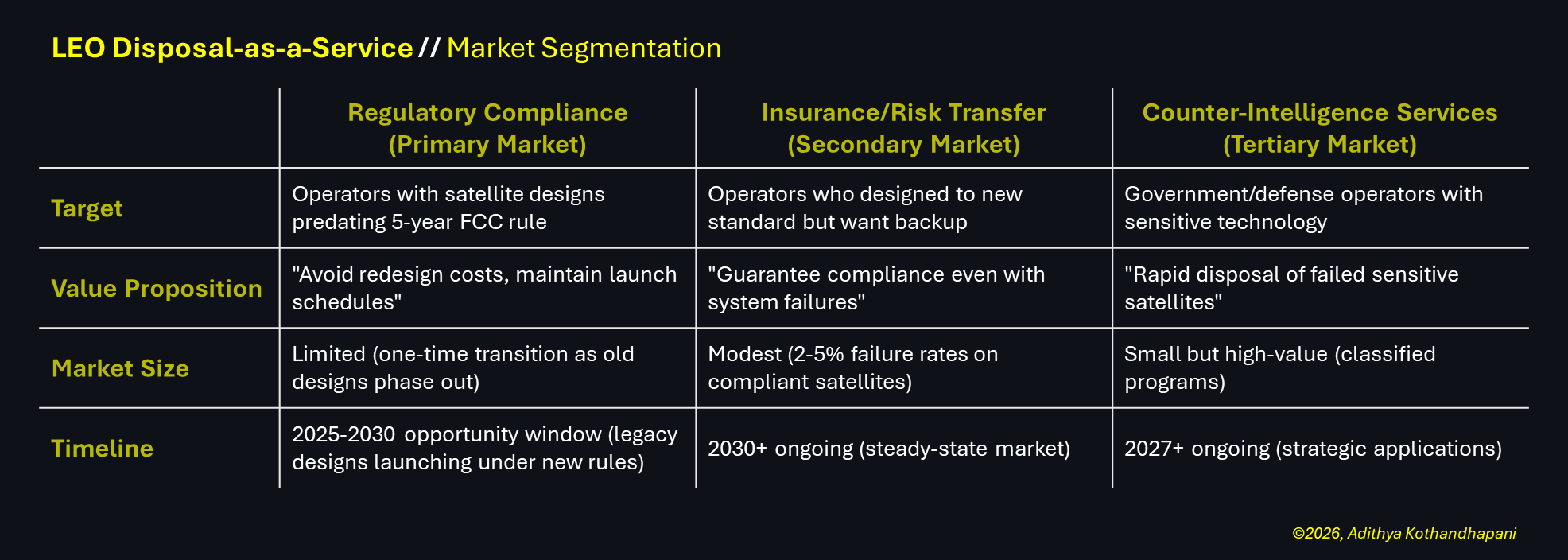
The above table shows a possible way that the LEO DaaS market may evolve, but the calculus would remain:
\(\text{Economic Viability:} \quad \left( C_{\text{sat}} + C_{\text{launch}} + N_{\text{life}} \cdot C_{\text{DaaS}} \right) < V_{\text{plane}}\)
\(\text{Liability Mitigation:} \quad \left( C_{\text{sat}} + C_{\text{launch}} + N_{\text{life}} \cdot C_{\text{DaaS}} \right) < L_{\text{max-plane}}\)
Where:
\(\begin{alignat*}{2} &C_{\text{sat}} &&= \text{Per-satellite cost (\$14M for SDA Tranche 1)} \\ &C_{\text{launch}} &&= \text{Amortized launch cost per satellite} \\ &C_{\text{DaaS}} &&= \text{Disposal-as-a-Service cost per satellite} \\ &N_{\text{life}} &&= \text{Satellite design life} \\ &V_{\text{plane}} &&= \text{Total asset value in orbital plane} \\ &L_{\text{max-plane}} &&= \text{Maximum collision liability per plane} \end{alignat*}\)
Note: using the above, one may be able to make a case for constellations in high LEO - e.g. Eutelsat OneWeb (designed to be 648 satellites with 12 planes having 54 satellites each, all in 1,200km near-polar orbit), contingent upon the clients’ business models themselves being sustainable in the first place.
The $52.5M award didn’t come from a single demonstration - it followed a progression in demonstrating technical maturity and operational readiness that competitors couldn’t match.
September 2024: SDA awarded six feasibility study contracts (~$1.9M total) to Starfish, SpaceWorks, Quantum Space, Impulse Space, and Arkisys. All studied disposal approaches for 90 days.
December 2024: Studies completed. Starfish was the only vendor to transition from study to operational contract.
January 2026: $52.5M award - first operational DaaS contract in history, not just another technology demonstration.
Otter Pup 1 (June 2023): Survived emergency deployment spinning at 330°/second, stabilized within two months using proprietary control algorithms, completed 1km flyby of D-Orbit ION satellite (April 2024)
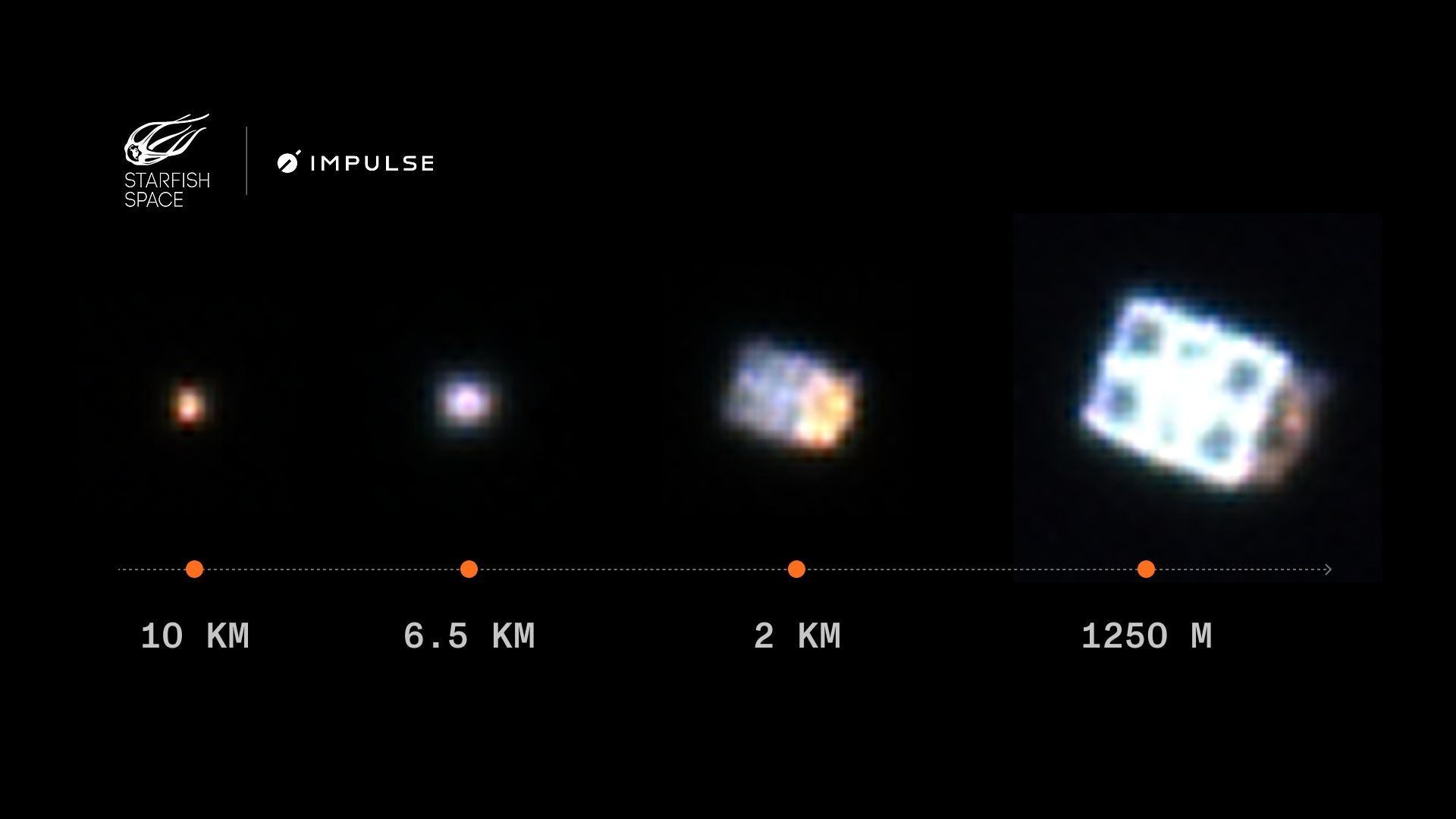
Remora mission (December 2025): Validated software portability by achieving autonomous rendezvous to 1,250m using only a single camera on Impulse Space’s Mira—a platform not designed for servicing - proving CETACEAN/CEPHALOPOD guidance suite works across non-native spacecraft
Otter Pup 2 (June 2025): Currently operational, attempting first commercial LEO docking with D-Orbit ION
While Astroscale (Japan, magnetic docking plates for OneWeb) and ClearSpace (Switzerland, robotic arms for ESA’s VESPA debris removal) lead in cooperative servicing for pre-prepared satellites, Starfish differentiated through non-cooperative capture capability - critical for SDA’s multi-vendor constellation where satellites weren’t designed with standardized docking interfaces.
SES/Intelsat (June 2024): GEO life extension contract
NASA (August 2024): $15M for LEO debris inspection mission
Space Force (May 2024): $37.5M STRATFI for GEO “augmented maneuver” mission
NRO (October 2024): Mission concept study
Starfish demonstrated architecture flexibility (LEO disposal + GEO life extension), software maturity (flight-proven autonomous guidance), and multi-orbit capability - exactly what SDA needed for a constellation using York, Lockheed, and Northrop buses without cooperative interfaces.
The contract validates operational capability, not just technical feasibility.
Meanwhile, China’s SJ-21/SJ-25 seem to have completed the world’s first GEO-to-GEO satellite refueling in July 2025 - four days docked at 36,000km altitude. This MEV-Refueler Hybrid demonstrates where sustainable servicing economics exist: high-value GEO/MEO assets with minimal repositioning costs and long operational lives enabling multiple service cycles.
The U.S. Space Force acknowledges this reality. The new RG-XX program (Reconnaissance-GEO) mandates refuelability for the first time, with initial contract awards starting March 2026 and IOC around 2030. But that’s a 5-year operational gap behind China’s demonstrated capability.
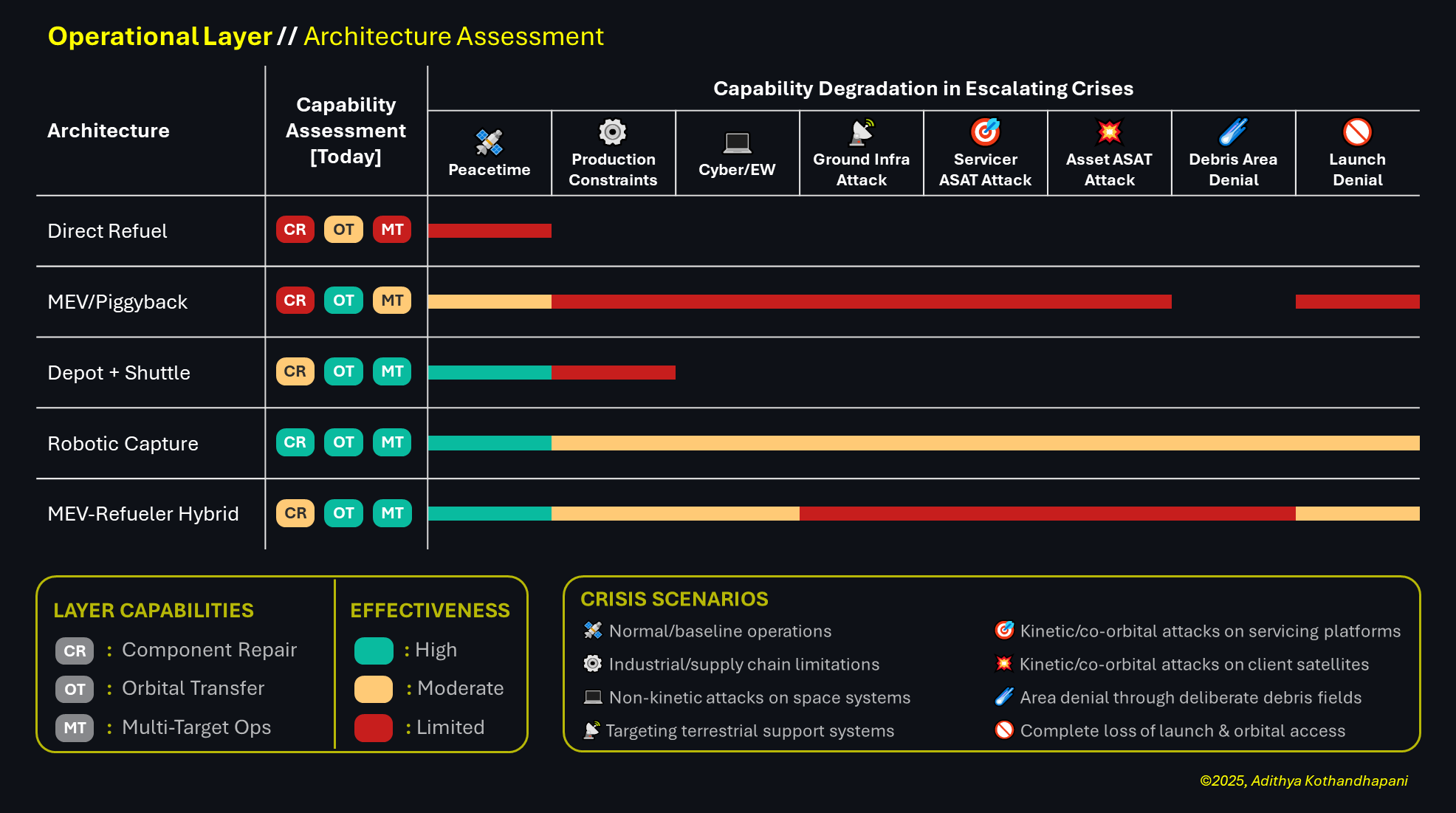
The above Operational Layer assessment shows why architecture matters: Robotic Capture systems excel through manipulation versatility and graceful degradation under stress. They can adapt missions, switch targets, and maintain partial capability during production constraints or cyber attacks.
The SDA contract validates a niche, high-value government service market for strategic asset management - not mass-market LEO servicing. True servicing economics remain in GEO/MEO, where China has operational advantage and the U.S. is still designing systems.
Architecture choices determine who maintains agency during extended competition. We’re watching those choices play out in real-time, with very different timelines between adversaries.
I hope you found this article useful. Please feel free to share this article and blog with your friends and colleagues. Connect with me on LinkedIn or email if you are looking for more detailed information on the topic.
No posts
Comments
Nothing yet. Say the first thing.
Sign in to join the conversation.